


-
You don't need to 'forget', you have the book. I was a step away from asking you if you were using, or being inspired by, any kind of resource but I thought you'd tell me if you wanted to.
 Originally Posted by GuyBoden
It took me a few seconds to find what I wanted because it's right there on the first page you posted (amazing that should be just the right page).
Straightforward major slash chords, i.e.C/E and Bb/D, are on the first page, ex. 4-5 and are played like this. Note the fingering:
The shape you were using is right next to them. Note the fingering:
Well, what do you know, they're dominants (omit 3) but with the b7 in the bass.
So the correct shape should probably have been the second one but it should have been called A7/C# and all that hifalutin' crap was unnecessary. Mind you, that was quite obvious anyway. You really should have just changed it to C#o and solved it instantly.
I don't think you 'forgot' anything. And now, after all the effort put in by others, instead of making it worthwhile and completing it, you're going to dump it.
I'm beginning to think you're a complete liability, mate. You remind me of my brother, he was even worse!Last edited by ragman1; 05-19-2026 at 09:32 AM. Reason: afterthought about C#o
-
05-19-2026 09:14 AM

-
I think we are having 2 different discussions here. One is simple A C# E is an A major triad. Boom done. Originally Posted by Christian Miller
BUT... I don't recall a part of Summertime where the tonic goes to major. So, for me, an A major chord isn't going to work. Since A is the tonic chord and Summertime is minor.
Based on that, and the freaking miracle that I was able to put together the BH diminished move by raising A to A#, I made my suggestion.
Is it really apparent that, in a minor tune an out of place tonic major would resolve up a fourth to a IV minor? Not to me, but I'm well aware of the Dunning Kruger valley I'm in, so enlighten me.
I see a bunch of charts have been added to the thread. At a glance, none of them have a major tonic chord...
-
It was never a major chord, it was a dominant. Read my post above. Originally Posted by AllanAllen
-
in a case like this? yes it is. absolutely 100%. it is expected and played above a certain level. Originally Posted by AllanAllen
there are countless hidden chords in the songs we play. and the I chord becoming a dominant to introduce the IV chord is absolute bread and butter. you can safely ignore anyone who claims otherwise.
-
They were all claiming otherwise, they were saying it was a major slash chord. I did warn Guy, I told him. Originally Posted by djg
-
The chord notes I'm using in the fifth bar are C#-A-E, I've always known a C#dim can be played, but I like C#-A-E or I've got accustomed to the sound . Originally Posted by AllanAllen
Below is my Amended chart, any suggestions are welcome.
(The way I play Summertime hasn't changed, but the chord names have. Many thanks.)
The song remains the same.
-
JFC it's an A (or A7) setting up a Dm.
Let's talk about something interesting like the whole concept of "Walking guitar." Could be a SUMMER OF RHYTHM segue...Summer of Rhythm 2026: LETS TAKE A WALK.
-
And where is the b7 in A C# E? Originally Posted by djg
Has anyone in this thread has called it an A7/C#? That's different than A/C#. These little bits matter to the uneducated, and by uneducated I mean myself.
-
Don't take this away from me Originally Posted by mr. beaumont
-
Function always dictates naming.
But nobody liked my C# A G chord? Too stretchy? Gets that 7th in there though...
-
Am A7 Dm is something I understand.
-
I just did. See above. God, this is tedious. Originally Posted by AllanAllen
'So the correct shape should probably have been the second one but it should have been called A7/C#'
-
I missed that, but I disagree about it being tedious. I'm learning stuff here, mostly that my harmonic analysis game is weak, but learning nonetheless. Originally Posted by ragman1
-
Well, bless you, Allan. I wouldn't mind if it had been accurate and enlightening but I didn't find it so, it was just confusing and ultimately not much use in this context.
Discovering that a major slash chord is a viable alternative to the usual dom is useful. I doubt that I'll be using it much, though, it's a specialised option.
-
Yes, my suggestion is now to play it, make it good, and transcend all this labelling bollocks. It's music so let's hear it and give you a big cheer. Originally Posted by GuyBoden
-
These things are a lot like stride piano Originally Posted by GuyBoden
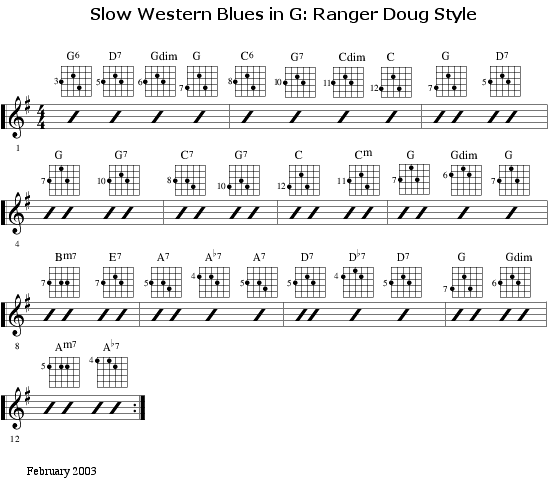
There’s was a Western swing guy - was it Doug Granger? - who used them a lot.
I use these types of shapes a lot to join chords to each other.
Things like Blue Monk, Basin Street Blues, Don’t get around much any more and so on lend themselves naturally to these types of voicings.
Sent from my iPhone using Tapatalk
-
Anyway, the last chord in bar 13 going to C6 should be G7/D not Dm6. Yes, it has the same three notes D-B-F as Dm6, it sounds the same, but crucially it has a different function.
Yes, we're all learning. It's only a hobby.
-
In that tune and context I don't see that as a C# chord. I see it as an A7 anticipating the D min that follows (as do most of the people commenting so far as I can tell). You can make the case for calling a C# via your logic, but I don't think most people writing a chart for others to play would write it that way (and on a quick search can't find any lead sheets that do). I would just write it as 3-1/2 bars of Amin and 1/2 a bar of A7 (or possibly just 4 bars of Amin) and assume that the players would come up with their own voicings. Googling around, one sees many different ways of charting Summertime, stemming from various intentions/arrangements and understandings of what's happening functionally in the tune (not sure how the original is notated, but I assume as a full score without chord names given the tune's origins). I think your certainty and dismissiveness about this is misplaced. Originally Posted by ragman1
-
I think you’ve got it. Originally Posted by AllanAllen
And for the reason that you say I would probably tend to write A7/C# in the chart just to be clear that this is in fact a dominant chord. Even though there’s no G note in the dots.
The half step below is always a strong move to the next chord root, even where it’s out of key. If you look at walking jazz basslines you see it all the time.
Here it’s C# to D.
A/C#, A7/C# and C#o7 (or bloody C#m7b13 lol) are just options for chords that go with that bass.
Which is to say I’m thinking about the bass note not the chord. Which is where your C#o7 came from.
-
Ranger Doug I think. Originally Posted by Christian Miller
Lots of examples here:
A Comparative Study of Rhythm Guitar Styles
-
Hey - is this thread rerunning the paradigm shift in 18th/19th century music theory from the study of harmonised bass lines to chord progressions based on root movement and functions? Originally Posted by John A.
As a generalbaß fundamentalist I must therefore say - filthy Rameau-ite
Down with fundamental bass!
Sent from my iPhone using Tapatalk
-
Ultimately it comes down to why you're writing a chart. If notating it this way helps you play it and internalize it, great. If you're writing it for others to play and you want them to play exactly those voicings, maybe it would help, maybe not (because it's making it seem functionally busier than the tune arguably is). If what you really want to do is present the tune concisely with the expectation that others will come up with their own voicings, it would probably be better to leave out the voicing info and just write it as | Amin | A min | Amin | Amin A7 | Originally Posted by GuyBoden
-
Very nice, thanks for posting the link, there are some good examples of three note chords on that site. Originally Posted by grahambop
-
everyone is dumb except me.
-
I use music notation to remind me of what chord voicings I use for each specific song, because I constantly forget them. The chord names are not really as important to me as the voicings. Originally Posted by John A.
I'm only hobby player, obviously.



 Reply With Quote


New LEDs Day
Today, 07:28 PM in Other Styles / Instruments