

Summertime is one of those tunes every jazz guitarist ends up playing sooner or later. Written by George Gershwin for the 1935 opera Porgy and Bess, the song quickly became a jazz standard.
Over the years, Summertime has been recorded by everyone from Billie Holiday and Miles Davis to Wes Montgomery and Joe Pass, and it remains a staple at jam sessions.
The song’s appeal lies in its catchy, bluesy melody and a harmony that leaves plenty of space for minor-key ideas, blues phrasing, and modal approaches.
In this lesson, you will learn the melody of Summertime and a solo over the chord changes. I also break down the scales, arpeggios, and ideas behind the solo.

Recommended listening:
- Charlie Parker – Charlie Parker with Strings (1950) – G minor
- Chet Baker – Chet Baker Quartet (1956) – D minor
- Monk Montgomery, Wes Montgomery & Buddy Montgomery – Montgomeryland/Far Wes (1958) – G minor
- Miles Davis – Porgy and Bess (1959) – Bb minor
- John Coltrane – My Favorite Things (1961) – D minor
- Joe Pass – Catch Me! (1963) – D minor
- The George Benson Quartet – It’s Uptown (1966) – Bb minor
- Ella Fitzgerald & The Tee Carson Trio – Live in Berlin (1968) – G minor
- Tal Farlow – The Return of Tal Farlow/1969 (1969) – G minor
- Paul Desmond – Summertime (1969) – F minor
- Jimmy Smith (with Kenny Burrell) – Fourmost (1991) – A minor
- John Scofield & Pat Metheny – Summertime (1994) – D minor
- Herbie Hancock (with Joni Mitchell) – Gershwin’s World (1998) – A minor
- Jim Hall & Pat Metheny – Jim Hall & Pat Metheny (1999) – E minor
- Jonathan Kreisberg – Nine Stories Wide (2009) – E minor
- DR Big Band feat. Mike Stern – Chromazone (2010) – Bb minor

Summertime – Harmonic Analysis
Form: Summertime is 16 bars long
Key: A minor (this arrangement)
Summertime has been played in many different keys over the years (see the recommended listening list above). The original 1935 recording (sung by Abbie Mitchell) is in B minor. The version in the Real Book is in A minor.

Summertime – Melody
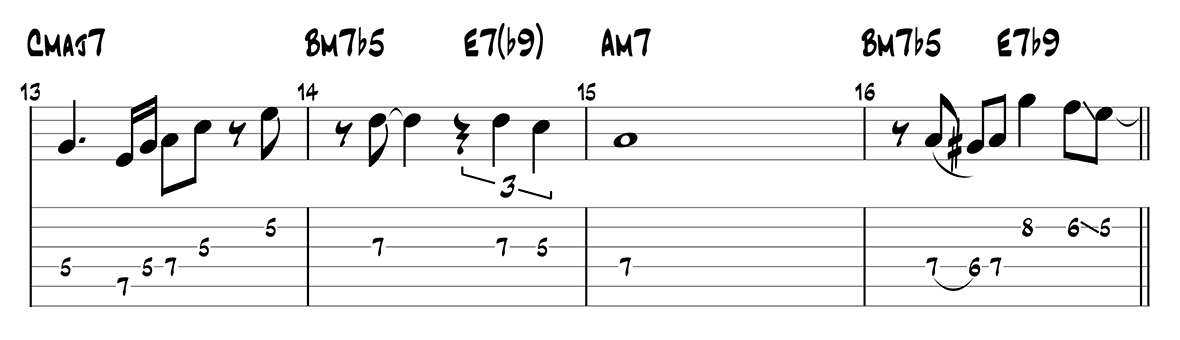
Here are the tabs and notation for this easy arrangement of the Summertime theme, combining the melody with simple jazz chord voicings.
The entire melody sits in the A minor pentatonic scale, except for the b-note in bar 7.
Backing Track
Listen & Play-Along

Summertime – Scales
There are two guitar scales that can take you through most of the chord changes of Summertime: the A natural minor scale and the A minor blues scale.
A Natural Minor Scale
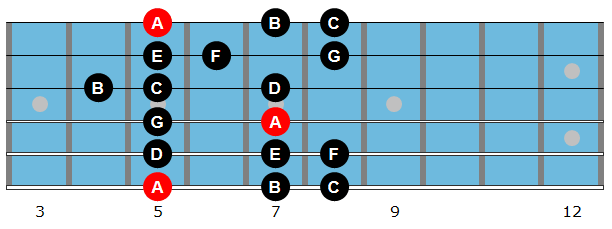
The first option is the A natural minor scale (also called A Aeolian mode). This scale contains the same notes as the C major scale.
| A Natural Minor Scale | A | B | C | D | E | F | G |
|---|---|---|---|---|---|---|---|
| 1 | 2 | b3 | 4 | 5 | b6 | b7 |
Here is the most common fingering on guitar, but make sure you eventually learn to play it everywhere on the neck, not just in one position.
A Minor Blues Scale
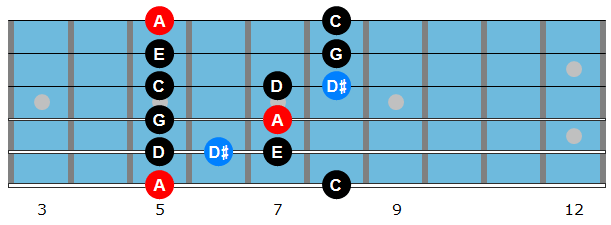
The A minor blues scale is the A minor pentatonic scale plus one extra note: The D# (Eb), which is the “blue note”.
| A Minor Blues Scale | A | C | D | D# | E | G |
|---|---|---|---|---|---|---|
| 1 | b3 | 4 | #4 | 5 | b7 |
Here is the most common fingering:
These two scales cover the tune, but if you only use those two sounds, your soloing will get repetitive. Let’s look at a couple of dominant-chord options that add color and tension.
The Harmonic Minor Scale
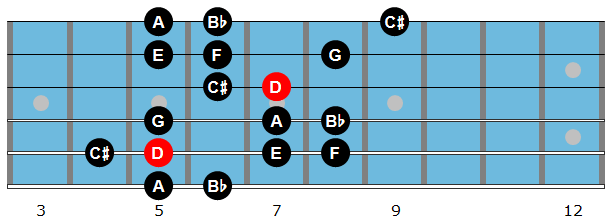
The D harmonic minor scale can be used in the 4th bar, over the ii-V in D minor (Em7b5 – A7):
| D Minor Harmonic Scale | D | E | F | G | A | Bb | C# |
|---|---|---|---|---|---|---|---|
| Played over A7 | 11 | 5 | b13 | b7 | 1 | b9 | 3 |
The D harmonic scale played over A7 outlines the dominant chord and gives you the b9 (Bb) and b13 (F), two classic altered dominant sounds.
Here is the standard fingering in 5th position:
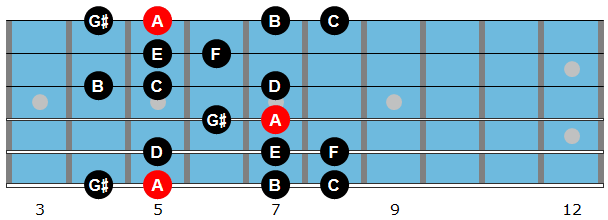
Over the ii–V passages in A minor (Bm7b57 – E7 in bars 2, 7, 8, 10, 14, and 16), you can use A harmonic minor. The logic is identical to the D harmonic minor example: you’re getting strong dominant-chord extensions and resolutions to A minor.
Here is the standard fingering for the A harmonic minor scale:
Summertime Arpeggios
Another way to add interest to your solos is by using arpeggios.
Without going into a full arpeggio study, here’s one practical example you can use over the ii–V in D minor in bar 4.
A common arpeggio to play over a dominant chord is the diminished 7th arpeggio starting on the 3rd of that dominant chord.
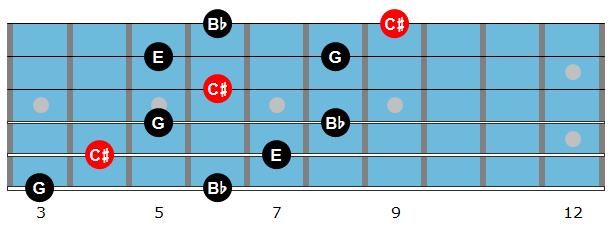
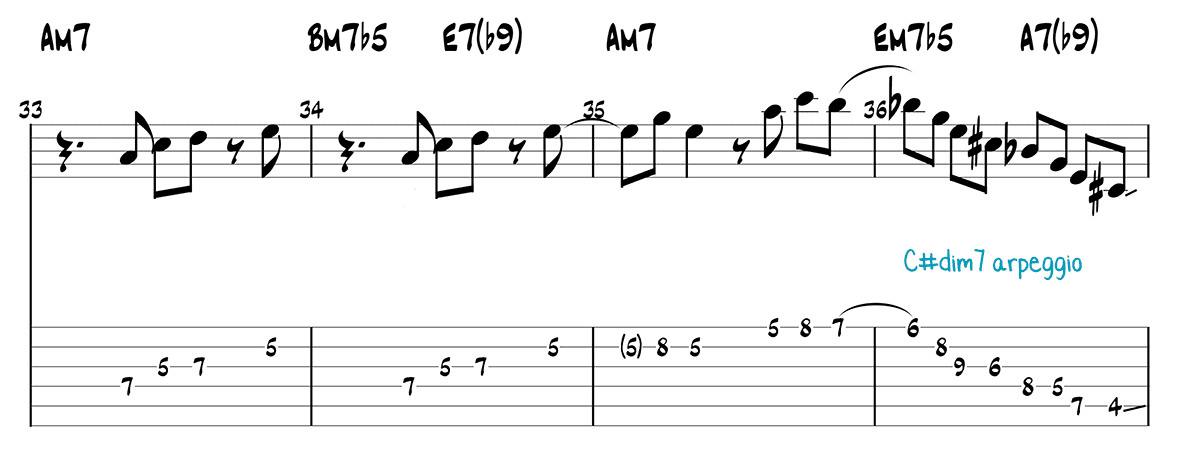
For example, over A7 you can play a C#dim7 arpeggio:
| C#dim7 Arpeggio | C# | E | G | Bb |
|---|---|---|---|---|
| Played over A7 | 3 | 5 | b7 | b9 |
Here’s one possible fingering for the C#dim7 arpeggio:
Summertime Solo Study Chorus 1 [0:35 in the video]
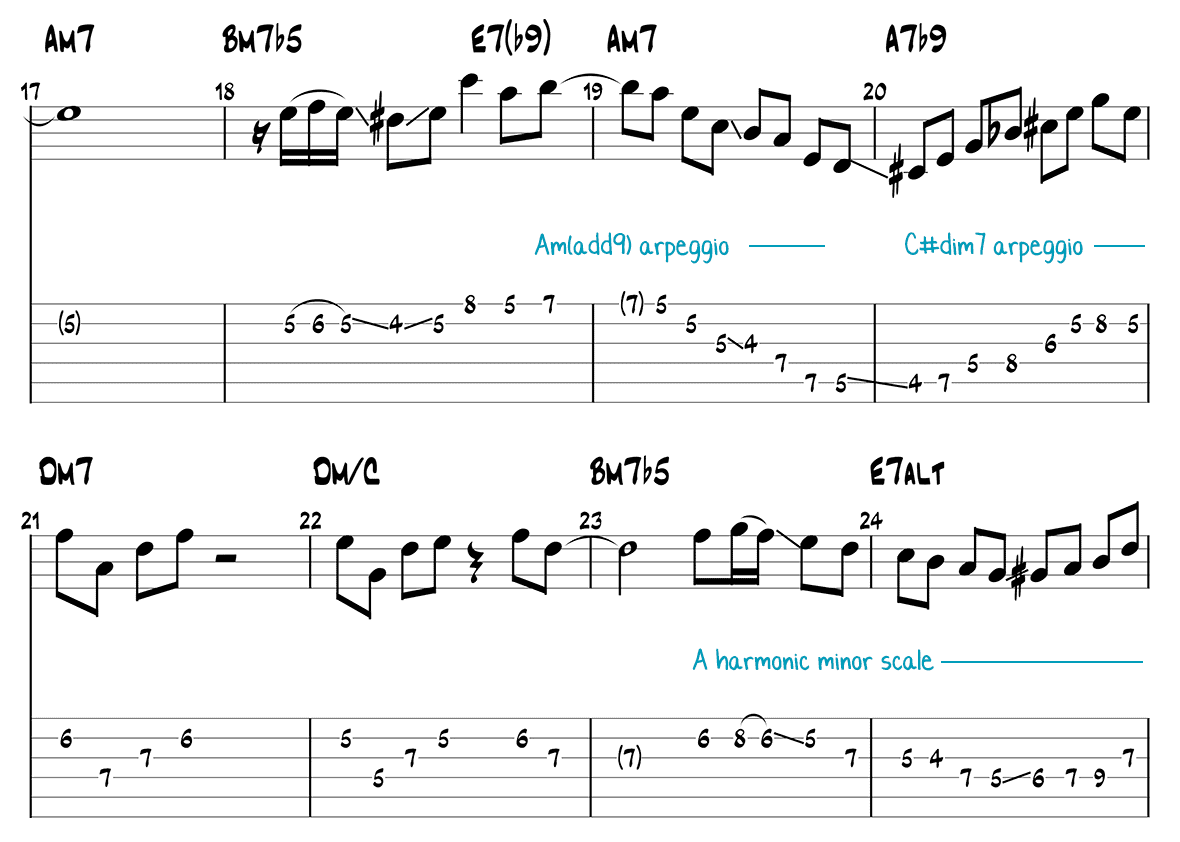

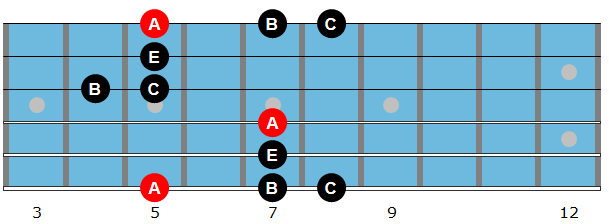
Bar 19: here I use an Am(add 9) arpeggio:
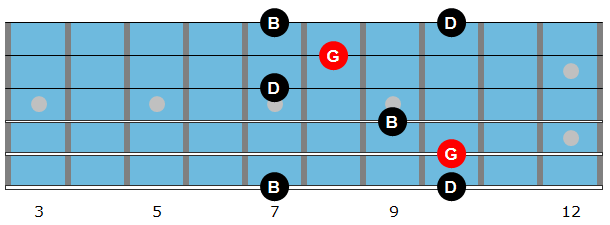
Bar 25: here I use a G triad arpeggio:
| G arpeggio | G | B | D |
|---|---|---|---|
| Played over Am7 | b7 | 9 | 11 |
Summertime Solo Study Chorus 2 [1:02 in the video]
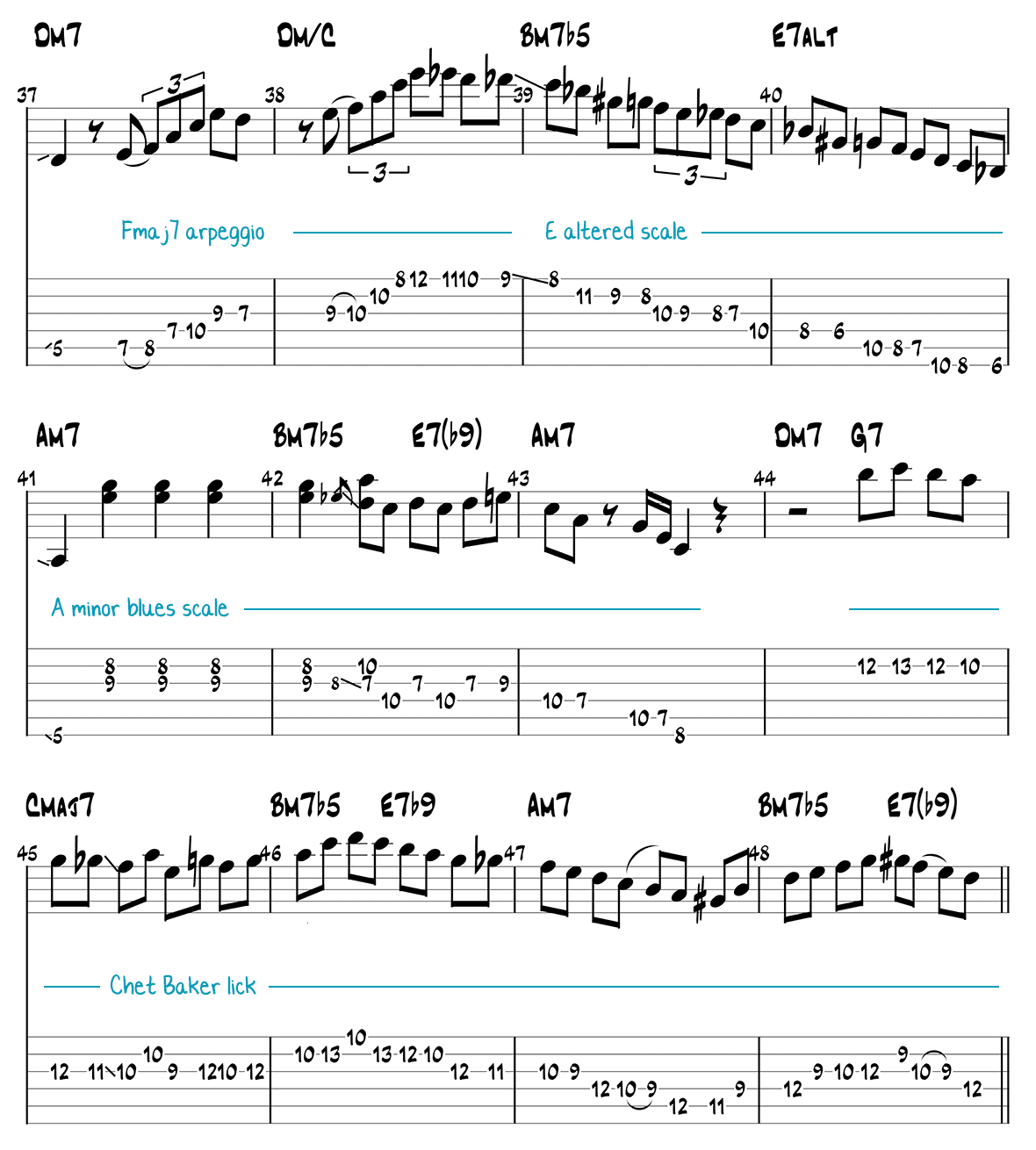
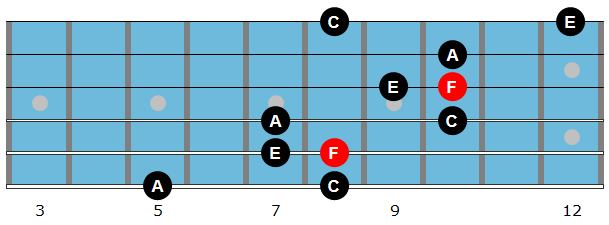
Bar 37: here I play an Fmaj7 arpeggio over Dm7.
When playing over minor chords, play a maj7 arpeggio starting on the 3rd of that minor chord to get a 9 sound.
| Fmaj7 arpeggio | F | A | C | E |
|---|---|---|---|---|
| Played over Dm7 | b3 | 5 | b7 | 9 |
Bar 39: here I play the E altered scale, with a chromatic note in between (click here to learn how to use the altered scale).
| E Altered Scale | E | F | G | G# | Bb | C | D |
|---|---|---|---|---|---|---|---|
| 1 | b9 | #9 | 3 | b5 | b13 | b7 |

Bar 44: this is a Chet Baker phrase.
Summertime Solo Study Chorus 3 [1:30 in the video]


Please make a comping lesson for Summertime!
Neat being in winter makes it summertime
Great improv work …. Will have to listen several times …. Maybe I will get it!!!
This truly swings Dirk!
fab
Another excellent lesson! Thank you.
this is incredible, awesome lesson. Thanks you!
Your lessons are best lessons I’ve ever seen! Thank you
Thank You, Dirk! Your lessons are inspirative and motivating.
Bel solo!
Veramente originale, non facile, dopo le numerose versioni già suonate; grazie Maestro, complimenti.
What a tremendous help for beginniners. great work, dirk
Dirk, thank you so much for this lesson. It’s really good!
Hello Dirk, is the guitar pro file available? Thanks for your marvellous work on jazz music.
What’s the tempo?
Hi, the tempo is 140 BPM.
Wow I’m so happy to have found this!
Hi Dirk,
Thank so much for this lesson,
👌🏽
Dirk, thanks so much for your awesome lessons!
Have you considered doing a count in instead of just having the audio start right up at the point you’re supposed to be playing? You don’t have enough time to play the beginning notes and get the rest of it in the screenshot. Thanks
Dank u Dirk,
De beste site om jazz te leren!
Mvg
Ronny Maes
Bedankt voor de feedback, Ronny!
Thanks this is a beautiful lesson!
nice way of teaching. thanks a million !!!!👍
Thanks for the excellent lesson on a great tune Dirk! Really enjoying your site.
Thanks 🙏🙏🙏❤️❤️
Great lesson! The notation is incorrect for Bars 55 (that F-flat, vs the tab) and 64 (wrong rhythm). Just wanted to let you know because it’s been a big help to me!
Excellent blog for real musicians
lezioni splendide .grazie
Glad you dig our lessons, Felice!
I like the lessons, but i havent conditions to buy the Ebooks, someone please help me.
Très bel arrangement avec une belle sonorité et une telle facilité d’exécution! Je suis jaloux!!!Lol
Really Nice again!
You play this beautifully, I would really like to know how you get that nice mellow tone. I know tone is also how the player touches the notes (both left hand and right hand) but what suggestions would you have. Interested in knowing what amp your using and any pedals you us, settings on amp and guitar. Thank you so much.
basically set your mids max bass max or 3/4 and treble 1/2 and on your guitar turn your tone knob all the way down for such an extreme sound anyway that works for me
i hope i could help
I think a big part of the jazz tone is cutting frequencies. I’d suggest cutting any frequencies under 200hz to get rid of any bass rumble and over 4k Hz. I can get the right tone from spending lots of time in the studio. Now just to work on the playing 🙂
I really like how you have put this lesson together, thanks much!!
Thanks for the feedback Steve!
Gracias por esta leccion muy bueno
Nice post!!! I can’t download the backing rack though, there seems to be a server error
Hi Miles, this should be fixed now, please try and let me know…
Hi Dirk,
Thank you, you do so much work for us. I have been with you since the early days and you are always giving more and teaching new material. For the Love of Jazz…You Are Great. Ill get some one day to repay your kindness, and i will buy from you. All the best. Matt Hawkins.
This is an excellent jazz guitar improvisation lesson. The solo was was well done with good lines, good tone and good variation in the feel of the improv
Thank you for this wonderful lesson!
Great lesson Dirk
Thanks so mutch
Many Thanks Dirk!
Really looking forward to practice over the weekend now!
Amazing!
Hallo Dirk,
Ik ben momenteel met vakantie.
Na de vakantie pak ik de gitaar weer. Summertime is een heerlijk nummer. Na de vakantie ga ik mij daar zeker in verdiepen.
Dank je wel voor de info.
Good morning, Dirk.
I’ve had a quick skim through this, and I’m looking forward to getting my teeth into it, but I have one comment to make about your description of the C# diminished arpeggio over an A7 chord.
The reason this arpeggio works, and the way it functions as a replacement for a dominant seventh chord, is that it’s actually an A7b9 arpeggio that misses out the root. When I hear a diminished chord or arpeggio in context, it feels transitional to me – providing a stepping stone from one chord to the next. A dominant seventh has a different feel and function.
Obviously there’s a tension in your lessons between the pragmatic (“this is where to find this arpeggio during a solo”) and the theoretical (“this is what’s really happening here”), but we’re big boys and girls on this forum, and I think we can take a little theory!
My tip for finding where to start this arpeggio it to play the root first and slide up a semitone (to Bb in this case) before starting the familiar sequence of minor third intervals.
A similar chord-naming issue arises with Em7b5, C9 and Gm6, where the same shape is used but is (usually!) given the name that fits its function.
Thank you so much, Dirk. One of your best lessons, definitely. Wonderful tone and sound. So jazzy!
Great Lesson, thank you very much!!