

Jazz guitar chords might seem tricky at first, but you really just need a small set of easy jazz chords to get started. In this lesson, you’ll learn how to play these chords with a chart of 17 essential shapes, with guitar tabs and exercises to help you practice and learn quickly.
The chords in this tutorial are some of the most common jazz chords on guitar, used in countless standards and progressions. Try using these shapes to add jazzy chords to your own music right away.
As you go through the lesson, you’ll find exercises and examples that show how to use these basic jazz chords in real progressions. This helps you start playing them in your own music right away.
Some terms and ideas in this lesson may go over your head at first, and that’s okay. Focus on practicing the chord examples, and learn the theory gradually as you go.
Table of Contents
Start Here – Your First Jazz Guitar Chords
Download the 54-page PDF, GP files, and backing tracks with JGO+ (click here to join)

The best way to learn jazz chords is to start playing them right away, rather than studying them one by one.
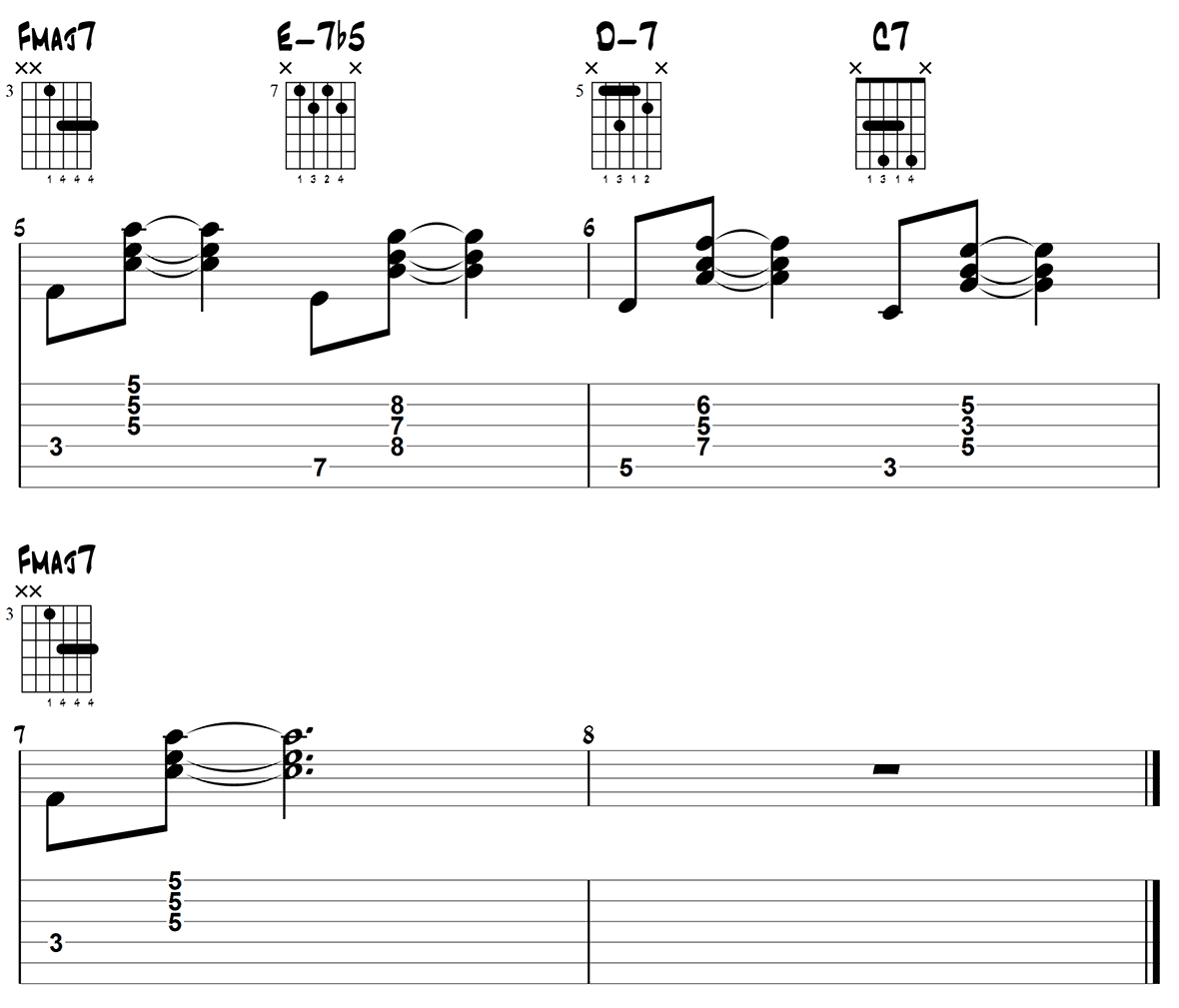
The chord progression in the example below gives you your first set of important chord shapes that are used all the time in jazz.
Play the chords slowly and don’t worry too much about the rhythm. Focus on getting used to the shapes and how they sound together.


What Are Jazz Chords?
What is a jazz chord? This question is trickier than it seems, since many chords called “jazz chords” also show up in pop, rock, blues, and even classical music.
Jazz chords usually have four notes or more. They go beyond basic triads by adding at least the 7th, with extensions like the 9, 11, and 13 for extra color.
For example, in rock and pop music, a G chord is often played as a simple barre or power chord.
In jazz, that same chord is often played as Gmaj7, G6, or G6/9, giving it a richer sound.
How do jazz chords work?
Jazz chords are constructed by stacking intervals, starting with a basic triad and adding the 7th and extensions like the 9th or 13th. These additional notes create tension and color, giving jazz its unique sound.
To help you understand how chords are built, the diagrams on this page show their interval structure. This makes it easier to picture how the notes fit together on the fretboard.
Here are the interval formulas for the five chord types you’ll learn first:
- Major 7: 1 – 3 – 5 – 7
- Dominant 7: 1 – 3 – 5 – b7
- Minor 7: 1 – b3 – 5 – b7
- Half-Diminished 7: 1 – b3 – b5 – b7
- Diminished 7: 1 – b3 – b5 – bb7
These formulas are explained in more detail in our chord theory lesson, so you don’t need to memorize them right now.
You can start playing jazz guitar without knowing much music theory at first, though learning some theory will make chords easier to understand.
What jazz chords go together?
Chords often move in progressions such as the ii-V-I.
In C major, for example: Dm7 → G7 → Cmaj7
These patterns help create movement and resolution, and are the foundation of many jazz songs.
You will learn many chord progressions by playing jazz standards and doing the exercises on this page.
For now, focus on learning the chord shapes and listening to how they sound in progressions. The theory will start to make sense as you go.
How to Read Guitar Chord Diagrams
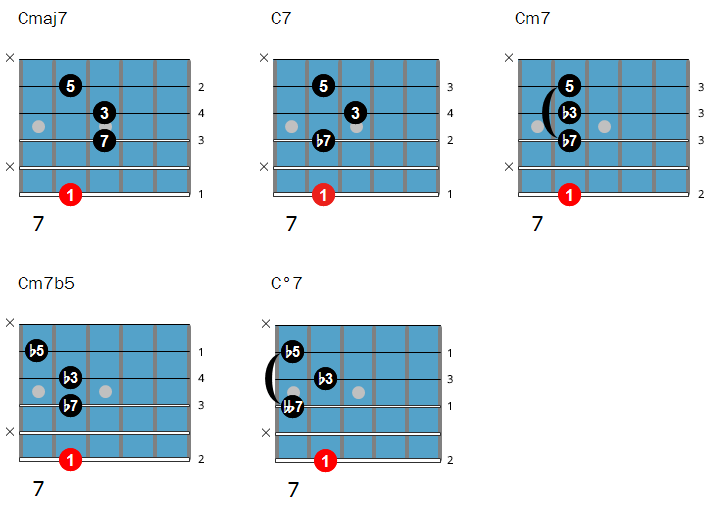
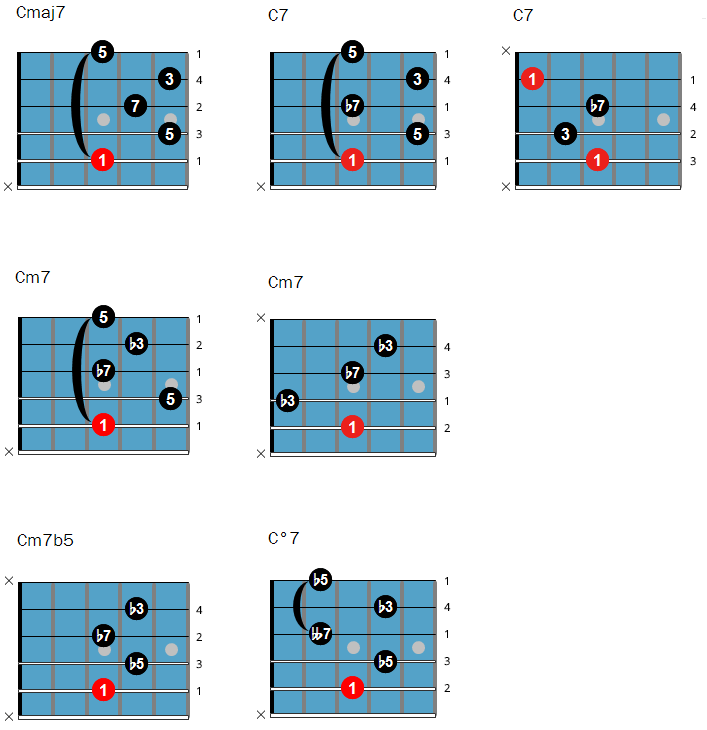
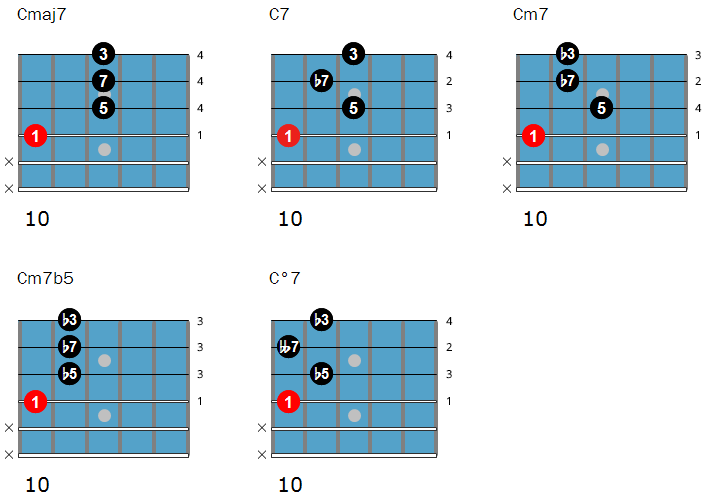
The red circle in each diagram shows the root note, also called the 1 or bass note. The numbers in black circles show the other notes of the chord.
In the chord charts below, all bass notes are C.
You can move these chord shapes up or down the neck to play the same type of chord in a different key.
For example: if you move the Cmaj7 shape up two frets, it becomes Dmaj7.
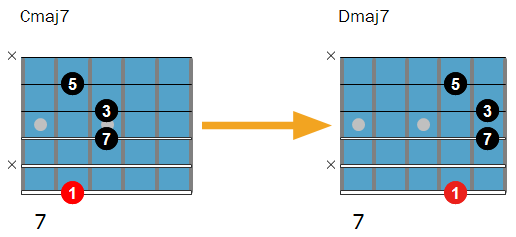
The number below each diagram is the fret number.
In the Cmaj7 example above at the 7th fret, you would play:
- 8th fret on the lowest string
- 9th fret on the D string
- 9th fret on the G string
- 8th fret on the B string
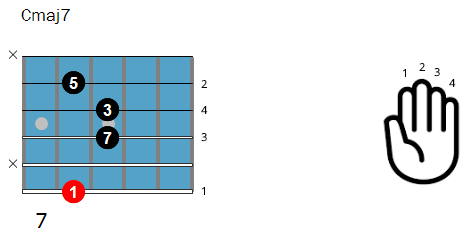
An “x” on the left means the string is not played.
Because of this, these chords are usually not strummed. Instead, play them fingerstyle with your thumb and fingers for better control and a clearer sound.
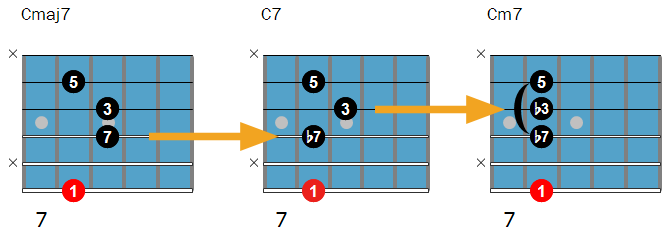
You’ll also see that each chord type changes only one note from the next. This makes them easier to learn and connect to each other.
For example:
- Cmaj7 → C7: the 7 becomes a ♭7
- C7 → Cm7: the 3 becomes a ♭3
Listen to how these minor changes affect the sound of the chord.
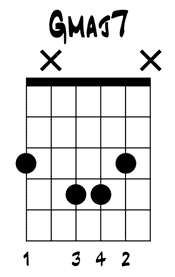
On Jazz Guitar Online, you will notice another type of chord diagram used in our sheet music that are vertical instead of horizontal.
They show the same information, but are formatted to fit above the staff, like regular chord symbols. Once you understand one system, the other will make sense too.
Jazz Chord Symbols
Here’s a list of jazz chords and their chord symbols as they are used in notation on a lead sheet.
 |
Two common symbols for major chords. On this site, we use the first. |
 |
Several symbols are used for minor chords. Here, we use the first two. |
 |
The standard symbol for dominant 7 chords. |
 |
Three common symbols for half-diminished chords. We use the first two. |
 |
These symbols indicate diminished 7 chords. |
 |
C6 adds the 6th to a major triad. C6/9 adds both the 6th and the 9th. |
 |
Major chords extended with notes like the 9, 13, #11, or #5. |
 |
Minor chords extended with notes like the 6, 9, or 11. |
 |
Suspended chords replace the 3rd with a 4th, creating a more open sound. |
 |
Dominant chords with added color tones (extensions) such as the 9 or 13. |
 |
Two symbols for augmented dominant chords (1–3–#5–b7). |
 |
Examples of dominant chords with altered extensions like b9, #9, b5, or #5. |
 |
A shorthand for a dominant chord with altered tensions (b9, #9, b5, #5). |
 |
These are called slash chords: chords with a different bass note than the root. |
Jazz Guitar Chord Charts
The chord charts below show the essential jazz guitar chord shapes that every player should know. These voicings are called drop 2 and drop 3, and they are common in jazz guitar.
Use the charts as a reference while you practice and as a starting point for learning jazz standards. For a full list of jazz chords, download our jazz guitar chord dictionary.
Once you have these chords under your fingers, you’ll be able to play the chord changes of most jazz standards.
The best way to learn jazz chords is to use them in real music. Start with the exercises below the chord chart, then try the same shapes in jazz standards and chord progressions.
Jazz Chords – Root on the 6th String
Jazz Chords – Root on the 5th String
Jazz Chords – Root on the 4th String
Basic Chord Exercises
What is the best way to learn jazz chords?
The most effective way to learn and practice jazz guitar chords is to play them in real music, not just practice the shapes on their own.
Begin with easy chord progressions and well-known jazz standards. This helps you hear how the chords fit together and builds muscle memory more quickly.
The following exercises use the chord shapes from the chart above and introduce common chord patterns that you will encounter in many jazz standards.
Basic Chord Exercise 1 – Diatonic Chords
In the following exercises, you’ll play the diatonic chords of a scale.
Diatonic chords are a set of chords built using only the notes from one specific scale.
Follow these steps to get the most out of the exercises:
- Begin by playing without a metronome. Try to memorize each chord and make sure that all notes sound good.
- Once you feel ready, try playing along with the metronome backing track. This time, focus on making smooth chord changes and keeping the rhythm. If a note is muted now and then, that’s normal and will get better with practice.
The metronome clicks on beats 2 and 4, which is how jazz musicians feel the beat. This might feel odd at first, so give yourself time to get used to it.
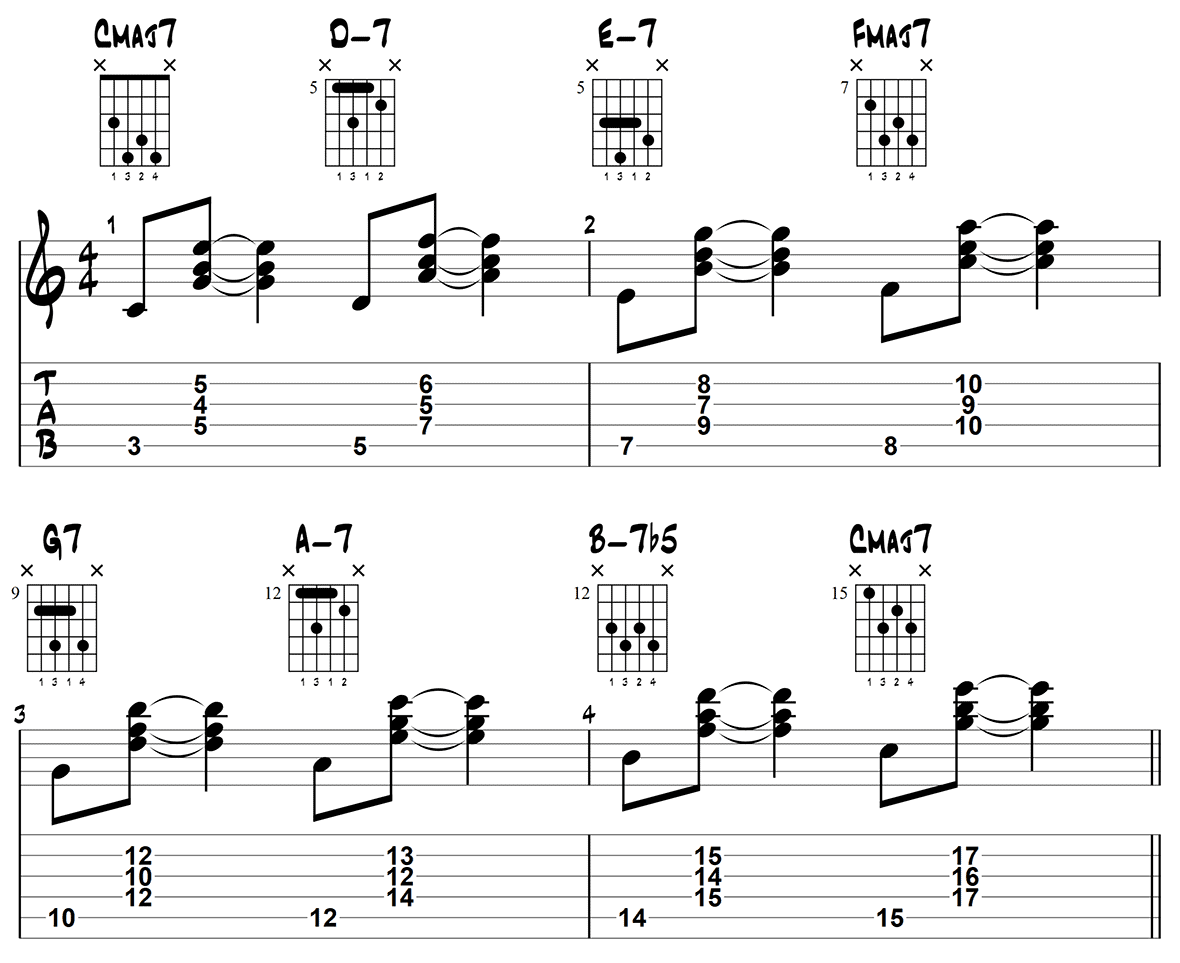
In these exercises, play the bass note first, then the rest of the chord. This gives you extra time to change shapes and makes switching between chords a bit easier.
First, you’ll play the diatonic chords of the C major scale, keeping all the root notes on the A string. Play up the scale and then back down.
Metronome Track (105 BPM on beats 2 and 4)
Listen & Play-Along
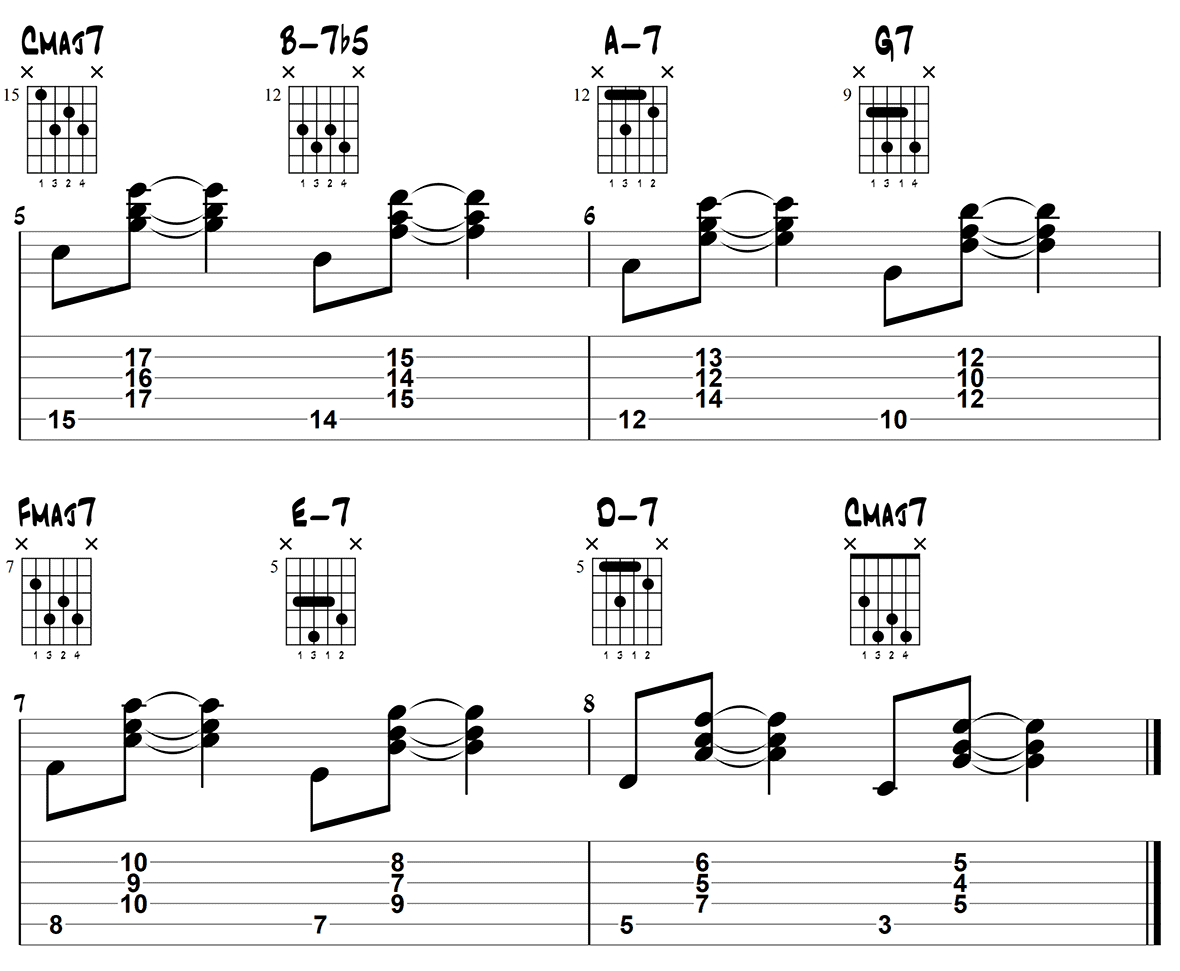
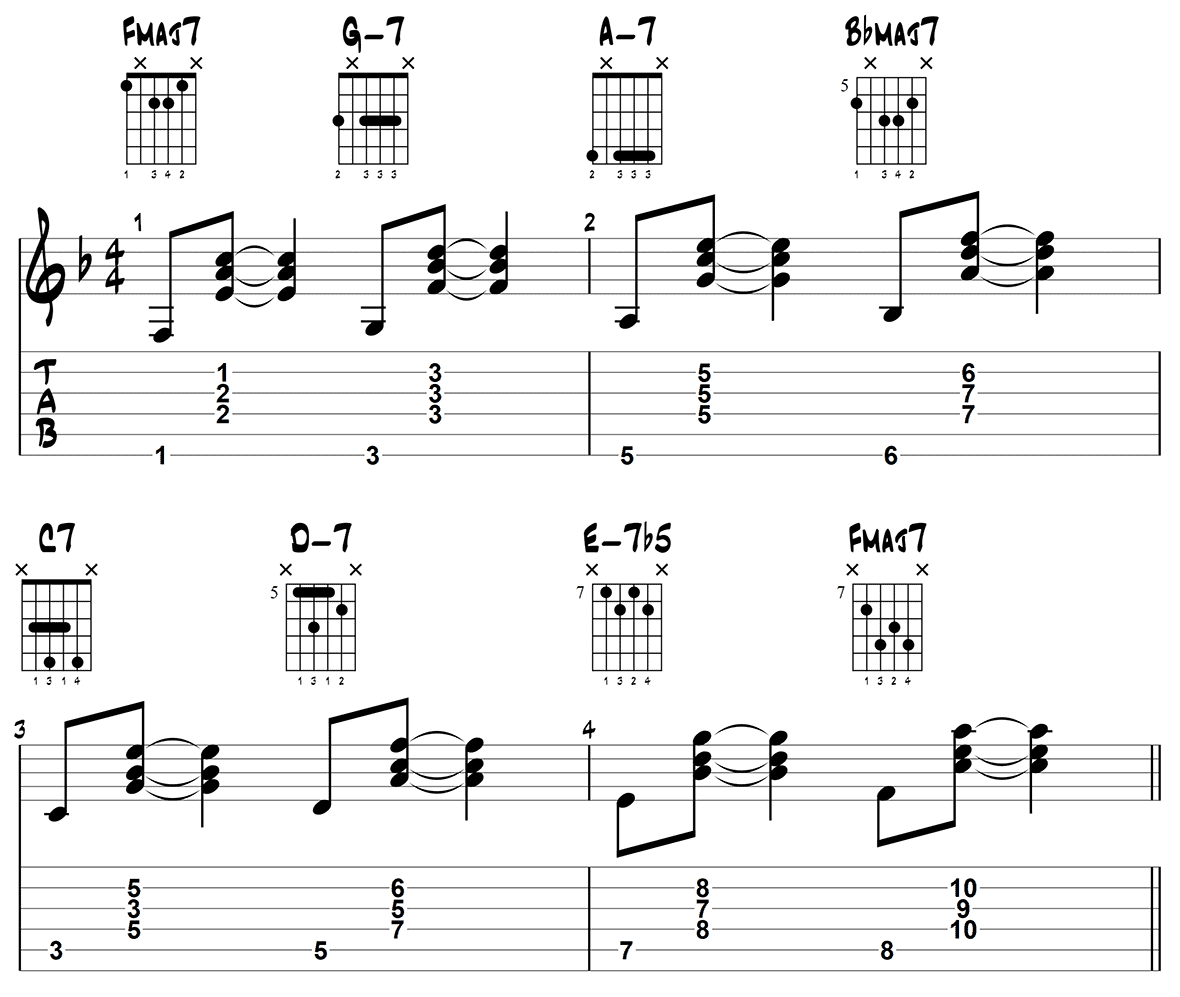
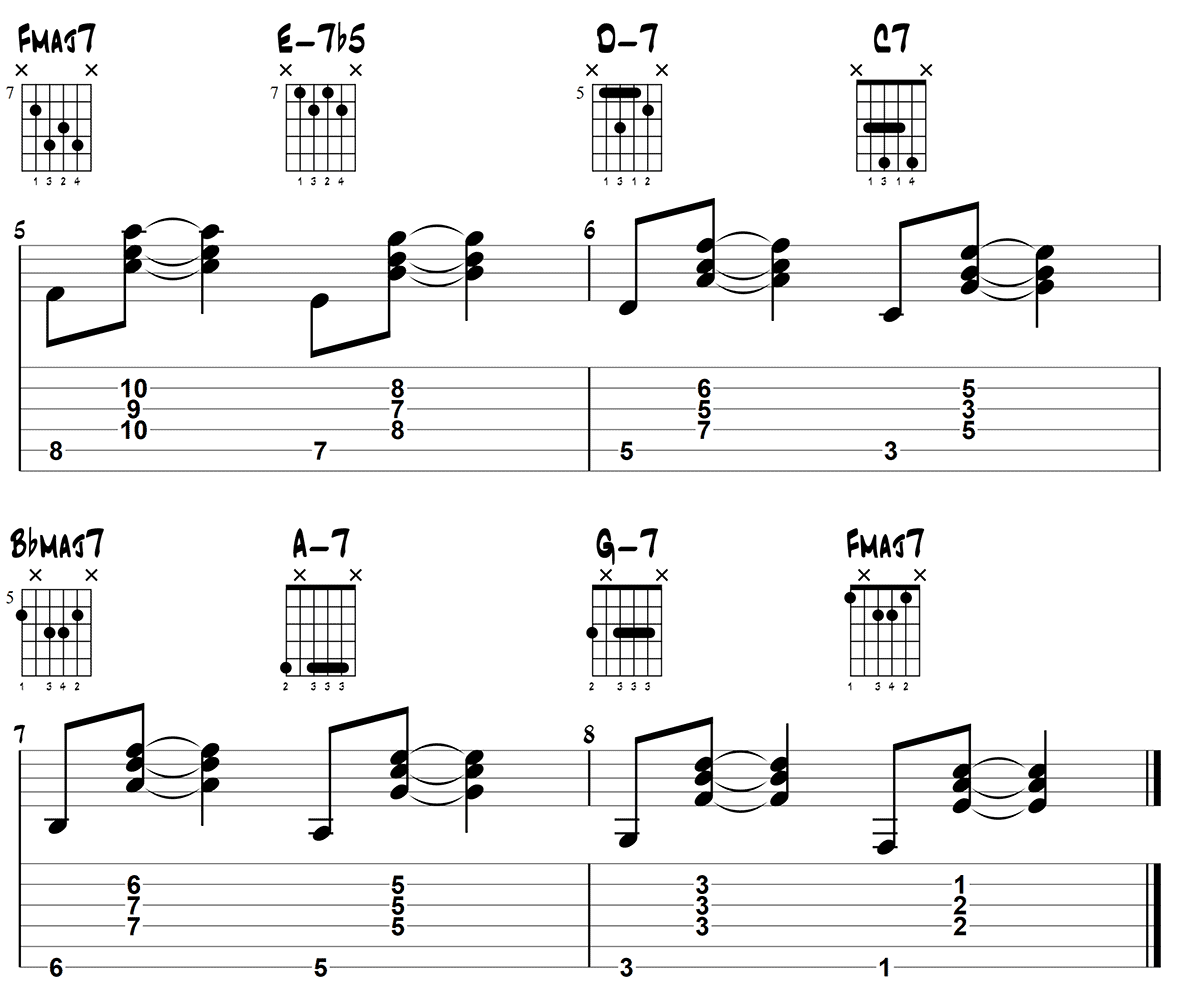
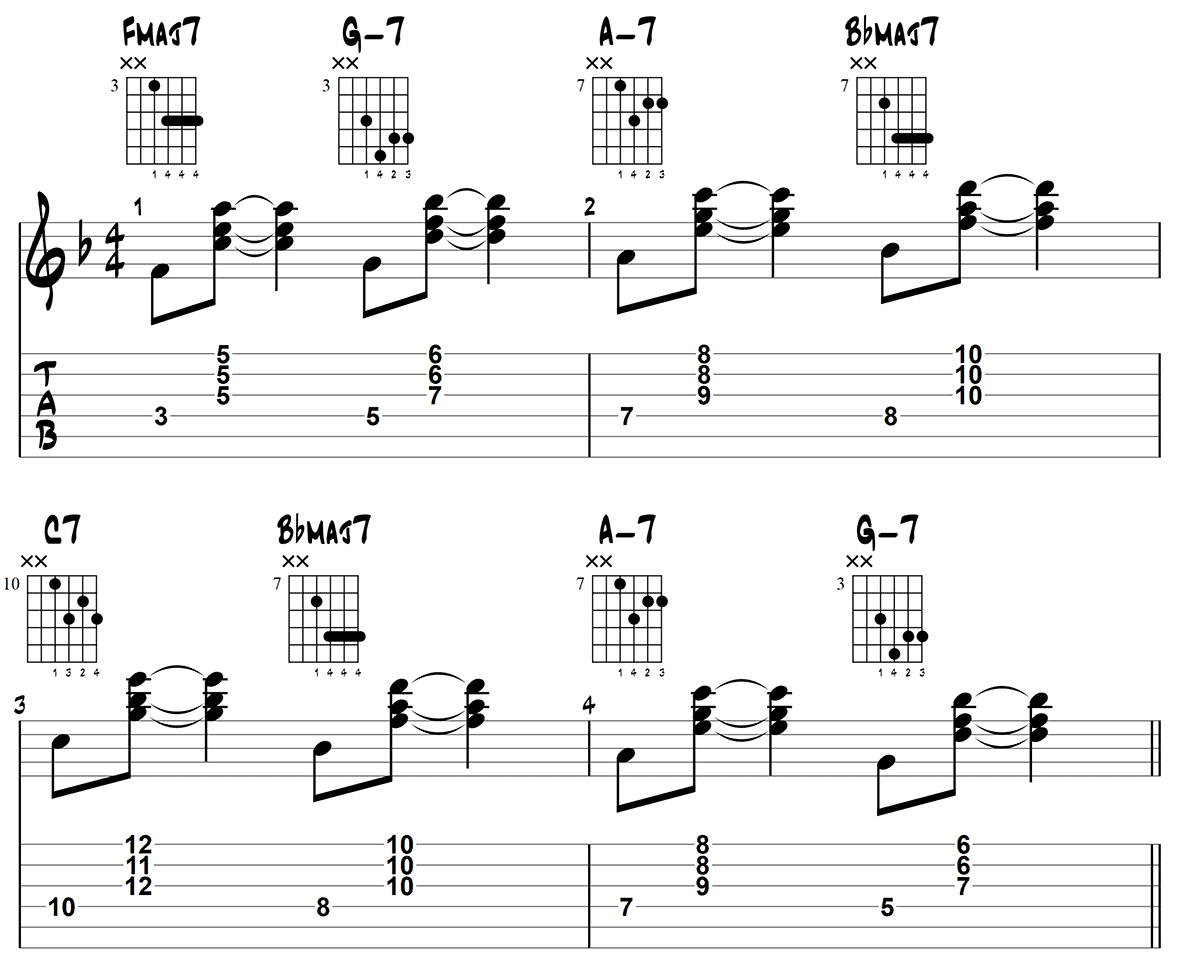
Basic Chord Exercise 2 – Chord Changes
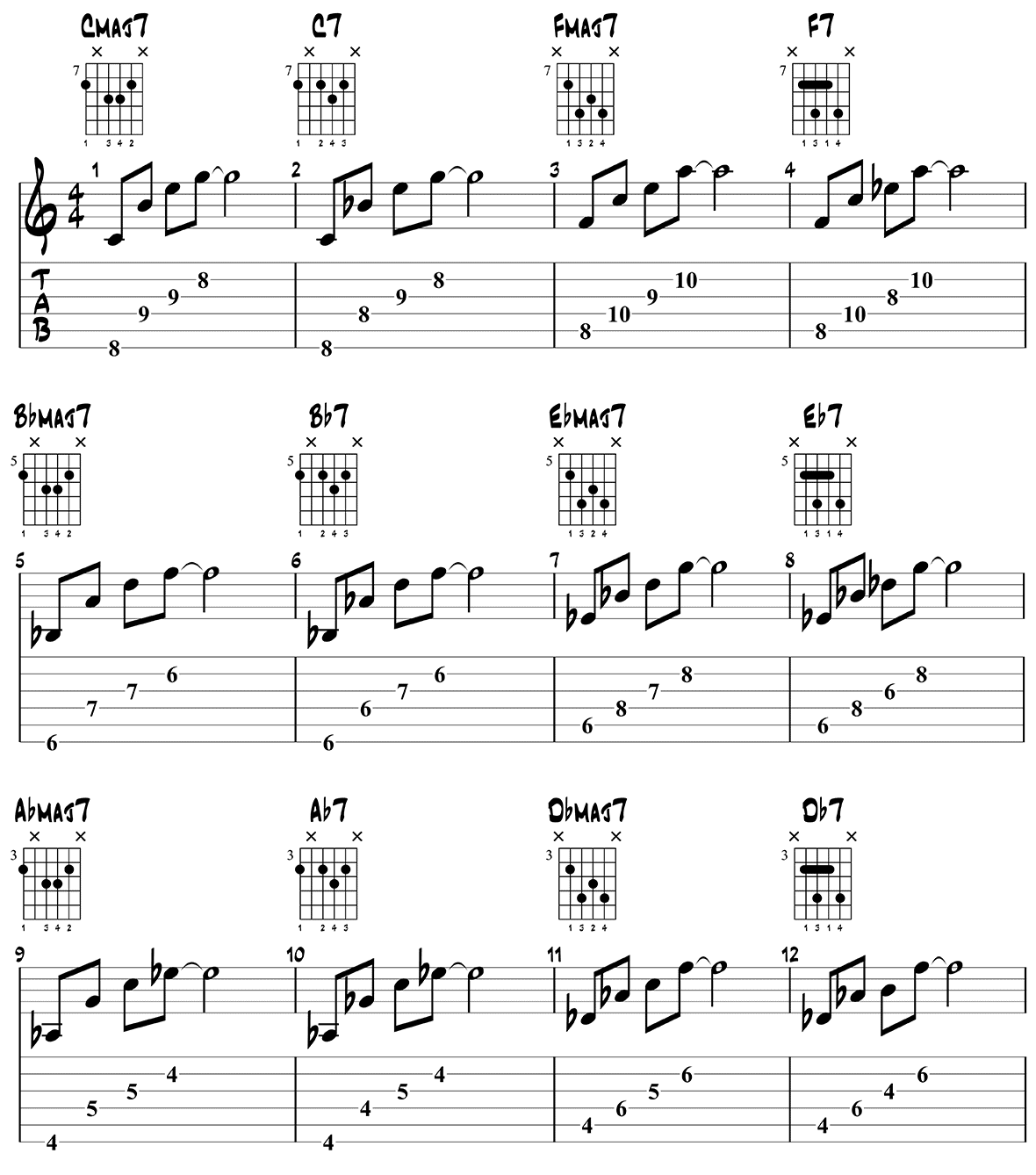
In this exercise, you’ll move between major 7 and dominant 7 chords on the same root, following the circle of fourths:
Cmaj7 → C7 → Fmaj7 → F7 → Bbmaj7 → Bb7 …
You’ll often hear this kind of chord movement in jazz standards, where a major chord changes to a dominant chord to lead into the next one (for example, Cmaj7 → C7 → Fmaj7).
Each chord is arpeggiated, starting with the bass note and followed by the other notes. This helps you hear how the chord quality changes and gives you time to switch shapes.
Metronome Track (120 BPM on beats 2 and 4)
Listen & Play-Along
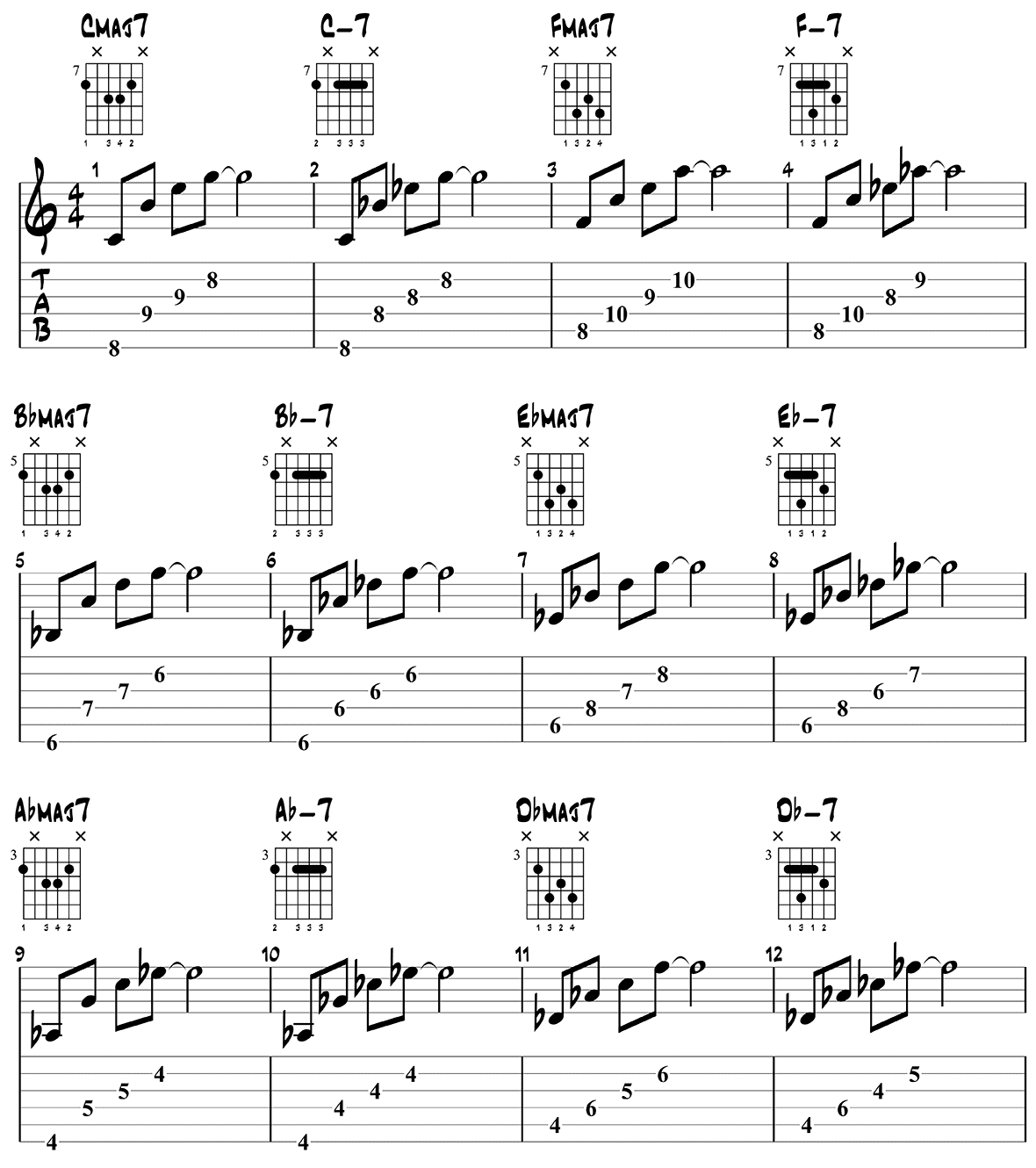
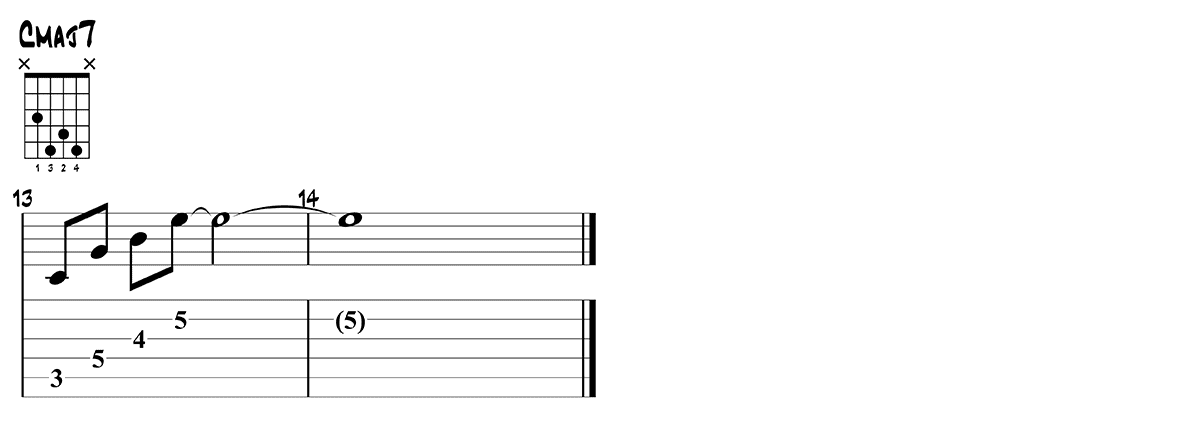
In a similar exercise, you switch between major 7 and minor 7 chords on the same root:
Cmaj7 → Cm7 → Fmaj7 → Fm7 → Bbmaj7 → Bbm7 …
Switching from major to minor is also common in jazz, especially during modulations.
Again, play the chords as arpeggios and listen to how changing the 3 and 7 (from major to minor) changes the sound of the chord.
Basic Chord Exercise 3 – Satin Doll
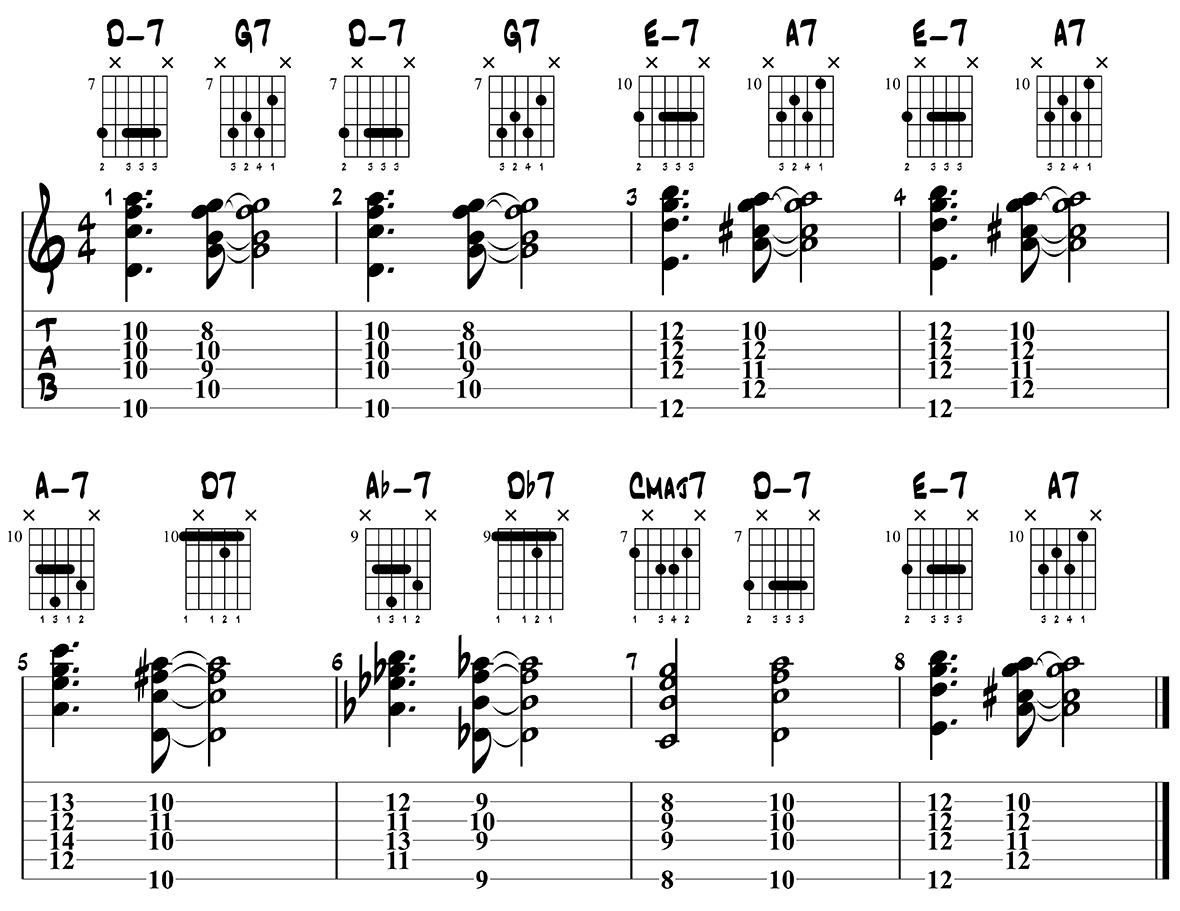
In this exercise, you’ll play the chords of Satin Doll using the Charleston rhythm.
The Charleston rhythm is a jazz pattern in which you play a chord on beat 1 and again on the “and” after beat 2.
For a more advanced version of this exercise with extended chords and a more complex rhythm, see Exercise 9.
Basic Chord Exercise 4 – Fly Me to the Moon
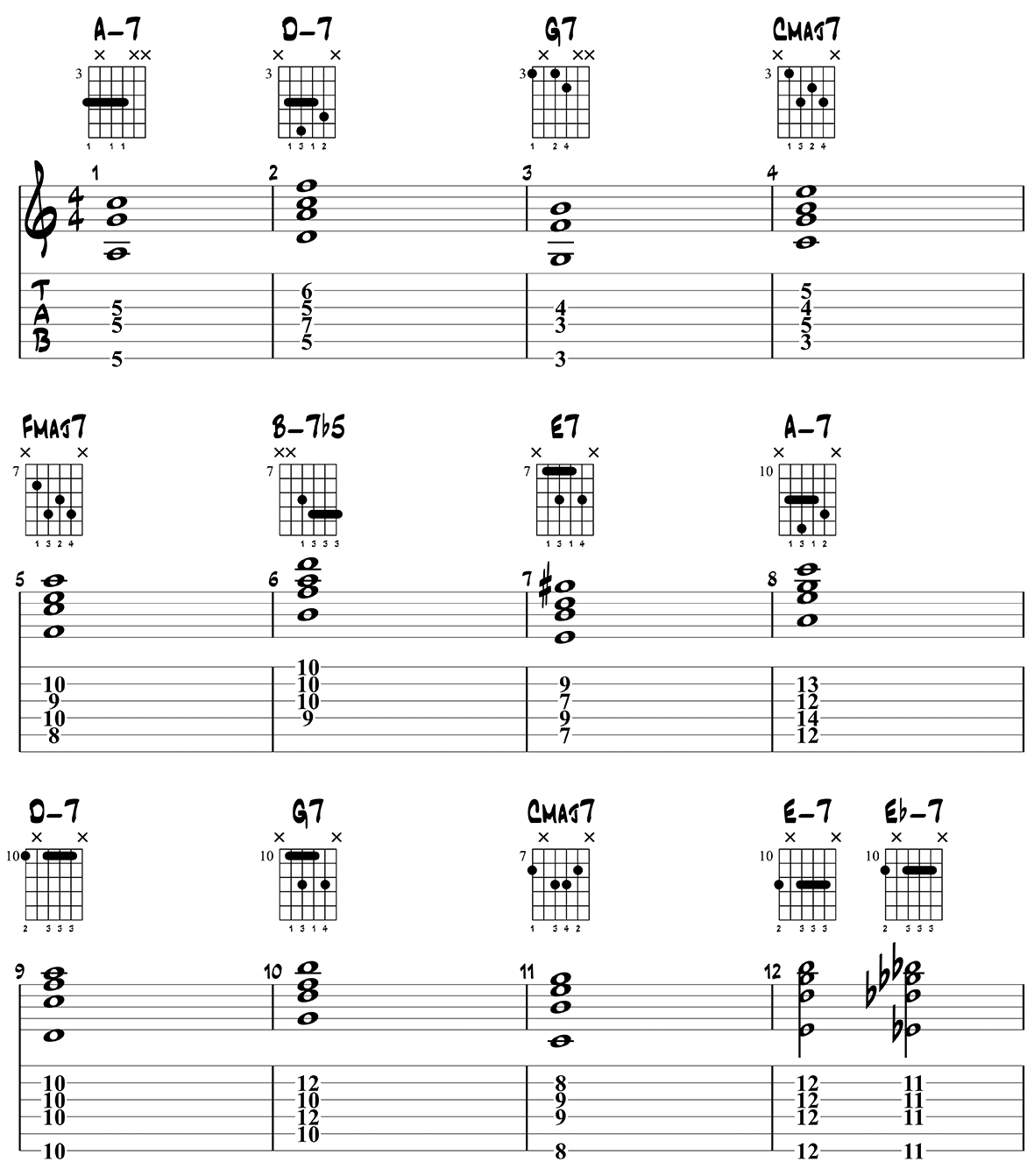
In this exercise, you’ll play the chords of Fly Me to the Moon using the basic shapes from the chart above.
The rhythm is simple: each chord lasts four beats. This gives you time to focus on playing clean chord shapes and making smooth transitions.
For a more in-depth breakdown of this tune, take a look at my Fly Me to the Moon chord lesson.
Also try our Autumn Leaves chord lesson. It applies similar ideas and goes beyond the basics.
Basic Chord Exercise 5 – Walking Bass
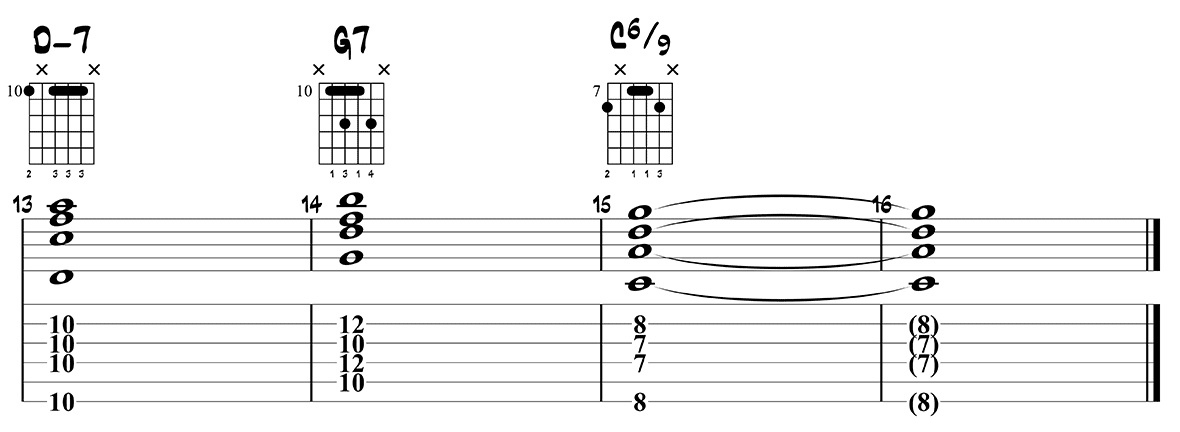
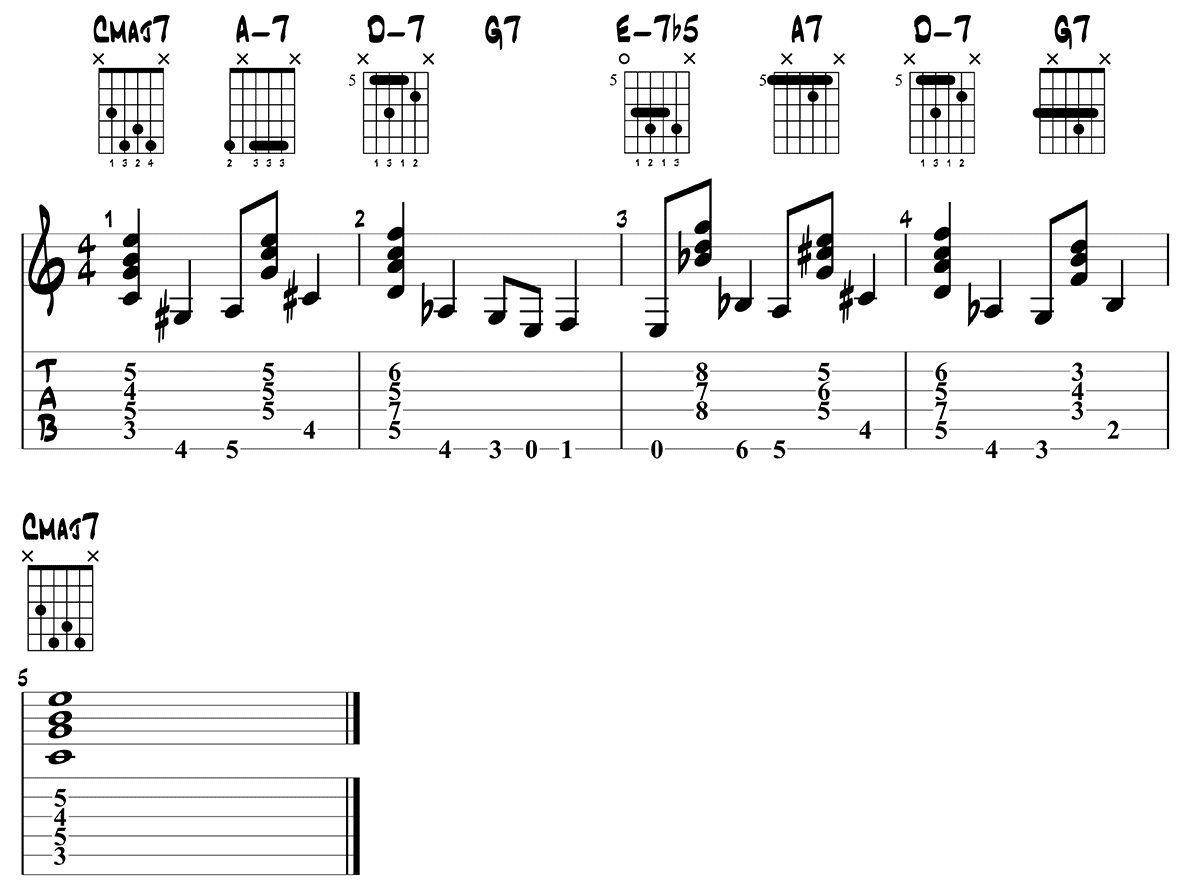
In this short exercise, you’ll play a walking bass line along with chords. This is a common technique used in solo jazz guitar.
The chord progression follows a cycle of ii–V movements in the key of C major:
Cmaj7 → Am7 → Dm7 → G7 → Em7b5 → A7 → Dm7 → G7 → Cmaj7
More Easy Jazz Guitar Chords
In this section, you’ll build on the basic chord shapes by adding tensions to the chords.
Tensions or extensions are extra notes (9, 11, and 13, for example) that are added to a basic chord to create a more colorful sound.
These extra notes make the chords sound richer, more modern, and lighter.
Extended chords are used all the time in jazz, but you don’t have to learn them all at once. Think of these shapes as variations of the chords you already know.
Chords with extensions might seem more complex in theory, but they aren’t always harder to play. In fact, many of these voicings are just as easy, or even easier, than basic chord shapes.
Major 7th Chords
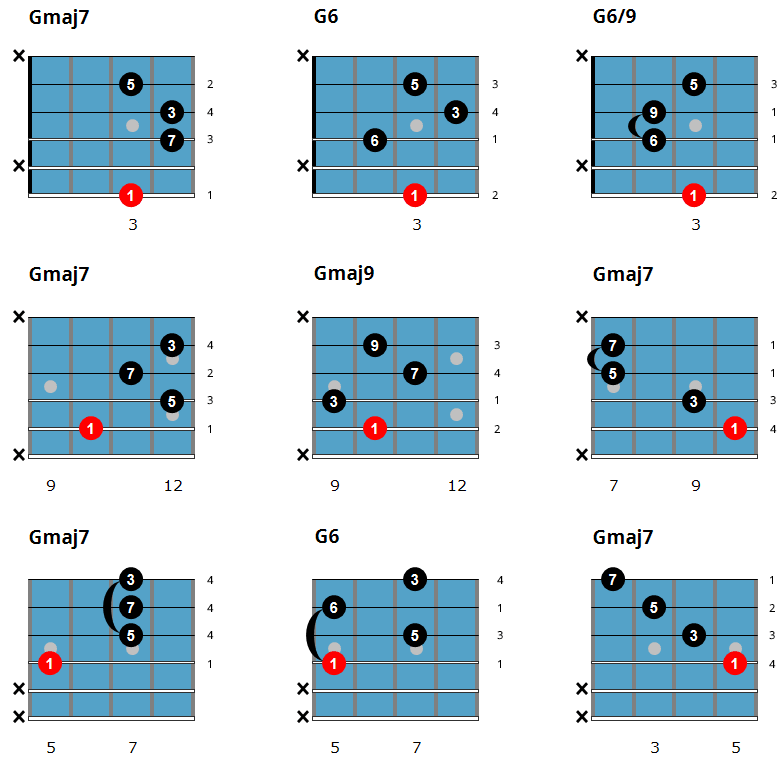
Here are nine ways to play major chords, including major 7, major 6, and 6/9 shapes.
These chords are often used as the Imaj7 chord in a ii-V-I progression.
Dominant 7th Chords
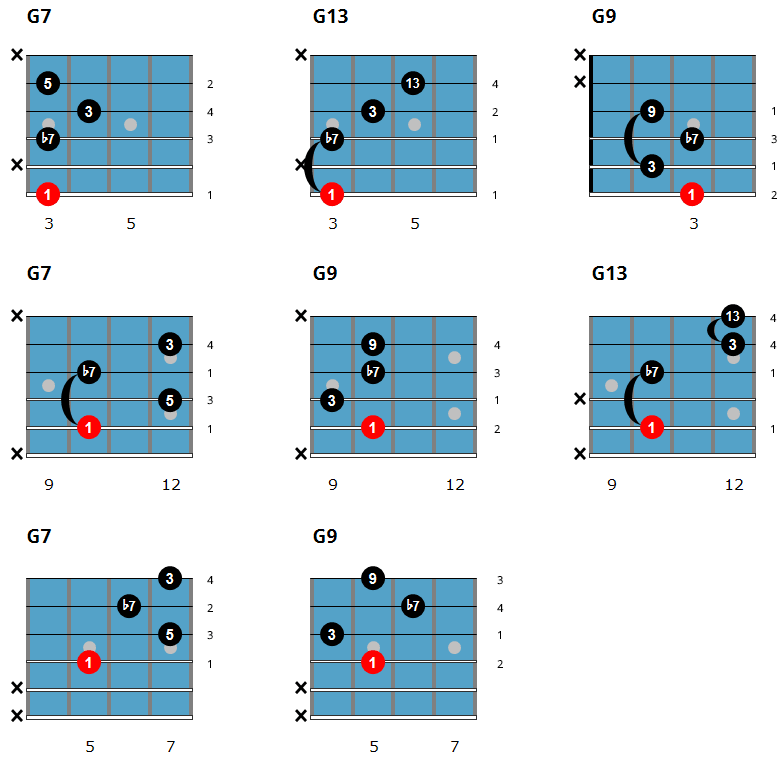
Next, you’ll practice dominant jazz chords, focusing on 7, 9, and 13 shapes.
You might already know some of these shapes from playing blues guitar.
These chords are used in jazz blues progressions and as the V7 chord in ii-V-I progressions.
Minor 7th Chords
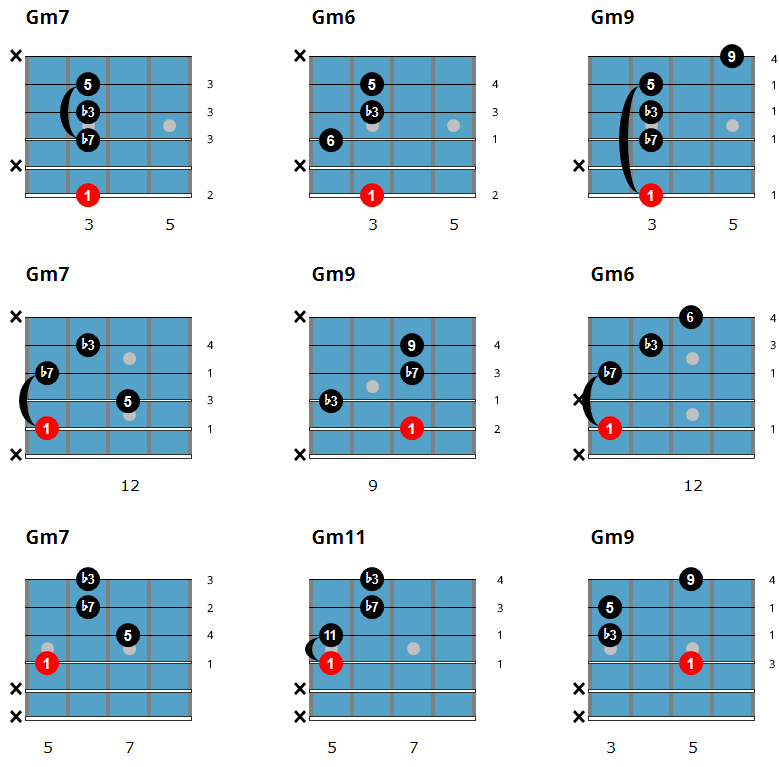
This section introduces minor jazz chords, including m7, m6, m9, and m11 shapes.
These chords are commonly used as the ii chord in ii-VI progressions, and as the i chord in minor ii-V-I progressions.
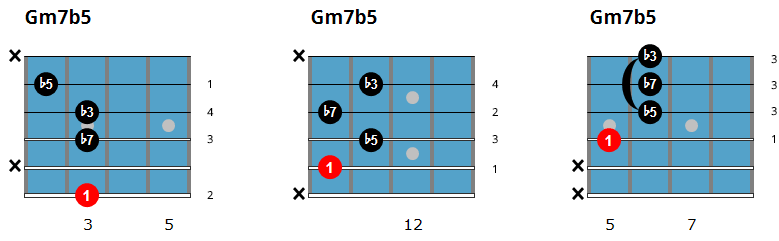
Minor 7b5 Chords (aka Half-Diminished Chords)
The next group is minor 7♭5 chords, also called half-diminished chords and written as m7♭5.
Each string set has one main shape, so you only need to learn three voicings.
These chords are used as the ii chord in minor ii–V-i progressions.
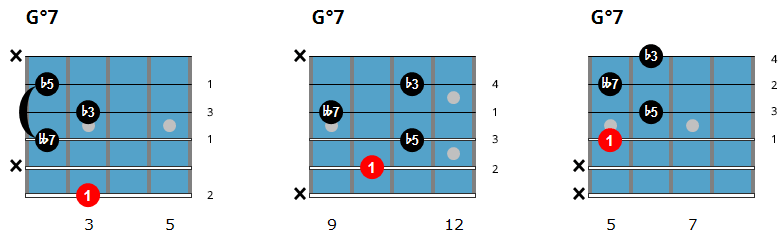
Diminished 7th Chords
Diminished chords are often used as passing chords, such as in the progression Imaj7 → ♯Idim7 → iim7 (see exercise 8).
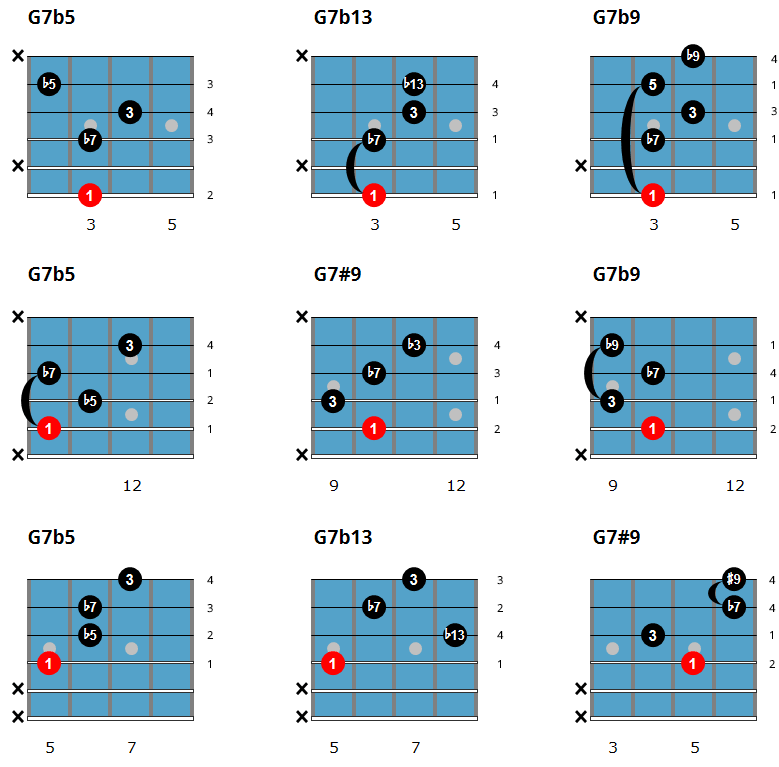
Altered Chords
The last group you’ll learn about is altered chords, often written as 7alt on lead sheets.
These chords include notes like b9, #9, b5, or b13 (#5), or any mix of these.
For now, use just one altered note per chord to keep things simple. Later, you can try voicings with two or more altered notes.
Applied Chord Exercises
The next set of exercises builds on what you’ve learned so far and adds chords with tensions.
You’ll move beyond the basic shapes and start working with richer, more colorful chord sounds.
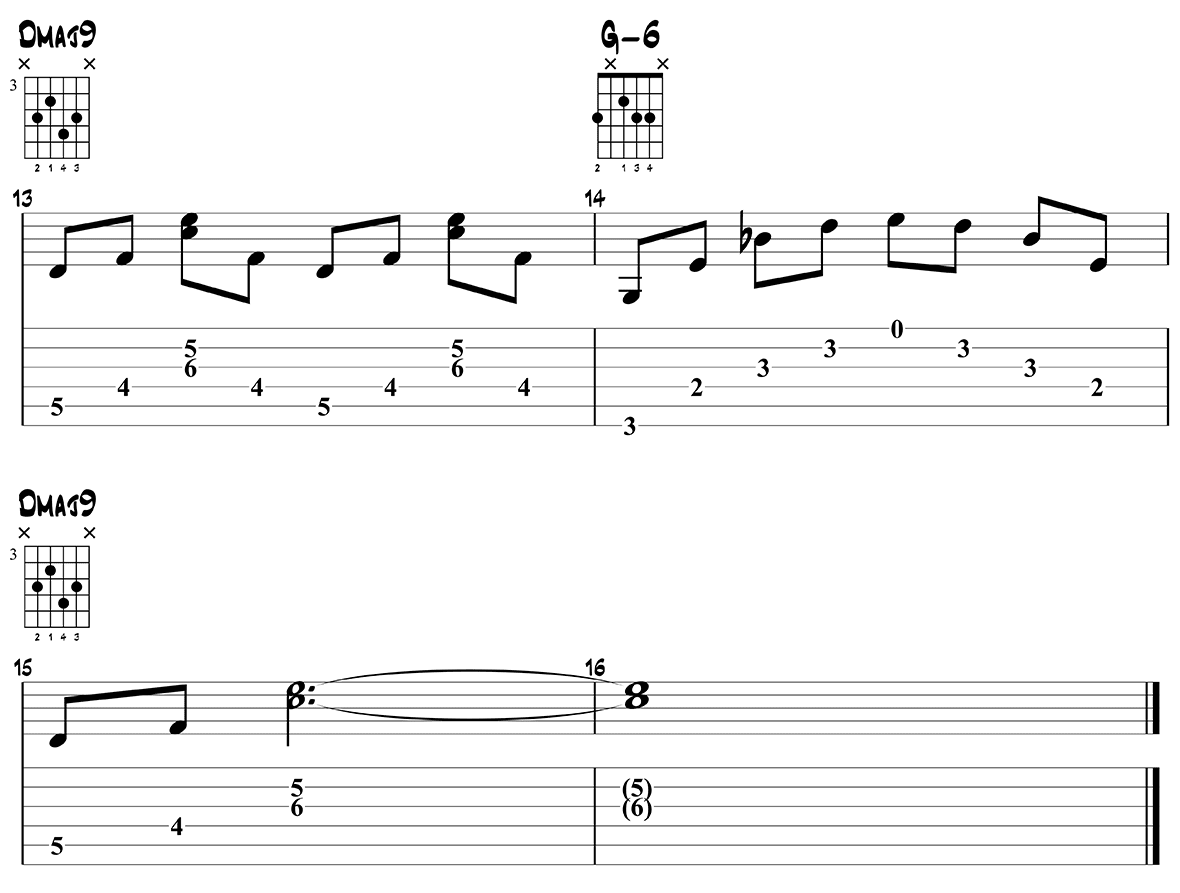
Exercise 6 – Modal Interchange Ballad
In this exercise, you’ll play a ballad-style chord progression that uses modal interchange.
Modal interchange means borrowing chords from other scales that share the same root note.
This exercise is in the D major key, but you will also hear chords taken from D natural minor and D Phrygian.
The progression starts with Dmaj7 (the Imaj7) and continues with a beautiful IVm sound with Gm6/9 (bars 2, 4, 8, 14).
In a major key, the IV chord is normally major (Gmaj7 in D major). When you change it to minor (Gm), it’s called a IVm chord. This sound is common in jazz and other styles.
You can hear the IVm chord in standards like All of Me, It Could Happen to You, and There Will Never Be Another You. It also appears in pop songs like Creep (Radiohead) and Blackbird (The Beatles). This chord gives the progression a more interesting and slightly darker sound.
Near the end, you’ll play a classic ending: ♭VI to ♭II to I (bars 11-12).
Bbmaj7 → Ebmaj7 → Dmaj7
The IVm and ♭VIm chords come from the natural minor scale (D minor here). The ♭IIm chord comes from the Phrygian mode.
Check the table below to compare the chords in D major, D natural minor, and D Phrygian. The three borrowed chords in our example are marked in blue.
| D major | Dmaj7 | Em7 | F#m7 | Gmaj7 | A7 | Bm7 | C#m7b5 |
|---|---|---|---|---|---|---|---|
| D minor | Dm7 | Em7b5 | Fmaj7 | Gm7 | Am7 | Bbmaj7 | C7 |
| D Phrygian | Dm7 | Ebmaj7 | F7 | Gm7 | Am7b5 | Bbmaj7 | Cm7 |
Drum Track (70 BPM)
Listen & Play-Along


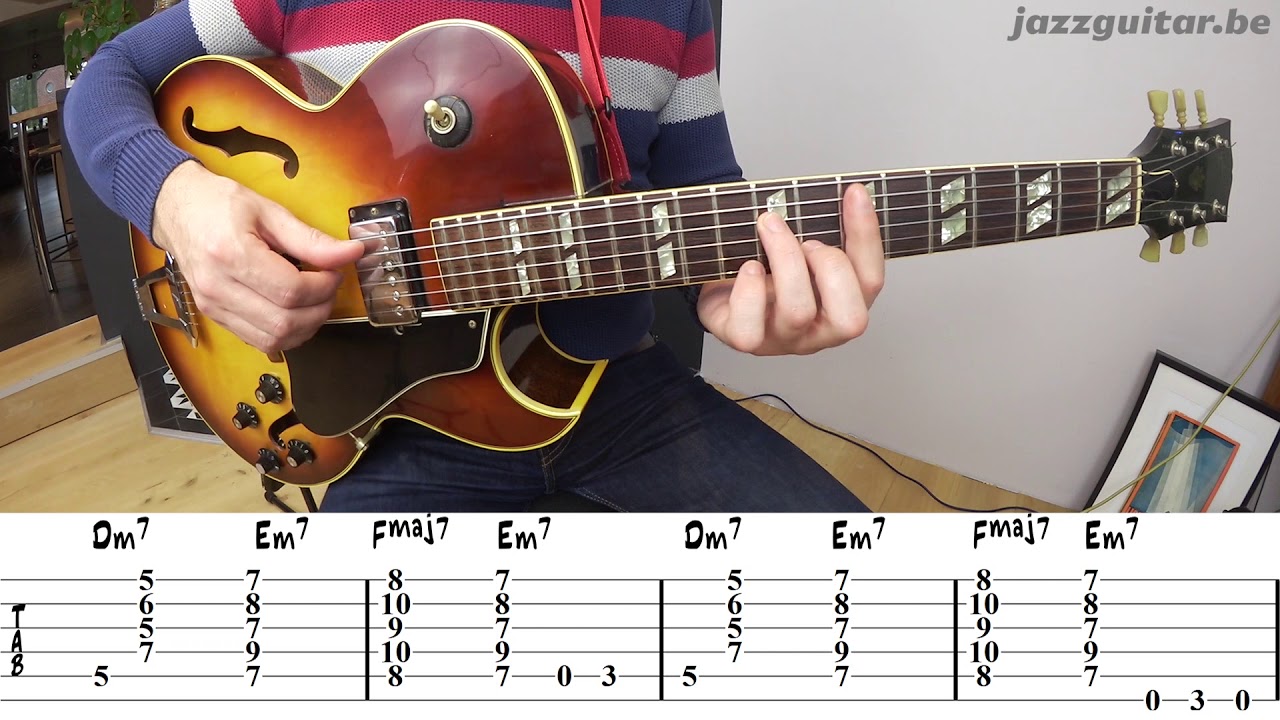
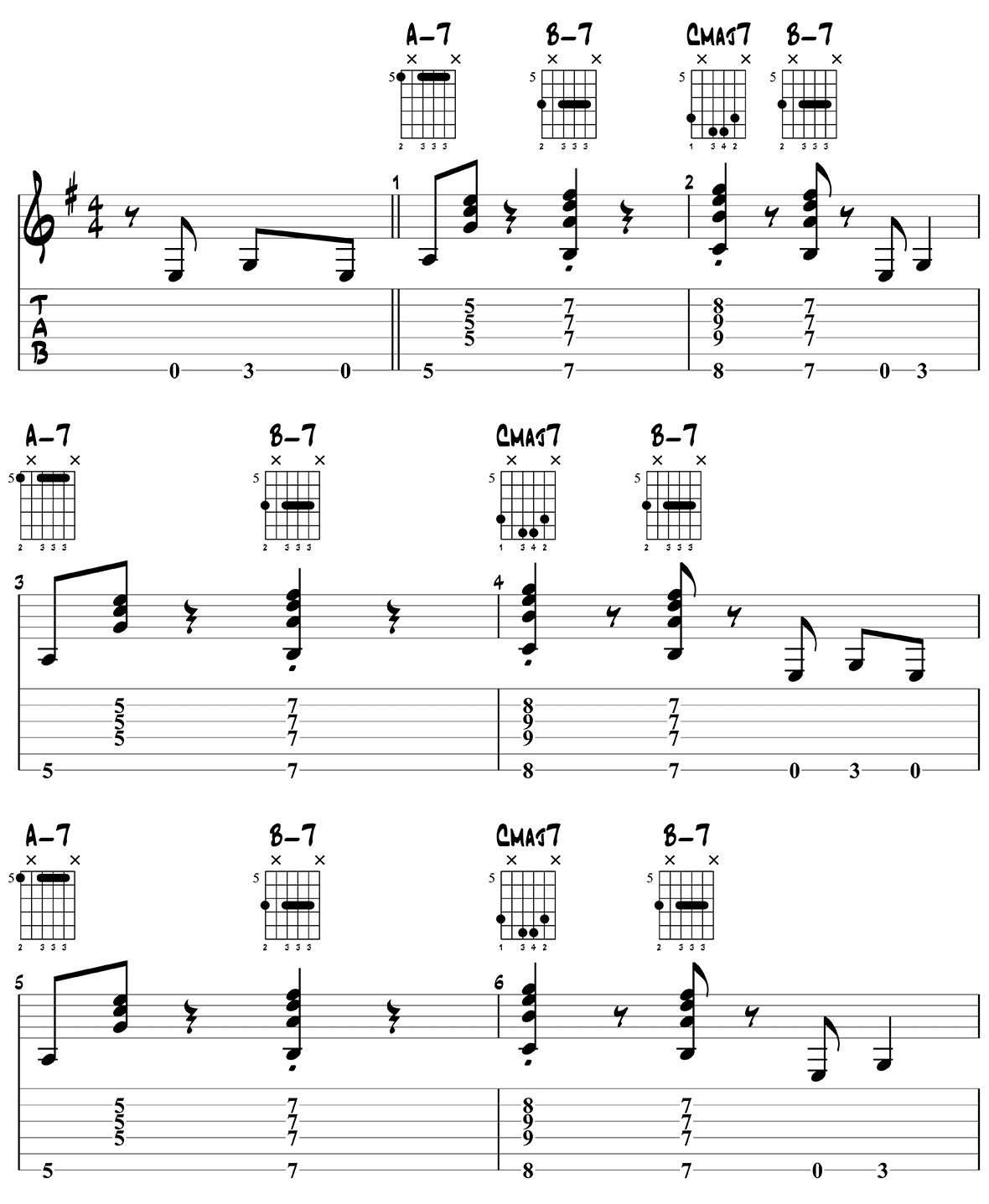
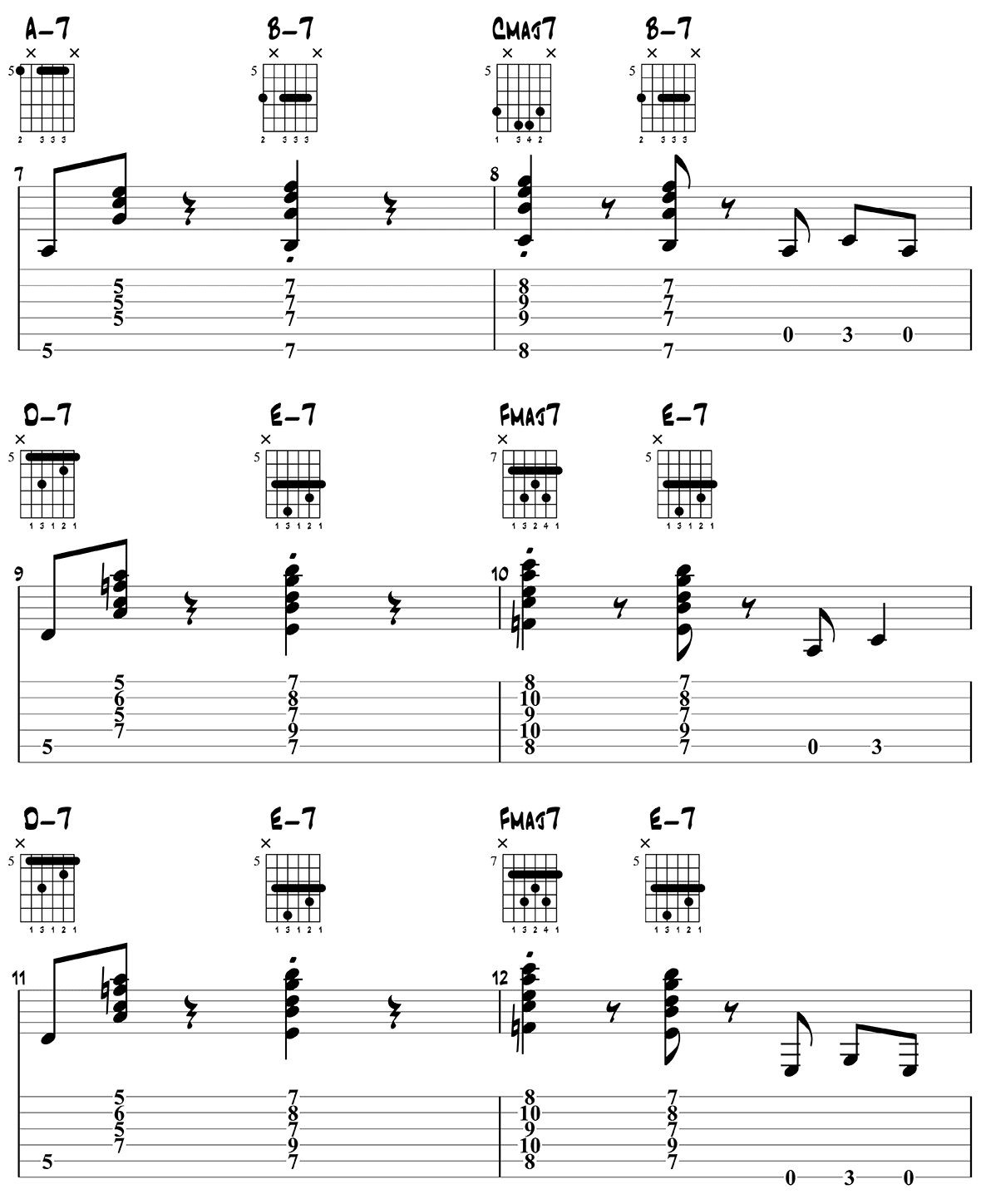
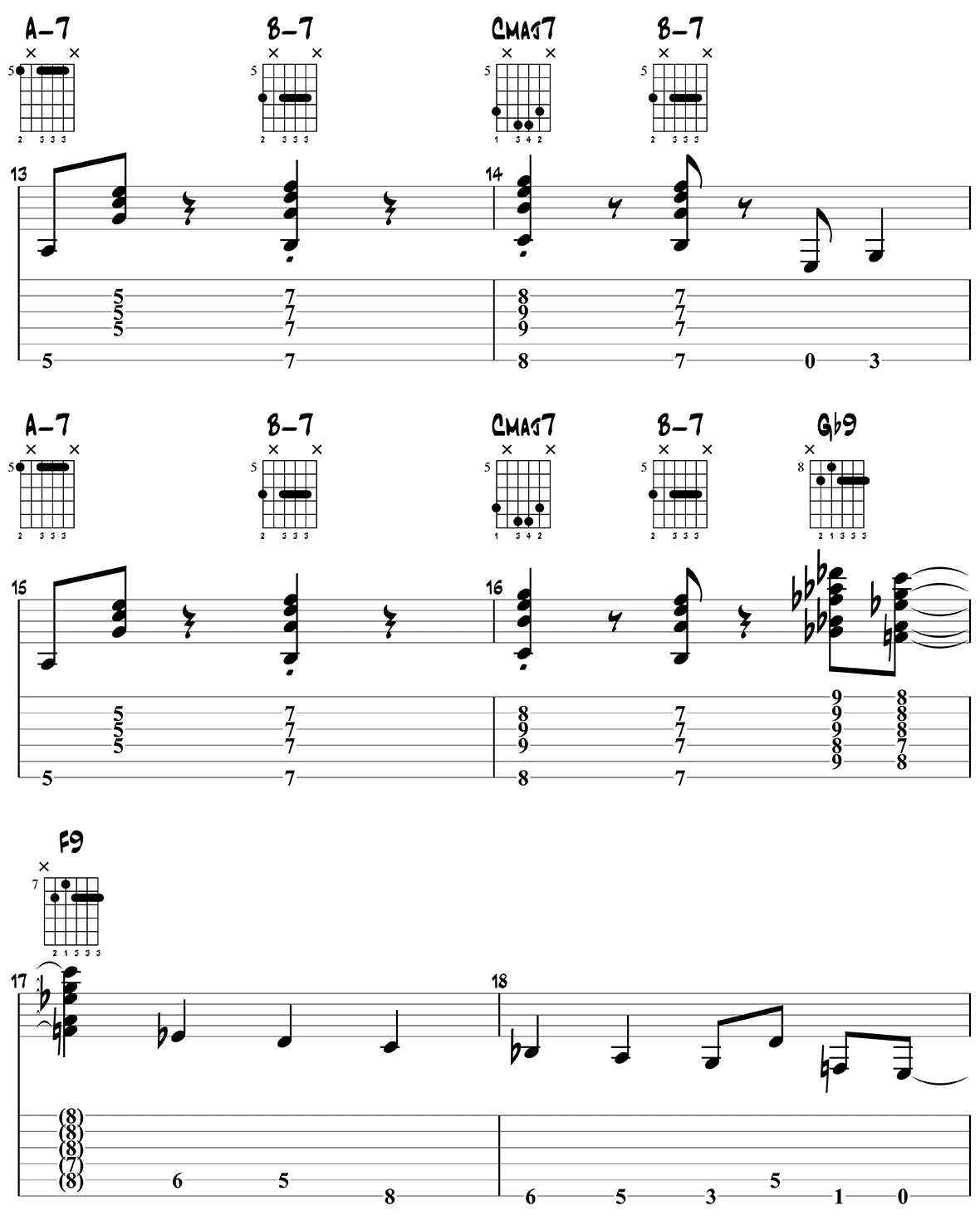
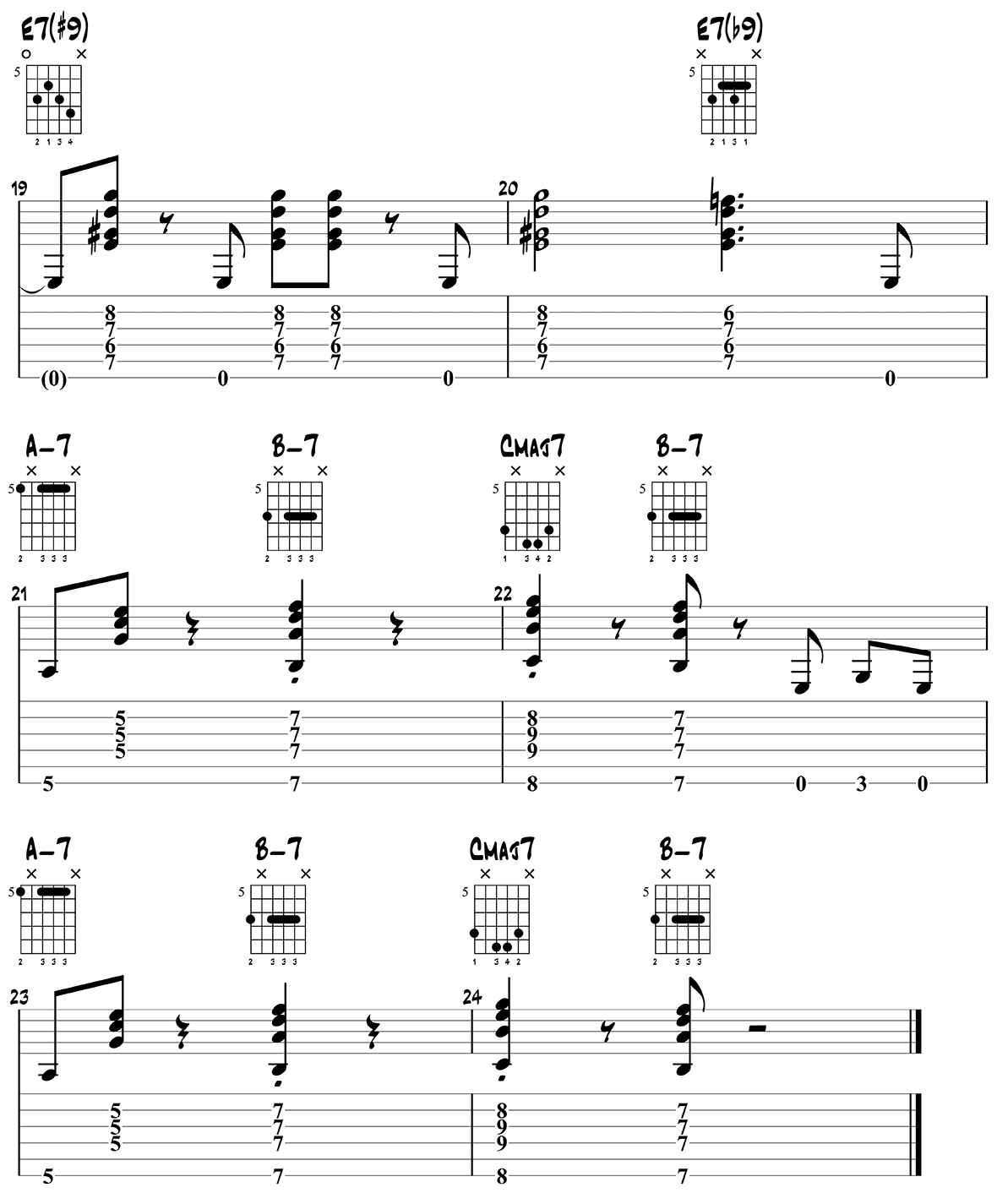
Chord Exercise 7 – Kenny Burrell Minor Chord Vamp
This vamp, inspired by Kenny Burrell’s Midnight Blue, is a fun way to practice minor and major 7 chords in a musical setting.
You’ll also learn three new chords that appear a lot in jazz and blues.
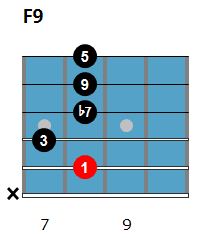
The first is F7 (bar 17), an F dominant 7th chord with the 9 added as an extension.
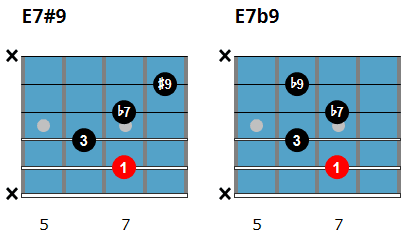
The next two voicings are E7#9 (the Jimi Hendrix chord) and E7b9. These are often played back-to-back (bars 19-20).
Drum Backing Track
Listen & Play-Along
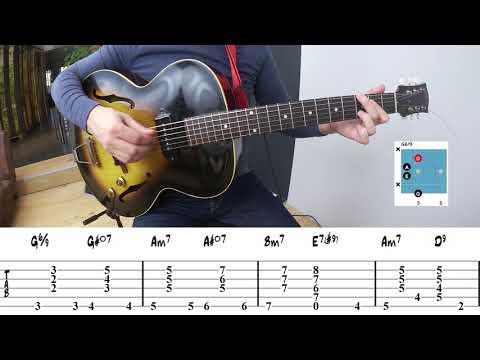
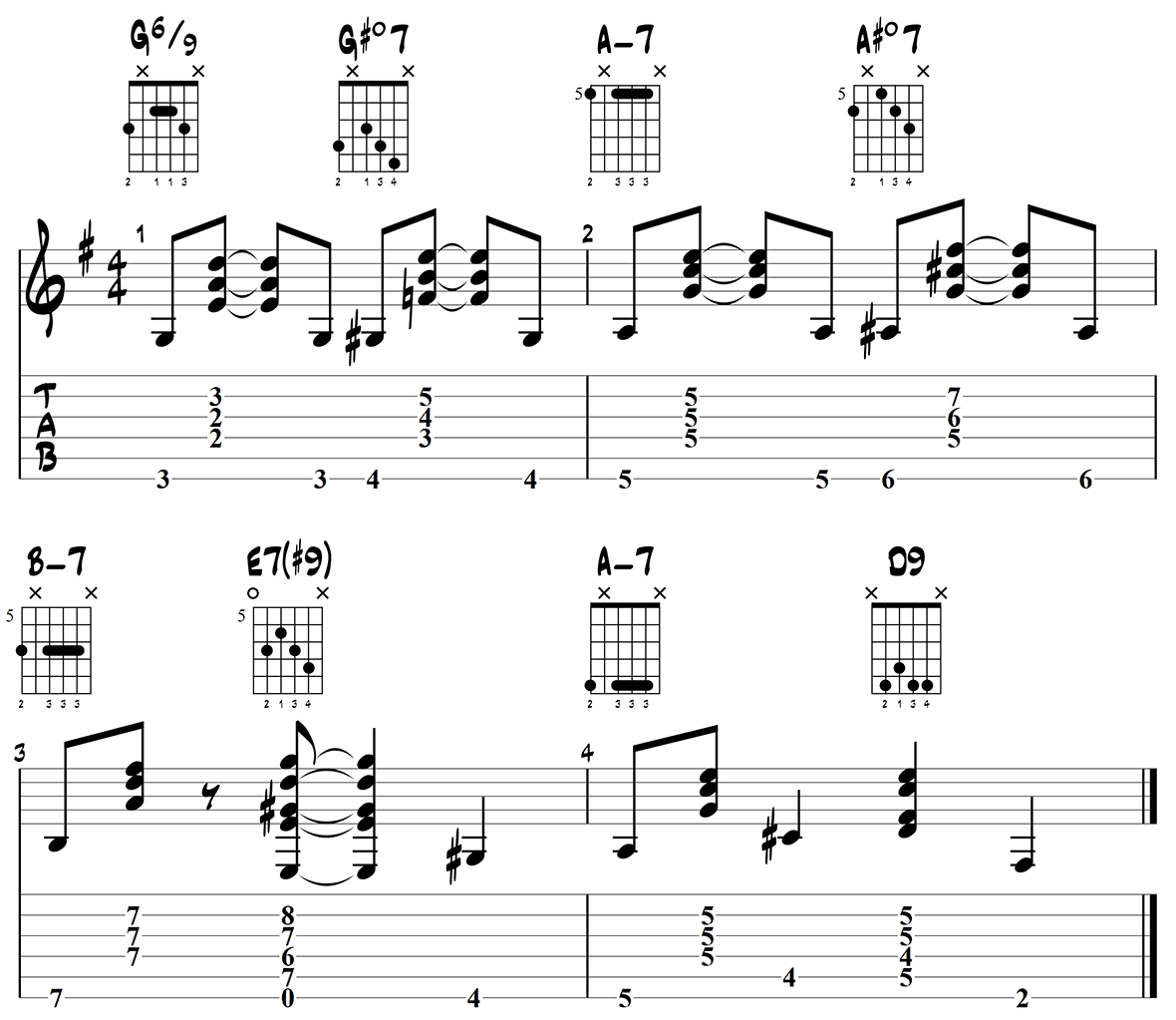
Chord Exercise 8 – Diminished Passing Chords
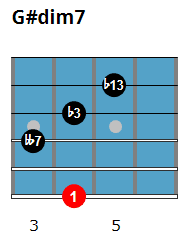
This chord progression exercise includes a common diminished shape that connects the main chords.
Even though this voicing doesn’t have a b5, it still functions as a diminished chord and sounds like one in this context.
Here’s how the voicing looks with G# as the root:
Drum Backing Track
Listen & Play-Along
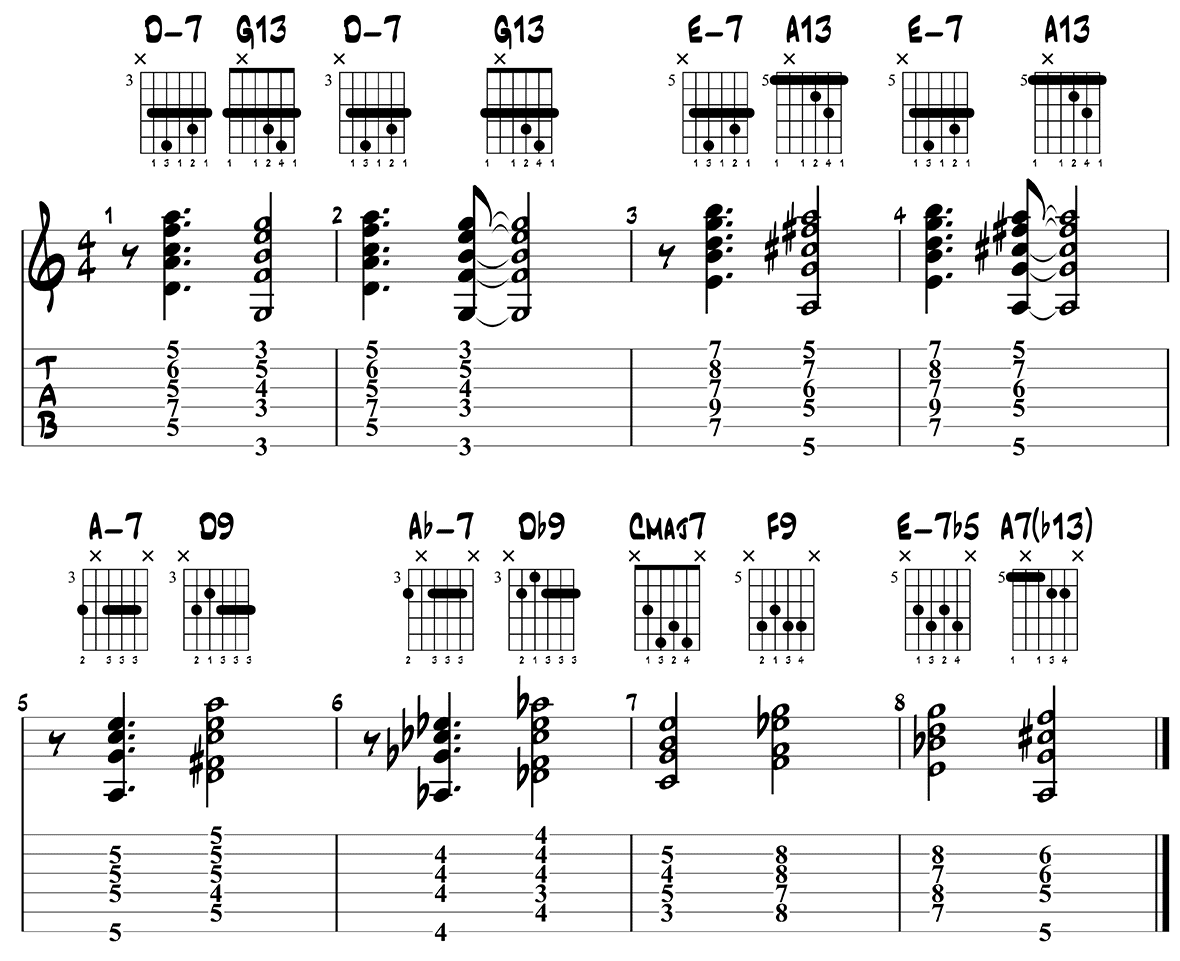
Chord Exercise 9 – Satin Doll (Extended Chords)
In this exercise, you’ll play Satin Doll again (see Exercise 3), but this time with extended chord voicings and a more active rhythm.
The dominant chords are expanded with 9, 13, and ♭13 tensions, replacing the basic 7th chords. This gives the progression a richer, more bluesy sound.
Backing Track
Listen & Play-Along
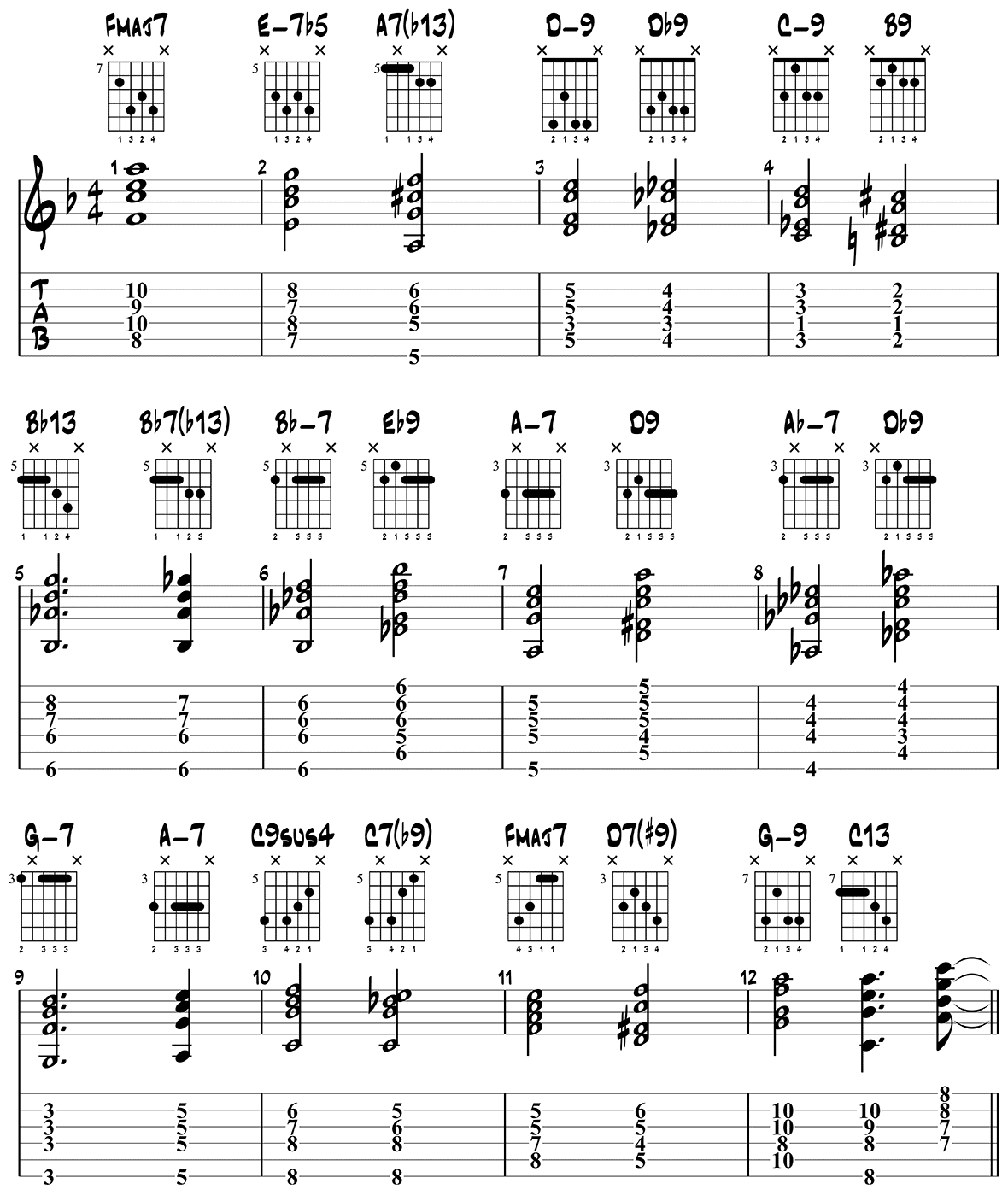
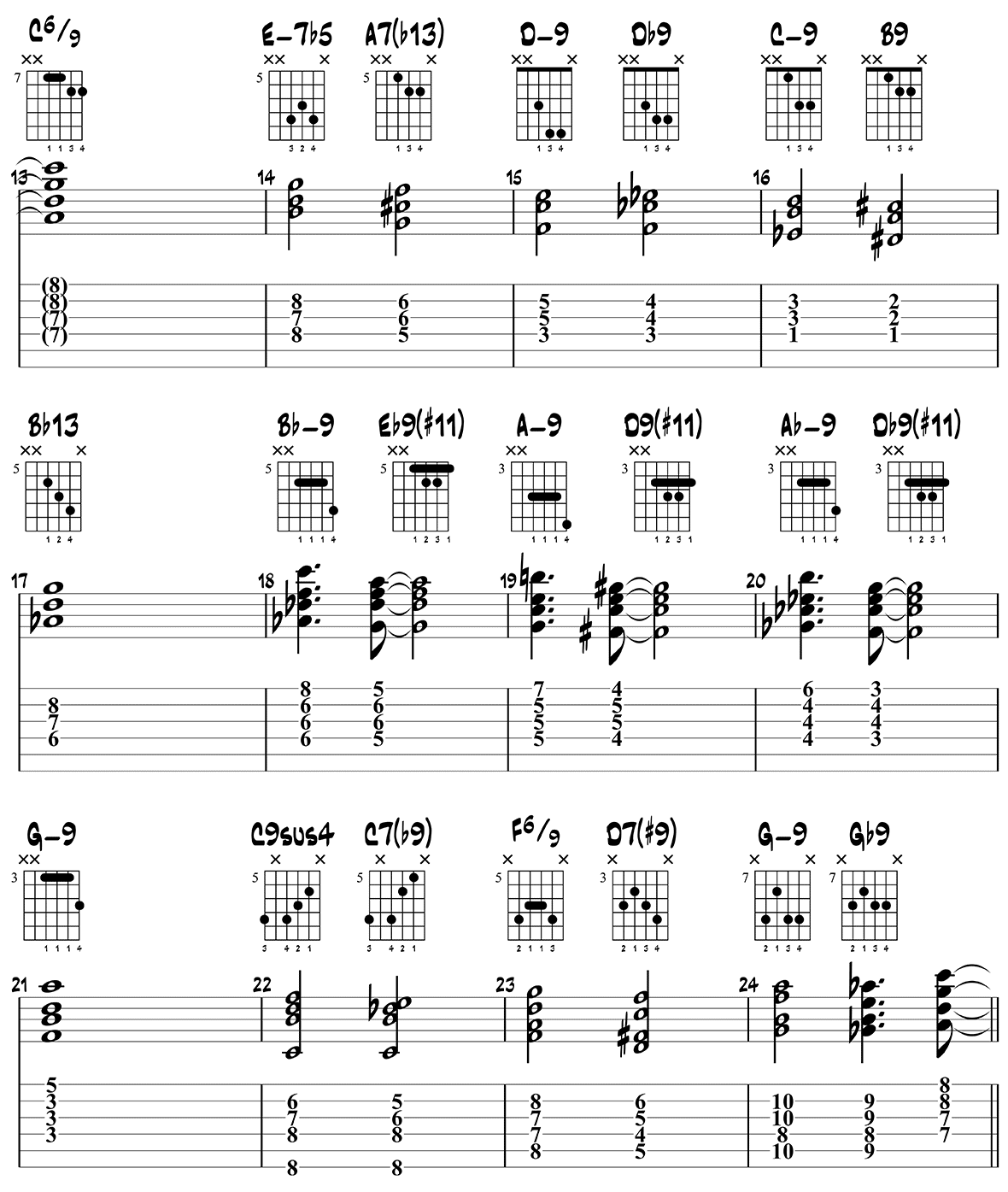
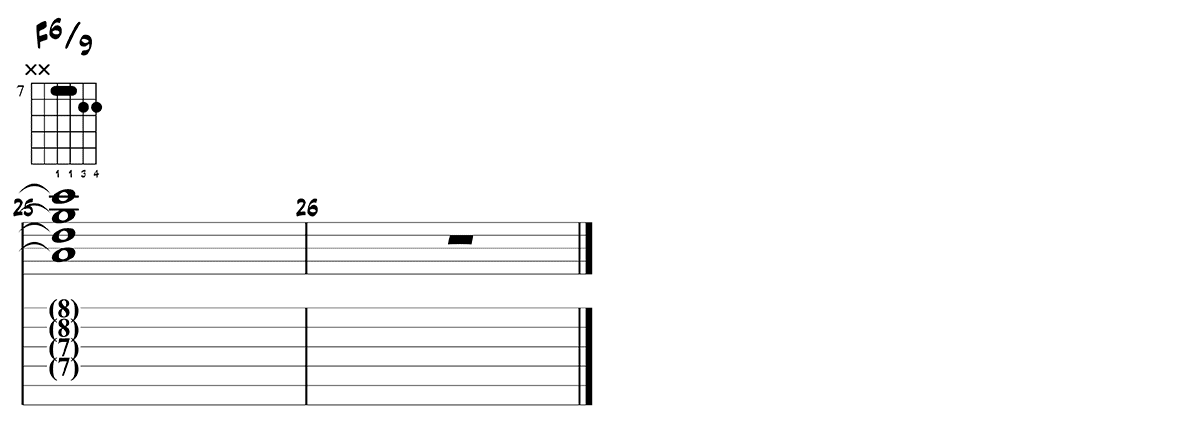
Chord Exercise 10 – Blues for Alice
In this exercise, you’ll play the chords of Blues for Alice (Charlie Parker) along with a backing track.
This tune is a Bird blues, a version of the blues form with more chord changes. Instead of starting with the usual dominant chord in bar 1 (F7), it begins with Fmaj7 and uses lots of ii–V progressions.
In the first chorus, the chords include the root note.
In the second chorus, you play the same progression with rootless voicings.
Rootless chords are widely used in jazz because they leave space for the bass player and allow for smoother voice leading between chords.
This last exercise is more complex compared to the previous ones, so take your time and start slowly.
Backing Track
Listen & Play-Along
Download the 54-page PDF, GP files, and backing tracks with JGO+ (click here to join)
More Jazz Guitar Chord Lessons
So well done. Makes me really believe all the resources I need to learn jazz are right here on this website. Between the free content and paid courses, they could fuel my learning and enjoyment for a very long time. Thanks Dirk! – Tony
Fantastic Lesson plan for beginners. I thank you for putting the time into this and your kindness for sharing it. 68 and still learning!
Bonjour
Je suis en train de faire la leçon.
Concernant les symbole pour écrire les accords, pour les mineurs au lieu d’utiliser la lettre “M” ( majuscule) j’utilise et vois souvent le “m” (minuscule) utilisé. Ex Cm7b5 au lieu de CM7b5.
Personnellement je préfère celà car ça laisse moins de place à une fausse interprétation. En revanche de trait d’union derrière la lettre nelaisse pas de fausse interpétation ex C-7b5.
Vos cours sont super complets. Merci
Thank you Dirk, this is a great collection of chords to study.
🙏🙏🙏
Thanks so much Dirk. Not so much a lesson – more of a mini course. You have put so much time and effort into this, it will keep me occupied for weeks if not months. The only issue I had was the fret numbering. I am used to having the fret number referring to the root note fret, and two numbers only appearing where there are two root notes in the chord. A minor gripe for such a fantastic resource, with audio and backing tracks too. Many, many thanks. . . Bob
This lesson, and the whole jazzguitar.be site, is one of the internet’s shining gems. Thanks, Dirk!
I agree with you.
Please can you explain the Chord Exercise 5, Walking Bass
The chord progression follows a cycle of ii–V–I movements in the key of C major:
Cmaj7 → Am7 → Dm7 → G7 → Em7b5 → A7 → Dm7 → G7 → Cmaj7
Where are the cycles of ii-V-I ?
Sorry, I meant cycles of ii-Vs
Thank you for yet another top lesson. JGO is so generous.
I am truly grateful for this lesson you have gifted us beginning jazz guitarists. Thanks for your generosity!
The chords and melodies in this lesson are absolutely beautiful! This is prefect for any guitarist
So much more than a lesson — a multi-faceted multi-week course of study! Thanks
Excellente leçon et excellent site. Entre ce que vous offrez et la formation autumn leaves que j’ai payé, j’ai du travail pour un long moment. Merci !
Thank you for this excellent website!
Buenos días
Tampoco sé mucho inglés; pero estoy traduciendo con el Traductor de Google.
Saludo cordial
Muchísimas gracias al autor, creador y profesor de esta maravillosa página.
¡Bendiciones!
It feels more like a chord substitution, since (for example) the “C#dim7” carries over the C#, D, and G of the “A7” chord, which would normally lead into the Dmin chord that follows.
This has been always puzzling to me: In the chord diagrams, why do people depict the thick E string at the bottom? As I am holding my instrument, the thick E is always on the top. I have to perform mental arithmetic to rotate the diagram to match what I see when I look at how I actually finger a chord. Just want to know what is the logic for the way chords are depicted here?
Chord diagrams are depicted with the low E string at the bottom to simulate the view from the guitarist’s perspective looking down at the neck. Depicting the low E string at the top of the diagram, as you mentioned, would simulate looking at the neck in a mirror from the guitarist’s perspective.
If you place the guitar on your lap (Lap steel style), then you are looking down and is exactly as the diagram shows. My own personal preference is to show the fretboard vertically, rather than horizontally. Just because most published works do it like that.
If you flip the guitar over in your lap and look down at it, the low E is on the bottom.
If you put the guitar on your lap, like a steel player, that is exactly what you see.
Man, das ist genau das, wonach ich solange gesucht habe.
Perfekt auf meine Bedürfnisse ausgerichtet und äußerst stimmig und nachvollziehbar dargestellt.
Klasse Arbeit !!!
Vielen Dank !
Hi Dirk, Awesome exercises. I am having a lot of fun practicing but my tone on the other hand is not sounding so great. I have a Dangelico Boardwalk DC semi with a Fender Mustang III V2. I have downloaded a few presets for jazz, but they don’t have your same sound. Any suggestions? Thanks again.
Hi Dirk – Absolutely brilliant .
Thanks Regards Gerald
Hi Dirk,
Wow that is amazing content, and well structured too! I love the Kenny Burrell example, playing it makes me feel like I know what I’m doing 🙂
One question though, in Jazz guitar chord exercise 2 you introduce the G#07 chord.
The fingering shows g#-f-b-e. Should it not be g#-f-b-d in order to be a dim7? Now it sounds more like a third inversion of an Eb9.
Thanks for the great content, this will have me working for some time!
Eddy
Thanks Eddy! Yes, that chord is a bit hard to name… One way to see it is as a diminished passing chord between I and II. The e is a color note of the diminished chord. Another way to see it is as an E7b9/G# (the V of the II). Yet another way to see it is as G13/Ab, so a G13b9 chord with the b9 in the bass (bVII). Cheers!
Might it also be G#m6#5? For example I have seen it named that way (and I hear Gilberto play that exact voicing in the Getz/Gilberto recording) where it appears as the second chord in the A sections of Corcovado, between the Am6 and the Gm7. (Although in that context, since the key is C and the chord is used in a chromatic descent, the naming is more often Abm6#5 whereas your exercise is in G and the movement is ascending)
Hi Bill, technically you could call it that way, but it doesn’t make sense in terms of functionality…
Hello Master ,
I am practising according to you book ,How to play perfect Cmaj7 -drop3 chord (page 21) by without playing open string A ,root position of C at 8th fret. When I am playing I am hitting the open string A .
Hi Ramesh, drop 3 chords are usually played fingerstyle: play the bass note with your thumb and the rest of the notes with fingers 1, 2, and 3. If you want to strum these chords, you have to mute the open A string with finger 1 from the fretting hand (the same finger that is fretting the bass note). I hope that clarifies it!
Extremely helpful and well done. The slightly harder progression of material makes it easy to build from the fundamentals you teach in example 1.
Thanks For Your Time and Effort,
Corbin Smith
Brilliant lessons. Well set out and straightforward to follow. Thank you for the time and effort you put into providing this information for us.
Kind regards
Rob
Awesome because I just began jazz. I am new for jazzing.
I love this stuff. It really brought home to me, to see how enjoyable this is to listen to and I’m jumping in with both feet. Thanks!
Hoi Dirk, great stuf to start Jazz guitar.
Thanks Frits!
This website is amazing. I will definitely use your exercises and memorize these chords. Thank you for this incredibly helpful chart and example.
Greetings from Germany!
Thanks a lot, this is seriously good and probably the best stuff I found over all internet for beginners. I myself as a blues/rock guitar player for over 15 years couldn’t benefit more to expand my horizons with all this great information from your blog and pdf lessons. Thank you sir, you’re awesome Dirk. Cheers!
What a great lesson, such an excellent way to learn chords and progressions. Exactly what I am looking for. Spent most of the evening going through the progressions. Your lessons are super, keep em comming 🙂
Hey Dirk I’m a 70 yr old white head and learning to jazz it up. I really appreaciate the tips and tricks THANKS BIG TIME.
I’m just starting out and have found this lesson to be a great tool to get me learning some chords without having to sit and just memorize chord charts! Would you more experienced guys out there recomend using a pick or finger picking when starting out with jazz guitar. I feel like the above exercises are easier with fingers, but I feel like most jazz guitarists use a pick. What are your thoughts? I have a background in guitar, just new to jazz.
Many jazz guitarist use finger style. Suggest a listen to the late Charlie Byrd as a premier example.
Hi Dirk,
This makes me want to come back for more! Entertaining good stuff.
Steve
Great lesson on comping too.I’ve played these chords for years and you still came up with a voicing I haven’t used.Bravo!
Great lesson once again – the backing tracks are also good for practising solo’s too
Wearing my accessibility ‘hat’ I am always on the look-out for praiseworthy sites that present clear, easy to read and unambiguous content. This particular chord chart is so well presented (even to the extent of making the orientation of the chord windows obvious by representing the thickness of the strings) that I would like to offer you a ‘pat on the back’ for the thought that went into assembling the page not only for clear-sighted but also for visually impaired prospective users. The fact that the lesson is probably the bet introduction to jazz chording I have found on the Internet is a welcome bonus!
You guys are wonderful. the formats that you present are all so easy to understand and laid out in such a logical manner. I look forward to every Email i recieve from you. It is a joy! Keep up the excellent work. All the best to you from Vernon British Columbia Canada
your input to the jazz guitar world Dirk is highly appreciatable, but for us in the part of the world with no easy access on the internet, does not offer much help.
Proprio quello di cui avevo bisogno…
Great stuff lad’s, beating through timber in the wood shed.
Thanks Dirk
This is a lesson I really needed to start playing jazz.
By the way, I come from the Dallas area & we have another Dirk here (Mavericks).
Muito, muito bom! Parabéns! Very, Very Good!!!
Hello,
You guys are the best, All your courses are very useful to me. Very nice work.
G.D.
Excellent tutorial!Thank you.
I can only thank you guys for sharing your knowledge on this challenging discipline of jazz music/guitar in the way that you do. No where have I seen such clarity and structure presented, not to mention the bag full of tips and tricks to make things easier where possible- the essence of any worthwhile instructional site. “FAN”-tastic and well done from a grateful enthusiast at the tip of Africa!
Thank you for the Chords, I´ve Been reading many articles and books about music theory, but wasn´t able to get chords. Now, with this excelente chords that you uploaded I have more information for practicing what I have learned. Thank you very much Dirk!
Thank you very much. A great lesson. As indeed other. The best site of its kind online certainly.
Great ,just what I needed.
Can’t thank you enough for the treasure of putting these together. Blows my mind how good they are and the generosity. Thanks Dirk and all who add!
Thank you for the lessons, they are so helpful. Chords and understanding how to form them are one of the fundamentals of playing Jazz guitar.
Great lesson…of course, all I KNOW are “easy” jazz chords. LOL!
Well arranged and good fun. Cheers
Great lesson, in spite of considering myself an intermediate player with decent rhythm and comping chops this lesson is a welcome refresher. It is too easy to slip into lazy or convenient fingerlings and lose track of the (available) alternatives.
Thanks as usual , great material! Dkw
Thank you very much. You are awsome. Everything is very usefull in your website. Cheers.
Thanks very much for the lessons , please add a lesson on quartal harmony on the style of Ed Bickert.
hugs
Great lesson! Thanks so much for putting this together Dirk!
The lessons are very helpful and deeply appreciated. So far, I’ve understood everything, but these old hands are struggling to make some of the chords.
Thanks again.
Thanks for sharing, you are the best website jazz. I’m learning to play this style of music and for many years, I had not found significant theoretical resources for learning.
Thanks for include chord progressions to teach it, is a great learning tool.
A million hugs my friends.
Thank You Dirk!! I’ve been noodling around on guitar for years. Finally learning the proper way to practice and *unlearn* some bad habits. Great stuff.
great, thanks a lot. Great method, no confusing. Could you put chord inversions as well?
Hey Jerry, drop 2 chords and inversions you will find here:
https://www.jazzguitar.be/blog/drop-2-chords/
Thank you so much ,,,, it helps me as a blues player to gett in the jazz , it is not easy but i have so much fun to play 2-5-1 progressions and learn new cords on that way.
i have a long way to go ,but every day i learn something new .
thank you mister Dirk.
Huub Luik
Great, I really appreciate your work because It’s really easy to understand, thanks.
Thanks again for these lessons.
Some positions are easier than others (big fingers, small cases…).
Un grand merci !
When in doubt or in search for inspiration , I always return to this site.
You manage to clarify things in a structured and understandale way, there where most other sites fail.
Thank you for the work; I’m having my regular portion of fun with it and it makes me hope I can one day achieve a reasonable jazz guitar level.
Your site is really great! Thank you!!
This is such a treat — Great little lessons that have applicable backing tracks
Thanks so much !!!
Great site and great lesson.
I have a question: where the root in on the 5th string, the alternate fingers for the 7-chord and m7-chord both drop the 5. Isn’t the 5 critical to defining the chord? What are the tradeoffs in the decision to use one shape or the other (keep/drop the 5)?
Hey Michael, the 5 is the least important chord note and is not critical to define the chord. 3 and 7 are the more important ones.
Thanks for the explanation. It’s a great lesson that I’ve been working on and enjoying for a few days. I’m still struggling trying to figure out the most efficient fingerings for the exercises.
I can only imagine how much work goes into assembling this lesson, which I and others greatly appreciate. Would you consider supplementing it with a YouTube video to help on the most efficient fingers for the exercises?
This is just great… amazing website, thank you!!!
…best guitar free teaching site on the internet.
From Malaysia, thanking you so much for this illustration.
The knownledge of chord construction is well explained. Thanks.
Thanks a lot Dirk. You´re the teacher!
Can someone tell me how to know which fret he’s on when looking at the chord charts?
There’s a number in the lower left on each chord chart which represents the fret number. If it isn’t clear look for where the C notes are.
Hi
What I do is look for where the R is. That will tell you where to play the chord. For example if the R is on the fifth string on the third fret it is some form of a C chord. As you become more familiar with the notes up and down the neck diagrams like this are very helpful because you begin to get a feeling for where the various chord tones are placed in reference to one another. When you come upon a chord you don’t already know you can use your fingerboard knowledge to figure out the new chord. For example if you know where the various chord tones are located in a particular fingering you can just lower the 7th 2 frets (one whole step) to get a major 6 chord
Very helpful and keep them coming. Your basic book is fantastic and recommend this to everyone and the price is so cheap. I’m waiting for the next one, but must admit there is hardly enough time to fully practice Introduction to Jazz Blues Guitar.
Hi
I love those basic chords, really useful.
and the practice part is more helpful for me.
thank a lot..
Since I’m just starting to play jazz guitar, this is going to be a great help!
Gracias, es de verdad excelente, y me ayuda mucho en mi aprendizaje, Saludos desde Mexico.
Muchas muchas gracias!!! Excelente tutorial para comenzar a aprender algo de este hermoso género musical. Saludos desde Argentina!
Now the translation: Thank you very much! Great tutorial, helps a lot to introduce ourselves into this beautiful world people call jazz. Greetings from Argentina!
This is awesome! Thanks Dirk
thanks a million. i listen to light jazz often and always wished i could get a sound like those guys. but i see that it takes a lot of practice to get the fingers moving the way my brain is telling them to. like you have mentioned, “stuck in the same old rut”….yes…for years…my fingers and brain are starting to come around and heading in a new direction and loving it
what a nice way to begin to play jazz , the beginner chords helps to build up the your chord , tones , voicing and also helps your fingers to be flexible , how can you help me to build up to the intermediate level in jazz , please can you send me a lesson on how you can improvise on the beginners jazz chord lesson. keep the good work am really learning from your lessons.
Great lesson as always ! Cheers !
This lesson could not have come at a better time. I’m trying to visualize the 3’s and the 7’s in these standard chords as I play through standards. This lessons organizes all my scraps of paper into one location. I wish I had seen this stuff 30 years ago.THANK YOU.
Inspired to woodshed after seeing Zappa Plays Zappa the other night. WOW,
This is really helpful.. I learnt quite good progressions from you. Million thanks for sharing this valueble knowledge with us. Warm wishes from Sri Lanka.
Thank you for your lessons. I am very new here, first steps in jazz, and I have not used tabs before. I am not familiar with the graphical presentation of chords above. I guess vertical lines are strings, and horizontal are frets? Black dots are fingers? What are the small gray dots? Also not sure of positions, because fret numbers are not marked? I have used to barré type chords when playing dance music here. That is why I am very confused. Could someone explain?
Oldjazzman
Hi Ollie, horizontal lines are strings, vertical lines are frets. Black dots are fingers, grey dots are the same dots as on your fretboard. Frets are marked by a number below the diagram, no number indicates first position.
Excellent introductory studies to set the mindset for jazz. Should be helpful for all.
So much to learn and so slow at it but really appreciate your course and love the insights I have from learnng to play when listening to it.
By far, this is the most simplest yet interesting Jazz tutorial I have ever tried. Excellent work and thanks heaps, Dirk.
Ed from Sydney Australia.
Thanx Dirk,your lessons are always very helpful
i really enjoy d lesson, they are the chords i need now!! thanks
As always….good stuff..very good..
A great site…to be sure…
Time on the instrument…
thank you so very much Dirk for some really great lessons
i am a senior citizen still thinking like a hippie
playing guitar for most of my life in bands
now just for myself and i still love the challenge of learning
something different every day
again thank you for making my time quality time
mike
Great! Just what I needed. Thanks
Hi Dirk, it’s a great lesson. Fine explanation – also for beginners.
Greetings from Austria 🙂
A great lesson Dirk. Thanks so much!
This is the best chord chart for beginning jazz guitarist.
Thank you for this lesson!
I actually knew those chord shapes but couldn’t figure out a musical way to practice them!
Thanks to you guys I won’t be lost and waisting my time anymore!
The great lesson: every day, before pick up the guitar, i’m a beginner, from 36 years. Thanks to remember Dirk!
Very inspiring and motivating for the beginning jazz guitarist. A real treat.
just the sort of help I need., am new at this jazz stuff, but i really like it and want to be able to play it. thanks
Good, clear explanation of the chord root and relevant tones.
Good , clear explanation of the chord structures.
I haven’t been studying, practicing or playing ‘jazz’ guitar for a few years now. Got the email link this morning, read through the page and started practicing the useful cycle exercises. For a free ‘taster’ lesson it is very generous and practical and I think you can get a lot of mileage alone out of whats on the page as an access point to practicing most jazz and I have read through other educational texts. Its not boring or rigorous, easy-on-the-eyes, easy-to-understand, succinct and to the point. Good Job Dirk, and thanks for your generosity.
Hi man, thanks for you lesson. It is cool
Dirk, I appreciate your effort to help me understand what’s going on with that thing called “guitar.” Maybe one day I’ll catch on!
Dirk, Many years ago I bought the Micky Baker Jazz Method. It took awhile for me to learn the basic Jazz chord changes. I see that you have presented these chords in a straight forward manner. Thanks for demystifying this important part of learning Jazz.
Joseph Tuccillo
Excellent and deep explanation of the way the chords change, amazing site and amazing work!!
Hi Dirk.
Your lessons make me love jazz more than I did!
Kindest regards from Colombia
Excellent guide to help players from other genres open up their ears to experimenting with jazz
Just seen this. Haven’t had time to try out yet but it looks very, very useful. Many thanks in advance.
Very nice lesson and definitely useful – thanks!
Well done, valuable, clear, user-friendly. Thank you, Dirk!
Dirk it is so nice to receive lessons from you . They are so informative and helpful . Thanks man ! Rob!
Excellent material. Thanks for sharing.
Nice! Keep up with this stuff!
interesting, opposite idea of mine ( i think note intervals very useful and should always be there), even for beginner i think learning the intervals is easy, it is better, and even if it might seems hard at beginning it opens the “world of understanding” 🙂
Actually, I don’t see it as an either or… it’s helpful to understand how chords are related, and it’s helpful to know how they are fingered.
It is absolutely great and generous what you send us, Dirk!
I am a visual artist, so I am not always able to follow the lessons in time, but it is just so convinving and seducing all the stuff you send! I am sure I will go through all of it as soon as possible. I have already studied a bit your chord construction lesson with good results 🙂
Many many thanks!
Great lesson! Not only for beginners!
A great insight into jazz chords for beginners, which IMHO is as equally important as single lines.
I had the privilege of being taught by a professional musician who put great emphasis on chord
melody playing, which is very effective when playing in trio”s etc.and very satisfying to listen to.
A very high proportion of the great players are /were very adept at chordal playing in addition to
phenomenal single lines/ octaves.
yet more pearls of wisdom from Dirk ! ( a masterly player )
Awesome Dirk, really nicely put together, thank you for this!
Hi, well done, I always thought that to learn chords with the “chord tones” and not finger position is the best way, It is so important to know what note your finger is pressing.
Thanks Dirk. A very valuable lesson even for non guitar beginners… I finally clearly understood how these chords are built. Once again it is shown that a picture is worth a thousand words…
Roland
Very good Dirk. Your teaching makes me a better player!!
This is great! I don’t know many shapes so this will help a lot. Thank you!
After years of playing pop,rock,funk. I am now moving to jazz . Thank you so much . This is of real help . appreciate the good work . Keep it coming .
I find it the easiest to play the 6th string with my thumb. I know strictly speaking this is bad technique, but it frees up a finger to mute the 5th string (very useful for Latin).
Happy strumming!
Awesome foundation study.
No guitarist can ever know too many II V I progressions.
I will pass this on!!!
Dank je wel, Dirk.
Thank you loads! Those are very helpfull.
AWESOME! Just what I needed. Baie dankie, Dirk!!
I’m a newbie and this is GREAT! Thanks a lot!
Great lesson Dirk. Really helpful to learn and/or teach the basics.
I downloaded your guitar chord chart for beginners. I don’t play guitar; I have always found it to be a difficult instrument with respect to the fingering. I respect it and enjoy listening to all kinds of guitar music: Flamenco, Bluegrass, Jazz, and Classical guitar. I truly liked your lesson on chord progressions. This I found to be a very useful lesson on chord progressions and chords.
Ralph Sirvent, Jr.
I have been playing guitar for 40 years and have just now wanted to learn some jazz. thanks for the chord chart.
Can’t ever go wrong reviewing the basics!
Dirk, this is really valuable stuff and helps to explain how to play good-sounding jazz. Please keep it up.
This is a nice beginner lesson: easy-to-read diagrams and notation, backing tracks, succinct text. It’s attractive enough for me to read and play through it a little even though it’s for beginners
This is just great.
I appreciate it that you make the time to do this.
Thanks so much!….
Glenn
Great stuff, Dirk !
Please keep ’em coming.
Do keep us, senior beginners, in mind.
I’m a 65-year old retired physician,
in Kerala, India,and have recently taken up
the guitar as a retirement project.
Thanks
Same situation for me . Recently retired, jazz guitar music a passion, have always wanted to play a bit, need to make some modest progress before it’s too late. Learning jazz guitar is not only a great mental exercise but also increasingly a physical challenge as you get older. Any help we can get from teachers like Dirk and Matt that recognise the limitations of the older learner is much appreciated.
I have played guitar for many years as a singer, last few yrs into jazz guitar. retired for 7yrs, found getting into a band of great benefit! you will soon find the things that are hard that you wont find playing alone. currently in four bands (all different) this type of info will set you right, and for me, invaluable.
good luck and enjoy!
Fantastic! Thanks Dirk!
As always, a lesson filled with hours of fun on my guitar! Thanks Dirk!
Thanks Dirk. As usual all the information you supply is of a high standard and helpful keep up the good work.
Beautifully illustrated.
This is indeed very useful! I consider myself as a beginner and I’m slowly getting better. These Chords and tracks will help a lot! Thank you very much for your support.
Rainer
Great tabs with great chords and other great stuff. Ty.
Good Intro to jazz Dirk well done.