

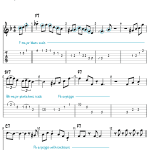
Charlie Christian is often referred to as the father of jazz guitar, and for good reason. In the late 1930s, he fundamentally changed the role of the guitar in jazz. Before Christian, the guitar was primarily a rhythm instrument, fighting for volume in big bands. By being one of the first to use amplification, Charlie Christian turned the guitar into a true solo instrument.
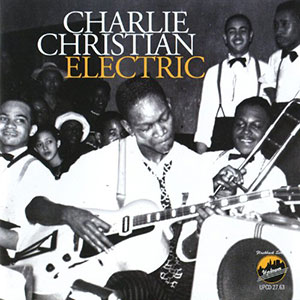
Although he never recorded as a bandleader, his recorded legacy with the Benny Goodman Sextet is some of the most influential material in jazz guitar history.
Christian approached the guitar like a horn player, using long single-note lines with strong rhythmic placement and a sophisticated sense of harmony.
His phrasing and note choices anticipate bebop, and his ideas influenced musicians such as Dizzy Gillespie, Charlie Parker, Thelonious Monk, and many others.
Charlie Christian was not the first guitarist to experiment with amplification. Players like Eddie Durham, Floyd Smith, and George Barnes were already exploring the electric guitar.
But Charlie was the first to fully realize the guitar’s musical potential as a solo instrument. Amplification freed guitarists from the need to focus on volume, allowing more attention to single-note improvisation, melody, and complex harmonic ideas.
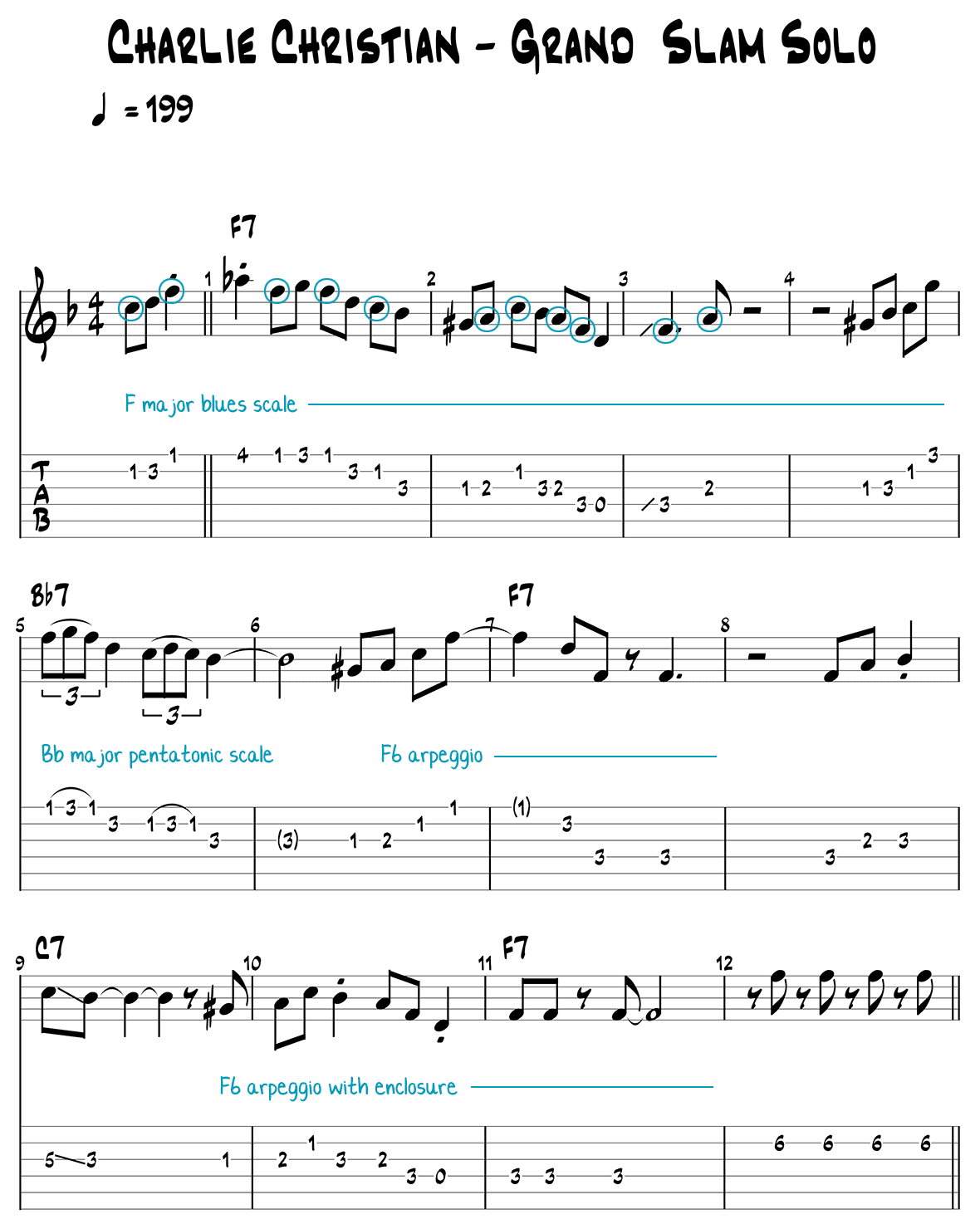
In this lesson, you will learn Charlie Christian’s iconic solo over Grand Slam (also known as Boy Meets Goy) from the 1940 Take B recording with the Benny Goodman Sextet.
Charlie Christian – Grand Slam Solo
The chord progression of Grand Slam is an F blues in its simplest form.
The harmony sticks closely to the basic 12-bar blues (I7, IV7, and V7 chords), without ii-Vs, extended turnarounds, substitutions, or altered dominants that became common in later bebop and modern jazz blues.
Charlie Christian’s solo begins with a phrase built around an F major triad (bar 1).
Unlike later jazz blues language, the ♭7 is used sparingly, while the 6th is an important color tone.
Notice that most of the triad notes fall on downbeats (the encircled notes on the notation), while the approach and color tones fall on upbeats.
F major triad
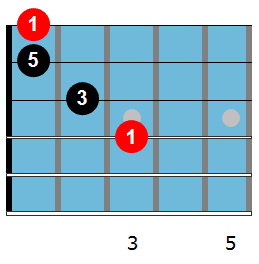
The F major triad, combined with the approach notes, form the F major blues scale.
This scale can be seen as an F major pentatonic scale with an extra note called the blue note (b3 or #9).
| F major blues scale | F | G | Ab | A | C | D |
|---|---|---|---|---|---|---|
| 1 | 2 | b3 | 3 | 5 | 6 |
F major blues scale
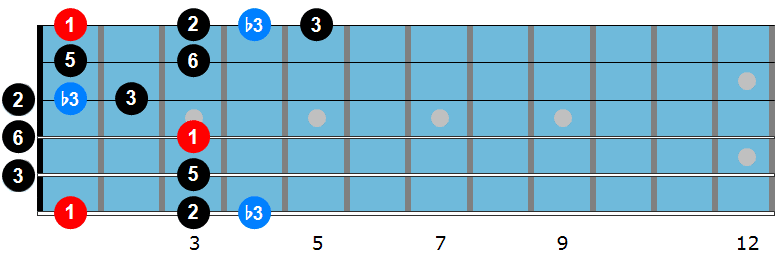
In early blues and swing contexts, this note collection is sometimes referred to as the Kansas City Blues Scale or Sweet Scale. This scale contains the same notes as the major blues scale, but starts on the b3 rather than the root.
In bar 5, Charlie Christian shifts to a Bb major pentatonic scale, which can also be viewed as a G minor pentatonic scale.
Bb major pentatonic scale
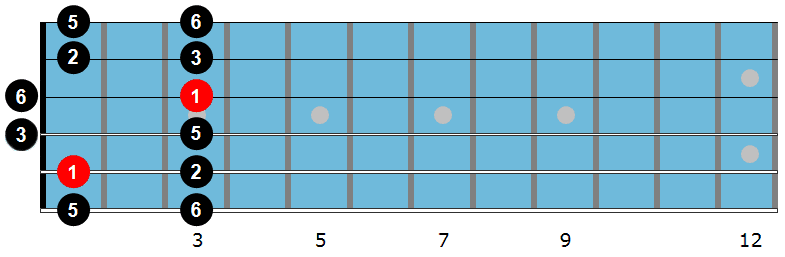
In bar 10, you’ll hear a typical enclosure that is also commonly used in bebop.
In bar 13 (over F7), Charlie outlines a Dm7 arpeggio and connects the 5 and b7 with a chromatic ascending line.
This is known as CESH (Chromatic Embellishment of Static Harmony), a technique used to add motion without changing the underlying harmony.
At the end of bar 16 (and again in bar 20), he plays a Dm7b5 arpeggio, anticipating the Bb7.
This kind of forward-thinking is a clear example of how Charlie Christian’s improvisational language was already pointing toward bebop.
| Dm7b5 Arpeggio | D | F | Ab | C |
|---|---|---|---|---|
| Played over Bb7 | 3 | 5 | b7 | 9 |
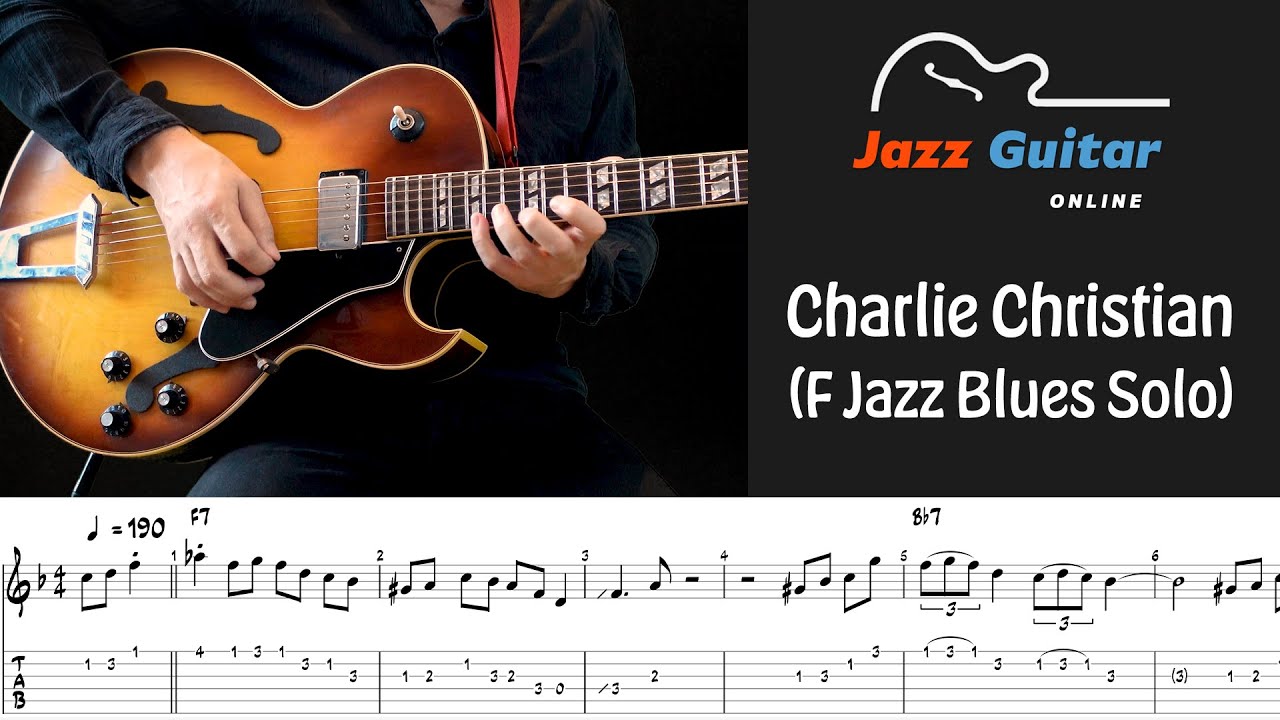
Backing Track
Listen & Play-ALong


Thanks for the lesson. Vintage phrasing which will keep me occupied for a while.
Much appreciation for New Jersey!
Typical Christian`s solo.Thanks Dirk.
I see a mistake in notation in measure 12, with four notes in the measure and the soundtrack has three.
Ah Charlie Christian !! always a swing Dream !! great thanks Dirk
Dank, heel mooi Dirk.
bedankt Dirk
Tolle Arbeit, danke Dirk
Thanks again for another great lesson!
Super, thanks!
We appreciate all that you do although many just do not take the time to tell you! Thank you!!
Larry
Great lesson Dirk! I’m slowly getting the hang of Jazz thanks to you.
Thanks Dirk