


-
The half step rules are different
 Originally Posted by AllanAllen
For C major, you put the extra note between 5 and 6, which would be G Ab A
For G7, you put the extra note between b7 and 1, which would be F F# G
-
11-24-2024 10:07 AM

-
Alright, I’d better stick to questions instead of answers.
-
I’d actually start with scale outlines, triads, chords, arpeggios and then thirds with lower neighbours, then the simplest variations of the added note rule. Originally Posted by GuyBoden
There’s a bunch of stock patterns
So I have Talk Jazz here - all the basic stuff is in here, so it’s a matter of preference, and who am I to question Roni?
But for my personal preference I’d do Chapters 3, 5 and 7 before doing the added note stuff, but it should all get covered.
Dominant going to a couple of notes of I via dim7 (or tritone) is nine tenths of the law
Sent from my iPhone using Tapatalk
-
It’s useful to treat G dominant as its own thing because it behaves differently with half step and wotnot. It’s also of much more interest to bop players. Originally Posted by AllanAllen
A friend of mine put it very well “contemporary post-modal jazz is the study of I chords, bebop is all about the dominants’
I’ve heard Evan Marien say the same thing. Barry said ‘let the dominant dominate’
(I would say it’s the dominants resolving into chords in forward motion.)
Sent from my iPhone using Tapatalk
-
Both of these ‘rules’ apply to the descending scale; there are slightly different ‘rules’ when ascending. Originally Posted by pamosmusic
-
True. Originally Posted by pcjazz
-
But what about pre-bop, Lester Young and Louis Armstrong? Originally Posted by Christian Miller
I feel like I keep getting pulled into post modal and bebop, but with few exceptions, I don’t really listen to those styles… I think. The Spotify summary will be out soon and we’ll find out.
-
Joe, I am guessing this is a tough-in-cheek response. You've been working on BH for quite sometime now, right? I thought you had a thread where you used the minor6dim scale (aka melodic minor + extra note) on different strings. I'm sure you're also quite familiar with the dominant scale, no? Originally Posted by joe2758
-
I got into Barry Harris stuff about 8 years ago, but I also quit playing for half that time. Originally Posted by Tal_175
While I still remember this stuff and can compose a convincing enough solo using it, my improvising is embarrassingly bad.
I put on my white belt and hired Peter as a teacher and started from ground zero.
I think I said ouch because I know what hard work I'm in for.
Goes back to early in this thread talking about the different degrees to which you can know something.
-
My opinion:
If someone puts in the time and study, they will eventually sound good. Some will sound very good, some great.
If you don’t put in the time, you won’t.
Start firing the arrows folks.
-
My favorite rule right now:
If your sounded upbeats synch with the drummer's pace,
everything (melodic, harmonic, and beat width variations)
else will have a best chance of sounding like real fine jazz.
-
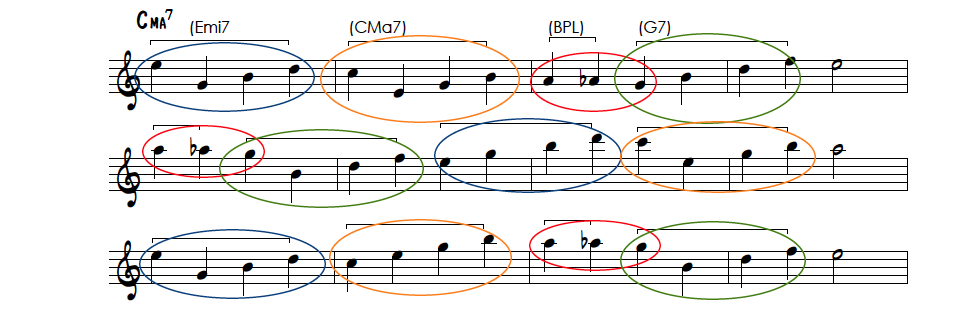
If you start using the half step rules, it all becomes much clearer.
Simple V-I example below, using Dom Half Step Rule 1:
-
would two added notes maybe better for this one? Originally Posted by GuyBoden
-
Yessir Originally Posted by joe2758
-
Add whatever sounds good, I'm just practicing Dom Rule One....................... Originally Posted by joe2758
What notes do you suggest I add?
-
You used the B (chord tone) as a pickup. So you’re starting the line on A (a non chord tone). You’d use either no half steps or an additional between 2 and 1. Originally Posted by GuyBoden
-
Ok, yes, starting on the 2nd. Originally Posted by pamosmusic
Rule 3. Starting on the 2nd, 4th and 6th, add no half steps.
Rule 4: Starting on the 2nd, 4th and 6th, add two half steps, between 2nd and Tonic, and tonic and 7th.
Sorry, I'm concentrating on learning Rule 1. Maybe, I need to learn all the rules simultaneously.
-
Learning 1 and 3 and spending a bunch of time with them, and then 2 and 4. Probably would make sense. Originally Posted by GuyBoden
Also just bearing in mind that the assumption here is that you’re starting on a downbeat. If you start on an upbeat, the rules reverse.
-
Thanks, 'start on a downbeat', but we are all in need of a pickup. Originally Posted by pamosmusic
-
Dom Half Step Rule 4 is trickier, but I've created this below:
(Edit: Yes, I've got to have a pickup.)
-
Quite right. Pickups are big and clever. Originally Posted by GuyBoden
Sent from my iPhone using Tapatalk
-
Just went through this entire thread.. what utter madness.
Jazz is a language, and the best and fastest way to learn any language is by listening to it and then playing it.
All this science and mathematics will do nothing but jam up your brain.
Do you really think Wes Montgomery, Grant Green and George Benson went through all of this stuff we are reading in this thread? Absolutely not.
Wes Montgomery was asked in an interview to explain how he plays, and he had no clue. Grant Green the same. George Benson is equally clueless on explaining how he plays.
Because they all do it naturally and they learnt it by listening and simply playing it. They all learned the language and the vocabulary using their ears.
Not mathematics and algebraic equations and patterns and graphs and charts and theories on half step approach this, or diatonic, cycle approach that.
I once had a ton of guitar jazz theory books and methods and apart from sterile scales and shapes and patterns and chords with all the years studying them I didn't learn anything that actually helped me to play jazz.
Until I just put all those books down, put on some Wes and early George Benson records and just started working the tunes out with my ears. And the music came almost instantly.
I remember when I was young and at school going to French classes, all the theory and grammar and verbs and adjectives and sentence structure rules.. I could barely learn a damn usable sentence.
I ended up hating the language and never tried to speak French again.
Years later I was dating this Italian chick and I ended up going to Rome for a couple of years, and without a single book or a single lesson or a single class I ended up mastering the Italian language in just two years simply by being immersed in the environment, listening to the language every day and learning to repeat it.
Sure I couldn't write a single word of Italian, and I had problems reading it (and who cares) although I could work out a lot of the written stuff.. but I was able to speak it so fluently, I could chat up girls, order in restaurants, book tickets, flights, ask for anything I needed, communicate effortlessly with anybody and everybody on any subject on the spot.. ... I could tell jokes, I could tell stories and describe long and complex notions and concepts, and I could even invent and make up stories completely impromptu and spontaneously.
That was over 20 years ago yet I have not forgotten how to speak Italian. However I can barely remember a single word in French.
Take something as simple as walking, how do we learn to walk? By studying the physics of motion and movement and mechanical levers and inertia and gravity?
Hell no, we learn to walk by watching our mums and trying it ourselves.
Just imagine we were all taught to walk by being given something like this:
----------------
The physics of walking involves several concepts, including Newton's third law of motion, muscular force, and frictional force:
Newton's third law of motion
When a person walks, their foot pushes against the ground, and the ground pushes back with an equal force in the opposite direction. This force of friction allows the person to move forward.
Muscular force
The muscles in the legs apply force to move the body forward.
Frictional force
The force that results from the relative motion between two surfaces, which always opposes motion.
Energy efficiency
Walking is energy efficient because the swinging leg uses muscle force to move forward, then relaxes and gravity moves it back to the ground. The planted leg moves forward with a passive rotation at the hip.
Walking speed
Walking speed is affected by age. Younger people tend to have faster walking paces because they have more energy, stronger muscles, and quicker reflexes.
--------------------
If that was a case we'd all still be crawling on our hands and knees.. but we don't, every single one of us here can walk why, we simply learned by watching our mums and imitating them trial and error with barely a single thought and not an iota of theory involved.
Why do people over complicate complicate music so much by having an overly mental and intellectual approach when it's really an aural approach that's required.
The only reason all these insanely complex 'methods' and theories exists is to keep teachers in business when all you need is your own ears to teach you anything you need to know.
They're also other downsides to following a method is that it produces magicians that all end up sounding similar or the same.. because they are shaped by a 'school of thought', it does not develop individual and unique musical personalities.
Which how we ended up with the Wes Montgomery, a Grant Green, and George Benson in the first place.
Oh, and while on the subject where are all the jazz guitar theory books written by these three greatest bebop guitarists to ever exist? They don't exist. I wonder why.
If you can't hear this stuff and decipher it with your ears, you definitely ain't getting it from a book.
-
joe henderson, james jamerson, paul chambers, charles mcpherson, frans elsen, donald byrd, john coltrane. they all got one thing in common. they all studied with BH at one point. his teachings were a big deal for musicians for many decades. i think it it was mcpherson who stated in an interview how the concept of sychronized scales opened a new world, because you could spin endless lines and did not have to rely on your stock licks. Originally Posted by Maxxx
bebop and hardbop are folk music. that does not mean that it's practioners were simpletons. it is an established fact that wes knew what he was doing. no need to yell at clouds.Last edited by djg; 11-26-2024 at 06:46 AM.
-
@pamosmusic
Check Jeff Ellwood approach (he has a book), very clever, it is kind of ´´Lego´´ bricking.
He talks about language, transcribing vs exercises, Barry Harris, etc
Also check Jerry Bergonzi Vol. 3 Jazz Line.
-
Jens Larsen complains that David Bakers approach of adding one note to an 7 note scale to enable chord tone syncopation is ‘boring’ and he extols the Barry Harris chromatic bebop variant. Which of course gives you 15 notes octave to octave compared to the 8 you get with Baker. That all said, Bakers actual books on the subject show some really natty useable lines and approaches that are very interesting. What I like with Harris as well is the chromaticism that is made available by using every note there is and having all on the beat too. I think one can do well to study both.


 Reply With Quote


New LEDs Day
Yesterday, 07:28 PM in Other Styles / Instruments