


-
Well sure, but that's learning the necessary technical skills of the craft, not a paint by number system.
 Originally Posted by Christian Miller
Again, one must develop the requisite fretboard knowledge and technical skill on the instrument to be able to improvise. Originally Posted by Christian Miller
-
06-18-2026 04:23 PM

-
Capricho Arabe in the big scale run at the beginning. Originally Posted by Christian Miller
Forgive me. It’s the only piece I still know.
-
You might be surprised by how many painters learn by copying master works or by filling notebooks with drawings in the style of x. Originally Posted by Mick-7
-
I recall hearing a lot of it in J.S. Bach's violin pieces - throw away your pick and use a bow. Originally Posted by pamosmusic
Especially the art forgers.... but not unlike musicians learning musical vocabulary. Originally Posted by pamosmusic
-
Wait, what's wrong with "all classical scale fingerings?"
Shift on half steps when possible and to the closest finger possible..what would you do differently?
-
Not really replying to anyone, but I adjusted my CAGED fingerings to 3NPS so I could have 12 beats of triplets for metronome symmetry. The dang thing is beep tick tick tick and if that beep gets someplace weird it bothers me.
I can finally do 12 keys in about 7 frets and that feels like an accomplishment. If I’ve been a member since 2019, it’s taken me 7 years to get the basics of the major scale. Maybe I should learn a song next… nah better to spend 21 years on the 3 minors.
And this is just one of the 2 dozen things members will toss at some green kid asking where to start.
-
When I have to teach the scale fingerings in the ABRSM CG syllabus I generally find them counterintuitive. Originally Posted by joe2758
There’s a logic to them, but it’s a bit different, and I appreciate them for that. I think they are like Segovia scales? I’m not sure.
More than that I can’t say. For actual pieces this is much less the case.
Sent from my iPhone using Tapatalk
-
I would suggest fretting everything with your index finger for a bit. It will change your life. Originally Posted by AllanAllen
I’m not even joking.
Sent from my iPhone using Tapatalk
-
oh ok fair enough, that stuff's bullshit Originally Posted by Christian Miller
-
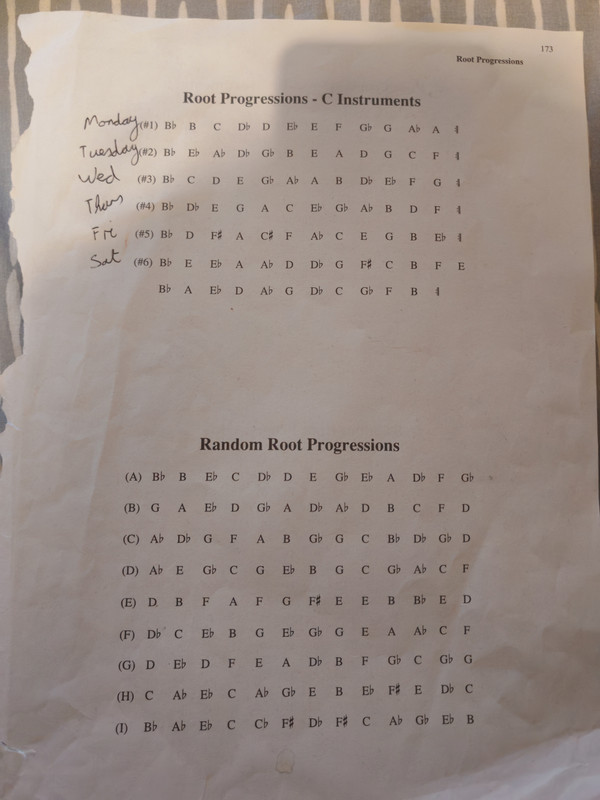
Out of curiosity do you go through the scales in the circle of fourths/fifths, or in other ways, such as major thirds (actually outlining descending augmented triads so C-E-G sharp, B-D sharp-G etc.). I spend about twenty minutes of my morning routine practising moving between scales in these different root progressions, with different rhythms, staying in one position or deliberately moving up and down the neck etc. Kurt Rosenwinkel demonstrates some of this in one of his clinics on youtube, plus it crops up in his creative exercises book. He mentions it as part of warming up the brain... Originally Posted by AllanAllen
This is what I use -
-
Fourths because that’s how GASB harmony moves.
I was thinking about mapping them in a Barry Harris X over Yth system. But I literally just got this down on Tuesday.
I might just use your sheet. I was thinking of using whatever system is in Bugs Bower Rhythms Complete, I forget what it is, but all the exercises repeat in a handful of permutations.
Or I could adjust them to MM and map them along them after I get both scales down.
The important part is playing triplets against the metronome and doing sweep picking to fix my right hand. I just want to hit the right notes at the right time. It’s a precision exercise.
-
My take, not that anybody asked, is that a very direct approach would be to 1) be able to think of good lines to play and 2) be able to play them instantly. Originally Posted by pamosmusic
So, I then ask, rhetorically, what would be the most efficient way to be able to do those two things?
One would be simply practicing playing a line that you hear. So, if you're watching TV with the guitar in your hands, you copy whatever music you hear. If you know a melody, you play it. With time on the instrument you get to the point where your fingers know where the notes are and you can play the melody in your head, in any key.
For this goal (#2 above) I don't see how theory helps.
If you can already think of good enough lines, seems to me that you're done. But, my guess is that most of us can't do that at the level to which we aspire. Next thing you know you're reading a prescription for 20 years of scale work. Or, a recommendation just to learn licks. Or some combination of the two, or something else entirely.
This is a big topic and I can't fully get my mind around it. But, I know this much. Knowing a ton of theory will not make you the kind of player that I want to listen to. My guess is that you have to be a pretty talented player for it even to be helpful to know a lot of theory.
My current thinking is that a good way to proceed would be to start with a lick. If you can hear it against all the harmony you might want to use, and apply it, you're done. But, for most of us, relating it to scales/modes/arps and substitution patterns may make it easier to remember and find later.
I've met some players who were able to use theoretical combinatorics to discover new sounds which they were able to find applications for. For me, it's pounding away at one sound at a time. Very slow. I am overwhelmed by things like "try every possible triad pair against every bass note, in every key and 5 places on the neck". That's only a minor exaggeration of a real post on another forum -- it didn't mention the 5 positions. I can't imagine getting anything from doing that, even if others swear by it.
My current approach is to mentally scat sing and play that. On the numerous occasions when this strategy fails, I have a rather poorly organized bunch of devices that create a kind of safety net. Principal among them is knowing the chord tones.
If I want to sound good on a gig, I'll call tunes with harmony that I can feel - so there's no need to think or analyze. But, I play in more situations where I'm not the one calling the tunes.
-
Theory is descriptive of sound. If you know the descriptions without knowing their associated sounds, you're like someone trying to bake a soufflé who has never actually tasted a soufflé. Originally Posted by rpjazzguitar
Thus, theory and ear training go hand in hand.
The way theory helps playing is when you hear something on the TV (or the bandstand, or in your head) your theoretical-brain says "my ears are telling me that I hear a ii-V-I" or "my ears are hearing lydian dominant" or "the pianist just subbed an altered dominant that is a tritone sub for the vanilla V" and then it goes further to say "so I can play Dorian, or melodic minor from the 5th, or a half-whole diminished scale, or a full diminished arp a half-step up from the root" because your mental connection between theory and sound is strong enough that you know not just what you heard but what those responses will sound like before you play them.
You may be using theory more than you are aware.
-
If I hear a melody in my mind, I can play it. If it's a song I know, I can play it in any key. I don't have to think about it. if you're suggesting I'm somehow using theory to do that beneath my conscious awareness, well, I don't know how to respond to that. I'm certainly not thinking in intervals -- I have to stop myself and think about my fingers to tell what interval I just played. Originally Posted by starjasmine
OTOH, I can't do it with chords except on very simple stuff. So, for trying to take the chords off a recording, I might very well think about ii Vs or tritone subs, or a m7 to a m7 a b3 higher, or whichever sounds I can recognize and label. I think this is because I don't have a good enough ear for my fingers just to go to the right place. In fact, sometimes that happens, and it's great, but it's not the rule.
If I'm reading complex harmony for the first time, I'm definitely going to be doing some math. Not art, but not clams either.
If I can label what I'm hearing, that might help. But, I'd much rather be scat singing a good line than thinking "I can play Dorian or melodic minor from the 5th", or whatever. In my hands, the solo is going to be much better if I'm scatting.
I'm not suggesting that the way I do it is the best way or even close. I'm well aware that great players did it differently.
But, I do have a viewpoint and this is the internet.
-
Theory is naming stuff. It doesn’t really matter if you call a Gm chord the orange sad sound or a Gm chord. Naming things helps sort it in your head and find the same sound later.
The specific names are useful in that they’re common language.
Its like the Dewey decimal system in a library.
Maybe some people act like the Dewey Decimal system is useless because they organize the shelves in their home alphabetically and by language.
Maybe other people act like knowing how to find a book is the same as knowing what’s in the book, so they spend all their time memorizing the system.
Both misunderstand its purpose.
-
I read this and just spent half an hour naming chords after characters from Shrek II Originally Posted by pamosmusic
-
Yeah. I don’t think you have to learn a lot of new scales. Just look at the ones you know from different angles. B melodic minor. But it has so many different applications. For Bb altered dominant. For E7+11. For DMaj7+5. Same scale. Different viewpoints. I think of them as one scale from different rooms. Originally Posted by Mick-7
Sent from my iPhone using Tapatalk
-
Did you play the gingerbread man chord in the second A?
-
Teaching is always interesting because you think about how much of this junk you know is actually important. Originally Posted by henryrobinett
I usually teach major and "dominant" or "mixolydian" as really useful modes to know. By which I mean it's good to the dominant or mixolydian without having to do the translation from major -- basically just because of blues. Good to be able to orient yourself to either of those. The other mode names get much less useful. Maybe a steep drop off to Dorian and Aeolian or Natural Minor, and then the other three I don't think I've ever needed to really know.
-
Another example.
I know what lydian sounds like. I know I can get to it by playing a #11 (or some chord tones a whole step up), but I have to think for a fraction of a second about it.
OTOH, I can hear and play lydian dominant without thinking at all. I know it by sound and my fingers go right to those notes on the fingerboard.
In the case of lydian dominant I feel like I have the sound internalized -- and it was almost instant when I heard baiao music that used it. No theory. Just hear the line and play it.
For lydian, I know the sound, but I don't have it internalized at the same depth. So, I use the theory as a support, or crutch, depending on your point of view.
One thing I know about this type of discussion is that if someone denies using theory, someone else will argue that he is in fact using theory but not recognizing it.
-
This is completely a tangent to the main discussion, but I wanted to ask your view of a small point. Originally Posted by pamosmusic
It has long seemed to me that a Cmajor scale and a G7 scale (I've had at least one world class teacher use those terms) are not the same thing. Or shouldn't be. I'd suggest that the Cmajor scale not have an F and the G7 scale not have a C.
So, one is a Cmaj7(69) and the other is a G7(69), or something like that. Calling them maj13 includes the 11, hence the odd names).
That is, that thinking of major scale harmony in terms of hexatonics makes sense. Otherwise you can think of them conventionally while acknowledging avoid notes if you believe such a thing exists.
-
What? Why not? Originally Posted by rpjazzguitar
-
Its a Muffin Man on the original recording for sure. Originally Posted by joe2758
-
That would be more confusing. A 13th chord always includes the 7th (if not it's called a 6 chord) but it may or may not include the 11th or the 9th, e.g., this common guitar chord includes neither chord tone: Originally Posted by rpjazzguitar
G13: | 3-x-3-4-5-x |
-
Depends what you mean by theory of course. Music theory in so much as practical musicians use it is at its best when it accepts that it is stamp collecting, and at its worst when it starts to think it is physics. Much music is built from oft repeated modules (or schemata if you are being posh.) These modules can be decorated and extended but they are still recognisable. Originally Posted by starjasmine
I’ve come to think that ear training, reading and improvisation all happen at the phrase level. It’s interesting how often musical styles gravitate to a fairly small number of archetypes - such as voice leading formulae. How many standards have 3-3-1 on II V I in their last phrase? Squillions of them.
This is so well known we have memes- the Licc, the Axis chord progression.
It seems people naturally learn music this way. The street knowledge of jazz has long categorised things like cycles, turn backs, Montgomery Ward bridges and so on. And these names might be localised to the community of players. One we have in the UK is the Kipper for a Night and Day style #IV turnaround. I have no idea if this name is widespread.
The same is even more the case for Common Practice European music. It’s a small room.
Where this falls down is in progressive jazz where there’s much greater variety in the way harmonies move. An obvious example is Wayne of course, but Wayne does have Wayne moves. It’s probably no coincidence jazz became more scale oriented at this time. But scales themselves are kind of modules.
But for the learner the advice learn tunes/learn solos is the most organic and holistic way to learn these elements. And despite my natural tendency to categorise everything like the massive nerd I am, I am skeptics about how much help this is. In fact, I don’t think there’s a shortcut. Plus if you learn hundreds of tunes by ear, you’ll know hundreds of tunes and will certainly have a good ear.
It’s a very efficient way to practice, despite the reductionist claims to the contrary. Instead of looking for shortcuts, perhaps we should ask ourselves if we really afford the time to learn it any other way?
Teachers leave them kids alone!
(thats what my MA in music education taught me haha. But it isn’t just jazz musicians who lament the loss of the apprenticeship system, as flawed as it is.)
Sent from my iPhone using Tapatalk



 Reply With Quote


New LEDs Day
Today, 07:28 PM in Other Styles / Instruments