

Minor chords are some of the most commonly used chords in jazz music, as they make up one of the three chords in the classic ii-V-I chord progression. There are two basic minor chord qualities used in jazz: minor 7 (m7) and minor 6 (m6) chords. Both are thoroughly explored in this lesson.
When first exploring these minor chord qualities, learning the drop 2 and drop 3 chord shapes will give you a strong understanding of each chord type on a variety of string sets around the fretboard.
Once you have explored these basic jazz guitar chords, you will be ready to move on to more advanced grips such as 4th rootless voicings, as well as add more colors to these minor chords, such as m11 and m9 shapes.
By knowing minor chord shapes of various harmonic colors, you’re able to comp of minor tunes with confidence. You’ll also be able to step out beyond playing only the written chords, bringing in extensions and chord colors along the way.
What Are Minor Chords?
Before you study these chords on the guitar, it’s good to know exactly what a minor chord is.
A minor chord is one that contains a minor triad (1 b3 5), with optional extensions on top of that three-note chord.
This means that every chord with a minor triad (1-b3-5), is a part of the minor chord family (if chord formulas like 1 b3 5 are new to you, check out this chord theory lesson first).
From there, you can add extensions to that basic chord, such as the 6, 7, 9 and 11.
Here’s a list of common minor family chords:
- minor triad
- m6
- m7
- m9
- m11
- mMaj7
Minor Triads
To begin, you’ll study the foundation for all minor family chords, the minor triad.
Interval Pattern = 1 b3 5
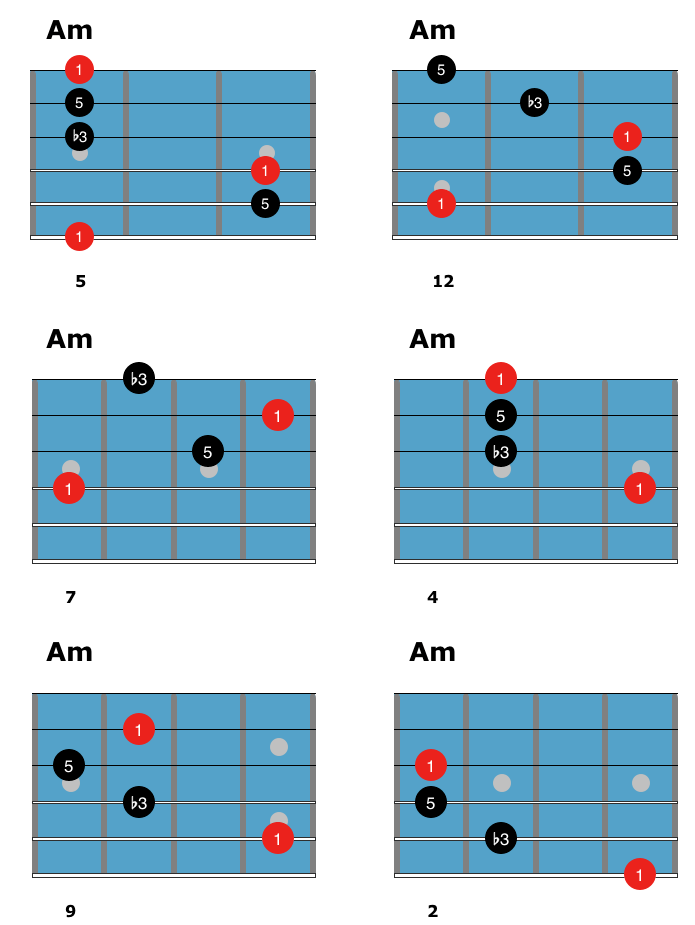
Here are six different Am chords that you can learn, take to other keys, and add to your rhythm guitar playing. Start by playing each chord separately, and then play them back-to-back as you compare how each sits and sounds on the guitar.
Minor 7th Chords
Probably the most popular minor family chord on this list, m7 chords are found in every genre of modern music.
These common chords are used as the tonic (im7), iim7, iiim7, and relative minor.
Here is the interval pattern for the m7 chord type.
Interval Pattern = 1 b3 5 b7
Basic Minor 7 Chords
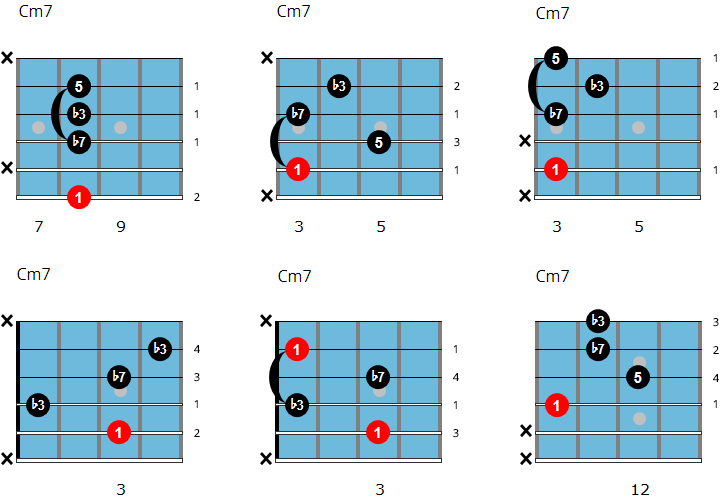
Here are 6 Cm7 chords that you can learn on guitar. Work each on their own, and then combine them to compare their sounds on the fretboard.
As well, make sure to work these shapes in other keys, over chord progressions, and over jazz standards.
Drop 3 Minor 7 Inversions – E-string Bass Note
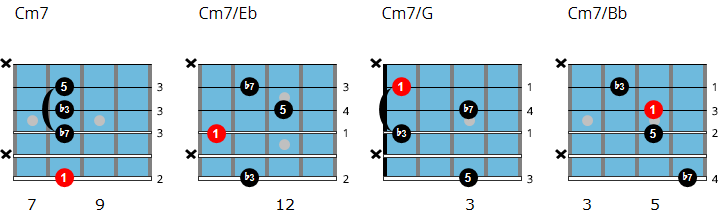
The first group of minor chord inversions we will look at are drop 3 m7 chords with the 6th string as the lowest note of each grip.
These chords use the following interval structure:
| Drop 3 m7 root position | 1 | b7 | b3 | 5 |
| Drop 3 m7 1st inversion | b3 | 5 | 1 | b7 |
| Drop 3 m7 2nd inversion | 5 | b3 | b7 | 1 |
| Drop 3 m7 3rd inversion | b7 | 5 | 1 | b3 |
Let’s take a look at how these chords fit on the fretboard by learning all four inversions of a Cm7 chord.
Once you can play these shapes from memory over a Cm7 chord, take them to all 12 keys across the fretboard so that you can see and hear how these four shapes sound in every key.
Drop 3 Minor 7 Inversions – A-string Bass Note
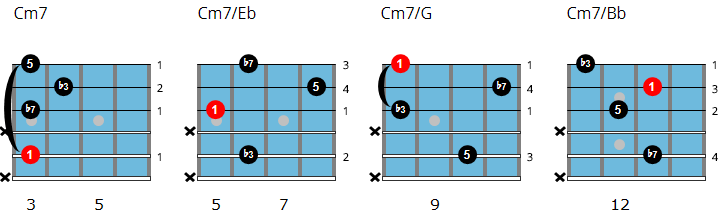
Here is the chord chart for minor drop 3 inversions, but this time with the bass note on the A-string.
Drop 2 Minor 7 Inversions – A-string Bass Note
Moving on to our first set of minor drop 2 chords you will learn how to build each chord from an intervallic standpoint before taking these chords onto the fretboard.
Notice that the drop 2 chords don’t have any wide intervals, as the drop 3 chords did, and so there will be no string skips in these shapes.
| Drop 2 m7 Root Position | 1 | 5 | b7 | b3 |
| Drop 2 m7 1st Inversion | b3 | b7 | 1 | 5 |
| Drop 2 m7 2nd Inversion | 5 | 1 | b3 | b7 |
| Drop 2 m7 3rd Inversion | b7 | b3 | 5 | 1 |
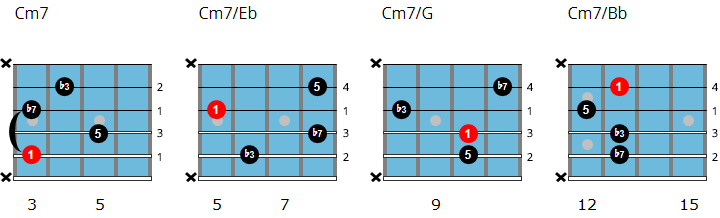
Here are those drop 2 m7 chords on the fretboard in all four inversions.
When you have these chords down, try playing the four inversions of Cm7 drop 3 chords on the 5th string, followed by all four inversions of drop 2 Cm7 chords on the 5th string, in order to compare these two groups of chords by both sound and shape on the neck.
Drop 2 Minor 7 Inversions – D-string Bass Note
And here are the minor drop 2 inversions on the top four strings.
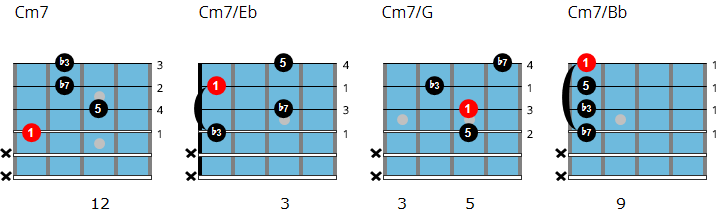
You will notice that we haven’t looked at any drop 2 minor chords with an E-string bass note. This is because those shapes tend to sound muddy on the lowest string set.
Minor 6 Chords
Minor 6 chords are often used in jazz and Brazilian music (among other genres), over iim and im chords.
Because there is a natural 6 interval in these chords, they are directly related to the Dorian and melodic minor scales.
Here is the interval formula for m6 chords.
Interval Pattern = 1 b3 5 6
Now that you know how to build these chords, you will learn how to play m6 chords on the fretboard.
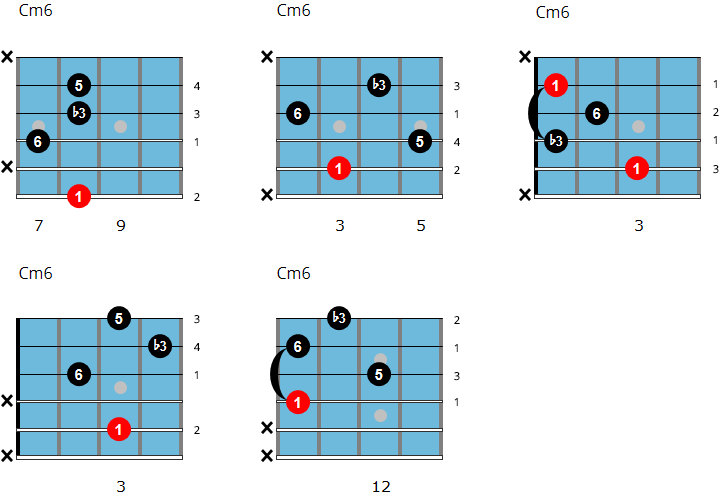
Here are five different Cm6 chords that you can learn and apply to your comping over progressions and full tunes. Once you’ve played through each shape, put on a backing track and add these new minor family shapes to your playing.
Minor 9 Chords
You’ll now move on to your first extended minor family chord, the m9 shape.
This chord is a favorite of jazz guitarists and is often used in Brazilian jazz music as well.
Here’s the interval pattern for m9 chords.
As you have 5 notes in this chord, you will often remove one note from these shapes. This makes it easier to play on guitar.
Interval Pattern = 1 b3 5 b7 9
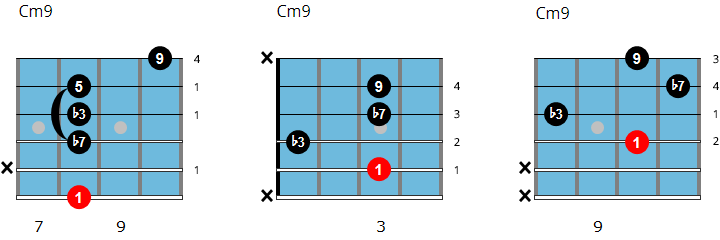
Here are 3 different Cm9 chords to explore in your playing:
Minor 11 Chords
With a modern sound, m11 chords bring to mind songs such as So What and other modal jazz tunes. Used by Bill Evans, McCoy Tyner, and other pianists, m11 chords have also become a favorite minor color for jazz guitarists.
Here’s the interval pattern for m11 chords.
Because these chords have 6 notes, you’ll only use some of these intervals in the chords below. When eliminating intervals from a m11 chord voicing, you need to keep the 11th in that shape. Any other note is ok to take away.
Interval Pattern = 1 b3 5 b7 9 11
Now that you know how m11 chords are built, you can take them onto the fretboard.
Here are 3 fingerings for Cm11 chords that you can explore in your playing, work in other keys, and apply to comping over tunes. Work each chord on their own at first, then play them back to back in order to hear how they sound compared to one another.

Minor/Major 7 Chords
The final minor family chord in this lesson is the mMaj7 chord, which you can see below written as CmMaj7.
This chord is often played as the tonic minor chord (ImMaj7) in jazz, though you can use it in place of any minor family chord in your playing.
The maj7 interval creates tension with this chord, much more so than any other minor family chord, so it needs to be treated with care.
Here is the interval pattern for mMaj7 chords.
Interval Pattern = 1 b3 5 7
Now that you know how to build these chords, here are examples of mMaj7 chords on the guitar.

So What Chords
Now that you’ve explored minor chords on the guitar, you can take that knowledge to a full jazz standard, in this case So What.
Built with two minor 7th chords a semitone apart, this tune is perfect for exploring minor chord colors in your playing.
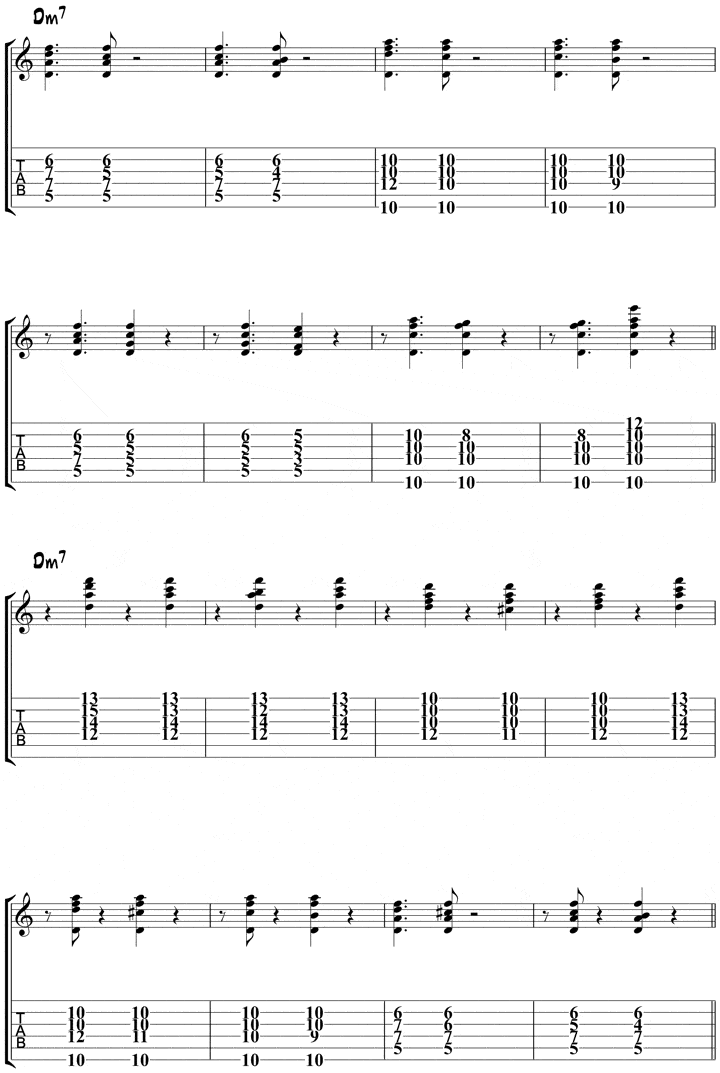
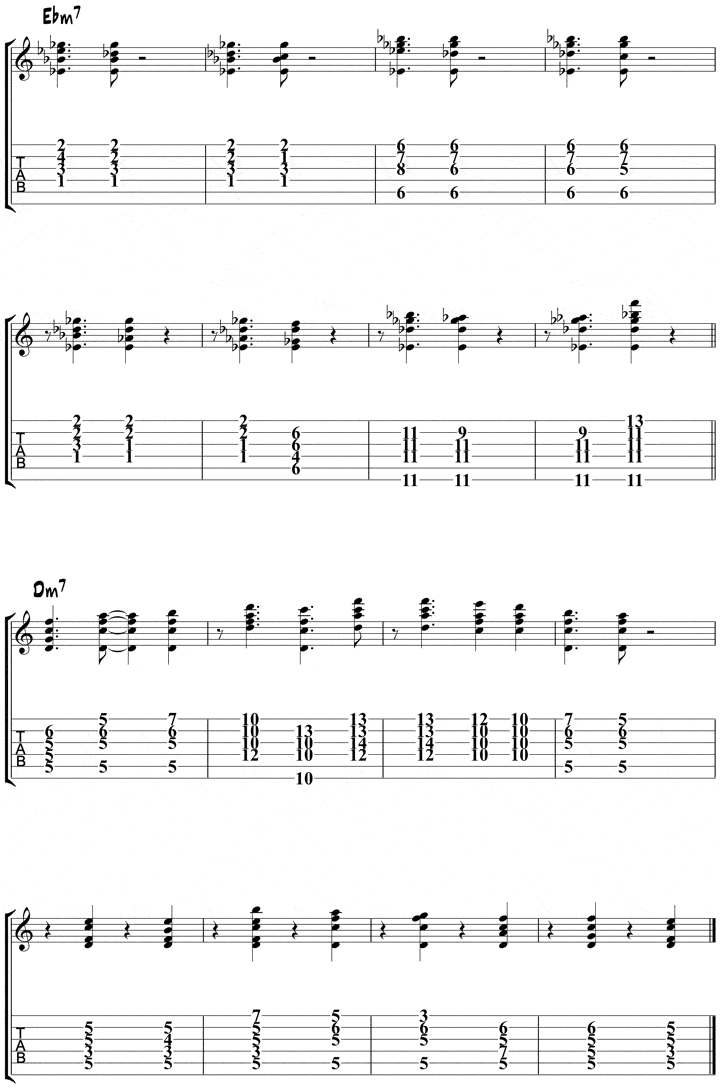
In this study, you mix various minor, m6, m7, m9, m11, and mMaj7 chords as you comp over this classic Miles Davis tune.
Once you’ve learned this study, put on the backing track below and jam with your own chords over this minor key standard.
Backing Track
Listen & Play Along
How to Improvise Over Minor Chords
In this section, we will have a look at the guitar scales, arpeggios, and substitutions you can use to improvise over minor chords.
All examples are based on a Dm7 chord unless otherwise specified.
The Dorian Mode
The 3 minor diatonic modes (Dorian, Phrygian, Aeolian) are the obvious choice for playing over minor chords. Which of the 3 modes you play depends on the harmonic setting and the function of the chords you are playing over.
The Dorian mode is the second mode of the major scale and is used to play over II chords as in a II V I chord progression.
We’ll take a 2 5 1 in C major as an example:
| Dm7 | G7 | Cmaj7 | % |
| iim7 | V7 | Imaj7 | % |
Over the Dm7 in the first bar of this chord progression, you play the Dorian mode:
| D Dorian Mode | D | E | F | G | A | B | C |
|---|---|---|---|---|---|---|---|
| Formula | 1 | 2 | b3 | 4 | 5 | 6 | b7 |
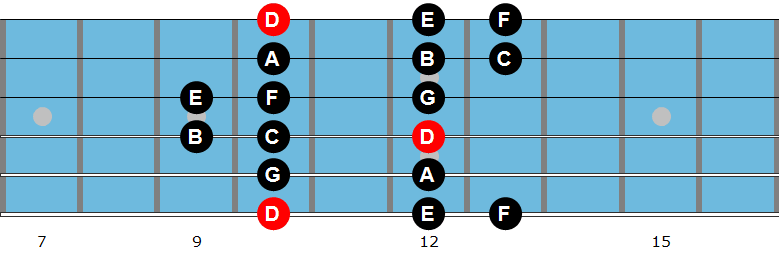
Here’s how the D Dorian mode looks on the fretboard in root position:
The Dorian mode can also be used to play over minor chords in modal tunes, such as So What or Impressions.
The Phrygian Mode
The Phrygian mode is used to play over minor chords that have the function of a iiim7 in a chord progression.
An example is the first chord (Em7) of the 3rd bar of a Rhythm Changes:
| Cmaj7 Am7 | Dm7 G7 | Em7 A7 | Dm7 G7 |
| Imaj7 vim7 | iim7 V7 | iiim7 VI7 | iim7 V7 |
On the Em7 in the 3rd bar, you play the E Phrygian mode.
As a side note I want to point out that although you theoretically play the Phrygian mode on the Em7, you don’t think about the Phrygian mode on rhythm changes. Instead, you think about the C major scale for the entire chord progression.
| E Phrygian Mode | E | F | G | A | B | C | D |
|---|---|---|---|---|---|---|---|
| Formula | 1 | b2 | b3 | 4 | 5 | b6 | b7 |
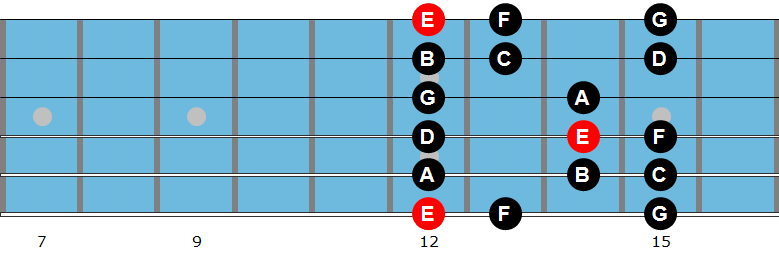
Here’s how the E Phrygian mode looks on the fretboard in root position:
The Aeolian Mode
The Aeolian mode (aka relative minor scale) is used to play over minor chords that have a VI function in major keys or a I function in minor keys.
An example of a VI is the second chord (Am7) in a rhythm changes. On that Am7 you play the A Aeolian mode.
| E Aeolian Mode | A | B | C | D | E | F | G |
|---|---|---|---|---|---|---|---|
| Formula | 1 | 2 | b3 | 4 | 5 | b6 | b7 |
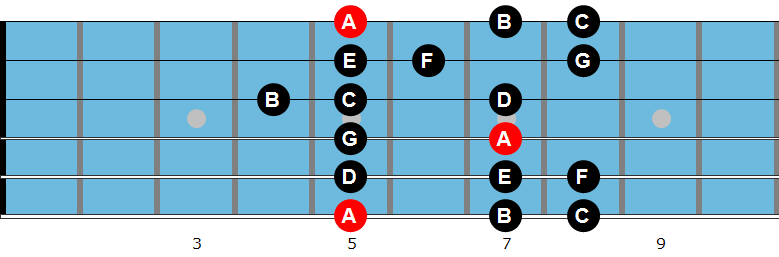
Here’s how the A Aeolian mode looks on the fretboard in root position:
The D Minor Pentatonic Scale or D Minor Blues Scale
An obvious, but very useful choice over Dm7 is to play the D minor pentatonic scale or D minor blues scale.
| D Minor Pentatonic Scale | D | F | G | A | C |
|---|---|---|---|---|---|
| Played over Dm7 | 1 | b3 | 11 | 5 | b7 |
The A Minor Pentatonic Scale
The A minor pentatonic scale sounds very nice over Dm7 because it brings out the colorful 9 and 11 sound.
| A Minor Pentatonic Scale | A | C | D | E | G |
|---|---|---|---|---|---|
| Played over Dm7 | 5 | b7 | 1 | 9 | 11 |
D Minor 7 Arpeggio
Surprisingly, the Dm7 arpeggio works very well over Dm7 🙂
F Major 7 Arpeggio
An Fmaj7 arpeggio over Dm7 is a common substitution and adds the 9-sound.
| Fmaj7 Arpeggio | F | A | C | E |
|---|---|---|---|---|
| Played over Dm7 | b3 | 5 | b7 | 9 |
A minor 7 Arpeggio
One step further is using an Am7 arpeggio over Dm7, it adds the 11 to the sound.
| Am7 Arpeggio | A | C | E | G |
|---|---|---|---|---|
| Played over Dm7 | 5 | b7 | 9 | 11 |
E minor 7 Arpeggio
Em7 sounds a little more distant over Dm7 but works fine if you alternate it with a Dm7 arpeggio, creating a tension and release vibe.
D F A C + E G B D = D Dorian mode
| Em7 Arpeggio | E | G | B | D |
|---|---|---|---|---|
| Played over Dm7 | 9 | 11 | 6 | 11 |
Dm6 or Bm7b5 Arpeggio
Emphasizing the 6 of a minor chord works well if the minor chord has a tonic function and not a sub-tonic function (as in a II V I). In other words, the minor chord should be the I, not the II.
An example would be the Im7 in a minor key II V I, or a minor chord in a modal tune.

Hi. For the drop 3 inversion tables that are in black and gold, the 1st inversion is written as:
Drop 3 m7 1st inversion b3 5 1 b7
Shouldn’t the 5 and 1 be reversed? b3 1 5 b7
I noticed this also on these other chord pages, too.
https://www.jazzguitar.be/blog/major-chords/
https://www.jazzguitar.be/blog/half-diminished-chords/
thnx!
Awesome…
this is what throws me when playing ,you learn a chord shape in 2-3 positions and then when you look at whatever you are playing say further into the piece the shape might be labelled BbM7 but the shapes you have memorised don’t look the same fingering and you “stutter” in what you are trying to do!!
Can other chords with b3rds substitute for minor chords? like diminished and half-diminished chords? And, can C triad, for example, substitute for an Am chord?
Hey, yes C is a great sub for Am7, you’re playing the b3-5-b7 and no root. So cool shape. m7b5 and dim7 chords are diminished family chords because they have a dim triad, 1 b3 b5, as their foundation. So a different group of chords.