


-
So presumably jazz didn't kill Chopin...
-
08-17-2019 07:16 PM

-
No I wasn’t thinking of Getz. His solos tended to be paraphrases of the melody.
 Originally Posted by 2bornot2bop
The problem is when you run the changes isn’t it? Which is tempting because the changes are mega.
-
I like the characterisation of Chopin as quite evil. Do you have a specific example? I suppose the revolution study?
-
Yeah. Originally Posted by benrosow
Django’s tune Tears for instance:
(Billy Strayhorn is a good example too. Although I think his tunes are just hard to improvise on.)
For example: I had to do a lot of research and thinking to learn how to play dim chords elegantly. By which I mean seeing them as connected to the tonality and not just running Coltrane style patterns on them.
I assumed this was down to me not being formally educated in jazz, but having spoken to those with actual jazz degrees, it turns out you can graduate from elite institutions with a very rudimentary knowledge of functional harmony. They can all play great, but they often have weird weak spots in their changes playing. The repertoire they are taught at college minimises those harmonic situations. But as you say - Bossa always stands out - and they have to learn it because people know those songs....
It’s impossible to play melodically on dim chords if you don’t understand how they are related to the central tonality. And as Bossa invites the older melodic tradition of jazz improvisation on the melody rather than the sophisticated changes running of the 50s boppers, so that sort of passage work always feels inappropriate to me.
It’s easy to see why dim harmony isn’t taught. Mostly dim chords went out of fashion in US jazz in the 50s I guess.
Brad Mehldau points out learning bop became about transplanting units of canned Parker material on ii Vs. Even for some of the greats of the 50s and 60s!
OTOH - there’s a much simpler solution that is even more alien to the jazz academies - you could simply not think about the harmony and rely on you ears to avoid clams playing diatonically through the song. The way the trad guys did it.... I actually think this is how Getz often soloed although he could clearly run changes too.
If I hadn’t needed to work out what the hell to do dim chords and other types of non Ii V motion you see in prewar jazz, it’s likely I would never have bothered.
I feel mention should also be made of Nazareth, Pixinguinha and so on. Often very classical tinged harmony in that music.
The first Bossa tune, Chega, was based on a Choro style form. Jacob do Bandolim played it as a choro. No blowing in the jazz sense.Last edited by christianm77; 08-18-2019 at 05:17 AM.
-
Gary Burton's first job was a couple of years on the road with Getz in the early 60's. He says in numerous places that Getz had limited theoretical knowledge and waited to hear what the band did behind him & then play by ear. For Burton CST is the answer.... Originally Posted by christianm77
-
Thanks for the Bertoncini, hadn't heard that. Originally Posted by Cunamara
More Bossa Chopin.. Jim Hall's on the Mulligan version.
-
Actually that really doesn’t surprise me from the bits of Getz I’ve transcribed. Originally Posted by dot75
Burton just got tired of of playing standards. I’d be interested to know how much of the CsT movement came out of that.
-
Burton has a very interesting overview of the Jazz Repertoire ..and Jazz & Music in general in this interview: Originally Posted by dot75
Last edited by Robertkoa; 08-18-2019 at 09:48 AM.
-
Hi Cristian, using the Barry Harris method would be a good way to think, reharm and play melodically, specially over dim7 chords? Originally Posted by christianm77
Changing the subject a little bit...
-
If you listen to bossa the way they played it in Brazil, you're hearing the real thing. Originally Posted by christianm77
I can't remember who said it, maybe Emily Remler? that Americans don't play it correctly, too much syncopation etc.
For example authentic bass lines in bossa are typically just a simple 2 feel, not all the added rhythms you're apt to hear in American interpretations.
-
-
Why would you listen to Americans doing it? Originally Posted by wintermoon
-
because when Americans do something you should listen! Originally Posted by christianm77
-
"I think of Bossa Nova as the final stage of Jazz as popular music"
Huh?
I was always under the impression that if there is a category in billboard magazine it is still considered popular music... it's just not on syndicated radio offerings that play the latest corporate smash hits to pre pubescent teenage girls and highly infatuated teenage groovy boys.
I seem to recall that smooth jazz had a pretty big footprint way after Bossa Nova.
-
Bossa Nova had some great harmony going on. Especially the sophisticated use of diminished, augmented (symmetric harmony) and Melodic Minor.
some jazz musicians substitute the Jobim harmony with II-V-progressions and changing diminished into altered dominant or 7b9b13. Interesting, but at the same time limiting.
Bossa is certainly not harmonically simple, au contraire.
Modern jazz is much more open to diminished harmony and symmetric harmony.
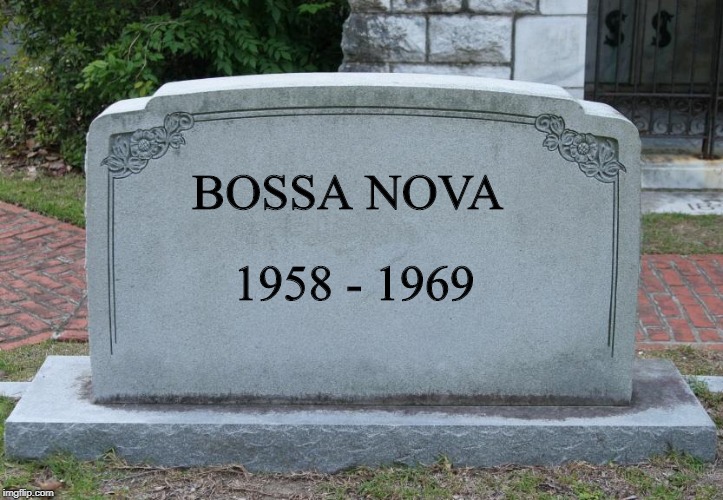
But did jazz kill Bossa Nova? Isn’t it the commercial Juggernaut of diluted and badly played Bossa that finished it, like it did with most art...?!
-
I would say, not interesting, and bad sounding :-) Originally Posted by Djang
The Aebersold charts for Bossa tunes are an abomination.
Jazz musicians forgot how to solo on anything that isn't a II-V-I. Getz did it all by ear.
-
Oh no; most of the bossa tunes I play (Wave, Corcovado etc...), come from Aebersold charts found in volume 31 - Bossa Nova. Originally Posted by christianm77
Guess I should find other charts and see what chords are used instead.
-
Getting good charts is not always the easiest, but the Almir Chediak books have really nice changes and voicings. Not the easiest to get hold of though and also in Portuguese. Originally Posted by jameslovestal
-
Authentic Brazialian bossa is better learned by ear or when copied from a player... Brazilian guitar (especially 7 string) is pretty different beast both from traditional classical and northern American guitars...Oh no; most of the bossa tunes I play (Wave, Corcovado etc...), come from Aebersold charts found in volume 31 - Bossa Nova.
Guess I should find other charts and see what chords are used instead.
I think it was mixed very much with classical guitar but it is not the same thing.
I am not that much inot it but I had a period of strong interest... when you begin to look at more from inside... or more from Brazilian music and guitarism perspective you begin to notice different things than we are used to notice in our pop and jazz bossa context...
In a word - though bossa was professional genre original - it comes directly from folk source and folk music is often unpredictably spontaneous and better learnt directly from the source
-
To original question ... No. Actually, IMO, it is Bossa (among other things) that have killed/ is killing Jazz (especially live club scene).
-
You may notice more Groove.
This guy is a Guitar Savant I think.
One think I dislike about many Classical Guitar Pieces is they don't usually play full extended chords...Yamandu solves this and has some cool grooves too.
A lot of Nylon Stringers sound more 'labored ' where he bounces along and grooves- an unusual Virtuoso - to my ears anyway.
Jazz killed Heavy Metal , then the Heavy Metal guys hired Brazilians to kill Jazz ....lol.
OR - people should ideally be able to Dance to the Music and still be able to clap for the Soloist , if they really want to .
Maybe Jazz just faded somewhat as it became more of a 'Musician's Music' than Dance Grooves.Last edited by Robertkoa; 08-26-2019 at 07:44 PM.
-
While the influence of Brazilian folk music upon bossa nova, especially in terms of rhythm, is clear I remember reading an interview where Jobim stated that at least harmonically speaking, his own music was primarily influenced by the classical tradition from Bach, Chopin, Debussy and Ravel to Villa-Lobos. So while he was no Jerome Kern (who considered jazz reinterpretations of his songs as "fraudulent imitations"), he probably felt protective of his compositions and was perhaps concerned that jazz musicians had a tendency to strip them of their musical and geographical essence.
-
In Argentine in the 50s there was a strong opinion that Astor Piazzolla killed the Tango. The great composer and founder of Tango nuevo said; "The dancers are my worst enemies". He wrote concert music not dance music. Piazzolla was a brilliant instrumentalist, not a singer.
Tango Nuevo is a mix of influences; Classical music, Jazz, Latin and European folk music. World music. In the 70s he plays with jazz authorities like Quincy Jones and Gerry Mulligan. In the 80s Grace Jones turned Piazzolla's composition Libertango into dance music and it became a world hit. At this time the dancers became Piazzollas best friends.
Jazz didn't kill the Tango and neither did Piazzolla. On the contrary, Piazzolla made the Argentine Tango and the Bandoneon immortal with good help from Jazz and classical music. There is a strong parallel to the development of the Bossa Nova. One is Samba the other is Tango, but the melting pot and the ingredients are not that different. It all happened in South America in the 50s when local music was blended with traditional European music, North American music, exceptional musical skills and a spoonful of passion.
Dizzy Gillespie is speaking through this lady's horn:
Guitaristic approach. Incredible performance
-
Ha funny.... just listening to Piazolla guitar music in the car..... Originally Posted by JCat
Here’s my bands take on Libertango
-
Just a glitch in the Matrix, Neo Originally Posted by christianm77
Very nice performance! Originally Posted by christianm77



 Reply With Quote


New LEDs Day
Today, 07:28 PM in Other Styles / Instruments