


-
That's right. The more important distinction I wanted to make was Barry’s exercises are not continuously voice-lead. At least I have never seen him talk about this version. In one workshop I attended, he also did the disconnected version.
 Originally Posted by Christian Miller
-
05-16-2025 06:31 AM

-
This is not quite what I was referring to. I mean voice leading uninterrupted 8th notes through the changes. Originally Posted by GuyBoden
-
Interesting. Can you please point me to the where he talked about this? Originally Posted by Mick-7
I've seen continuous scale exercises in various sources, mostly written by pianists. Most notably, it is recommended in Mark Levine's Jazz Theory. David Berkman also goes through different variations of it in The Jazz Musican's Guide to Creative Practicing. I don't remember seeing it in any Joe Pass resource but I might have missed it.
-
I wouldn't recommend doing continuous scale exercises before getting good at continuous arpeggios in quarter notes. Continuous scales in every chord change would be too big a hurdle before getting good at chord tones. At least that was my learning path. Once you get good at chord tones, scales are just a small step.
-
The closest I've found is in page 35 of Joe Pass Guitar Style where he introduces some solos that are all eighth notes by saying that by eliminating rhythmic variety you force the ear into building better melodies and also avoid using memorized licks. Originally Posted by Tal_175
-
Continuous 8th notes studies by Howard Roberts Super Chops
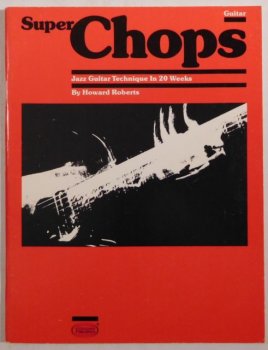
Jimmy BlueNotes' great Study Group is here:
Howard Roberts Super Chops: study group for a tune based practice routine
-
Obviously eventually you want to get into leading them through the changes. What I have found is that often you can start on a chord tone for each chord and keep the scale going. The added note rules help with this. Originally Posted by Tal_175
Even for things like Giant Steps.
-
Yes getting the chord tones on strong beats while playing continuous 8th notes is important for bringing out the changes. There are many ways to get there. BH outlines and half step rules can be good preparation. Originally Posted by Christian Miller
Last edited by Tal_175; 05-16-2025 at 03:43 PM.
-
Originally Posted by Tal_175
Originally Posted by Tal_175
Yes, playing the changes to a song using Barry Harris Scales with 'uninterrupted 8th notes' would take a lot of practice.
I've shown in the examples I've posted, that BH scales don't need to only start on the root of each chord.
Your statement "Barry Harris scale exercises start from the root for each chord" is incorrect.
Below, Barry Harris chromatic scale over a ii-V-I.
-
I think we are talking about different things. I wasn't referring to the half note applications in general. I was referring to scale outline of tunes as shown in for example Howard Rees's Barry Harris workshop videos. Barry Harris started improvisation classes with scale outlines of a chosen tune as shown in that workshop video. There are specific ways chords are outlined in those exercises depending on the movement.Those typically start on the root and go to the 7th. In the next bar, it'll start on the root of the next chord again. If it's a two bar phrase such as a ii-V it'll go back down to the root. There are some exception to this, such as minor ii-V, then he'll play dominants into each other not necessary from the root. Also for example I chord going to vi will also be outlined differently. Originally Posted by GuyBoden
In any case, the continuous 8th note scale exercise I am referring to is not something I've heard Barry Harris talk about. If he did and some one can post a link to it, I'd be interested in seeing it. As I said above in one of my previous posts, Mark Levine's The Jazz Theory book has one of the clearest descriptions of it. Nevertheless, you can totally apply half step rules to continuous scale exercises with great results.
-
Alas, Guy, you’re off the mark on this one. Originally Posted by GuyBoden
Tal and Christian are referring to the scale outlines BH uses to outline a chord progression.
-
Looks a lot like F Major to me … Originally Posted by GuyBoden
-
Pass recommended it at a workshop he gave that I attended, and I took some lessons from a guy who also recommended it and he said he got the idea from Joe. Originally Posted by Tal_175
Yes, I mentioned this earlier.... Originally Posted by pcjazz
Originally Posted by Mick-7
-
Also worth mentioning is that Adam Rogers also advocates the continuous eighth-note idea on one of his 'My Music Masterclass' videos - IIRC, he demonstrates it with no leaps and then with a largest leap of the third. He says it's a good exercise because it sort of backs you into a corner - by which I think he means in terms of fretboard knowledge and generally keeping up with the changes.
-
I believe that was also the rationale behind Joe Pass'es exercise, there is a natural tendency to start and stop when one is practicing improvising on tunes, over chord changes, and this practice derails it. It's similar to the idea that if you want to be a proficient sight reader, you should keep reading through a musical piece in spite of any fumbles you may make while doing so. You would take note of the parts you have difficulty playing and work on them, and you could do the same thing with the 8th note improvisation practice. For example, you may find you have a hard time playing lines over nondiatonic chords, and that is something you'll need to work on. Originally Posted by James W
-
Might make a good study group to do this through some tunes. I've found these exercises harder them they might seem. You really have to know your scales well. Originally Posted by Tal_175
-
I think that learning to arpeggiate all the chords of the chord changes in real time will speed up the process, I suppose that's why Adam Rogers suggested that your lines not contain interval leaps greater than a 3rd. Originally Posted by charlieparker
That just jogged my memory... I remembered that my former guitar teacher, the one who said he learned this exercise from Joe Pass, had a corollary to it: when you proceed from one chord to the next, go to the chord tone of the new chord. For example, if the progression was Dm7 to G7, and the last note you played over the Dm7 was A or C (the 5th of the chord), you'd play the note G or B over the G7 chord, the closest chord tones of that chord. It's an easy way to conceptualize lines that will flow over the chord changes.
-
d1115, I know by now you've got a lot to think about.
You might consider bringing it back to something you carry with you: Your voice.
Sing a Doe a Deer scale, even in your mind.
See it in the air.
Sing a simple tune. See it in the air. Move your hand in space to envision the scale, like music written in the air. And take a tune like Doe a Deer, or Jingle Bells, or Ornithology... and see it in the air as you sing it. This is basic ear training; to see what you hear.
Now find your chord tones. They are the stepping stones of the scale. Find them in your ear and in space. Take note of how melody rests and moves to and from these notes. Really see it.
Now take a region of the fingerboard, take a piece of paper and write out how the scale fits on the guitar. Take your scale and play it noting the way if lays or folds around the map of the fingerboard. Do this with awareness and patience.
Find these notes on the guitar with an equal awareness of your voice, the scale in space, the map of the fingerboard and your fingers on the fretboard.
Play the scale.
Find the chord tones.
Envision your fingers "singing" what you're playing and use the map to learn how to play what you can sing; to hear what you play.
This will take time. If you've ever played with a piano, you'll know how much easier this is. Find the "piano" on your guitar (single string is really cool this way) and work with simple melodies.
Train your ear. Train your eye. Train your fingers. They all need to be a part of you. Only then can your control your noodling and licks. Bring it back to the music and learn to control it.
Give it a try.
Or not.
-
Originally Posted by Tal_175
Sorry, the type of Barry Harris scale exercise wasn't specified in Tal_175's original post, so obviously I was confused by the statement. Originally Posted by pamosmusic
Originally Posted by Tal_175
I'm sure you can start BH scale exercises from any note in the scale. The workshops are only simple basic examples.
-
I don’t know, probably. Simple, basic, but foundational and harder than they sound. Originally Posted by GuyBoden
So far as I’m aware, he wasn’t real big on “exercises” as such and had his couple of Get It In Your ear tools and his ABCs and then was learning heads, line building, and experimenting. So most other formalized exercises using his material would be extrapolations by enterprising students.
Might be wrong, but either way, that outline format is sort of capital letter The Barry Harris Scale Exercise.
-
Every time I went to his classes it was scale outline and then making lines up. We didn't do any continuous 8th exercises, except though Giant Steps.
However he did say - cats would be able to pay a tune in one scale from the top of their instrument to the bottom, and vice versa. So nailing all the changes in one continuous scale, but not changing direction to accommodate the chords.
-
Not sure if I follow this. Continuous scales do not require changing direction when chords change but it'll frequently require scale change to accommodate the new chord. How would you make all the changes with one scale? Originally Posted by Christian Miller
-
Yeah it's a similar exercise. He meant it in the way of play stepwise through the tune and use the added note rules as appropriate. Originally Posted by Tal_175
-
Some very good ideas in here today. I enjoyed the very simple BH chromatic lines a lot. Even though they are so simple there is a lot of juice to get out of them. And shows the inherent logic of chromatic notes on the dominant chords and chord tones on the tonic (especially the 3rd in those examples) which cashes the check.
I'm a little surprised nobody mentioned to the OP that guide tones would go along and simple way towards improving the structure of his lines. Identify the third and seventh of every chord, since those are the notes that give most chords fundamentally distinct flavor.
Cmaj, Cmaj7, C7, C6, Cmin, Cmin7 Cmin-maj7, etc., all contain C and G. Those two notes do not strongly differentiate the chord. The guide tones are (respectively) E, E and B, E and Bb, E and A, Eb, Eb and Bb, Eb and B. Knowing where the guide tones are for every chord will sort of "pin" your line to the harmony of the song and make it sound logical and connected. Since those notes are already in the scale patterns, this study will leverage what you already know and begin to make you know where you are in the song and how what you are playing relates to the underlying harmony. And you'll start to see (and hear) how voice leading works.
-
A chord connection improv strategies study group? Yeah, I could see value in that. Originally Posted by charlieparker


 Reply With Quote


 (Also, I know all the note names on the fretboard too, in the 6 most common keys.)
 Hopefully Ionian will be covered in the next lesson.


New LEDs Day
Yesterday, 07:28 PM in Other Styles / Instruments