

Half-diminished seventh chords are minor chords with a flat five and are commonly used as the first chord in minor-key ii V I progressions. It’s important to have this type of chord with all its inversions under your fingers because they are used in almost every jazz standard.
In this lesson, you will learn how to build, play, and improvise over half-diminished chords in your jazz guitar playing.
An Overview of What You Will You Learn
- Half-Diminished Chord Construction and Notation
- Basic Chord Shapes
- The Similarities Between Major 7 and Half-Diminished Chord Shapes
- The Difference Between Half-Diminished and Diminished Chords
- Half-Diminished Drop 3 Voicings
- Half-Diminished Drop 2 Voicings
- How Are Half-Diminished Chords Used?
- How To Improvise Over Half-Diminished Chords
Half-Diminished Chord Construction and Notation
Half-diminished chords are also known as minor seven flat five chords (m7b5) because they are built as a minor chord with a flat five (b5).
Half-diminished chords are four-note shapes that contain the interval pattern 1 b3 b5 b7.
Here is Cm7b5 for example.
Notation: Cm7b5, CØ, Cm7(b5), or Cmin7b5
| C | Eb | Gb | Bb |
| 1 | b3 | b5 | b7 |
Basic Half-Diminished Chord Shapes
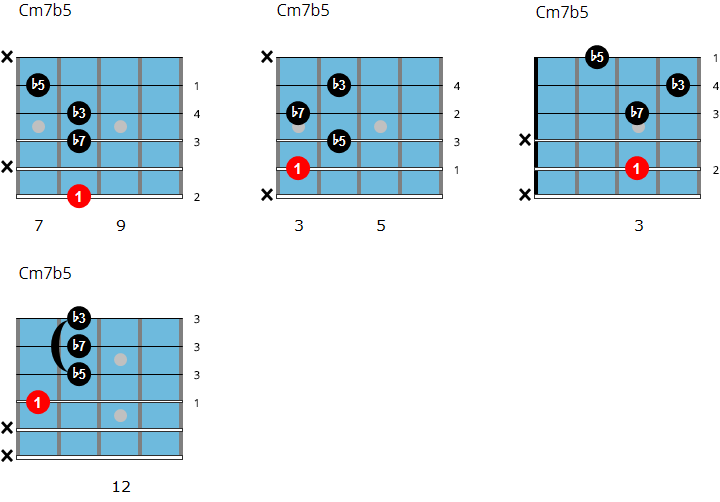
Below are four common voicings for Cm7b5.
The Similarities Between Maj7 and Half-Diminished Chords
If you look at the half-diminished chord voicings above and you know your major seventh chords, you will notice that the m7b5 chord shape looks familiar.
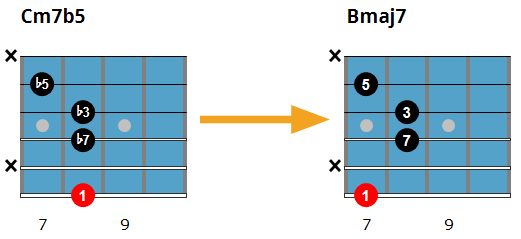
If you lower the root of a m7b5 voicing with a half tone and keep the rest of the chord tones, you will get a maj7 voicing.
For example, if you lower the root of a Cm7b5 with a half note, you get a Bmaj7:
The Difference Between Half-Diminished and Diminished Chords
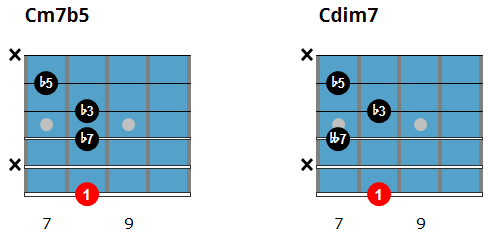
The difference between half-diminished and diminished chords lies in the seventh.
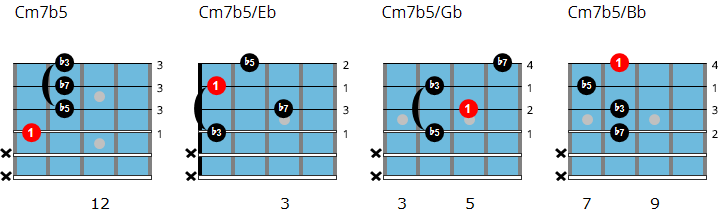
Half-diminished chords have a flat seven (b7), while diminished chords have a diminished seven (bb7).
You can see the difference in the following chord diagrams:
Half-Diminished Drop 3 Voicings
Drop 3 chords are the type of chords we use the most in jazz.
Drop 3 half-diminished chords are built with the following interval structure:
| Drop 3 m7b5 root position | 1 | b7 | b3 | b5 |
| Drop 3 m7b5 1st inversion | b3 | b5 | 1 | b7 |
| Drop 3 m7b5 2nd inversion | b5 | b3 | b7 | 1 |
| Drop 3 m7b5 3rd inversion | b7 | b5 | 1 | b3 |
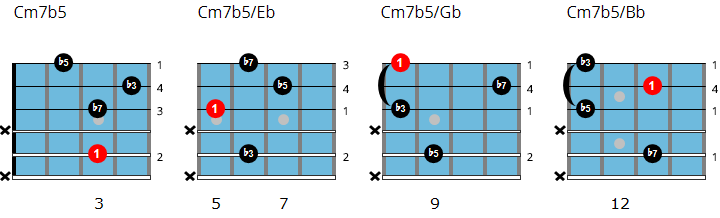
Below you will find all drop 3 half-diminished chords and their inversions for Cm7b5.
Drop 3 Half-Diminished Inversions – E-string Bass Note
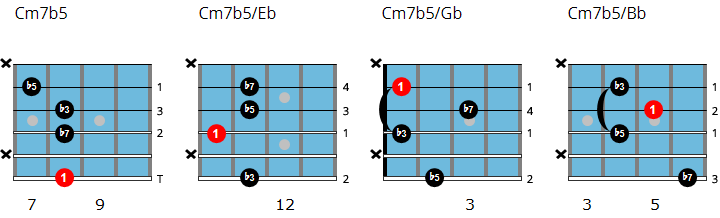
Drop 3 Half-Diminished Inversions – A-string Bass Note
Half-Diminished Drop 2 Voicings
Drop 2 chords use the same notes as drop 3 chords, but in a different order, which results in a different kind of sound.
Here is the interval structure of the m7b5 drop 2 chord and its inversions:
| Drop 2 m7b5 Root Position | 1 | b5 | b7 | b3 |
| Drop 2 m7b5 1st Inversion | b3 | b7 | 1 | b5 |
| Drop 2 m7b5 2nd Inversion | b5 | 1 | b3 | b7 |
| Drop 2 m7b5 3rd Inversion | b7 | b3 | b5 | 1 |
Drop 2 Half-Diminished Inversions – A-string Bass Note
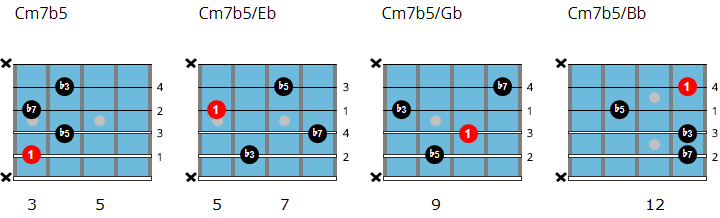
Drop 2 Half-Diminished Inversions – D-string Bass Note
How Are Half-Diminished Chords Used?
The II In Minor II V I Progressions
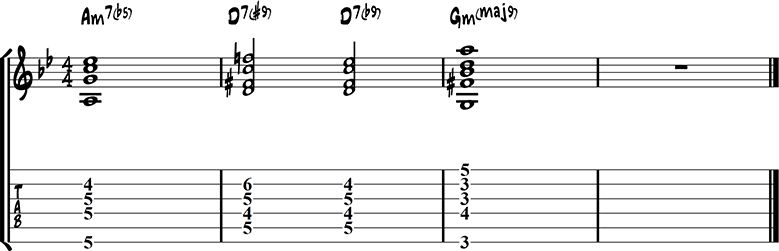
The main use of half-diminished chords is as the iim7b5 in minor-key ii V I progressions.
Here is an example in the key of G minor:
The Flat-Five In Major Progressions
Half-diminished chords are also used in a flat-five chord progression. This progression is often used to end a jazz standard.
Here is an example in the key of C major.

How To Improvise Over Half-Diminished Chords
Below you will find twelve tools (scales and arpeggios) you can use to solo over half-diminished chords.
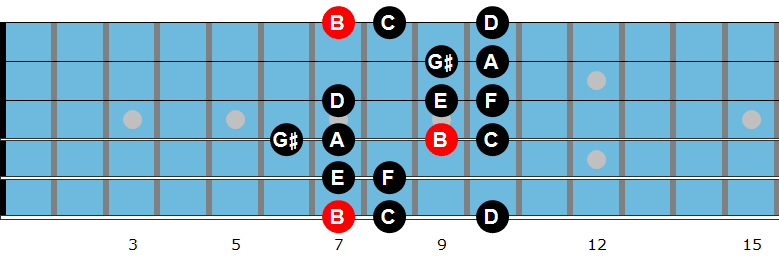
The B Locrian Mode
The Locrian mode is one of the seven modes of the major scale and the obvious scale choice to play over half-diminished chords.
Over a Bm7b5 we play the B Locrian mode:
| B Locrian Mode | B | C | D | E | F | G | A |
|---|---|---|---|---|---|---|---|
| 1 | b9 | b3 | 11 | b5 | b13 | b7 |
Here is the B Locrian mode in its root position on the guitar neck:
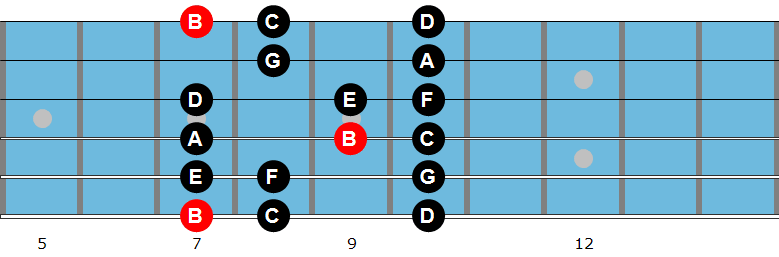
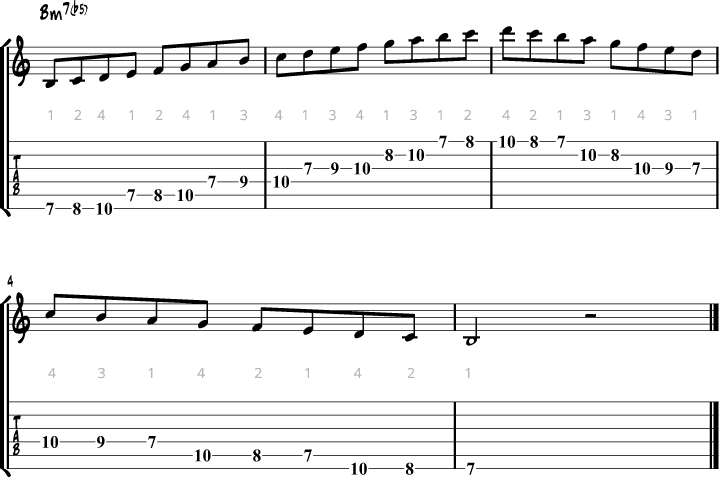
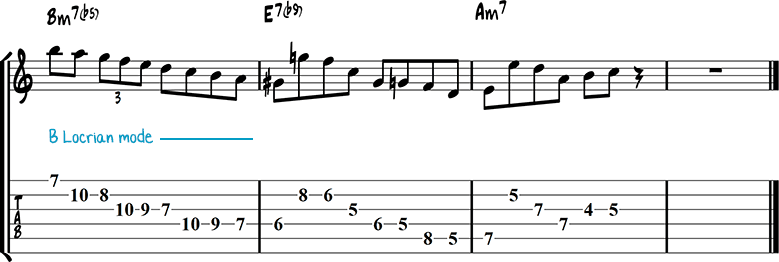
Here is an example of the Locrian mode over a ii V I chord progression in A minor:
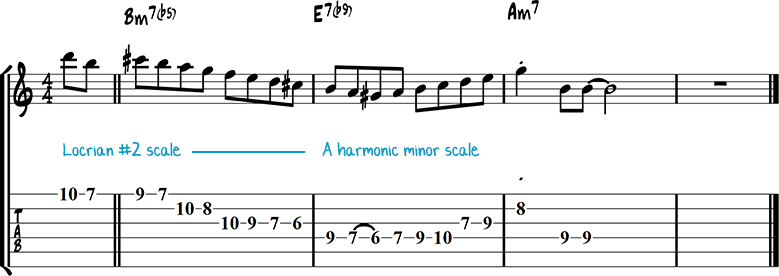
The B Locrian #2 Scale
The Locrian #2 scale has a more modern sound compared to the regular Locrian mode.
In the Locrian #2 scale (aka Aeolian b5), the C from the Locrian scale is raised with a half step. This is the 6th mode of the D melodic minor scale.
B Locrian #2 scale = D melodic minor scale
| B Locrian #2 Scale | B | C# | D | E | F | G | A |
|---|---|---|---|---|---|---|---|
| 1 | 9 | b3 | 11 | b5 | b13 | b7 |
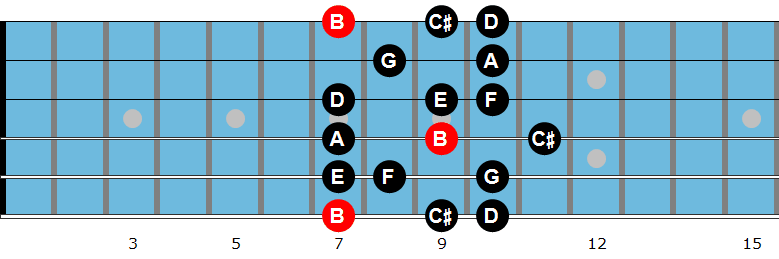
Here is an example of how you can use the Locrian #2 scale.
The B Locrian 13 Scale
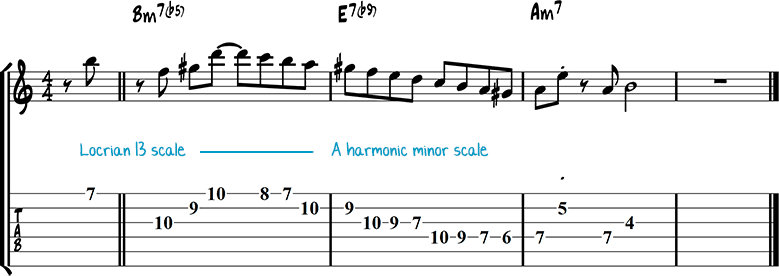
The Locrian 13 (or Locrian 6) scale is the second mode of the harmonic minor scale.
B Locrian 13 scale = A harmonic minor scale
Piano player Bud Powell frequently used this scale to play over half-diminished chords.
When you play the A harmonic scale over Bm7b5, you get a natural 13 (G#) instead of the b13 (G) of the normal Locrian mode.
You can continue playing A harmonic over the E7 as well. A harmonic over E7 is called the E Phrygian dominant scale.
| B Locrian 13 Scale | B | C | D | E | F | G# | A |
|---|---|---|---|---|---|---|---|
| 1 | b9 | b3 | 11 | b5 | 13 | b7 |
Here is an example lick:
The E Minor Pentatonic Scale
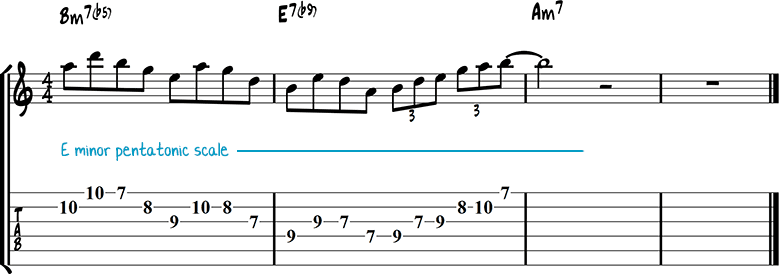
The E minor pentatonic scale is a good choice to play over Bm7b5.
| E Minor Pentatonic Scale | E | G | A | B | D |
|---|---|---|---|---|---|
| Played over Bm7b5 | 11 | b13 | b7 | 1 | b3 |
In this example, I play E minor pentatonic over the entire chord progression.
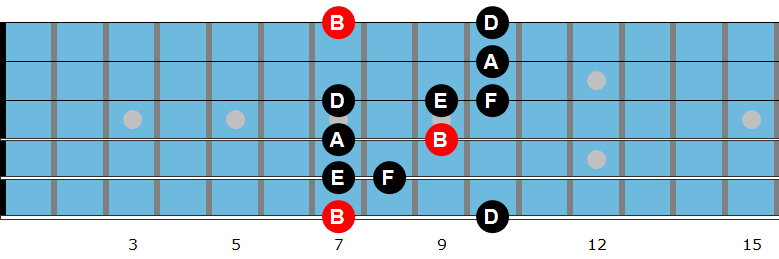
The B Minor Pentatonic Scale With a Flat Five
This is also a nice one: the minor pentatonic scale, but with a b5 instead of a natural 5.
You can also look at it as a B blues scale without the natural 5.
In root position, this pentatonic scale looks like this:
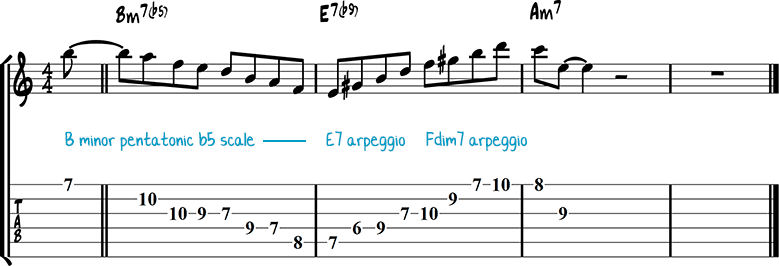
Here is an example of how you can use this scale.
The B Locrian Bebop Scale
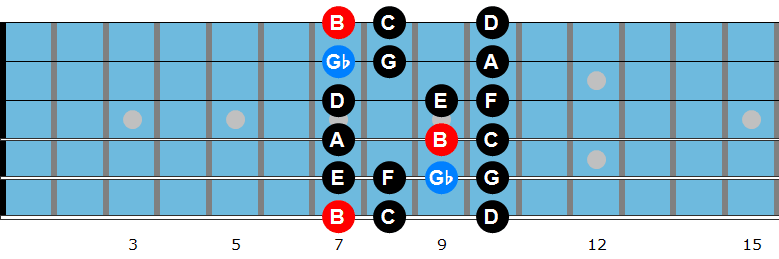
The Locrian bebop scale is the Locrian mode with a chromatic note (Gb) between b13 and b5.
This is the third mode of the G (dominant) bebop scale.
B Locrian bebop scale = G dominant bebop scale
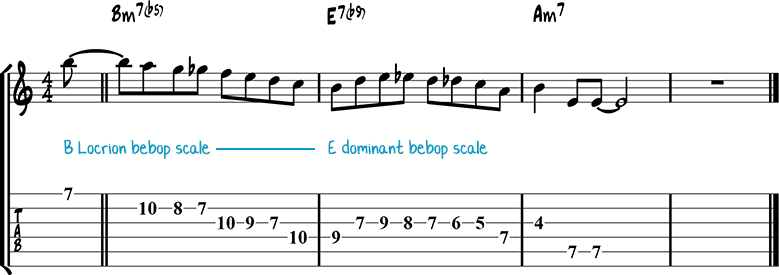
In the following example, I play the B Locrian bebop scale over Bm7b5 and the E (dominant) bebop scale over E7.
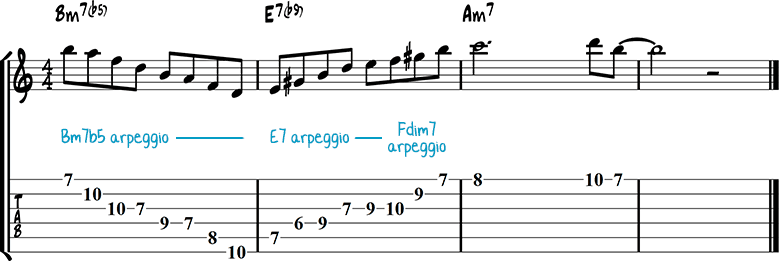
The Bm7b5 or Dm6 Arpeggio
Playing a Bm7b5 arpeggio, which has the same notes as Dm6, is the obvious arpeggio choice to play over Bm7b5.
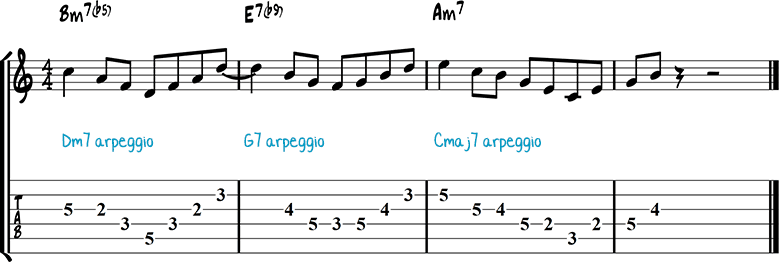
Dm7 Arpeggio / Relative Major ii V I
A Dm7 arpeggio sounds good over Bm7b5.
| Dm7 arpeggio | D | F | A | C |
|---|---|---|---|---|
| Played over Bm7b5 | b3 | b5 | b7 | b9 |
This leads to something interesting for minor ii V Is: if you substitute the E7 in bar two with G7 and the Am7 in bar three with a Cmaj7, you get a major ii V I.
This means you can play major 2 5 1 licks over its relative minor 2 5 1.
| G7 arpeggio | G | B | D | F |
|---|---|---|---|---|
| Played over E7 | #9 | 5 | b7 | b9 |
| Cmaj7 arpeggio | C | E | G | B |
|---|---|---|---|---|
| Played over Am7 | b3 | 5 | b7 | 9 |
Here is an example:
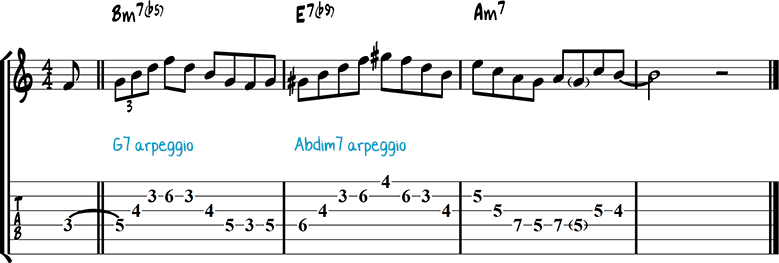
G7 Arpeggio
A G7 arpeggio over Bm7b5 sounds good as well.
| G7 arpeggio | G | B | D | F |
|---|---|---|---|---|
| Played over Bm7b5 | b13 | 1 | b3 | b5 |
In this example, I play a chromatic voice leading going from G7 to Abdim7 to Am7.
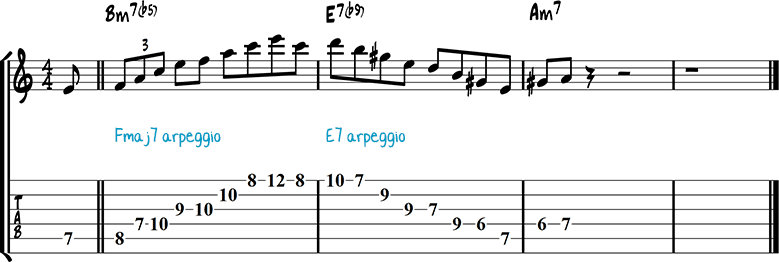
Fmaj7 Arpeggio
Fmaj7 is another arpeggio that works well over Bm7b5.
| Fmaj7 arpeggio | F | A | C | E |
|---|---|---|---|---|
| Played over Bm7b5 | b5 | b7 | b9 | 11 |
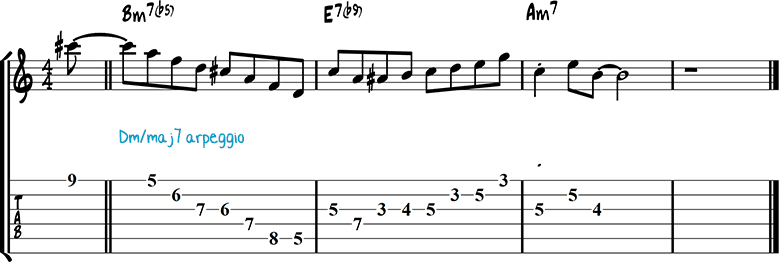
D Minor Major 7 Arpeggio
Playing a Dm/maj7 arpeggio over Bm7b5 sounds more modern compared to the previous examples because of the natural 9.
Dm/maj7 is the first chord of the D melodic minor scale.
| Dm/maj7 arpeggio | D | F | A | C# |
|---|---|---|---|---|
| Played over Bm7b5 | b3 | b5 | b7 | 9 |
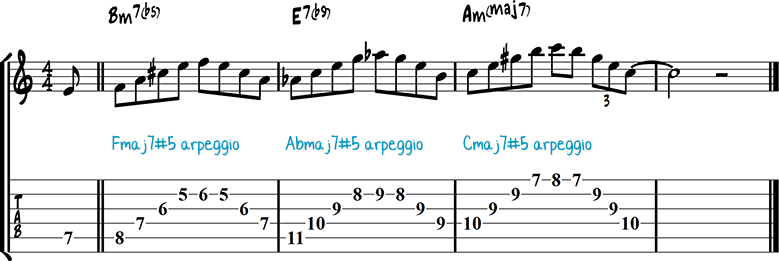
Fmaj7#5 Arpeggio
An Fmaj7#5 arpeggio over Bm7b5 has the same modern sound as the previous example because of the natural 9.
| Fmaj7#5 arpeggio | F | A | C# | E |
|---|---|---|---|---|
| Played over Bm7b5 | b5 | b7 | 9 | 11 |
In the following example, I play three augmented major chords in a row.
| Abmaj7#5 arpeggio | Ab | C | E | G |
|---|---|---|---|---|
| Played over E7 | 3 | b13 | 1 | #9 |
| Cmaj7#5 arpeggio | C | E | G# | B |
|---|---|---|---|---|
| Played over Am7 | b3 | 5 | 7 | 9 |
Do you have more ideas? Let us know in the comments below…

This is very very helpful information! I just have one question: you say that a Locrian #2 scale is “aka Aeolian b5” – but I don’t understand how these could be the same scale since the #2 in locrian is not the same note as a b5 in aeolian. But it could be me, since I’m just learning! Thank you.
Nice course, though I play keyboard but this is a great course
For those musically illiterate of us out here who have learned Guitar, more from visual and mathematical techniques, would it be incorrect to assume from the examples above, utilizing Maj7#5 arpeggios in the ii7b5-Valt-i, are built on the 3rd of each chord in the progression? Remarkable information I’m absorbing here musicians, thanks to all of you for this direction….OBTW, the x6 and xm6 Barry Harris method also works very well, with this lesson.
“ A harmonic over E7 is called the E Lydian dominant scale.”
Is that correct? What about the F (b2)? Is that part of Lydian dominant?
That’s a typo and should be E Phrygian dominant scale. Thanks for letting me know!
Lydian dominant, as the name implies is a scale that utilizes the Lydian sound (#4) as well as the dominant sound (b7). Therefore if you want to access that mode, you can do so in any 7 #11 situation. Ideally, lyd dom works really well over a classic Dominant 7 chord because you are utilizing the “chord tone plus a whole step” rule, in which you derive your chordscale directly from the chord tones and then adding a whole step to fill in the missing gaps. Using C7 as an example, you would have C E G Bb, So to fill in the blanks, you end up with C, D, E, F#, G, A, Bb, C. Ionian #4, b7.
So to answer your question, no. A harmonic minor would not be associated with E7 as it is not a mode of harmonic minor, it is a mode of melodic minor. Hope this helps
It’s not Lydian dominant, but Phrygian dominant, a common scale to play over dominants going to minor chords. A harmonic minor played over E7 gives you 1 b9 3 4 5 b13 b7 (= E Phrygian dominant = 5th mode of the A harmonic minor scale).
thats cool stuff to listen too
Very well done and thorough. You could mention too that not only does an Em7b5 have the same notes as Gm6, but it’s also the same as a rootless C9.
Well informed, complete, clear, concentrated: a short and perfect essay on the half-diminished sound on the guitar..
Thanks Roberto 🙂
Thanks for this amazing course! +++
So amazing
This is a subject that has confounded me for years. Thank you for this valuable information. You guys are the best!