


-
Not sure what you mean, are you reminding us that every note in MM against it's parent chord contains no "avoid" notes? As a sequential scale, or as a stacked 13th chord arp? In modal music, I find that Dorian has no avoid notes either, either as a scale or as a 13th chord, or the 7 triads. The b7th is an important colour in that sound. Also not sure that the passing note in an 8 note scale does not create its own Harmonic references (I think Reg often refers to this?). Regardless, I think there is a broad, fuzzy dividing line in Jazz that divides us into camps that either think in scales, and those that don't. If we use MM to create chords and arps, it's not the same thing as using it as a scale, like many do.
 Originally Posted by Christian Miller
And there are probably 2 different camps among those that play MM scales, those that came to it from an expansion of the Bop thing, and those that bought a book of "Jazz Scales" when they were learning, and are still trying to work out how to make MM scales sound good!
-
01-06-2024 02:16 PM

-
I mean obviously (although I prefer to formulate it as a V triad with an added b6, same pitch set different conception) Originally Posted by GuyBoden
However the entire scale can be used in this way. So, m13(maj7). In practice we may not want to be dealing with the whole thing.
-
I’m in the second camp. Learning the melodic minor scale after trying to blow over Bohemia After Dark and Caravan and sounding really flat. Originally Posted by princeplanet
Those fell off the repertoire before I got anywhere.
-
I guess, mostly, I don't get this stuff.
Suppose I'm playing a song that starts with 2 bars of Fmaj7 and goes to two bars of Bb7#11.
That Bb7#11 can be seen as generated by the F melodic minor scale. If I'm comping, that means I can sub in any chord from F melmin, meaning Fminmaj7, Gsusb9 etc, all the way up to Ealt. Probably annoy the singer or the soloist, but possible.
But, when I'm soloing, I start with a melodic idea on Fmaj7 and when I get to the Bb7#11 I want to develop the idea. I want to avoid thinking about it mathematically. The last thing I want to do is run a scale. So, all I'm going to think about, if I think at all, is that the harmony just went from something with an A to something with an Ab. That something with an Ab is Fmelmin. I may not even play A or Ab, but I'll hear that in the back of my mind as what is happening harmonically. I won't name it, just hear that A to Ab in my mind. I'll also hear the bass movement from F to Bb.
But that's on the bandstand. What about the practice room? That depends on your level. At mine, I can already scat a better solo than I can execute on the guitar, so I'm going to focus on improving my ability to execute what I hear in my head. After I've mastered that, then maybe I'd start looking for new sounds -- but I'd do that with lifting bits that catch my ear on recordings.
I understand that others find this sort of thing to be useful and I'm not the most advanced player, but I admit, I don't get it.
-
Nowadays, this example below is how I'd simply play a minor iiVI.

-
Yes. Or as an intervallic tone cluster. Or a Mick Goodrick quartal voice leading cycle. Or whatever. All seven notes are basically always available as colours in any combination you like. Originally Posted by princeplanet
I agree, and I think this born out by the way musicians use it.In modal music, I find that Dorian has no avoid notes either, either as a scale or as a 13th chord, or the 7 triads.
The avoid note concept is a mess and the theoretical definition given in the Berklee Chord Scale book for example of it doesn't really match up with what my ear perceives. I think it's a simplistic concept.
However it IS certainly true that some notes in some of the major modes are rather dissonant. One example is the b6 on minor and another is the 4 on major (but NOT on dom7 to my ears interestingly).
These notes are actually extremely compelling and even emotional when used in melodies. But if we put them into voicings - most traditionally into various 13th chords in thirds - they make the chord very dissonant. Which is not a bad thing per se, dissonance is lovely and important in music.
But it does rule out these pitch collections from being used as 'colour harmony' at least in mainstream jazz. (The lines are a little porous here. Music is a subjective art.)
Obviously jazzers have a more colouristic understanding of harmony than trad classical harmony say - a maj7#5 is a colour in jazz, but is resolved in tonal classical music, even Schumann and Strauss.
Depends on the music. The effect of the b7 is complete the major triad with the 3rd and 5th of the minor triad, so it tends to neutralise the minor tonality somewhat. It's more of a post 1959 thing.The b7th is an important colour in that sound
TBH I haven't tried to make 8 note intervallic dorian add 7 clusters. My prediction would the false relations would be dissonant, but it would be fun to be wrong. I'll give it a try!
I still don't really know what Reg means by Harmonic References. Feel free to enlighten me if you can explain it clearly.. Also not sure that the passing note in an 8 note scale does not create its own Harmonic references (I think Reg often refers to this?).
All of this for me is context dependent. There are plenty of scales in the 'wild' in bop. I won't bore you with a list haha. Scales are part of music. Bebop players were borrowing from popular culture, folk melodies and classical music. Many of them had at least some formal music training. Of course, their music had scales in.Regardless, I think there is a broad, fuzzy dividing line in Jazz that divides us into camps that either think in scales, and those that don't. If we use MM to create chords and arps, it's not the same thing as using it as a scale, like many do.
I think it maybe a guitar thing? Guitarists traditionally solo'd out of shapes and chords of course. But even the arch 'chord shape' soloist himself Charlie Christian, did indeed play the odd scalar figure. For example, on the bridge of 'I found a New Baby' after a very much arpeggiated shape (Bm7b5), Charlie plays a bunch of scale steps - A mixolydian and then D dorian which isn't an option we often hear about for a minor II V I haha (but quite common.) Clearly they are just passing tones here, and harmonically that phrase in 18-20 is dead simple - A7 to a Dm6 triad. But they are also very much scales, and I remember being a little suprised when I transcribed that solo.
OTOH it's interesting how many things in the Holdsworth I'm doing atm remind me a little of Charlie Christian. Charlie Christian was an adroit user of the m(maj7) sound. For example, from Rose Room:
That Bb Ab Fb Db C (Dbm(maj7)add6) on the Eb7 is strongly reminiscent of several lines Allan plays in a similar situation in his solo on Nuages (For example Cm(maj7) on D7). Allan was intimately family with Charlie Christian's solos, and HE was DEFINITELY thinking in terms of melodic minor. Charlie, probably not. But it's there.
Charlie's minor scale playing tends to heavily revolve around the lower pentachord - 1 2 3 4 5. Which again is more common than you might think - I remember someone had a Train example of this 'half scaling' as I call it.Goodness knows what Charlie thought of it - just a melodic fragment perhaps?
OTOH I would say it's amazing how little you need to do to make a scale (or arpeggio) sound like music. Top and tail it maybe. The main thing is to play it in forward motion.
It depends on the music. When a musician plays a scale I'm going to say it's a scale.
If I had a problem with this stuff, it would be that neat smug thing - oh well, of course, Bird plays the Lydian Dominant in the bridge of Moose the Mooch. Well done have 10 jazz cookies.
That use of the "lydian dominant" is a very specific device - using a C aug triad on D7, which reminds me of what Billy Strayhorn was doing with A Train. (It may be a semi-quote). It's not like we was playing a lydian dominant pattern like a modern player might, so that sort of anachronistic interpretation does wrankle a bit.
TBH that's why most of the good jazz schools push the importance of learning bop language by transcribing and applying on students. It's understood to be an essential basis for modern jazz. In fact it's not essential, but it is well trodden and effective approach.And there are probably 2 different camps among those that play MM scales, those that came to it from an expansion of the Bop thing, and those that bought a book of "Jazz Scales" when they were learning, and are still trying to work out how to make MM scales sound good!
The problem comes more from people outside real jazz education who read theory books and think that's the end of it. 'OK I can noodle on this scale and it will be jazz'. The scary thing is some people are so musical, they CAN do that. For most of us, more work is required.Last edited by Christian Miller; 01-06-2024 at 04:46 PM.
-
Do you disagree with my explanation of the concept in my post 159? In that example A melodic minor becomes a harmonic reference for other chords and voicings in the expanded C major tonality. Especially the voicings that have the blue note F# in them. Originally Posted by Christian Miller
Last edited by Tal_175; 01-06-2024 at 07:26 PM.
-
Now this is good. Of course, with all those 'thuds' and whatnot, no doubt you were trolling but never mind. Originally Posted by princeplanet
Precisely. Beats brain guitar every time, what? :-)If we're talking about Bop language (and I think we are?), then I never hear the greats playing "scales". What I hear is a lot of clever dancing around chord tones. OK sometimes for effect, perhaps a blues scale, or one of the many symmetrical scales, but they're still played in a way where placement of every note is considered with respect to the underlying chord. Alright, if there's a singular exception, then maybe it is the Blues scale, which can often just be "superimposed" in many ways over many different kinds of chords and will forgive any kind of illegal dissonance provided it lands well. But TBH, I perceive blues scales to be arps with passing notes, anyway...
Well, eventually, yes. Let's not get carried away!I get how CST came after the Modal era (I think?), but even the modal greats were thinking in terms of embellishing chord tones and extensions. Sure, add up the notes from a 13th arp and you can say they make up a Dorian scale, and point to a passing tone between 5th and 6th or whatever and you can refer to the "Bebop scale" . But don't stop there, keep looking and you'll often find all 12 notes being used, even in modal music
Actually it probably is, as it happens.A rock guy once asked me what scales they use in Jazz, and I told him just one, the chromatic scale. So for a laugh I put on an RC backing track so he could see what randomly playing chromatic scales sounded like against it. "Hey, this Jazz shit is easier than I thought!"...
-
I'm in the wrong place here, I apologise. This is like scholars discussing what they think is religion. Which it is not.
-
Er, well, not always :-) Originally Posted by Tal_175
-
Thats kind of my understanding. Seems like an idiosyncratic term for expanding a tonality with upper structures and the like. Like the Martino converting to minor … thinking of Cmaj as an Amin kind of opens the possibility of playing the Melodic Minor (or any other minor junk over it). So rather than the Amin7 being a sub and then it ending there … it opens up some other ways of expanding it outward. Originally Posted by Tal_175
Thats an idea I’m familiar with. Just never heard it referred to with the “references” vocabulary.
-
Good. Most people would turn it on themselves and think 'But I should be getting it, I'm not good enough'. But if you don't do that, and still ask yourself why, it opens up far greater things. Originally Posted by rpjazzguitar
Emperor's clothes, emperor's clothes.
-
This is just Dm7 - G7 - CM7 many times. Dashed off, no premeditation, no analysis, no tricks, no editing, just as it came out.
There are lots of opportunities for MM (Dm, Em, Fm, Abm) over the Dm and G7. But there's also blues, dorian and mixolydian, major and lydian, technically, all mixed together. I never thought about it. If I'd thought 'I must play octatonic scales' I'd probably never have got to the end of it and it would have been a real mess.
On paper is one thing. When the green light goes on, there's no safety. If you can't play what you feel as you feel it, it's not worth doing.
They'll burn me for heresy. Too bad.
-
Maybe the long way around? I only heard of modal interchange recently, but I've known for a very long time that it can work to play in the key of the V. So, you play G major over Cmajor. All it does is raise the F to F#, but, that takes away the so-called avoid note, gives a nice lydian sound, and, if you want to think of the F# as a blue note, sure. And, of course, since A dorian and Gmajor have the same notes, you've already dealt with the dorian version. Originally Posted by Tal_175
Now, if you want to, you can think, "Cmajor, what's the relative minor? Am. So I can play A melodic minor or A dorian minor as modal interchanges". You end up with two changes the F and the G are each raised a half step. That's the same F# from the previous paragraph. The G# is new but it's hard to make it sound good as anything more than a passing note.
It's a lot of mental machinations to figure out you can think G while playing C.
-
I would tend to agree. All the upper structures eventually sound good with good vocabulary applied to them anyway. Originally Posted by rpjazzguitar
I do think it’s useful as a practice tool though.
What does Cmaj7 sound like played over the C? How about Emin7? How about the Gmaj7? The Bmin7? The D7, the F#m7b5, the Amin7?
So I still think it can be fun to play with one sound at a time and see what does what.
-
If a player hasn't gone through those superpositions (x over y), it's a good idea. I'd also suggest maintaining awareness of the resulting chord. Em7 over C, for example, makes Cmaj9. Gmaj7 over C makes Cmaj9#11 etc. Originally Posted by pamosmusic
And, then, you have to keep the keys straight. Even with this simple notion of dividing the major scale into two parts, the m7 can be iim, iiim or vim.
On the bandstand though, what I end up thinking, well, back when I had to think about it, is Cmaj tonal center, major type, takes 6,9 and/or nat 7. #11 if I want that sound.
And, for dominant type (Warren's Type II), Dm7 with an 11, 9, and maybe a 6. So, it helps to know the sounds of Dm9, Dm11 and Dm6 (you could say Dm13, but that's all 7 notes). In comping,
There are four notes left in the chromatic scale. They all can work. But, they require a really good line to work (say this however you prefer). Against major are the b2/b9 (harsh), b7 (makes it sound too dominant), b6 (can work, but it wants to resolve quickly to my ear) and b3 (makes it sound minor and clashes with the nat3). The #11 sounds pretty good against major. Again, they all can work in a good line, but they aren't automatic the way chord tones are.
Against dominant, consider G7. Probably the F# is going to be harder than the chord tones. And, there's the C, which makes it sound sus (which is fine, but can change how you feel the coming resolution. The other 10 work. The student, IMO, needs to work on hearing the altered 5s and 9s.
I guess what it comes down to is different paths to a similar goal. And, as usual, however you do it, some great player did it a different way.Last edited by rpjazzguitar; 01-07-2024 at 03:22 AM.
-
I will say this for ya Rag - you're playing is certainly less offensive than some of your barbed writings Originally Posted by ragman1

-
Yeah, Bird played many diatonic scale fragments, but mainly as connective tissue between the more important stuff Originally Posted by Christian Miller
 .
.
As for the DbMm7 over the Eb7, presumably CC was not thinking MM scale, but was targeting the pitch group similar to DbmM7. Was this a thing? How do we know he (and others?) weren't thinking of it in other terms? Just curious...
-
Yes, thank you, how true. If the writing was more melodic and the playing more pointed I'm sure the world would be a better place :-) Originally Posted by princeplanet
But I did like your post, though :-)
-
I do think that’s mostly true. But it’s not the only way to look at it. Originally Posted by princeplanet
I would say it was transcribing bird that pushed me towards thinking more about scales again. I was a chord tone guy until then. Which then took me over to Barry who is very much a scale guy, doesn’t talk about chord tones much.
nfiAs for the dbmm7 over the eb7, presumably cc was not thinking mm scale, but was targeting the pitch group similar to dbmm7. Was this a thing? How do we know he (and others?) weren't thinking of it in other terms? Just curious...Last edited by Christian Miller; 01-07-2024 at 06:06 AM.
-
I have no idea. Is that what it is? Originally Posted by Tal_175
the value of the melodic minor in this situation is all of the notes will create a colour.
That said, my favourite scalar sub for I is actually mode VI of harmonic minor. This is not purely colouristic in quite the same way. In that not all voicings generated from the harmonic minor are ‘usable’ according to the books out in practice if I run an interval set in parallel through the scale I like pretty much everything I hear
but you know, this is all highly subjective.
So why not an 8 note scale for this purpose?
Ive been playing around with tone clusters of A G# G on C major seventh chords and I quite like them. I wouldn’t describe it as a ‘standard sound’Last edited by Christian Miller; 01-07-2024 at 05:56 AM.
-
But tbh I’m no longer 100% clear what’s being discussed here haha
Do some classic era jazz musicians mix up the melodic minor and Dorian habitually? Yes, very much.
Is it better to think about an 8 note scale that includes both? If it helps, why not?
-
As has been stated, the melodic minor has no wrong notes, so it's instant noodling over purely mm progressions, I was once fond of creating these type of melodic minor noodling progressions, see below:
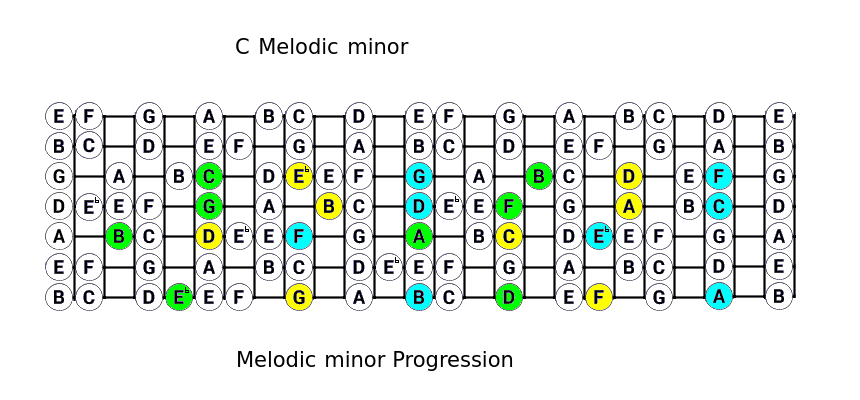
(Yes, 7 string and some big stretches.)
-
And THIS is why we shouldn't EVER teach chord scale theory to beginners haha. Originally Posted by GuyBoden
IMO the way we usually teach entry level jazz improvisation is profoundly broken. But that's another rant. It's also not something I can affect on my own.
The psychological framing of it if nothing else is just really unhelpful. You don't tell children to stop doing something - you ask them to do something you would prefer them to do (easier said than done.)
I remember the concern with 'wrong notes' or 'clams' when I was getting started. You start to dwell on them subconsciously, and lots of people seem to fret about that stuff. But in reality, no-one - musician or non-musician - perceives music note by note. We all perceive music as larger structures. Phrases, melodies, chord progressions, songs and so on.
This meme taught us that right?
Instead, I propose, give them options of RIGHT things to play, and not just single notes but phrases that make sense. Give them choice in what line to play where, but don't give them choice at the single note level. That gets them out of noodling.
You could do worse than get them to ply the LICC on a standard haha. The zoomers would like that lol.
-
I paid good money to be taught badly, I'll have you know. Originally Posted by Christian Miller




 Reply With Quote


New LEDs Day
Today, 07:28 PM in Other Styles / Instruments