


-
Hi James,
thanks. I have a Mac, so if you open your photo in "Preview" or "Photos" you can then export it as a PDF.
If you work on a PC then I have no idea!
I read through it a few times. Quite interesting.
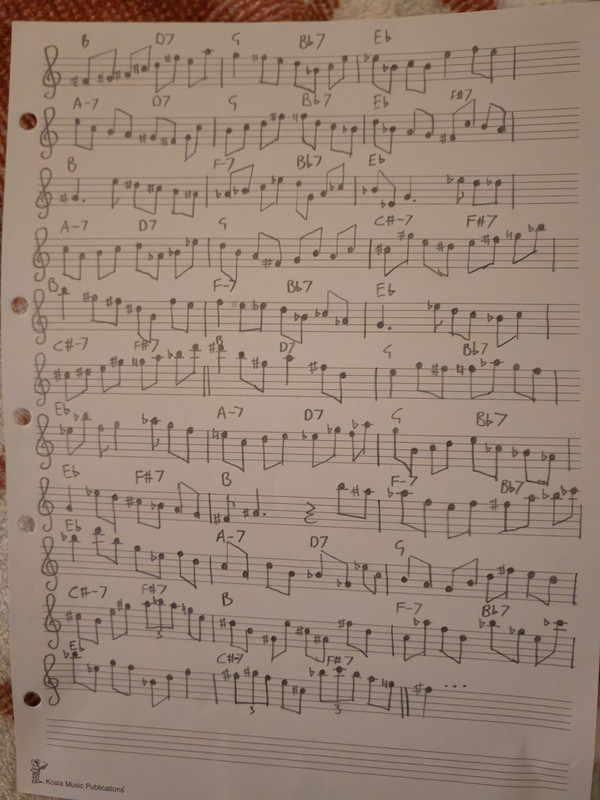
What I learned, (and this is just my opinion so of course play it as it sounds good to you) is that in the sections in the first three bars and then bars five-seven where it modulates quickly, if I alter the dominants too much it seems to lose the sound of the harmony somewhat. The "bridge" is a different story; there the dominants sound fine either pure or altered.
For example in your etude in the second bar with Bb7 you have an E-natural and on bar 5 of the second chorus you have alterations on the Bb7. Although it is a logical place to alter the dominant to its resolution, it loses the chord quality to my ears and sound a bit weak. Of course my goal is maybe stricter than yours as I am really trying to get the sound of the harmony in my lines without having someone playing the chord behind me.
The etude that I wrote is intentionally very diatonic and not meant to be played as a solo; it is just an exercise on a one line idea.
If you record your etude please post it. Please take my criticism as constructive as music is always subjective.Last edited by Question; 01-26-2026 at 08:13 AM.
-
01-23-2026 03:10 PM

-
A few choruses at 180bpm, wringing melodic lines out of this tune's harmony is hard work!
 Targeting chord tones helps.
Giant Steps Improv @180bpm - Box.com
-
I shared Dave Creamer's Giant Steps study here: Dave Creamer Exercises
-
 Originally Posted by James W
I didn't find it improved my improvisational ability to compose complicated lines like you have, although it's fine as a technical study. I found it more productive to take melodic motifs and phrases and develop them.
-
A good way to practice GS is to work on short musical motifs.

-
Here's a slow rendition. I'm not capable of doing it the usual fast way so here's this. And, yes, I followed a 'method' but if I told you what it was I'd have to kill myself

-
Here are two Etudes. The first one I wrote, which is more or less just one idea run through the changes
.
This second one is me playing an etude written by forum member JamesW. This is much more like a "real" solo and contains some very interesting melodic ideas. James studied composition, so there are some nice constructed ideas.
There are some stong melodic lines (I "borrowed" one or two to write into my practice book) and a few places that I think could be a bit less altered or resolved differently. This is of course a matter of taste. I especially like the two hemiola phrases near the end of the second chorus.
-
Cheers for playing my etude, Question!
I'll still upload a recording of me playing it soon-ish...
-
Hi james,
your welcome. I recorded my simple etude today so I just recorded yours as well since I was already set up.
I would like to hear you play it at a (slow) tempo that allows you to really articulate it. I think my version of your etude is about 125bpm; I would need a bit more time to play it any faster.
My etude is around 150 BPM if you want to give it a try.
-
I don't find that difficult but improvising long melodic lines over the changes is, and the one (short motifs) does not seem to lead to the other (long phrases), think I'll try a different approach. Originally Posted by kris
-
What an extraordinary an unusual tone and response! Originally Posted by mikeSF
Why does it sound like that?
-
I have a different vision of the GS exercise. First, you have to master short chord-progression combinations, and then build long phrases while playing the whole GS. Originally Posted by Mick-7
J. Aebersold Vol 75 - [Countdown to Giant steps]- GS is divided into segments - I recommend it.
-
The way I approach it is to come up with short phrases (e.g. 4 notes per chord), and try to voice-lead them, i.e. look for the nearest available starting note for the next phrase, and work out the next phrase from there, and so on. So basically trying to connect the 4-note ideas smoothly across the changes. Originally Posted by Mick-7
Of course at first it’s very slow and you have to ‘compose’ phrases rather than improvise them. But eventually it’s possible to chain these ideas together into long lines at a medium tempo, and if you do enough of it, a certain amount of improvisation starts to creep in.
Even Coltrane’s solo contains a certain amount of repetition, so I don’t think he was able to improvise on it continuously.
-
They sound somewhat disjointed when I do that, whereas imagining longer phrases and playing them does not. But to do that, I have to think in terms of 2 to 3 bars at a time, not in single bars of V-I, which the chord progression encourages. Originally Posted by grahambop
-
This is not an easy tune and requires a lot of work....To play with phrases correctly, you need to practice GS for many years. Originally Posted by Mick-7
And this can also be problematic at a high tempo.
-
Nothing should take years, that would be a sign one has a musical hearing/playing deficiency that needs to be corrected - or a serious lack of musical aptitude, which obviously does not apply to you. Originally Posted by kris
-
Playing a musical instrument is not only about hearing, which is the basis. Originally Posted by Mick-7
In addition, there are manual skills and creative abilities.
It also depends on what goal the musician sets for himself, the so-called jazz musician.
In my case, it is hard work for many years.
You won"t play GS after a year of practice.
-
Well, I've only played it a few times, haven't spent hours let alone weeks on it. If you know how to improvise, can execute the lines you hear in your head, then you should be able to improvise competently without much practice over any set of chord changes that is not really unusual. I don't think of Giant Steps' changes as being in that category, they are not that odd, e.g., the bridge of Have You Met Miss Jones has Giant Steps like changes. Originally Posted by kris
Of course soloing over it near the tempo Trane played it at is a different story, you're relying on memorized licks/muscle memory when you do that, I'd hesitate to even call it improvising. His solo sounds composed.
But I don't really understand what you meant by: "To play with phrases 'correctly' you need to practice GS for many years." What is "correct phrasing."?
I'll record a few choruses at 200 bpm, see how I do, you can tell me if I've achieved "correct phrasing."
-
This is an example of phrasing in GS-playing with phrases and mastering chords. Originally Posted by Mick-7
-
That's the sort of phrasing I try to avoid, aimless solos that are forgettable, you can't remember what you've heard when they're over. Originally Posted by kris
Giant Steps formulaic chord progression does encourage such pattern based phrasing and to me, not playing it like that is the challenge.
-
-
-
Really? Word on the street is that Trane practiced playing on this progression for 2 years before he recorded it. Originally Posted by Mick-7
-
Even if true, it may not mean much, because he was a perfectionist who practiced obsessively, period. Charlie Parker said he was a "devout musician" when a reporter asked him if he was religious but compared to Coltrane, he was a "Go to church on Sunday only" parishioner. Originally Posted by jbromusic
-
Here I am at 200bpm, attempting to be lyrical.
Giant Steps Improv 200 bpm - Box.com



 Reply With Quote


New LEDs Day
Today, 07:28 PM in Other Styles / Instruments