


-
If V7-I or IIm7-V7-I routinely moving in major 3rds is not formulaic/predictable, I don't know what is.
 Originally Posted by James W
Compared to say this:
-
01-16-2026 06:14 PM

-
That was really nice I like that completely. The pace and notes were cool one of best version I have heard. 15 Years ago too, do you still look this way Originally Posted by JDNC64
 ?
?
-
I just listened to Re: Person I Knew
First impression..well its Bill Evans..in some way I hear the echos of Kind of Blue..modal flavors..both major and minor at the same time.
I think one would have to hear this tune quite a few times to let the harmonic/melodic mesh sink in before taking it for a spin on an instrument.
In terms of practice material..combine this with Giant Steps. It will be good for your heart health.
I often end some tunes with the first five(six) chords of Giant Steps.
I get asked.."..what was that thing at the end..?"
-
Thanks for the nice words! Originally Posted by deacon Mark
I look nothing like that these days,
for better or worse.
-
Originally Posted by wolflen
I started to map it out, thinking of the min^7 chords as augmented 7th chords made it easier to handle but the progression remains nebulous.
-
JM's take:
-
Beautiful, but not exactly GS - if I'm not mistaken, some of the chords are stretched out to a whole bar rather than half a bar. Originally Posted by Woody Sound
-
John M is great but may I suggest that it might be more constructive if you post a video of yourself playing GS; or if GS is too difficult, then maybe ask how you might go about learning to be able to play it.
We all already know that there are countless musicians who can play Giant Steps well. (and probably thousands who can play it better than I ever could!)
In my original post I have offered to help anyone who would like to develop a strategy as to how one learns to play on these types of changes.
There are several players on this forum who can play Giant Steps well who could also offer some explanations as to how they learned to play on these types of harmonies. (for example JDM64 or Kris might want to explain how they learned to navigate GS)
I am here to learn as well as to share my experience with other musicians.Last edited by Question; 01-21-2026 at 02:23 PM.
-
I"ve been practicing GS every day for three weeks.
The better I play GS, the better I play other jazz standards.
I have a very good book"Coltrane-A Players Guide To His Harmony"/Weiskopf,Ricker/.
I'm slowly adopting the exercises from this book on the guitar - it's very creative.
The ways of fingering on the guitar are endless
GS is a brilliant tune.
Best
Kris
-
Here's a version I recorded a couple of years ago. Sounds pretty terrible to my ears now, and I'd welcome any feedback to help me improve in general, but I don't see myself coming back to this particular tune any time soon. There are many more that I'd much rather be able to play well, and playing it at a decent tempo is still beyond my basic technical skills.
-
Hi Cliff,
you are definitely on the right track. Playing short phrases as you are doing makes logical as well as musical sense.
I can hear that you are purposefully outlining the changes, despite a few occasional weak note choices.
You might try just playing the first four bars and adding a turn-around. (Maybe out of time first).
Like this: Bmaj7 D7-Gmaj7 Bb7- Ebmaj7- then C#min7 F#7 as a turn-around to get you back to Bmaj7.
I spent a fair amount of time building "pathways" through the changes. These are not really "licks" but rather short lines with good resolutions. I write these in my practice book. I almost always sing my lines (either out loud or in my head) while I am playing, which helps my phrasing since I have to breathe.
I am not able to remember specific lines very well so I found that working out what notes function well outlining the chords and how to resolve any line that I might build allows me to vary the notes, rhythm and phrasing in real-time.
I am definitely repeating melodic ideas (so is Coltrane!) but when I transcribe myself I realize that the repeated lines are never exactly the same.
I find it hard to describe what is going on in my head while I am playing, if you can ask me something specific I will try my best to explain it.
Hope that helps!Last edited by Question; 01-21-2026 at 03:50 PM.
-
Giant Steps is an entirely different species at the tempo at which Trane played it, around 250bpm, than it is at slower tempos, say, 180bpm or lower.
I am not a lick player and my solos on it start to sound like gibberish above 200bpm or so. They'd probably improve if I worked on it but I don't like the tune enough to do so. Moment's Notice, which also has difficult changes, is more to my liking.
-
Huh? I just though people would like to hear another guitarist's tribute. I think you have me mixed up with a different member/poster in this thread. Originally Posted by Question
-
Thanks very much! I really appreciate the advice. I do compose out-of-time lines through changes, but usually only two or three chords at a time. Maybe I should start writing them down too? Currently I have two sides of A4 with a bunch of short Bird and Benson phrases that I practice and morph through changes also. Originally Posted by Question
-
Hi Cliff,
I think the act of notating the lines encourages me to write a good one.
This also helps me to really understand and hear what makes a line effective or not.
You'll have to try it and see if notating them helps you or not.
I know this sounds contradictory, but I rarely if ever play the lines as I have notated them.
I realized this when improvising in 3/4 time and noticing that I am able to subconsciously in real-time modify lines to fit in both 4/4 and 3/4.
The lines are also usually 1-4 bars and focus more on the resolutions than the line itself. Sometimes they are just a little enclosure comprised of a only a few notes.
It would be difficult for me to play memorized lines literally (my own or from others) as you describe and get them to fit rhythmically and in phrases that make sense.
It is very hard for me to explain what is going on in my head while playing, but the lines morph and get combined in ways that are primarily guided by ear and not logic.
I guess my only concrete advice would be to play honestly and really "hear" what you are playing; if you believe in what you are playing it will have a better chance of connecting with the listener. Easier said than done, and the road to get there is long and full of technical hurdles that we are all trying to overcome.
In any case it is a process of transforming math into art.
I hope this makes sense!Last edited by Question; 01-25-2026 at 04:40 PM.
-
To be clear, none of the licks I practice against the changes really come out when I'm actually trying to improvise. But I do find that parts of them are beginning to, eg enclosures, pivots, maybe some chromatic approach notes.
Yep, definitely a long and winding road. The more I learn, the more I realise I've yet to learn .
.
-
No, no, no, you people have no idea. This is how

-
You have a faster thumb than Wes Montgomery – amazing.
-
I know, it's magic

-
-
After re-reading my explanation to Cliff I realize that it is a bit nebulous, so I wrote a fairly simple one chorus etude showing one concrete way to weave a line through these changes.
This is not what I would normally write into my practice book; those would mostly be much shorter and focused more on the connection of two or three adjacent chords.
This version is intentionally all eighth notes without any rests or phrases, which is definitely NOT how I would play it in a real solo. Having said that, it does represent how I might voice-lead my lines to connect the chords.
I did not concern myself with the sequences being "mathematically" correct or consistent, just what sounds good to me.
This is not meant to actually be played at the tempo of my video (278bpm) and I would not be technically capable of doing it myself. This is just to get started on one way to connect the chords.
I don't read/write TAB so if someone finds it worthwhile to post a version in TAB that would be fine with me.
Last edited by Question; 01-26-2026 at 10:40 AM.
-
Hi Kris,
Matteo is great, but I would prefer that you post a video of yourself playing Giant Steps.
I heard your nice Bossa version, posting that would maybe be more constructive than posting virtuosos like Mancuso who we all already know can play it better than all of us mere mortals. I would be much more interested in hearing your version and talking about how you learned to play GS.
I was hoping to keep this thread from going off track like my Giant Steps 2025 thread, which devolved into an argument as to which virtuoso player deserved the golden crown for his/her version of Giant Steps.
I am aware that I am not the moderator, so anyone is free to post what they like, but we have several players on this forum who could share their wisdom as to how they learned to navigate GS. I personally prefer that we discuss how WE do it, as all of the stars are already on YouTube for us to reference.
Just my opinion!
-
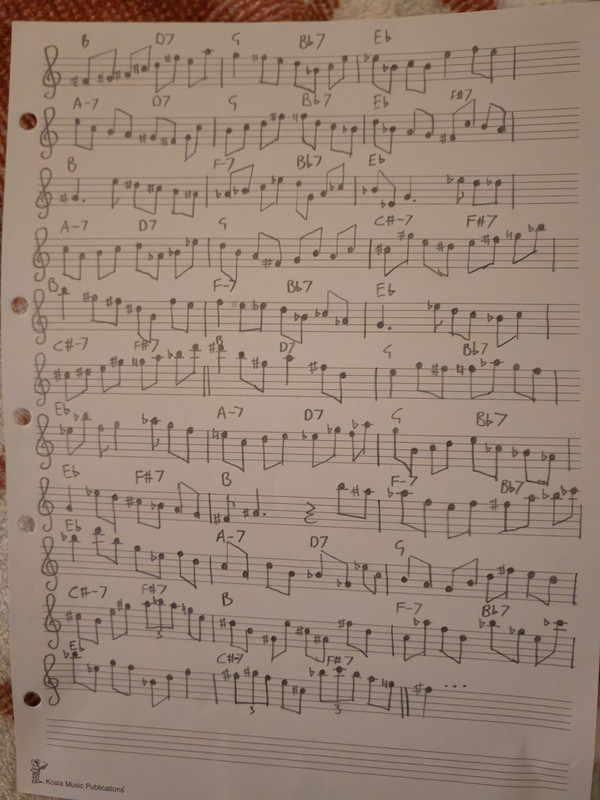
I started sort of re-learning this piece today. I say 'sort of re-learning' because I'm not unfamiliar with it, though never got to the point where I could improvise on it properly. I have a three-chorus etude I wrote some time ago which I've been enjoying reading through today. I could post an image of the etude if anyone expresses an interest...
-
Hi James,
yes, if it is in standard notation I would be interested in reading through it. Can you post a PDF?
I hope that people don't misunderstand my previous post; I dig Mancuso and John M, but we also have a pool of knowledge on this forum that is not available on YouTube, and that is what interests me more.
-
I don't know how to make a PDF, sorry. And it's actually two choruses, not three. Originally Posted by Question



 Reply With Quote


New LEDs Day
Yesterday, 07:28 PM in Other Styles / Instruments