


-
I follow this guy on youtube:
I'll give you a bit of background and then it might make more sense. I'm not really a guitarist, although I have owned and played guitars almost all my life. I'm primarily a pianist and organist playing popular repertoire from about the 1920s - 1960s. This is mostly the sort of great American songbook type stuff arranged as swing, foxtrots, quicksteps, etc. for organ. The same goes for piano, I play more or less the same repertoire just with more pianistic arrangements.
Why am I telling you this? Because I understand music as simple chords and melody with some embellishments, runs, fills, harmonic movement etc. I always read, I cannot just sit down and "improvise" and never try. If I do "improvise" melodies I'm simply using the chords from whatever tune is on the music stand in front of me and play an improvised melody against the accompaniment. It's simple, it works for me, I find it easy, I can sit and play for hours and entertain myself and others.
But I cannot do it on guitar. What I know and understand and my way of thinking from playing keyboard instruments does not make any sense on guitar. And it frustrates me because it seems like it should but I've never found a simple way to make it work. Guitar takes too much "thinking" for me for it to be enjoyable. I'm not thinking when I'm playing organ or piano, I'm enjoying playing music.
Anyways, the guy in the link seems to be doing it. He seems to be playing the guitar in the same way I approach music on keyboard instruments. You may think it's boring or "vanilla" or doesn't sound particularly modern, but that's fine, it's close to the style I'm trying to achieve.
Here's what I take from watching him play. He flows, it looks natural, there is none of the awkwardness usually associated with trying to play melody and harmonies at the same time on the guitar. He appears to be using just a few simple chord shapes, mostly on the top 4 strings with some bass notes on the 5th. I don't see him using chord shapes that involve the 6th string much. (By 6th I mean the low E). He's reading I think, in several of the videos he appears to be referring to an arrangement or a score. Which would suggest he's fluent in being able to read and find everything he needs under his hand, in the same way we would play a keyboard instrument.
What are those chord shapes he appears to be relying heavily on, he comes back to very similar shapes in almost every bar?
I notice that it "sits" well under the hand. He rarely has to stretch and for the most part he is able to find everything he needs whilst keeping his left hand in a relaxed 1 finger per fret type frame. When he does have to shift positions he's rarely having to move far.
You might have to watch a few of his videos to get the idea and see that he appears to be applying a "formulaic" approach to any tune.
I can find no other information about this guy other than the few videos on his youtube channel. I do suspect though that there must be plenty of players who used to play this way, I imagine if you learned to play in the 1950s and 60s this was probably not an uncommon approach.
I wonder if anybody knows any other players we could look up who have the same sort of style? I wonder if there used to be books, either method books or books of arrangements, again probably from the 50's or 60's, where tunes were arranged in this way? He must have learnt it from somewhere.
Thanks.
-
09-12-2025 04:24 AM

-
Contact the Player you like on the video and ask for lessons.

But, I remember the song from the famous Django version.
-
Yes, I've thought of sending him a quick email or something to ask if he's any advice. But I cannot find any contact details other than his youtube channel which appears to have a south African phone number in the description. I'm not sure he's even still active on youtube, his videos are from some years ago.
 Originally Posted by GuyBoden
Last edited by padraig; 09-12-2025 at 05:41 AM.
-
Not sure what you mean by "awkwardness usually associated with trying to play melody and harmonies at the same time on the guitar", he is harmonizing melodies with block chords as well as at times playing the melody under the chord by holding he chord shape (I watched some of his other videos). What would be an example of a jazz guitarist who does this "awkwardly"? Originally Posted by padraig
He stays very close to the melody. He is really more playing the tunes than improvising. He alternates harmonized melodies with licks and runs. These seem to be isolated ideas around the chord shapes sort of like runs.
It seems like playing in this style on the keyboard comes easy to you because you've internalized this type of vocabulary over the years. But someone who is not as experienced playing in this style would have to "think" more initially regardless of the instrument, I think. Yes, guitar is a bit less intuitive than piano but after a while the fretboard becomes your familiar territory.
Are you asking for someone to transcribe the chord shapes he is playing? or are you looking to get a more conceptual description of the players approach?Last edited by Tal_175; 09-12-2025 at 09:32 AM.
-
Here is a book from 1955 that's generally held in high regard: Amazon.com Mickey Baker
-
He's not reading that, he's likely got the melody memorized and he's glancing at the chords. This is pretty standard guitar player reading. we are illiterate and rely on a combination of rote memorization and ear training. I don't think he looks up enough to be reading staff notation. People playing from sheet music typically have their eyes glued to the page.
Looks like he's using standard chords too, stuff from the Mikey Baker book. There are a bunch of shapes you need to memorize and awkwardly recall for the first few years. You can always leave off notes to make things easier. Guitar harmony is an illusion, we imply complex chords with 2-3 notes a lot of time.
There just isn't a quick and easy way to move from guitar to piano. I've heard it's easy to go the other way, from guitar to piano, because all the awkwardness of guitar disappears and what's left are the notes, all laid out in a line. That might sting for you, but there's a reason why we are all crazy here.
-
By the "awkwardness" I meant the logistics of it. It is not so straightforward to sight read and harmonise a melody on guitar, it takes some forethought. There are choices about where to play the melody and implications as to what harmonies you can fit under it, this is the nature of the guitar. On keyboard instruments there aren't the same challenges. I can read from a score and not have to worry about where on the keyboard to find my notes, there is only one choice.... what the score says. I don't have to worry about limitations in choosing my harmonies, I can pretty much grab notes from any chord under any melody notes. Originally Posted by Tal_175
I was asking if someone could identify the chord shapes he's using because there seems to be some "formula" or system to it. He is using very similar shapes and using them often, it seems like he has a small group of familiar chord shapes and he's able to manage quite well with them. It's fine, I can sit and work them out myself, will take me a while but I can do it. I was just wondering if somebody here would be able to look at his playing and say "ah yes, this is how he's approaching it...." or even better, here are some other players who use the same approach and here's a book that used to be popular where this kind of thing was recommended.
-
This is so true. Originally Posted by AllanAllen
-
The Mickey Baker book has been suggested, the Mel Bay books and Levitt books will soon be recommend. It's not going to be quick and easy. I work out my own grips like the attached regularly. Originally Posted by padraig
G Melodic Minor Chords.pdf
Also, this will get you going on the mechanics, and some extremely basic chord shapes. You need technical/mechanical foundation with guitar. Like Joe Diorio said, if there was a shortcut I would have found it by now.
-
Perhaps it's the same way you get to Carnegie Hall. Practice. You appear to have spent a lot of practice time on keyboards , and there is no shortcut that I know of for it. Guitar perhaps requires even more practice than keyboard, because there are many places on the fretboard to play the same note. You need to get shapes and licks under your fingers, and that takes time and practice. That one quick trick for playing guitar well does not exist, IMO. If I knew of such a thing, I would have used it long ago, and so would every other guitarist on the planet.
-
It sounds like you're an experienced musician who understands the type of ideas used for this style of playing. The amount of forethought it takes to do this on guitar depends on the amount of harmonic ideas and movements you can access on guitar quickly. Otherwise you rely on analytical as well as trial and error methods to work out an arrangement. Originally Posted by padraig
There was a thread about members posting their solo playing recent. You can look through that thread and see if any of the player's approach matches what you want to achieve. I'm sure they'll share their thoughts if you ask them. In particular, Mr. Beaumont's approach comes to mind in terms of being similar to what you want to achieve:
This is the thread:
The Autumn of Solo Guitar 2024
-
He's a very good player with a textbook style. The chords he's using are basically the first ones you'll learn in most method books. If you worked out the chords by ear like you said, I bet you'd find there is more variety in chord shapes than you think. Reason is when good technique is employed the movements are so small they can barely be seen. When a beginner plays the finger move in inefficient ways. Originally Posted by padraig
-
Sorry, I think I've not been clear enough. I'm not a complete beginner at playing the guitar, I've played since I was a teenager. I can play it, I can play tunes, I can play chord melody arrangements, I can arrange my own. Originally Posted by AllanAllen
My point was this guy in the video seems to have a better way of doing it than mine and it's also different from a lot of other approaches that we see, which often sound a bit clunky and don't flow particularly well. Yes he is mostly following the melody more or less as it would be written on a lead sheet but he is also getting plenty of harmony in there too and it seems to be right under his fingers all the time. He isn't reaching or shifting. In fact his chords all appear to be very close together and he keeps going back to the same few shapes again and again. He is actually playing quite pianistically, with the minimum of movement and with good voice leading.
And at the same time his arrangement is "clean", it's the bare bones but it's also faithful to the original and the phrasing makes musical sense. It comes across as someone who can just sit and play the guitar in the same way I can sit at a piano. I've not seen many others that manage to keep it that simple. There are plenty of jazz guitarists who I listen to and cannot even recognise the tune, the melody being so embellished, the harmony so extensively substituted and the timing so heavily relying on rubato.
-
Not playing a bassline helps
-
You're right, he is, very understated. Question is..... which textbook and where can I find it!? Originally Posted by joe2758
I could sit down and play music with him. He can play. Something is not right with the world when these silly youtubers with video after video of sensationalist titles like "3 licks you must know to sound like Charlie Parker" have very little musical content yet hundreds of thousands of views, whilst channels like this guy who can actually play are completely unknown.
-
Absolutely! good taste like your example don't come by often. I really think the Mickey Baker book is what you are looking for. To play the style of this gentleman, learn the chords in that book, learn the melody to the song on the top 2 maybe 3 strings, then use the chords minus the bass notes here and there. There is also a couple arrangements in that book which I would say is aa very similar style. Originally Posted by padraig
Not to sound like a carnival barker, but some years ago I made a youtube series going through the entire harmony section of the book for beginners
-
Great, few people have mentioned Mickey Baker now so I'll have a look. Which book(s), I think there were a few weren't there? Originally Posted by joe2758
If you give me the link to your youtube series I'll definitely check that out too. Thanks.
There was another recommendation for the George Van Eps book, having just taken a quick look online I can categorically say that's not what I'm looking for. In fact, probably the polar opposite in terms of style.
-
You might like Jonathan Stout's Swing Guitar. Originally Posted by padraig
Jonathan Stout is an infrequent poster on this forum and on Band Camp.
"Front Porch Swing" Sheet Music/Tab (PDF) | Jonathan Stout
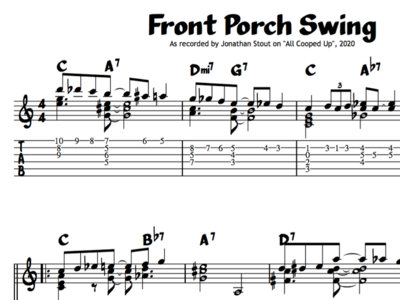
"All Cooped Up" Sheet Music/Tab (PDF only) | Jonathan Stout
Jonathan Stout blog: Swing Guitar Blog — Jonathan Stout and his Campus Five featuring Hilary Alexander
-
wow, 9 years ago. First few videos just show the chords, but that is just preliminary.
There's a story about Van Eps wife hearing him doing some arrangements and she said something like "you know they invented the piano"
-
Originally Posted by GuyBoden
One more Stout link, his online course for this style. Vol 1 and 2 are single note Charlie Christian style courses, no need to go through those first.
In The Style Of Jonathan Stout, Vol. 3 | DC Music School
-
I am surprised no one has dropped the B word yet. Especially given that the OP is a pianist, I can't imagine a better approach to developing flowing, horizontal harmonic movements than Barry Harris's.
Alan Kingstone has a book that shows the concepts on guitar. Another guitar harmony movement book with a piano heritage is Randy Vincent's drop 2 book which is based on Mark Levine's The Piano Book. Not surprisingly, there are a lot of overlaps between Alan's book (Barry Harris) and Randy Vincent's book.
-
Very true. I do think that may be a longer road to playing actual tunes though. Especially because OP seems especially interested in a minimalistic style. Either way, you should certainly look at BH stuff to use for your piano playing Originally Posted by Tal_175
-
Alternatively, Allan's (AllanAllen) PDF about melodic minor voicings exemplifies one of the most practical approaches. That is to learn how to harmonize the underlying scale with each chord type on the top four and middle four strings. This means playing the scale with different voicings and substitutions of a single chord quality. Later on, you can apply this to progressions by connecting different chord movements. Then you work on embellishing the movements with chromatic approach notes and dominant/diminished passing chords. I worked extensively on harmony on guitar, and I got the most out of this approach, which is also how Bruce Foreman teaches chord melody.
-
I see this in a totally different light. "On keyboard instruments, there aren't the same challenges"??? With all due respect, I think that's nonsense. I've been playing both guitar and piano / keyboards for many decades. Each has its own intricacies and challenges, but neither is less challenging. Simply coordinating two hands independently is a challenge. Both hands are pursuing the same musical end on guitar, but left and right hands are creating different and often disparate sounds on piano. Having multiple locations and fingerings for the same chord is a blessing as well as a curse. On piano, you have to know and weave melodic lines from one hand into inversions, harmonies, full chords etc from the other. Most guitarists with any proficiency at all have pretty equal strength and coordination in both hands because they develop together as you learn to play. Most pianists have less skill and facility at melodic and linear playing with their left hands but can find and structure chords with the left much more easily than with the right. Letting (or making, if it's a struggle for you) your hands work together is equally challenging on both guitar and keyboard. But the digital and mechanical skills needed to do it on a guitar are not the same as those needed for keyboard. Neither is easier or more intuitive - they're just different. Some players naturally pick up on one or the other easily and never master the other.
Many pick up multiple instruments easily. But I think that's more a function of the player than the instrument. Just as some people are visual learners while others learn better from reading, listening to, or otherwise getting new input, some people pick it all up and others become very proficient on one instrument and can't get a decent scale out of another. I've never been able to play an instrument tuned in fifths. I can play guitar and bass with great facility. But I've never been able to master violin, cello, mandolin etc. I can play a 5 string banjo well, but I just can't get comfortable on a tenor banjo. The other (and probably the most disappointing) hurdle I've yet to get over is the pedal steel. I'm great on lap steel, but after years of trying I still sound like a 3rd grader at his third lesson on a pedal steel. My intonation and facility are geat on slide guitar - but facility on the pedal steel still eludes me.
The keyboard is a visual instrument, and many players with even rudimentary piano skills use a mental keyboard visualization while playing other instruments. I've always been able to play any song in any key because I picture the melody in C on a piano while I'm playing a tune I don't yet know well (or am transposing on the fly) on guitar or trumpet or sax or any other instrument. The reason this works is that I can hear the intervals and locate them accurately on my mental keyboard model. The message is that you have to know your instrument well enough to visualize or feel the notes as (or preferably a tiny bit before) you play them. I know where every note on the fret board is located, so I can translate my mental keyboard image into a physical one on the guitar. Some have a mental sonic image and picture or feel the key signature and scales that I "see" when I play. But however you do it, you need to know where all the notes are and how to put them together.
If you'e a visual piano player, you can't transfer this approach to guitar unless you know the fretboard thoroughly. For some of us, it's intuitive. The rest have to learn it through repetitive practice. Mickey Baker's book is outstanding - it's the only book I ever bought for learning, and I got it when I was 13 or 14 on the recommendation of my music dealer. But unless you can translate the content into intimate practical knowledge of the fretboard, it's pure memorization and much harder to make intuitive. You need to know all the notes you're playing and differentiate the melody from the accompaniment / harmonization so that the melody or improvisation is heard clearly.
The OP's illustrative clip (I'll See You In My Dreams) is not what I think of as chord melody playing. The guitarist is playing the melody with scattered harmonic accents on 1 or 2 additional strings, and he's doing so over a backing track. All it takes is enough knowledge of harmony to add a few complementary notes. But, again, you have to know where all those notes are in any position in which you find yourself on the fret board. As for the use of only one or two positions, the entire melody spans less than an octave and a half. You can play the entire tune (even with full chord melody) without moving your hand very much.
EDIT: I found a much better version of the tune played as chord melody, even though it's over a swing rhythm guitar. I think the first verse (45 seconds) is probably even closer to what the OP wants than the clip he included. The second verse is single string, and it's great swing guitar - but it's probably not what the OP wants to be able to do.
When I heard the first few bars of the OP's clip, I tought he was going in a different direction, more like this. This is a great example of what you can do with it a la Chet. Perhaps the OP can find something inspiring and achievable in this (although it will also take a lot of hard work and practice to master):
Last edited by nevershouldhavesoldit; 09-12-2025 at 01:58 PM. Reason: typo
-
Thanks for your reply but that's really not the style I'm after. Originally Posted by nevershouldhavesoldit


 Reply With Quote


JJ music sales Ontario canada
Today, 04:01 PM in For Sale