

The melodic minor scale is one of the most useful scales in jazz. It’s the foundation for several important modes that are used over dominant, minor, and altered chords.
In this lesson, you’ll learn the 7 modes of the melodic minor scale, how they look on the guitar, and how to use them in your solos.
All examples are shown with an A root so you can clearly hear the differences between the modes, and each one includes a sample lick to put the sound into context.
If you’re new to modes, make sure you first learn the modes of the major scale. And if you’re looking for a practical introduction to when and how to use the melodic minor scale in jazz, check out our separate lesson How to Use the Melodic Minor Scale.
What Is the Melodic Minor Scale?
The melodic minor scale is a minor scale with a raised 6th and 7th degree.
In classical music, the scale is played differently ascending and descending, but in jazz it is played the same in both directions.
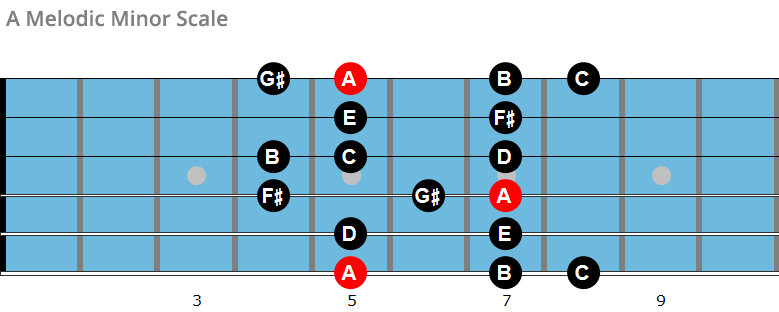
For example, A melodic minor contains the notes:
A – B – C – D – E – F# – G#
Compared to the natural minor scale, the 6th and 7th are raised. Compared to the harmonic minor scale, only the 6th is different.
| A Melodic Minor Scale | A | B | C | D | E | F# | G# |
|---|---|---|---|---|---|---|---|
| 1 | 2 | b3 | 4 | 5 | 6 | 7 | |
| A Harmonic Minor Scale | A | B | C | D | E | F | G# |
| 1 | 2 | b3 | 4 | 5 | b6 | 7 | |
| A Natural Minor Scale | A | B | C | D | E | F | G |
| 1 | 2 | b3 | 4 | 5 | b6 | b7 |
This change in interval structure gives the melodic minor scale a brighter, more modern sound and makes it especially useful in jazz harmony and improvisation.
What are modes?
A mode is a scale that is built from the same notes as another scale, but starting on a different note. Changing the starting note creates a different sound, even though the notes are the same.
For example, if you take the melodic minor scale and begin on each of its seven notes, you get seven different modes. Each mode has its own interval structure and characteristic sound, even though they all contain the same notes.
On the guitar, this means you can use the same group of notes over different chords and create very different harmonic colors depending on which note feels like the tonal center.
The 7 Modes of the Melodic Minor Scale
Here’s a list of the 7 modes of the melodic minor scale. The most commonly used modes in jazz are bold, the other are more “exotic” and appear less often.
- Melodic minor scale (jazz minor scale)
- Dorian b2 (Phrygian #6)
- Lydian augmented
- Lydian dominant (overtone scale)
- Mixolydian b6
- Aeolian b5 (Locrian #2)
- Altered scale (Super Locrian)
1. A Melodic Minor Scale
Other Names: Jazz Minor Scale
Use On: minor chords, min/maj7 chords
| A Melodic Minor Scale | A | B | C | D | E | F# | G# |
|---|---|---|---|---|---|---|---|
| Formula | 1 | 2 | b3 | 4 | 5 | 6 | 7 |
Listen & Play Along
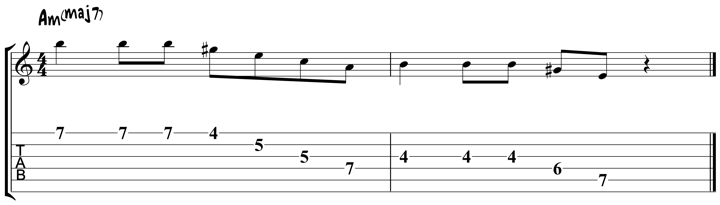
This melodic minor scale lick is based on a Wes Montgomery idea that brings to mind the classic solos of this legendary player.
Listen & Play Along
2. A Dorian b2 Scale
Other Names: Phrygian #6
Use On: b9sus4 chords
| A Dorian b2 Scale | A | Bb | C | D | E | F# | G |
|---|---|---|---|---|---|---|---|
| Formula | 1 | b2 | b3 | 4 | 5 | 6 | b7 |
Listen & Play Along

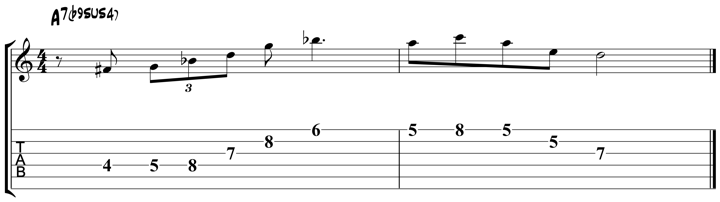
Here, you will play a line that uses an extended Bb note (the b9) to emphasize that color tone over the underlying chord.
When applying lesser-used modes such as this one, it’s always a good idea to emphasize the characteristic note to make it sound intentional and not like a mistake in your lines.
Listen & Play Along
3. A Lydian Augmented Scale
Other Names: Lydian #5 scale
Use On: maj7#5 chords
| A Lydian #5 Scale | A | B | C# | D# | E# | F# | G# |
|---|---|---|---|---|---|---|---|
| Formula | 1 | 2 | 3 | #4 | #5 | 6 | 7 |
Listen & Play Along

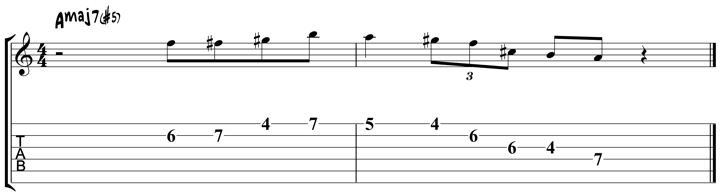
Here you will use a triplet rhythm, as well as start the line on the #5 of the underlying chord, both common ways to apply this scale to a soloing situation.
Listen & Play Along
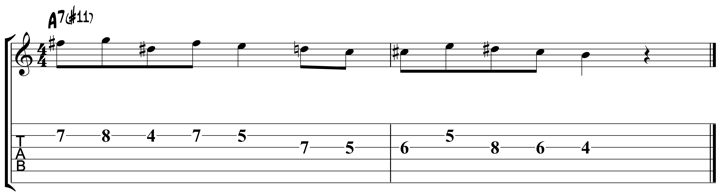
4. A Lydian Dominant Scale
Other Names: Lydian b7, Overtone scale
Use On: dominant 7(#11) chords (also see Tritone Chord Substitution)
| A Lydian Dominant Scale | A | B | C# | D# | E | F# | G |
|---|---|---|---|---|---|---|---|
| Formula | 1 | 2 | 3 | #4 | 5 | 6 | b7 |
Listen & Play Along

Here is a lick inspired by the playing of pianist McCoy Tyner, and uses a few leaps and an enclosure of the C# note to add color to the phrase.
Listen & Play Along
5. A Mixolydian b6 Scale
Other Names: Mixolydian b13 scale, Hindu scale
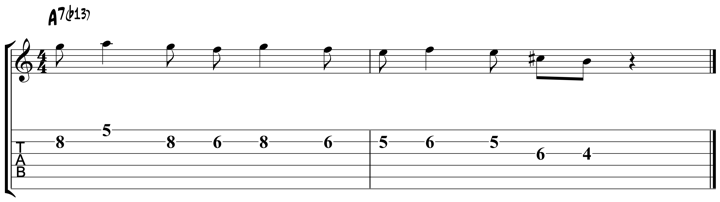
Use On: dominant 7b13 chords
| A Mixolydian b6 Scale | A | B | C# | D | E | F | G |
|---|---|---|---|---|---|---|---|
| Formula | 1 | 2 | 3 | 4 | 5 | b6 | b7 |
Listen & Play Along
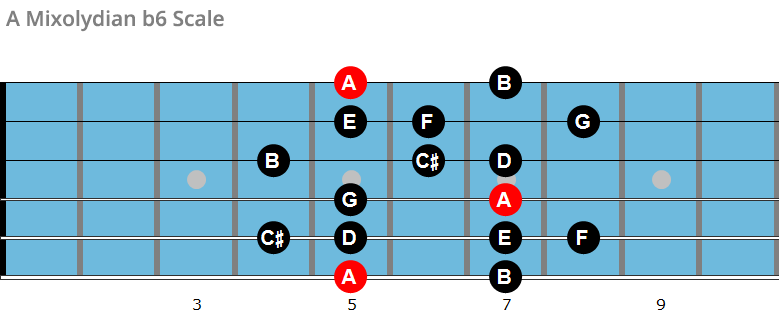
In this lick, you’ll use a rhythm pattern to work your way through the scale. Sometimes something as simple as a rhythmic motive can create a good level of interest in your soloing lines.
Listen & Play Along
6. A Aeolian b5
Other Names: Locrian ♮2 scale, half diminished scale
Use On: m7b5 chords
| A Aeolian b5 Scale | A | B | C | D | Eb | F | G |
|---|---|---|---|---|---|---|---|
| Formula | 1 | 2 | b3 | 4 | b5 | b6 | b7 |
Listen & Play Along
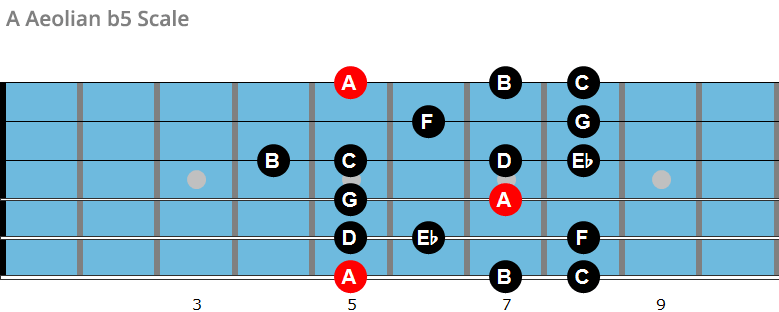
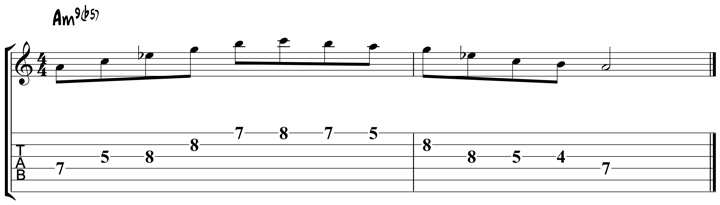
In this Aeolian b5 lick you will focus on the Am9b5 arpeggio as you climb up and down that shape to create this line.
Listen & Play Along
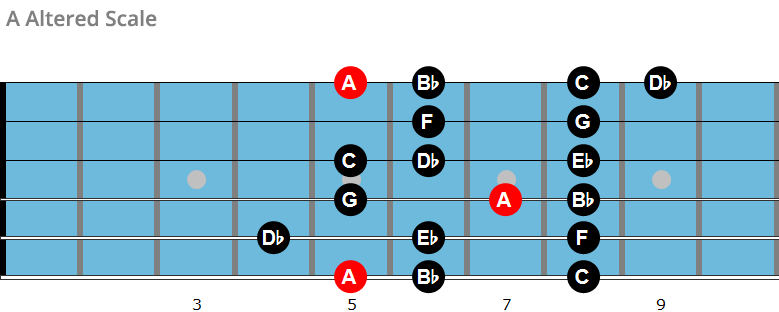
7. A Altered Scale
Other Names: Super Locrian scale, Locrian b4 scale, Diminished Wholetone
Use On: dominant chords with altered tensions, also see The Altered Scale
| A Altered Scale | A | Bb | C | Db | Eb | F | G |
|---|---|---|---|---|---|---|---|
| Formula | 1 | b2 | b3 | b4 | b5 | b6 | b7 |
Listen & Play Along
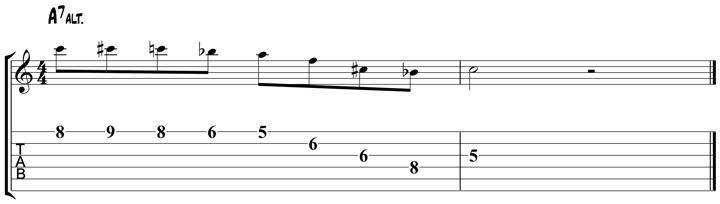
The final lick in this lesson is based on the playing of jazz guitar master Pat Martino, and focuses on the BbmMaj7 arpeggio that is diatonic to the scale.
Listen & Play Along
More Guitar Scale Lessons
Is there any recommended webpage or blog for bass guitar the same like this amazing one here? Please advise!
just use these patterns on the bass
Would be nice to be able to download the backing track too!
I was toying with combining Melodic and harmonic minor scales in the same lines. But I could find much reference on how to do that. I did discover from trial and error that the E harmonic minor scale complements the C melodic minor. And I can play them in succession against the B7 to Emin7 changes in Autumn Leaves (in key of E). Is there any Jazz theory that supports this, or is it just dumb luck on my part?
Yes, C melodic minor over the B7 = B altered scale.
Over the Emin7 chord, theory suggests using E natural minor scale to avoid the natural 7th contained in the harmonic minor scale. Tbh though, in that song, over the E minor in the key of E minor… you can get away with a lot.
Awesome stuff