


-
The blues uses I, IV and V. So does a lot of rock and folk music. Classical, too. In Jazz it's ii V I. When did the shift from IV to ii take place? I know the IV and ii chords are "close", and I tend to lump chords together, for simplicity, in major keys:
"tonic": I iii vi
"dominant": VI vii(half dim)
"sub dom": IV ii
But still, when did the shift take place?
-
11-18-2010 12:40 PM

-
BDLH,
The I vi ii V progression was the meat and potatoes of Tin Pan Alley popular music as far back as the 1920s. A close examination of the music of George Gershwin and his contemporaries will reveal chord progressions rife with I vi ii V, both direct and disguised.
This progression was so common that musicians referred to them as "Standard Changes", which is where the use of the term to describe those tunes came from. Joe Pass used this term to describe these changes. Other common terms were "Ice Cream Changes" and "Cantor Changes".
In the 1950s, the progression changed to I vi IV V and can be heard in numerous uptempo songs as well as ballads. Some musicians that I've worked with called them "50s Changes" to differentiate them from the "jazzier" I vi ii V changes.
Many of the blues performers of the 30s and 40s commonly used the I IV V progression but if you go back to the really early stuff such as W.C. Handy, Mamie Smith, Jelly Roll Morton and Bessie Smith, you can heard some progressions that are different from the plain I IV V.
Remember, also, that many of the ragtime tunes between 1890 and 1910 had some sophisticated harmony.
One of the best books I've ever read on early blues is Elijah Wald's Escaping The Delta. It's a very well researched, enlightening history of the early years of blues as popular music in America. It may well change some of your conceptions of the music.
I doubt that this actually answers your question but hopefully sheds some light.
Regards,
monk
-
Well, in all fairness, ii has long been a sub for IV, dating back before the Baroque. So I wouldn't really say that there was a shift. The decision that the IV is the "real" subdominant is completely arbitrary, dating at least back to Jean-Phillipe Rameau (1683-1764). (True, the ideas he codified had been bouncing around for a while, but he really brought it all together in a coherent system that revolutionized musical thought and is still the basis of how we think of music.)
Rameau preferred the IV because of the strength of major triads (he codified the idea that the I IV V are the primary chords) and the strength of the root movement from the other chords to the I (he also codified the idea that the "root" of the chord defined the chord and not the bass note.) True, ii could be used, but it was understood to be a sub for the "real" sub-dominant, IV.
But in jazz, we don't care about the strength of the triads - we don't even use triads. And while we lose the strong root movement from I to IV, we gain the strong root movement from ii - V (and leads to more consistent location of guide tones - its always the 3rd and 7th.) Jazz (certainly early jazz) put a lot of weight on the circle of 5ths. This is of course completely arbitrary, but so are most of the "rules" that define any musical genre.
I don't think that there was a real "shift". Classical music made an aesthetic choice for the IV and jazz made a different aesthetic choice in favor of the ii7.
Peace,
Kevin
-
Not to hijack but along similar lines,
Back in the 70's at college there was some discussion about progressions. Some players held to the idea that you could reduce everything down to V-I.
If you think about it, by the time we get done substituting chords and adding extentions one could make a convincing case for the idea that all the other chords are just V's or I's with extentions
The both the iii and vi are closely related to I. The ii, IV,and vii are closely related to V
If I wanted to simplify a tune I would 'reverse engineer' the ii-V's to be just V or undo the tritone sub (Emi7 A7 becomes Eb7, depending on context like in ATTYA). Same with the vii. vii = V
-
That explains so much more of what I've been reading lately with regards to the "rhythm changes" from IGR. I kept going over in my head why the hell Gershwin was able to come up with something that basically became the standard jazz changes.
~DB
-
Without disputing anything Kevin says about Rameau, I'm really not sure IV-V is preferred over ii-V in classical music. Especially classical classical - Fernando Sor, for example, uses ii, not IV, in every example I can think of of this kind of harmony. And my old piano teacher used to insist that Mozart only had one chord progression, V - I (which squares with ii - V, not IV - V). It does happen that the ii tends to appear in its first inversion, making it hard to distinguish from IV.
 Originally Posted by BigDaddyLoveHandles
-
Where I went to music school would say every piece of music can be analyzed down to a II-V-I by applying the chord subs.
I subs are III, VI
II sub is IV
V sub is VII
Gets down to what root/bass movement you want will determine which chord you use.
-
Doc,
Are all of those subs majors or should they be the relative minors where applicable?
~DB
-
Diatonic to the harmonized major scale. It easy to see just write out the chords and look at the other chords spelled within. Originally Posted by lindydanny
Like C Ma7 C E G B D F A (C E G)
I CMa7 C E G B
III Emi7 E G B D
VI Ami7 A C E G
-
I'm not putting myself forward as an authority, I'm not one, and there there's nothing wrong with any other convention, but I think it's a tiny bit quicker to read these chord symbols if we use capital Roman numerals for major chords and lower-case Roman numerals for minor ones, So Cmaj7, Em7 and Am7 would be Imaj7, iii7 and vi7. This refers chiefly to the third, the fifth being assumed to be a perfect fifth unless otherwise indicated (vii7b5).
-
I figured it was... I just wanted to make sure because I'm used to minors being written in small letters: Emi7 = iii rather than III.
This is a great topic!
~DB
-
I'm going to look over my daughter's piano books for some simple Mozart pieces and see. Originally Posted by JohnRoss
The question occurred to me because on another forum they were talking about good old three chord songs, "you know, I IV V"...
-
I don't know if anyone is interested in this, but I ran this together just a moment ago because I was curious about the relationships of all of the chords. This will probably hit some of you guys as a total newbie thing, but I figured I'd share it anyway.
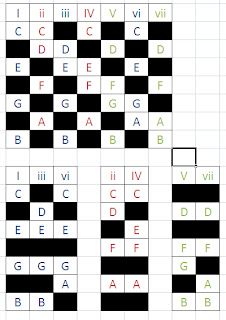
This makes me notice that the I6 is actually the fourth inversion of vi. Never really got that before.
~DB
-
I'm not saying that Rameau was saying that IV was better than ii, just that IV was the real subdominant and ii was its substitute. A lot of this distinction was based on the a priori assumptions that the major triad was "better" based on his work with the corps sonore and that the strong root movement should be relative to the tonic and not the root. Originally Posted by JohnRoss
I guess perhaps we read the question differently. I was not reading "I IV V" as a chord progression but as a collection of harmonies. In other words, are we going to think of the sub-dominant as a IV or as a ii.
As far as Sor, there are of course many examples of IV chords, but you may be right in the context of going sub-dominant to dominant, he may prefer ii-V (instead of IV-V). I'd have to look through the literature (The only Sor I do is the "Marlburough Variations," and that doesn't count as it is a borrowed melody/harmony.) It would make sense, that Sor, being so far removed from Rameau in time, that things had started to loosen up harmonically. You may be right that he prefers a ii before a V.
As to Mozart, if your teacher says, "Mozart only had one chord progression, V - I." Then it sounds like he learned from a Schekerian. Shenkerian analysis (for those who haven't had the pleasure/torture) is where you do a reduction of a reduction of a reduction (etc.) until you are left with a (typically) 5 note melody and progression like I-IV-I-V-I or a 3 note melody and a chord progression of I-V-I. This is true of nursery rhymes or symphonies. I even saw a Schenkerian analysis of side 2 of Abbey Road. I'm not saying it is right, but it is a very influential analysis and is very influential in American academia - many times being assumed to be the best analysis.
Additionally, Mozart was evolving out of the style gallante, where clear melodies over clear harmonic accompaniment was the rage for a while (as a reaction to the Byzantine lines of the Baroque, sometimes switching harmony every beat.) Pretty much by definition, Mozart's harmonies are going to seem simpler than Bach (before) or Beethoven (after). But he of course, did have a rich harmonic vocabulary and did use IVs a lot. Did he prefer a ii before a V? I don't know. I can hear in my head one of Haydn's symphonies where he went IV-V, but sorry, I can't remember which one (he wrote over 100.) I'm sure we'd find some cases in Mozart, but I don't know how many. By his time, the theories of Rameau had been fairly sell absorbed so he is not going to be applying them as pedantically.
ADDITION: Now that I think of it, Mozart and his buddies did have a habit of ending their symphonic works with repeated V-Is, may that could have been the origin of a joke: "Mozart only had one chord progression, V - I."
I agree. Unfortunately, there are some classical theory books that insist that they should all be uppercase and that you should understand from context. But it does seem to be prevalent in the jazz community to use the lowercase for minor and diminished. Makes sense to me. Originally Posted by JohnRoss
And just on a side note, the grouping of iii and vi as tonic harmony is arbitrary. In classical theory, a iii can also work as dominant harmony (because it contains the leading tone - Beethoven and Chopin were fond of this) and the vi often acts as sub-dominant (because it contains the 6th scale degree, the defining note of the subdominant.)
Peace,
KevinLast edited by ksjazzguitar; 11-19-2010 at 03:49 PM. Reason: addition
-
I used to try and focus on which case roman numerals I use but there is some much inconsistency out there I gave up. I do try to use lower case when talking a minor key.
-
and using a IIImi7 for a IMa7 give you a I Ma9 sound. Originally Posted by lindydanny
-
You can use that trick more generally to get a 9th sound wherever, for example subbing the viim7b5 for the V7. Originally Posted by docbop
-
Quite possible, but I think it's more like he just played an awful lot of Mozart - I spent an entire year with him working our way (laboriously) through Don Giovanni scored as a piano duet, as much as a harmony exercise as anything else, and it was crystal clear: V - I throughout. Originally Posted by ksjazzguitar
Incidentally, Rameau died in 1764, yet the dictionaries - English, not French, dictionaries, of course - date the origin of the word 'subdominant' nearly thirty years later. I know ('cos I've seen it while browsing just now, not because I know a lot about Rameau, or indeed anything very much) that he developed his ideas about the subdominant years after the Treatise on Harmony (1722), but years after he was dead? Anyway, I haven't found any definition of 'subdominant' that explains any relation to the dominant, which was what at first I thought you meant by 'real' subdominant (we were talking about X - V - I chord progressions, after all), which is what led me to the dictionary - evidently, I misunderstood you, it's the dominant-ish thing under the tonic that it's always been. How could anyone think that would be the ii, the supertonic? Well, apparently (you know this, of course, it was news to me), Rameau thought you could treat a ii7 and a IV6 as the same chord with two roots - double emploi, it's called, Chord Progressions in Tonal Music tells me, adding that the idea is "seen as a weakness in Rameau's theory of root progression." Considering that that is not very different from the way we look at ii7 and IV6 ourselves, I don't understand the weakness, but it does look a bit as if the 'real' qualification was the result of Rameau arguing with himself.
-
Perhaps, but I find Classical Era vocal works to be less adventurous harmonically than the instrumental music. I think that the vocal stuff tended to adhere more to the style gallante ideal of simple accompaniment (both in harmony and texture) so as not to obscure the melody. I haven't Originally Posted by JohnRoss
studied it in depth, but the Mozart and Haydn string quartets and symphonies I have studied have been more harmonically adventurous than his operas. I don't know for sure, but that's my perception. We never analyzed any of his opera stuff, and I think for that reason - they were just for enjoyment, not to challenge people listening skills. Just my perception.
Yeah, I can't remember exactly where this comes from - Rameau wrote several theoretical works. And unfortunately, Rameau's prose is famous for being obtuse and impenetrable. I can't remember what terminology he used for the subdominant - this was from a grad project from 2 years ago and I was more interested in his epistemology - but it is not uncommon to apply modern theoretical terms to old theories; we analyze Bach with Roman numeral notation even though it was still a few centuries away. I wasn't so concerned as to what he called the subdominant as to what he meant by it. Originally Posted by JohnRoss
I think we're on the same page here, but just to clarify, the subdominant is not called that because it is under ("sub") the dominant. It is called that (by my understanding) because it is the "dominant distance" (a P5) in the opposite direction, down. So the "dominant" is a P5 above the tonic and the "subdominant" is a P5 below the tonic. In the same sense, the iii chord is called the mediant and the vi chord is the submediant (the same diatonic interval, but in a different direction.) Originally Posted by JohnRoss
OK, John get's the prize - he's found a point where my BS finally runs out. I have no idea from where the logic for "supertonic" and "subtonic" (the b7)" comes. I'll have to leave that for someone smarter than me. Originally Posted by JohnRoss
Web site looks interesting, I'll have to check it out better when I have time. OK, took me a second to process about the labeling of the chords. Be aware that when John (and the web site) is saying IV6, he is not using this in the figured bass sense (first inversion IV chord) but as an added 6th chord, like a pop-musician might think of a 6 chord (a triad with an added 6th.) Originally Posted by JohnRoss
Yeah, Rameau was not perfect. He did fudge a little to get things to fit his theories. But he was a huge improvement over the past. Before him, theoretical works often had little practical application (they routinely complained about musicians playing "wrong" things - they might sound good but they contradicted the God-given theory.) Often the theoreticians weren't even practicing musicians but were philosophers or mathematicians. Rameau was one of the first guys to apply real scientific thinking - the rationalism of Descartes and the empiricism of Newton - and to keep in mind practical application. His work stunned theoreticians and performers alike. Even scientists from other fields admired his work, calling him the "Newton of Music."
For interested parties I recommend Thomas Christensen's Rameau and Musical Thought in the Enlightenment. For a more general music theory history, I found his, The Cambridge History of Western Music Theory to be amazing.
Peace,
KevinLast edited by ksjazzguitar; 11-21-2010 at 03:23 AM. Reason: typos
-
Aren't a lot of Hymnal hymns I - IV - V on piano? Originally Posted by BigDaddyLoveHandles
It seems to me, way back when I was just starting out on piano (various times in my life), that the first three chord forms I learned were those.
And it seemed like an awful lot of popular music in America, including those hymns, were based on those simple shapes on the keyboard and their tonality being "normal" for us Western European descendants.
The Methodist Hymnal has influenced everything from Hawaiian Slack Key, to slave songs. Everywhere missionaries went.
Is this a valid connection?
When I think of New Orleans, and then the reference to Gerschwin's "I've Got Rhythm" changes, I get this amorphous sense that ii-V-I was/is a "hip-i-ning" of I-IV-V.
One gave birth to the other? And that's what we're trying to track here? Does this make any sense?
-
Same thinking, supertonic is a Whole Step above the tonic; subtonic is a Whole Step below. Originally Posted by ksjazzguitar
Regards,
monk
-
Simple. The V is all a turnaround. Essentially, a ii-V is in fact, a "turnaround" to "I." Originally Posted by BigDaddyLoveHandles
"electric" BLUES: I/IV/I/I IV/IV/I/I V/IV/I-V/I-V
Jazz blues: I/IV/I/I7 IV/IV/I/VI7 ii/V7/I/V7
what's different (first off, the IV and the ii are interchangeable due to relative minor properties, setting up all kinds of new ii-V gravitaional centers, backcycling ect). Essentially a I-IV-V can be a I-ii-V.
Notice that in measure nine of the "jazz" set of changes features a ii subbing for a V, as ii and V are interchangeable due to upper tensions, common tones and dodeckaponics (the theory of think in terms of soloing over/using either the II chord and its notes, ect exclusively or the V chord exclusively in a ii-V cadnece, but not using both) Naturally, the V chord follows the ii, which leads to the I. Now, in order to create more motion, movement, tension and release, we sub the I in measure eight with a VI7 chord to gravitate to the ii. So in essence, a I-IV-V can becme a I-VI-ii-V. II-V is all about tension leading to release (I) ust as IV-V is tension (same thing as ii-V)
so you could take: C/C/F/G7------becomes C/C/d-/G7 becmes C/A7/d-7/G7
-
Right, but it is different logic. The subdominant is not "under" the dominant, it is the same distance down, the "dominant" distance from the tonic. The same with the submediant, it is the "mediant" distance down from the tonic. By that logic, the subtonic would be the "tonic" distance down from the tonic, but that of course is nonsensical - there is no "tonic" distance. Originally Posted by monk
I was just pointing out the change in logic. Perhaps they just mean "tonic" as in "tone" as in "whole tone."
Peace,
Kevin
-
I see what you're saying regarding the intervallic distance and you're right about the different logic. I misunderstood your initial statement. Originally Posted by ksjazzguitar
Perhaps whoever named the supertonic and subtonic was, in fact, referring to the supertonic being one step above the tonic and the subtonic one step below.
Regards,
monk
-
"Back in the 70's at college there was some discussion about progressions. Some players held to the idea that you could reduce everything down to V-I."
I have to laugh at this one John...when I was in college one of my professors held the idea that you could reduce everything down to just "I".
Sailor



 Reply With Quote


“Shearing style”
Today, 05:26 PM in Comping, Chords & Chord Progressions