

Billie’s Bounce, one of the most iconic jazz standards from the bebop era, was written by Charlie Parker in 1945 and is one of his most famous songs. In this in-depth tutorial, you will learn about the melody and bebop language used in this classic tune.

The original recording included Charlie Parker (alto sax), Miles Davis (trumpet), Dizzy Gillespie (piano !), Curley Russell (bass), and Max Roach (drums).
The story goes that Billie’s Bounce was named after Billie Holiday, but actually refers to Billie Miller, who was the secretary for Charlie Parker’s agent, Billy Shaw. That’s a lot of Billies!
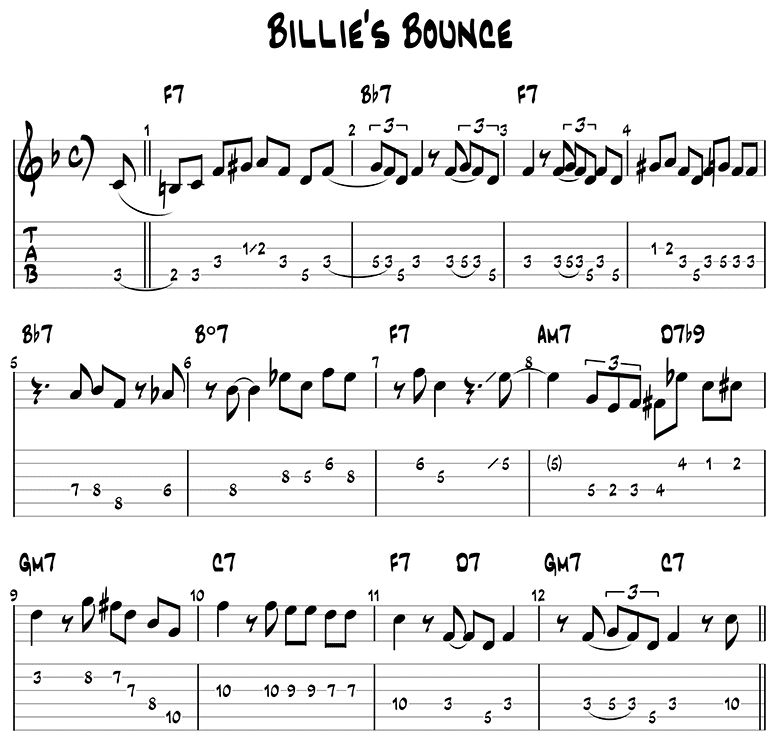
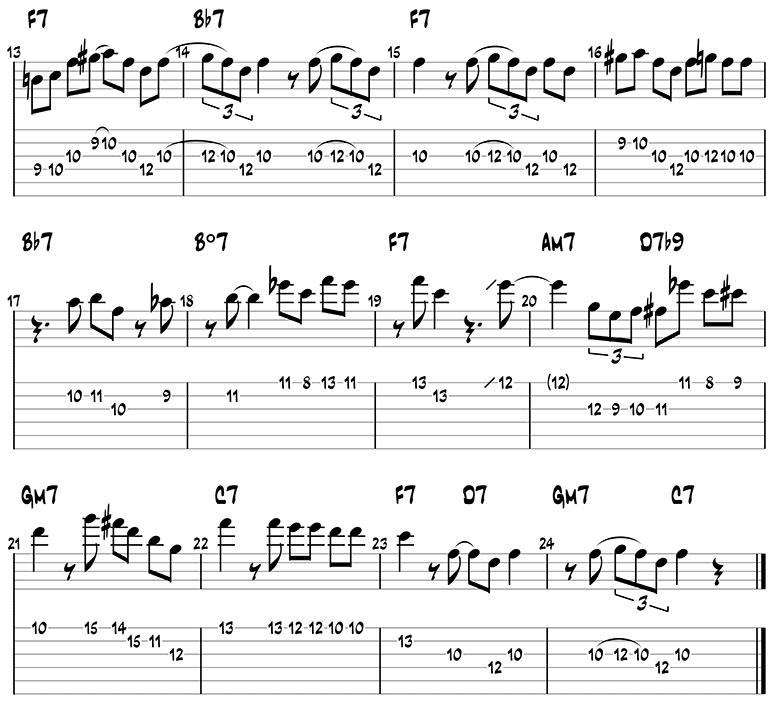
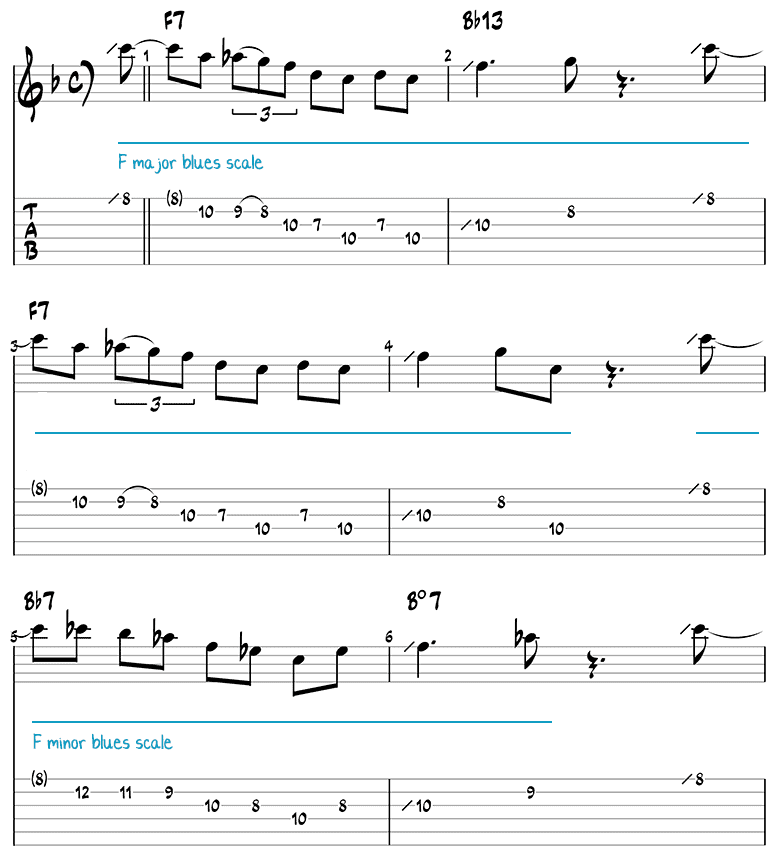
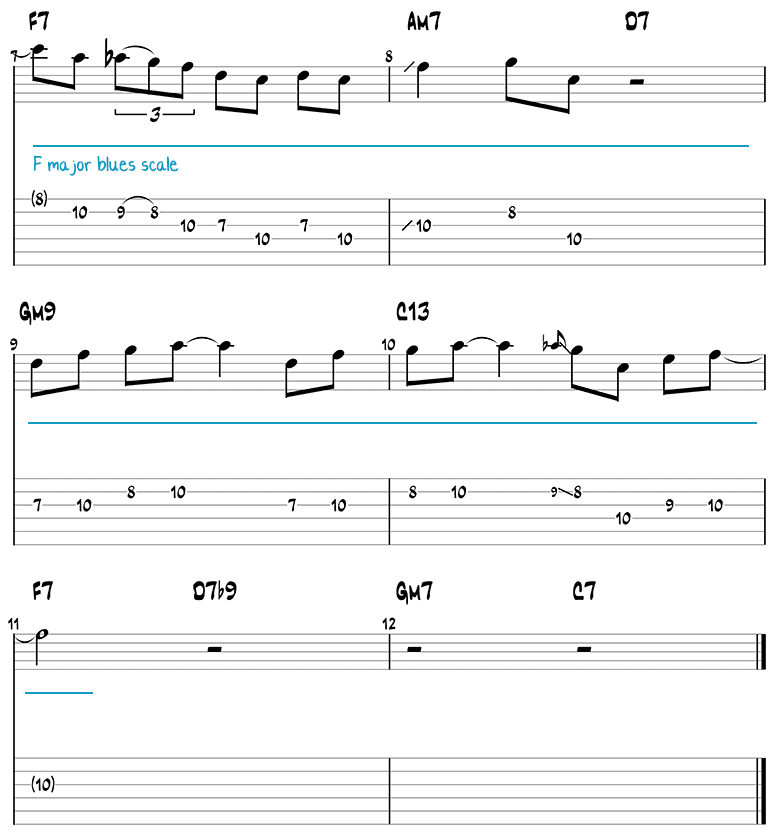
In this guitar lesson, you’ll learn to play the melody of Billie’s Bounce in two octaves. Practicing it will help you understand jazz phrasing and get comfortable with syncopation.
The melody uses syncopated rhythms, the F blues scale, chromatic approach notes, and enclosures. You will learn more about these features in the melodic analysis later in this lesson.
Billie’s Bounce follows a 12-bar bebop blues form in the key of F.
Download the PDF, GP files, and backing track with JGO+ (click here to join or log in)

Recommended listening:
- Charlie Parker – Charley Parker’s Ree Boppers (1945) → not my typo
- Chet Baker – Out of Nowhere Volume 2 (1954)
- Jimmy Smith (with Kenny Burrell) – Jimmy Smith at the Organ (1957)
- Stan Getz and J.J. Johnson (w Herb Ellis / Oscar Peterson) – At the Opera House (1957)
- The Red Garland Quintet with John Coltrane – Dig It! (1957)
- Wes Montgomery – Fingerpickin’ (1958)
- Eddie Jefferson – Letter From Home (1962) → vocal version with lyrics
- George Benson – Giblet Gravy (1968)
- Jim Hall – Live in Tokyo (1976)
- Jimmy Raney – The Master (1983)
- Oscar Peterson (with Herb Ellis) – Encore at the Blue Note (1990)
- Tal Farlow & Philippe Petit – Standards Recital (1991)
- Keith Jarrett – Tokyo ’96 (1996)
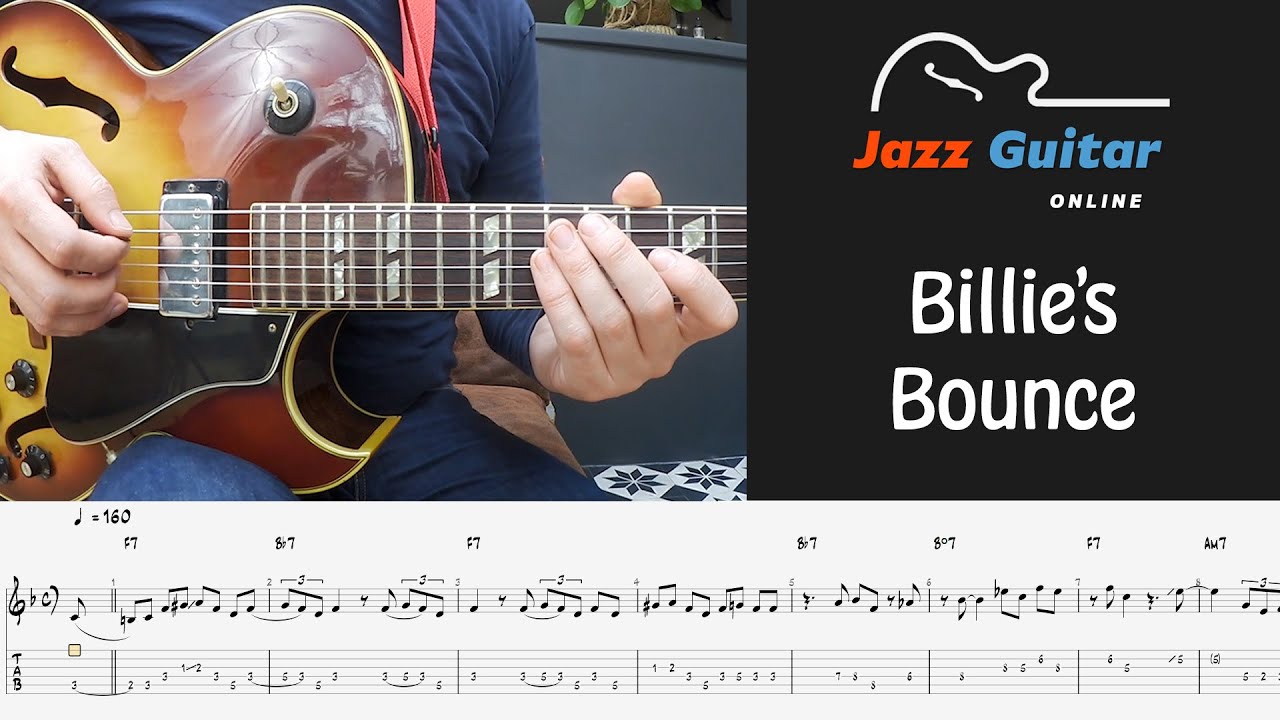
Billie’s Bounce – Video & Guitar Tabs
Backing Track
Listen & Play-Along
Billie’s Bounce – Melodic Analysis
Here you’ll find the analysis of the head of Billie’s Bounce, along with jazz patterns that are taken from the melody.
You can use these ideas in your own jazz blues improvisation over any F blues chord progression.

Take a look at our course Jazz Guitar Patterns & Phrases Volume 1 and learn 87 classic jazz guitar patterns that are great building blocks for your jazz guitar solos.

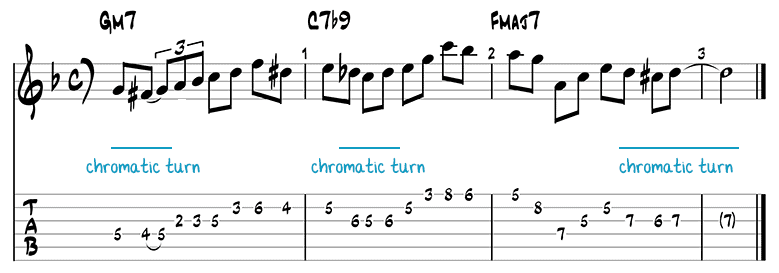
Jazz Guitar Pattern 1 – Chromatic Turn (Bar 1)
A chromatic turn happens when you play a note, then approach it again from its chromatic lower neighbor.
This technique adds both tension and release to your phrases.
Here is an example of this pattern over a ii-V-I in F major.
The F Major Blues Scale (Bars 1-4) and F Minor Blues Scale (Bars 5-7)
The first four bars of Billie’s Bounce use the F major blues scale.
On the Bb7 chord (bars 5-7), the minor blues scale is used.
You can use this approach in your own solos too.
In the following example, I play the F major blues scale, except on Bb7 (bars 5-7), where I switch to the F minor blues scale.
Jazz Guitar Pattern 2 – Chromatic Approach Notes (Bar 5)
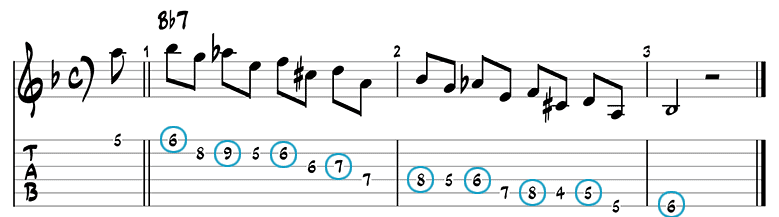
Chromatic approach notes are notes outside the key that lead into a target note, usually a chord tone.
They create tension, which is then resolved by landing on a stable note.
Here is an example of chromatic approach notes on a Bb7 arpeggio.
The circled notes show the chord tones of Bb7, while the other notes are chromatic approach notes.
Voice Leading (Bars 7-9)
Here, Charlie Parker uses voice leading in a clever way. The top notes F – E – Eb – D (which are encircled) form a descending F bebop scale.
Voice leading in a melody means connecting notes smoothly from one chord to the next, often by moving in small steps to outline the harmony.
Jazz Guitar Pattern 3 – Chromatic Enclosures (Bar 8)
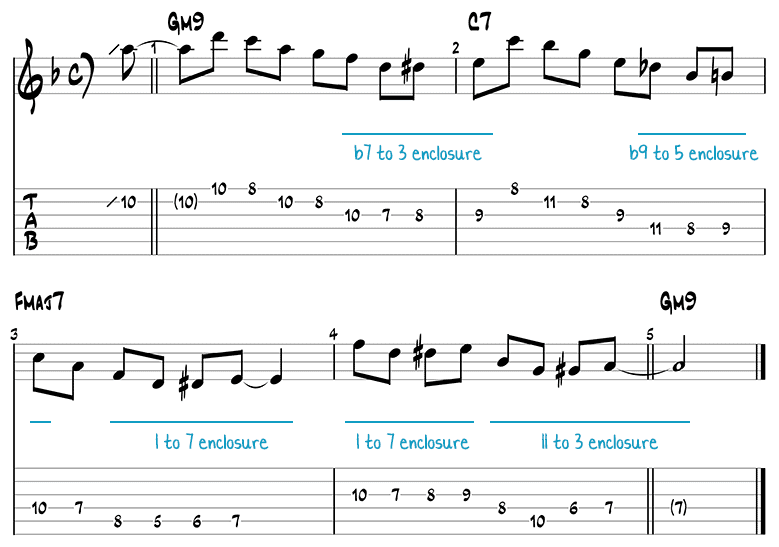
Chromatic enclosures are a common jazz technique where a target note is surrounded by its chromatic neighbors. This adds tension and dissonance to the phrase and helps create a sense of movement.
There are many ways to use chromatic enclosures. In this example, we start a half step above the target note, go down a minor third, and then move up chromatically to the target note.
Here are two examples:
- In the first example, the target note is the 3rd of C7. The enclosure starts a half tone above (F) the target note (E), descends a third to D, and then chromatically ascends (D#) to the target note (E).
- In the second example, the target note is the 5th of Fmaj7. The enclosure starts a half tone above (Db) the target note (C), descends a third to Bb, and then chromatically ascends (B) to the target note (C).

Here is a lick over a 2 5 1 in F major that uses these two enclosure examples and adds a few more ideas:
More Charlie Parker and blues lessons:
- Jazz Blues Guitar Patterns → Blues in F
- Cool Blues (Charlie Parker) → Blues in C
- Charlie Christian Grand Slam Solo → Blues in F
- Straight, No Chaser (Thelonious Monk) → Blues in F
- Blues Connotation (Ornette Coleman) → Blues in Bb
- Blues in C (Barney Kessel)
- Bb Jazz Blues Comping Study
- Jazz Blues Chord Progressions
- Jazz Blues Guitar Licks & Solos
Download the PDF, GP files, and backing track with JGO+ (click here to join – click here to log in)
Muchas gracias. Gran trabajo
Would love to hear you perform a model solo over this!
Hallo, hoe kom ik in de JGO?
Als ik het aanklik kom ik steeds op een pagina waar ik het kan kopen maar ik heb al een inlog gekocht.
Hallo Fred, je kan hier inloggen: https://www.jazzguitar.be/courses/my-account/
Click daarna op “My Library”
Ok werkt , bedankt
P.s. Geweldige website
I thank you for the insight to this material!
Kind regards Keith and thank you
Like it! I’m just going to the margins of playing outside, like everyone does today, yet staying with the melody, like Bird did.
Thank you – it was especially useful to have a recording with the slurs performed on guitar, as it’s a bit hard to decode how that translates from the sax recordings I’ve heard. Nice fingering, too, and your example recording swings and is worth emulating. I appreciate it.
This is fantastic! Thanks you so much for doing this. Great website!
Fantastic lesson and a Great website! Thank you!!!
Derrick Bartley
Great stuff, really useful.
Thank you Dirk for this great lesson. Superb!
Very good lesson! Thanks a lot. I love this theme.
Excelente material.
Muito bom, obrigado por postar essa lição!..