


-
Charlie PArker told me he used band in a box....trade secret
-
12-20-2025 09:43 AM

-
Miles Davis from Jazz told me the same thing
-
By listening to 33 LPs, picking up the needle and putting it back down again and figuring out what was being played. Yeah, I'm a non reader, even though I took lesson for a couple of years more than 50 years ago. Sorry.
-
The trick was to play difficult parts back at the next slowest speed - 33s at 16, 45s at 33, etc. The pitch was lowered, but it was usually easier to hear the individual notes. Many decent turntables had multiple speeds.
 Originally Posted by Midnight Blues
-
It’s so much easier to do now it’s crazy. Just being able to access the whole recorded history of a tune. Slow things down. Isolate tracks….
Sent from my iPhone using Tapatalk
-
I guess I had one too many glasses of wine last night because I just noticed that I misread the Thread title. Originally Posted by nevershouldhavesoldit
Anyway, that's very true and then you'd have to transpose it to the correct key. Mine had all three as well, so I did that all the time. Ruined a lot of records too!
-
And learn from people such as yourself Christian. Oh if only YouTube was available 50 years ago... Originally Posted by Christian Miller
-
Still, a good way to wear out your records, I taped the records with a cassette tape recorder to make transcriptions. Originally Posted by nevershouldhavesoldit
-
Why would playing a record at a slower speed wear it out any faster than playing at the recorded speed? Originally Posted by Mick-7
-
It's not that, it's playing it over and over that does it. Blank cassette tapes were comparatively cheap, plus you could reuse them repeatedly. Couldn't slow them down though, you'd have to use a reel-to-reel recorder for that. Originally Posted by nevershouldhavesoldit
-
True ‘nuf! But cassette recorders weren’t available until about ‘65 in the US. I started playing 10 years before that, AKA “way back when” Originally Posted by Mick-7

My father had a Webster-Chicago wire recorder when I was a little kid. I’m old!
-
Dropping and lifting the needle on the tracks also degrades them. So playing the same spot over and over degrades the grooves where you start and stop the needle. Eventually you’ll have pops and skips at your favorite part of the tune. Originally Posted by nevershouldhavesoldit
-
That won’t happen if you have good equipment and use it properly and carefully. The arm drop on any good tone arm (like my SME or Formula 4) is very precise and well controlled. If tracking parameters are set right and your stylus is properly designed, clean & intact, there should be no damage at all to disc or stylus. Originally Posted by AllanAllen
If you’re doing it with your fingers on a poorly set up, heavy arm on a marginal fulcrum, you can do some damage.
-
33 1/3 RPM records' signals require a phono EQ gain stage before passing through the line stage. The phono EQ does not know when you lower the speed of transcription of the record so the recovery curve is misapplied to the signal; be careful - it will have drastically more low end and less high end frequency not just from the frequency shift due to the lower RPM but because of the misapplied compensation curve (RIAA).
The signal from original tape is normal. That signal can't be used to make a record because the low frequencies would require too large an excursion of the groove (too big a wiggle) resulting in the grooves needing to be a lot further apart from each other. Likewise, the high frequencies would be so small they would pretty much not be heard during play back (so small a wiggle they would be down in the noise).
The RIAA curve is a filter applied to the signal during the cutting process that approximates making all the frequencies cut the same size wiggle for a certain volume level by reducing/increasing the low/high frequencies respectively.
During record playback, the phono EQ uses the inverse of the cutting filter to bring back up the low end and reduce the high end. The effect on the high end enjoys a companding effect similar to Dolby noise reduction - reducing the high end level during playback reduces the noise in proportion to how much louder the high end signal was during cutting compared to noise at cutting (a lot).
-
The facts are correct. But the effect is purely “cosmetic”. We did this to learn the notes, not for listening enjoyment. It sounds a bit off, but it’s a very effective way to learn or transcribe intricate or otherwise difficult lines. Originally Posted by pauln
I still have and listen to many LPs I bought in the late ‘50s & ‘60s to which I did this on specific tracks. I did it many times to almost every track on my original Incredible Jazz Guitar - I’d bet that I did it over 50 times to D Natural Blues and Airegin. It still sounds fine today, 64 years after I got it.
-
I suspect the record player I had at the time would not meet this qualification? Originally Posted by nevershouldhavesoldit
-
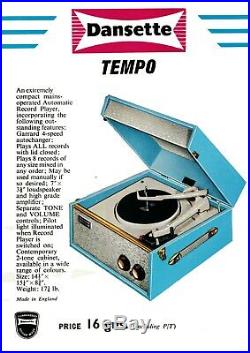
I remember we had a terrible sounding blue Dansette in the 1960's, but as children we loved it, until we broke it. Originally Posted by Mick-7
-
I must say, I'm really surprised to hear that a record player with such advanced "outstanding" features as playing with the lid closed did not have high quality sound to match. Originally Posted by GuyBoden


 Reply With Quote


New LEDs Day
Today, 07:28 PM in Other Styles / Instruments