


-
Recording from a gig in December. I set a Tascam DR-40X on my music stand.
Last edited by AllanAllen; 01-22-2025 at 02:01 PM.
-
01-22-2025 01:37 PM

-
Allan, do you need to change the sound of your guitar from rhythm to solo? Your solo sound should be much bolder and have a much fuller tone to be fully effective.
Otherwise I enjoyed it, it's all pretty good.
-
Probably, I don’t like pedals so I’m always trying to play around with the knobs to get a little boost that way. Sometimes I forget to boost it and other times I forget to dial it back down at the start.
Glad you think it sounded good. I do too. Listening back 6 weeks later. I forgot all the biffs I thought were obvious when I played it. So that’s cool.
-
Oh, I know that one pretty well! I'm all over every little note after I've played a solo. A week later I don't notice a thing unless it's seriously skewed :-)Listening back 6 weeks later. I forgot all the biffs I thought were obvious when I played it
Re. pedals, if I was using an electric guitar (which I would if I was doing jazz gigs) I think I'd probably use a pedal which would change the tone from rhythm to solo. As far as I know, it can be set up in advance. And one pedal wouldn't be too much to handle, it's worth the result.
But, watching other players, most of the time I just see them quickly turn a knob and that's that. Don't know how that works, though.
-
It's very simple...you just play much louder when it's the solo of your life.

You can use a simple guitar booster effect.
-
Here's one. If you go to about 8.15 you'll see him just turn the volume down. I suspect he's already set the volume and tone for solo-mode and then just turns it down after that. Rather than the other way round, I mean.
It's probably that simple.
-
I use pedals but don’t mess with them. Just volume knob.
-
Yeah, I try to get it sounding rich and fat at wide open, then go back from there. That's the plan anyway.
-
Its that stupid logarithmic taper that makes it weird
 Originally Posted by AllanAllen
-
My guitar came with non-original pots, I might have the other kind. The gear page kind of pots, lol.
-
Depending on how the pots are wired, the fattest tone may not be with either pot wide open. There are 3 common ways to wire guitar pots: Originally Posted by AllanAllen
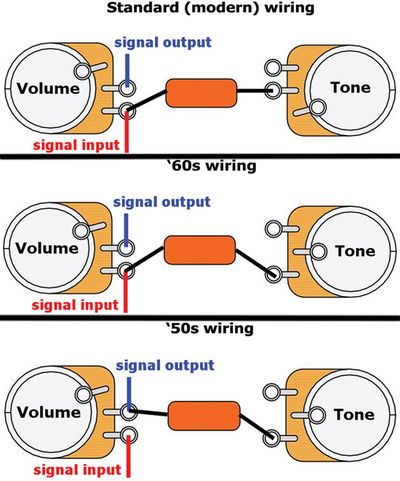
With "modern" wiring, treble drops disproportionately as you lower volume because the same amount of treble is being shunted from the pickup's signal to ground (through the tone pot) regardless of the output level of the volume pot. So rolling back the volume pot even a little bit fattens the tone. "Classic" or "60s" wiring is the same in this regard, but it's a bt better at keeping noise out of your signal because the tone pot's wiper is grounded regardless of where the tone pot is set. This shunts EMI to ground, keeping much of it out of the guitar signal.
With "50s" wiring, the tone pot acts only on the output signal from the volume pot and is decoupled from the pickup's inductance. This greatly reduces any change in tone with changes in volume pot setting. Many think the sound of the '50s wiring scheme is "bigger", eg it's been credited with the big sound of '50s LPs. By having the tone pot bleed treble from the output of the volume pot, it shunts more signal to ground as you roll back the tone pot and audibly reduces the signal strength. Since the resistance of the volume pot is a variable in the RC filter that comprises the tone circuit, the volume and tone pots are more interactive and changing either one will audibly affect the other.
I've always intended to take the time to rewire the same guitar and record it with modern and '50s wiring - but I haven't gotten around to it yet
-
I appreciate the effort, but that might as well be greek to me. I've read it three times and my head is spinning. I just don't get this part of guitars. I happen to have two pictures of the guts when I swapped the pickups. I don't know if they're useful, but I put them below.
Best I can get from your post is 90% might be the sweet spot, but now I'm going to be trying to juggle 80% for chords and hitting 90% for the good single note tone, and that's just too complicated for me. If I overshoot and have a louder shrill tone, then if I try to fatten it up I'm also turning the volume down and I've now spent 8 bars testing a note and playing with a knob.... not good for the show. Which is why I try to get wide open fat and the chords are what they are.
-
There are other ways of wiring guitars. I like this one, because it minimizes changes in tone as the volume is changed.
Bravo wiring diagram.pdf
I can't get the forum to show .pdf files, so sorry for no picture. If you don't want to download the file, the lower lug on the volume takes the hot from the pickup, and is connected to the center lug of the tone control. The capacitor is soldered between the case of the tone control and its bottom lug. The center lug of the volume control goes to the output jack.
-
Hey Allan - I really liked the tune, and your solo shows a great deal of progress compared with earlier things you've shared.
I agree with others that your single-line tone seems a little thin (comping is fine to my ears). My advice would be to practice playing with a lighter touch. Seems to me at the moment we're mostly hearing the attack, followed by the characteristic 'plink' sound when the vibrating string hits the strings. Try practicing with a lighter touch until that plink goes and the attack no longer dominates, and I bet it'll start sounding fatter. Of course, you will have to compensate with a change in guitar or amp volume.
-
Thank god I've only got an old acoustic :-)
-
Thanks to nevershouldhavesoldit and sgosnell.
Compare this:
With:
I've been using Cap to earth (ground).
-
I think you're trying to oversimplify this and make it objective when it's largely subjective. There's no single answer - it all depends on several factors. The values and tapers of your pots, the way they're wired, the presence and value of "tone caps", the height of the pickups relative to the strings, the environmental factors in the room, and even the strings and pick you're using all combine to determine how you sound. It'll be different in different places with different settings of your controls - hard, reflective walls and few people vs heavily draped & carpeted rooms filled with people, very high plaster ceilings vs low suspended ceilings, playing in a corner vs being in the middle of a large open space, etc etc. Originally Posted by AllanAllen
Even if you knew all those parameters, you couldn't mathematically determine your "sweet spots" or anything else. It's all up to your ears. Watch videos of top players and you'll see them all adjusting pots on their guitars while playing. You have to set up your guitar to give you as close to the sound(s) you want from the amp you're using as you can. But it won't sound exactly the same when you get to the gig, and you have to figure out how to judge and adjust for the sound you get there. You can use the % rotation of volume and tone pots as starting points and rough guides, but you'll have to adjust for each and every room. A lot of players use a parametric or multiband EQ pedal to compensate for gross differences in the room when they can't do so with the guitar's pots without unwanted changes in tone.
As for volume, your gear has to have enough juice to be heard in the band and to cover the venue. The higher the frequency of a wave, the more energy there is (determined by what's known mathematically as the "area under the curve"). If you "boost" your treble (which passive controls like the pots in a guitar accomplish by reducing the amount of treble bled out of the signal to ground), you will be putting out more acoustic energy and will be louder. But that increase is in the higher frequencies, which will make your guitar sound more bright / harsh / thin / whatever descriptor you prefer. And if you have "modern" wiring, increasing the guitar's volume pot also increases the high frequencies in your signal relative to the lows (which increases the apparent brightness /thinness).
I described those pictured wiring diagrams as 3 common ways to wire guitar pots, not the only 3 ways - there are many others. Here's one called the "treble bleed" mod. It lets the highs bypass the volume pot and will essentially eliminate the drop in highs when you roll off the volume with modern wiring:
I can't tell anything about your pots or wiring from those pics.
-
I generally find comping with my fingers and soloing with a pick is enough of a boost.
-
Neither can I. Originally Posted by nevershouldhavesoldit
-
For simplicity, I prefer a boost pedal of some type for switching between rhythm and solo. I own, and have used, several pedals that work well enough, including a JR Barnyard, a Joyo American sound, and a Boss GE-7. The Boss is perhaps the most versatile, and sounds pretty good with the AnalogMan mod. I can use it to boost the volume, or to lower it by using the gain slider. Depending on the guitar, amp, and my whim at the time, sometimes I set the volume for soloing with the GE-7 off, and turn it on to reduce volume for rhythm, and sometimes I set the volume for rhythm with it off, and turn it on for volume boost. It depends on which needs more EQ help. The other pedals are pretty much self-explanatory, but you can do the same with them if you need to. Again, it depends on which needs the tone adjustment of the pedal, but the GE-7 works better for this use, at least for me. At home, which is about the only playing I do these days, I just plug into the amp and make it sound the way I want, but for playing with others I think a pedal of some sort is usually necessary. It's quick and reliable. YMMV.
-
Guitar volume on "7" provides the right jazz tone for me - it quiets pick, finger, and string noise. I set the amp volume for solo level with normal picking firmness. For accompaniment I relax my grip and play gently.
In a trio, this is plenty of contrast, nothing too loud. I find the most effective is soloing from a sense of "normal playing" and all the rest from a sense of "reduced playing". This is opposite the idea of normal with a boost for solos, but it allows never having to adjust anything, and makes solos sound and feel natural.
-
At the gig last night I tried a mix of playing softer overall with more attack during solos and I did more knob fussing than I would normally do. Overall I think it was better, except when I'd get my wires crossed and turn the volume down for my solo! I tried recording it, but haven't listened to it yet.
-
…..in most rooms on that guitar at that volume with those pickups, pots, caps, wiring and strings plus that pick, that cable, and that amp. Originally Posted by pauln
The numbers on knobs are arbitrary, have no absolute meaning, and cannot be extrapolated to other guitars.
-
I grew up like most guitarists with rock/country/pop where pedals are the way we shape sound and most players just left the volume all the way up. Then I started to realize Jimi worked that volume control more than anyone, then I started watching guys like Kenny Burrel and Barney Kessel and saw them just turning knobs mid solo to get the sound right. So I think a lot of the answer lies in the fact that good players are always listening to the band and themselves and making adjustments.
I set my archtops so they get some grit when I dig in with volume at full, and dials down to more muted when I roll off to say 60%. Every guitar is different, but if you aren't already start thinking of the volume as more of a "gain" control than true volume control. I like to keep it simple, most comping is 60% most solos are 90%, and an extra 10% at the top for when I really need to cut through. And I roll off the tone for more traditional jazz sound, but it's got the added bonus of being able to crank the tone up to cut through if needed or create some sonic space when everything is competing for those creamy mids.
As far as the playing goes I like it a lot. You have a really cool part around 4:05 that I like, and some nice chords you stab right after that...very cool. And the comping seems really solid throughout. It does get to feel like you our outlining chords without much thought about melody after that first chorus...but I'm preaching to the choir about htat as well! Thanks for posting, I really enjoyed listening.
-
Nice, good to hear you playing and improving Allen. Nice rhythm playing which as I’m sure you know is 90% of the gig.
For the soloing stuff I don’t think there’s necessarily anything wrong with the tone for that kind of music, but if you are striking the strings quite hard with volume low the sound dies on the vine faster. On the other hand the percussive quality can be nice.
When you started playing some high register chords it was really effective and I wonder if you couldn’t work towards integrating the single note stuff and the chords more? Think of the chords as a source of single note arpeggiations
Sent from my iPhone using Tapatalk


 Reply With Quote


New LEDs Day
Today, 07:28 PM in Other Styles / Instruments