


-
Well the point is not that everything sounds good there’s no mistakes, bro - but your internal perceptions might have little to do with the music as it actually is.
 Originally Posted by starjasmine
It is quite often the case that I realise that what I intended to play wasn’t great and what I unintentionally played was better - but that’s almost a cliche at this point .
A massive one is time/feel. You have to learn to couple your internal feeling with what is actually in the pocket etc. This required quite a radical realignment for me.
Sent from my iPhone using Tapatalk
-
02-09-2026 05:16 AM

-
Interesting question. The answer is not obvious to me. Originally Posted by Mark Kleinhaut
“Music theory” as jazz musicians call it is often practical skills and resources for making music. So that translates into things you should ideally be able to hear. You should know what a Dorian mode sounds like, if you are going to use one to improvise, for example.
(And btw I think people often hear more of this stuff than they think.)
And the time honoured way of doing that is going to your record collection.
But yes there is a disconnect. I’m kind of thinking there shouldn’t be. Music theory in the grand sense is more abstract, but as I understand it even things like Schenkerian analysis are meant to be about guiding one’s perceptions on some level.
Sent from my iPhone using Tapatalk
-
No. Some schools even designate ear training as a “lab” corresponding to a theory course. Originally Posted by Mark Kleinhaut
Wait what? Why does a collection of notes get a name that complex if not to help designate its assumed function?If you play me a chord and I say that’s a G7b5 it’s a simple statement of fact. True or false, nothing’s theoretical about it.
And I mean honestly that’s a perfect example. Because I might say “false — it’s a Db7b5” … which is also true. The label we choose is 100% a consequence of the theory we applied in that case.
-
All chord names have multiple alter egos depending on which note you choose to call as its root, or an unplayed implied root for that matter, and it always assumes a function. If the definition of theory is simply that we stop and think about it (name it, consider function etc) then I’d agree it’s happening constantly. All I know is that when I’m playing there is no time for any of that. Still, the non verbal ear training part of the brain does keep up real time responding to harmonic changes instantly and proportionally. That’s why I associate ear training with the fast subconscious and thinking with the slow consciousness. Also aligns with my experience that to play well, consciousness must surrender control to the subconscious mind. Literally, I tell myself to go fuck off Originally Posted by pamosmusic

-
Even if you don't consider categorization of schemata, chords, scales, etc to be music theory, I believe you acknowledge that they are not music either. They are concepts that are used for teaching, analysis and communication. They are not completed pieces of art to listen to. Originally Posted by Christian Miller
There is a useful distinction to be made between the aspect of music theory that codifies "what" vs the aspect that codifies "why". I think you believe that codified "what" is too useful and practical to be considered theory? One can just as easily argue that codifying "why" shouldn't be called music theory, instead, it should be considered a subbranch of psychoacoustics. That gets us into what the term "theory" means and what not. Since most people's use of the term falls more in the first category and definitions are conventions that are hard to change (and in this case it's not even that clear what the change should be), I think this distinction is getting more attention than it deserves on the forum.
-
I think I have a hard time with the idea that labeling a chord and choosing from its synonyms using traditional nomenclature of functional harmony isn’t theory. Originally Posted by Mark Kleinhaut
I hear you on the other bit, and I don’t love language analogies, but that’s sort of like saying I don’t use grammar when I’m speaking.
I don’t think about grammar when I’m speaking but that’s not really the same thing. Whether I picked up the rules from English class or just from lots of speaking, they are in use and they’re relevant. No one actually thinks about them in real time.
Music isn’t a language in the same way, so sure some beginners think about theory and it’s easy to flip into that mode when you’re not feeling it. So we’re not as fluent as we are with spoken language or whatever
-
I wish there were different words for them that were widely understood. I don't care what they are. Originally Posted by Tal_175
The distinction is valuable because some things are worth getting into and other things are less relevant when learning to play jazz or whatever.
Asking why a II V I works from a theoretical perspective for example is not particularly relevant. Practicing a load of ways to play on II V I's in all keys is. etc etc
If you go and do a degree in music you choose if you want to do an academic degree or a performance degree.
-
I think it is taken for granted that working on what you call "slow consciousness" is a way to improve the "fast subconscious" ear with or without sufficient evidence. There are also ways to work on the "fast subconscious" directly without involving the abstractions of the conscious mind. For example singing a phrase and playing it without an intervallic or relative pitch analysis or hearing a chord while listening to a record and playing it without identifying what that chord is in chord-symbol terms. One still has a certain "feeling" associated with the chord quality or the intervals in a line. But that doesn't have to be a conscious name and remain at the "feel" level. Originally Posted by Mark Kleinhaut
There was a recent thread on this and I tried to press this issue and asked if there is any evidence that involving the "slow consciousness" is a more effective method for improving "fast subconscious" ear rather than the direct approach. It didn't get any tracking unfortunately.
-
To me, music theory is analogous to geology. That is, music theory, like geology, is an attempt to describe what happened, but in no way **determines** what happened. The music, or the earth, behaved like it did because of what it was. The "theory" tries to describe it so that you can do it again, deliberately.
Sometimes the "theoretical" attempt at describing something is the best the analyst can manage, but is wrong or unclear in some way. If that happens, try describing the event a different way.
-
I don’t know how this thread evwr got so long, but somewhere upstream I was saying that what you’re calling the direct approach is something that can and should be worked on. Otherwise, the entire process of pulling up unconscious material is needlessly left to chance. I don’t think direct or indirect input is necessarily better than the other. They seem different but rather compatible and can be utilized by each of us as we wish. You can only look at the results right? I will say for myself that most of the more advanced sounding things I play (and I’ve littered this forum with hundreds of videos) were developed using the direct approach with extremely little analysis or thinking. Originally Posted by Tal_175
-
I have been doing that exercise that Kessel suggested and I am finding that I absolutely do end up still thinking about scale degrees. Especially for the first note of the phrase. Once you have that the rest is mostly steps and leaps. So, I personally, think that, yes, the "slow consciousness" approach is very valuable. Originally Posted by Tal_175
-
Just play a single note, any one will do. It’s hard not to be content with that in itself for very long. Once you add another, then we experienced musicians can’t help but hear associated chords, keys, movement. I find that both useful and very, very annoying!
Even Ornette called the interval of the notes A and B a flat 5 - see if you can figure out why.
I put up a video yesterday in a thread discussing non-US guitar makers, in which I played a Bb Blues on a Hagstrom. I hated the video, as all it proved was that I had learned a bunch of cliches that are associated with that jazz form. I have to be careful here, as some members are striving to be able to do just that. But for me it is a signal that I wasn’t really communicating in my own way with sound.
Many members here know that I suffered a bad illness in 2024, from which I’m still recovering, and one of the outcomes is that I no longer play anything. I have a psychological block that is stopping me picking up any of my guitars, as every time I look at them I am reminded of my illness, and also forced to accept I can’t play like I used to.
I mention this because my attempted cure is to buy yet another guitar - in this case an Atkin Essential 000s, arriving tomorrow - and my plan is to start with that single note I mentioned above, and to try to evolve from it my own sound world. Not jazz or any other style, try to free myself from what seem like chains, and it doesn’t matter if I succeed or fail, as just doing it is enough. I doubt it will be for public consumption.
I mention it here as Mark has been a shining light to me in finding your own voice, and I’d like to publicly thank him for that. I’m not as bedded in jazz as most of you are, though I love it, but have many other influences that are bound to come out. But my aim is not to aim for anything, just be in music again. Thanks, Mark.
-
What the hell, Rob? I had no idea about any of this! Not playing anything? No! That can not stand! Originally Posted by Rob MacKillop
I’ve never got the hang of the PM function of this board (nothing I ever write is saved) so please email me when (if) you feel like it. -Mark
[email protected]
-
A harmolodic thing I guess..... Originally Posted by Rob MacKillop
In a Downbeat interview excerpted in John Litweiler’s Ornette Coleman biography, Don Cherry provides a definition of Harmolodics that for me feels both precise and yet somehow also makes perfect sense (!): "If I play a C and have it in my mind as the tonic, that’s what it will become. If I want it to be a minor third or a major seventh that had a tendency to resolve upward, then the quality of the note will change."
From: Harder Bop: Defining “Harmolodics”
Here's hoping your journey of 1000 chords starts with a single note, Rob, I always appreciate your sharing here.
-
I appreciate your zero BS Mark
I do the same approach to playing
tunes/changes myself
(although I have a tiny fraction of your
bag and no counterpoint to speak of)
it’s so nice to know that’s what you do
there’s some great people on here
I learn a lot ….
Ps all power to you Rob !
-
Yes, all the best to you, Rob! I hope the new axe inspires, thrills and gratifies you!
-
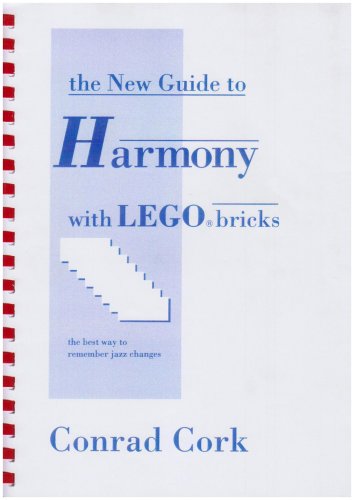
I bought the original "Conrad Cork: Harmony with Lego Bricks" about 25 years ago.
I'm still try to use the "Lego Bricks" method to hear common progressions when improvising. Recognising where phrases fit over common changes.

JazzGuitar.be/forum/LegoBricks
-
Looks like a method for mapping out song forms; that is totally and completely different than what I was thinking about Originally Posted by GuyBoden
. Good thing I had no plans for a book or anything
-
Yes, Mark, seems you prefer to stay in the pink Lego block room shown in the chart that GuyBoden posted..... Originally Posted by Mark Kleinhaut
Doesn't have a point of view
Knows not where he's going to
Isn't he a bit like you and me?
-
. Originally Posted by Mick-7
Absolutely. maps are the antithesis of discovery.
-
My horn experience on only the Bb clarinet never required self transposing, but I imagine pro horns readily transpose their instruments with music written for nontransposing instruments, music written for their transposing instrument but which is being played in another called key, and even music written for a different transposing instrument from their own, and maybe even that latter and additionally to a different called key. Can't they do just about anything needed to align to any concert sounded key from any music score? Originally Posted by Rob MacKillop
Maybe with no score and the nature of free jazz, the easiest reference point in the moment might be the flat five sound of a melody line. Maybe the interval A to B connected to flat five is some kind of reference relating to the Eb tenor or Bb alto.
I have fooled around with the piano for a while pretending transposing and have not found a universal way for specific "A to B as flat five" to apply. In a score written in C for Eb tenor, concert flat five Gb of C would be sounded by fingering A in the score. That is as close as I get and that's not universal except C. Maybe free jazz is never having to worry about any key but C?Last edited by pauln; 02-10-2026 at 08:40 PM.
-
It would be the b5th of an F^7 or F7 chord, the note A being the major third of the chords, that would be my best harmolodic guess. Originally Posted by pauln
-
I"ve never had Lego blocks.
-
I had 'Stickle Bricks'. An inexpensive imitation of 'Lego Bricks'. Originally Posted by kris


-
Originally Posted by kris



 Reply With Quote


Last 8
Today, 05:54 AM in Improvisation