


-
Not sure who said that, but I've seen it often. Anyway, what do you think this person meant by this - that he gave us continuous stream of 8th notes? Or that he gave us a straight 8ths feel as opposed to swung 8ths?
-
09-10-2025 01:35 AM

-
Well, the continuous stream of eighth or sixteenth notes is really a baroque thing.
-
On the swing thing it gets contradictory. Jimmy Raney said that in his opinion bop was straight, and that's what marked it out from the earlier music. OTOH the people like Patrick Bartley say that early jazz was straight and bop era jazz has a more pronounced triplet swing.
It is probably true that Bird popularised the running eighth style of jazz lines. Lester has a bit of it obviously, and he was a huge influence on the boppers. It's hard to generalise, but a lot of earlier players had a style were they creatively paraphrased the melody, or phrased more in quarters with syncopations and so on, the way we tend to think of Louis.
But all that said there's plenty of 8ths in Louis, and plenty of things in Bird that aren't simply 8th notes.
To my ears main thing that changed was the feel of this eighth notes, and Prez is an important precursor if you compare him to how other players (inc Coleman Hawkins) were phrasing at the time. Bop is more laid back on the beat (no really) and a bit more legato. It might be hard to tell that from the early bop records given how 'not relaxed' they feel, but Bird is always in the pocket even at crazy tempos.
-
Yeah, and I'm not even sure you can argue that he was the first to give the stream of 8ths things to Jazz...
 Originally Posted by James W
-
One thing bird did that was new was introduce more anticipations to the beat, the rhythms are less 'on the beat' compared to Prez or Louis.
-
Who knows, it may have even been Raney's quote...? Originally Posted by Christian Miller
-
Or was it Lennie Tristano? I guess its true enough to say that Jazz was "pulsed" more so in quarters before Bop.
-
As for the swing thing (or lack of), did the Boppers make it a thing to swing less, or did it just happen because of the faster tempos and syncopated phrasing? Originally Posted by princeplanet
-
I did give this some thought. Tbh, in isolation the quote seems like silly nonsense.
-
As the kids say, tell me you don’t listen to pre-bop without telling me…. Originally Posted by princeplanet
-
From a listener who lacks the technical language: Insofar as "swing" is rooted in dance, there's a practical (that is, danceable) upper limit on tempo, and serious uptempo is one of the markers of early bebop. To my ear (and body), swing needs some space to be felt and executed, and way-uptempo tunes just don't provide much of that. At least, that's what I felt during several years of sitting in with a bop-centric group--the higher the metronome marking, the more "square" my rhythm playing felt. Which, to my ears and hands, was not the same as being in the pocket. And FWIW, I also heard a distinct and danceable swing feel in bop tunes (especially earlier examples) that slowed down a bit.
-
Interesting experiment is to slow Parker down to half speed on youtube
-
Yes, there's plenty of swing there to my naive ears. Originally Posted by joe2758
-
Not sure I agree. Originally Posted by RLetson
We are definitely more comfortable playing at the natural tempi of the body ... the breath, the heart rate, the walking tempo, the dancing or marching tempo. So there's a window where we feel comfortable. Everyone is different, but 80-120 is maybe a decent comfortable range for the average joe? So obviously fast is hard to dance to, but your argument here would rely on the tempo being some single specific thing, which of course it's not.
Pick a song. Clap the quarter note.
Are you sure that's a quarter note? Does it matter?
We get to choose, to a degree, where the pulse is. Are we going to feel the quarter note, the half note, the whole note? We can feel a fast song in cut time, a slow song in double time. So a lot of the time, rather than hard upper or lower limits, we get sort of Uncanny Valleys in our ability to play a certain tempo.
If my body moves at that 80-120 bpm and the song is at 160, then I'll feel it in cut time to get that nice, breathable danceable pulse in the music. If the tempo is 60 bpm, I might feel a little double time to get to that 120 march. So the danger zone, is often in that middle ground -- 75 bpm ... 150 bpm ... where I can't quiiiiiiiite find a pulse that falls in that natural range that I like to feel.
Again, everyone is different. You can also lower that lower limit with practice. I'm not really sure what mine is ... maybe 70 to 120? Something like that? If I get a ballad, then I often feel it in double time. My upper limit is usually kind of higher maybe, but I have this big pot-hole in my playing at like maybe 240-260 or something.
So it's interesting. And this is all to say that one can absolutely swing at 300 bpm and Charlie Parker is generally regarded to have been kind of lightyears ahead of his time (maybe ours too) rhythmically, so I wouldn't underestimate his ability to make a wild tempo elastic and hip.
-
The eighth note is the extra note in the bebop scale. Add the b7 to a major or a lydian scale, and you get 8 notes instead of 7, ie. the eighth note.
That said, Bird didn't invent the bebop scale. Chromatic passing tones existed pre-bop. What he did was utilize the technique prominently into what could be perceived more like a melodic language.
-
I thought the bebop scale was the adding the b5?
-
That's interesting. All the other post assume "eighth note" means the 1/8 note rhythmic value, but you're saying it refers to the eighth (in the ordinal sense) note added to the major scale in bebop. I think we really would need to see the "quote" in a fuller context to understand who said it and what they meant. Originally Posted by enalnitram
As far as the rhythmic sense goes, most of the people I know think Kenny Clark invented bebop.
-
Major version is b6 so that you get chord tones of a Maj6 chord in your strong rhythmic positions … Dominant version is the natural 7 so all the notes of the 7 chord end up in strong rhythmic positions Originally Posted by AllanAllen
-
Arguably better to think of it as a passing tone in a dominant scale. Reason being that it is applied in that context harmonically and the major 7th isn’t really a harmonic tone - it’s just a passing tone. Originally Posted by enalnitram
Anyway yes, commonplace in 19th century music. Chopin, Beethoven etc. and, of course early jazz…
Sent from my iPhone using Tapatalk
-
Perhaps it was a fancy way to say that he went beyond the 7 notes of the do-re-mi scale and into the stratosphere.
-
The truth is he invented eight new notes beyond the diatonic scale - H I J K# L flat, ??? and Gary (the last is my favourite but can lead to gastrointestinal dysfunction.) Originally Posted by Howzabopping
Sent from my iPhone using Tapatalk
-
Not a bad quote. Parker did codify lead jazz improv. Although that 8th note based melodic pulse still existed in the 30s and even 20s, it was just more swung and old-timey.
-
Too many syncopaths.
-
There is an eighth note - “Na”. Originally Posted by Howzabopping
-
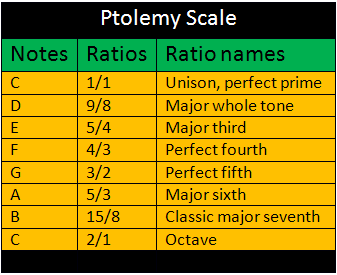
But, Ptolemy decided on the 7 notes quite a while ago in Ancient Greece.



 Reply With Quote


Delete
Today, 03:21 AM in Guitar, Amps & Gizmos