


-
Guitar amps usually have less higher frequencies compared to a PA speaker
 Originally Posted by rpjazzguitar
Sent from my iPhone using Tapatalk
-
04-16-2026 04:01 AM

-
The design of a Guitar Speaker isn't the best for clarity of clean notes (especially chords), but they sound like the guitars we've grown to know and love. Originally Posted by Christian Miller
PA speakers are much cleaner, with a clarity I've got to like in my old age.
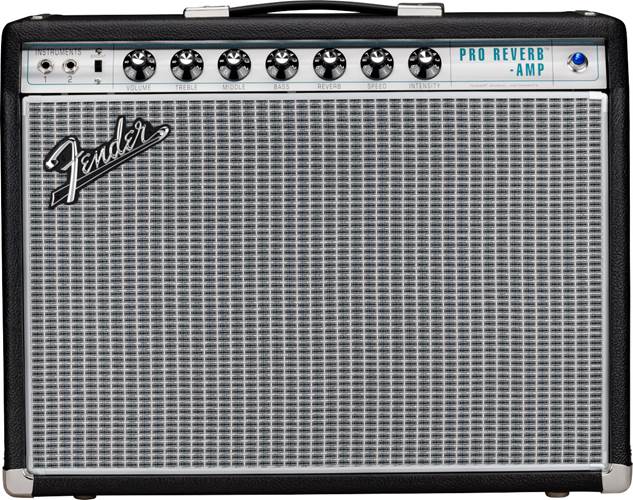
But, over the weekend, I played thru Trefor's valve/tube Fender Pro Reverb, I was instantly smitten like a teenage in love.
(But again, with a Fender Valve amp, I'd need a roadie to carry it. )
)
-
I wasn't surprised that the LJ had less highs. I was surprised, when I tried to make them sound alike, that the roll-off needed to start so low. Originally Posted by Christian Miller
-
Most guitar amplifier speakers have a sharp roll off around 4khz. The typical FRFR will go up to 20khz or so.
In my experience, guitar models sound more like a combo amp if you drop in a filter to block out everything above the 4khz to 5khz range. Just sounds more edgy and harsh if you don't.
Amplifying an acoustic archtop is a different discussion of course.
-
If you used a device that runs a Neural Amp Model (NAM) file for a clean DV Mark Little Jazz sound, you might get close. As it is, you're running models, and quite dated ones at that with the Boss and analog Joyo, of a Fender black face. You may get a great tone but it may not sound like a particular amp you like unless you get current tools that specifically model it. Originally Posted by rpjazzguitar
-
That’s a long and highly technical thread… Originally Posted by Spook410
I’d suggest from fifteen years of bitter experience that the answer to that is most often very simple.
Sent from my iPhone using Tapatalk
-
Seems like for one’s mental health and wallet that might be the best way to look at it. Originally Posted by Spook410
Apparently the Iridium sucks now. Modelling seems like an exhausting vibe.
Sent from my iPhone using Tapatalk
-
Actually a fella on Reddit made a great point which I understand is hard to swallow, but go with me on this. Originally Posted by Spook410
Analog units like SansAmp/Tech 21, Quilter and the various hilariously named Humboldt Simplifiers (have you seen those things?) actually tend to fall down on their Cab Sims, which I would expect is broadly similar to what you describe.
This is acceptable (if not amazing) if you are playing clean, but is an issue for those who use drive. Things are better with the high end shelving, but drives still tend to sound rather fizzy.
In general, we tend to paper over these things with delay and reverb.
So thing that made a big impact on me was trying my Quilter SBUS though my amps cab. It sounded basically identical. Then the PRRI through my TOOB sounded like the Quilter. Perhaps that’s obvious to many but I had mostly played combo amps. So that made very clear to me that the cab is a huge part of the sound - even besides the speaker.
I miked my amp the other day for the first time in about five years and it sounded so great compared to everything else I use. Sweet trebles etc etc. I didn’t even make much effort. Just put a condenser mic in front of the grill.
Bugger.
And as I understand it a lot of the people au fait with modelling seem to be mostly concerned with the modelling of the speaker and mic side of it. IR’s solve some of these issues but not all I think. Sonically speaking, I don’t think the amp models have been the issue for a while. Certainly for clean jazzy jazz tones.
But then - I’m not even sure I want that stuff for live use. Things get complex in a room.
Sent from my iPhone using Tapatalk
-
So that made very clear to me that the cab is a huge part of the sound - not even the speaker.I very much agree with both conclusions, as i have seen these happening, year after year, rig after rig. Bear in mind practically all modern powered PA speakers are digital, so your signal will get AD and DA converted. If you have a digital preamp/modeler one of the same. And if you have digital effects or pedals, or a looper, .. conversion again. Each time some latency is added, some digital ugly compression, some artifacts, and all the in between frequencies are lost. If you have 3 or more digital links in the chain, or even less sometimes, playing will feel detached and kind of fake and plastic. And the worst thing for me is how digital reacts to different rooms and bands, the profilers more than the modelers. You never know how things are going to sound before playing, changes on the fly are difficult, and the sound is always kind of ghosting around. There is no comparison with analog really.But then - I’m not even sure I want that stuff for live use. Things get complex in a room.
But, alas,.. the weight... !! Can't play music if you hurt yourself getting to the gig.
-
I actually like the tone I'm getting with my cheap Joyo American and digital IR's. So probably don't want to over analyze.
For better or worse, music amplification is only becoming more digital and more complex. If I were professional musician I would likely invest time into the tools the rest of the industry expects me to be competent with.
-
What I was trying to do was to get the JBL to sound like the LJ. The ME70 was in both signal paths. The Joyo was only on the JBL side. And, I tried it without the Joyo. Bypassing the ME70 made little difference since my clean patch only adds a bit of reverb. Originally Posted by Spook410
I couldn't get them to sound alike. I ended up doing all kinds of tweaks to the 8 band master EQ on the JBL The impact of the changes to each parametric EQ band (if that's the right word) was surprisingly limited. The graph had to get pretty extreme before I could hear much difference. I kept fiddling with it but eventually it seemed like a rabbit hole I didn't want to descend into.
All that said, I did get the JBL, with the Joyo, to sound better than the LJ, overall. But, the LJ has a certain thickness to certain notes that I liked and couldn't reproduce with the JBL -- I heard it as less high end. I chased that but didn't nail it. I don't have the gear for a frequency vs volume graph, but I'd be curious to see one.
Overall, it seems to me that the Joyo allowed the JBL to function more like a guitar amp. And while doing that, I could still run vocals through the JBL.Last edited by rpjazzguitar; 04-17-2026 at 12:20 PM.
-
Wow 6 pages on this! I bought a Joyo American to try out with my Alto powered speaker. Never found a sweet spot and gave the Joyo to a friend.
I don't want to be a wet blanket, however here's my take.
In the late 80's I was a Staff Mixer at Group IV Recording in Hollywood. In additon to being a studio that Joe Pass did a lot of recording in, we did scoring sessions for film and TV. Mike Post was a big client. The guitar chair was usually Steve Lukather, a very talented young player in that era. SIR would bring in tons of Anvil cases with every possible piece of rack effects. Lots of cords and interfacing with the Trident desk in the control room and all the outboard gear on that side.
On a Joe Pass date, he would come in with his 175 in a gig bag on his shoulder, carrying a Polytone.
It was all he needed to blow the roof off the place.
-
It’s simple really. Get a Fractal or Neural DSP and work with it. Originally Posted by Spook410
You are right. We aren’t in the era of the miked amp any more. The expectation has shifted - it’s all modeller amps and in ears now for big gigs. (Unless you are Joey Bonnamassa lol.)
For the stuff I do - small jazz gigs - it’s less pressing, but I’ll make the switch when the dates are in the diary that require it.
Sent from my iPhone using Tapatalk
-
And 50 years hence someone will think with fond nostalgia on how CM showed up to the studio with only his (Fractal or Neural DSP) and got that great sound.. Originally Posted by Christian Miller
-
If you are regularly encountering the idiots-masquerading-as-sound-engineers described throughout this thread, I would argue that you would be better served by being hung up on balanced mic-level XLR DI outs. Originally Posted by Christian Miller
Reason being: Most idiots-masquerading-as-sound-engineers expect the XLR output of something called a "DI" to be at microphone level, and if they are not savvy enough to confirm the output level before plugging stuff in, they will clip the input stage of their FOH mixer and then look around for someone else to blame.
A balanced line-level XLR output is, comparitively speaking, a fairly rarified commodity: Until very recently (e.g., the past ~25 years or so) they were only encountered on genuinely "professional" audio equipment. If it's on a DI, being able to switch select between mic- and line-level is a useful luxury...but again, that requires the idiots-masquerading-as-sound-engineers to be able to read, and to understand the implications of that switch.
-
note: edit because I wasn't very clear.. Originally Posted by Bob_Ross
Sometimes I'm fortunate in doing my own sound. And it's nice that nobody I've seen in this forum attempts to misrepresent themselves so it's easy to know what you're getting for advice. Being out in the real world might be a little jolting. If we get hung up on mic vs pro line vs consumer levels then it's a learning process we're all used to. And we'll tread that path again sometime in the near future because it is, in fact, confusing. Not to mention the vendors not giving us clear and concise users manuals.
The other thing I've noted on this forum is the respect people show each other even given widely varying levels of skill, background, and even propensity for diligence. It's a welcome tradition and I find it a good place to learn new things. Speaking of which.. what does happen if you plug a mixer out in to a mic input providing 48V phantom power?Last edited by Spook410; 04-20-2026 at 08:22 PM.
-
Oh god that’s a whole new realm of worry Originally Posted by Bob_Ross
EDIT: I should probably emphasise that despite a little humorous exaggeration, I don’t actually think I am surrounded by fricken idiots, but like all jobbing players you encounter some situations.
I’m pleased to report that of gigs I have done over the years, very few have involved people trying to take a DI from the speaker out. OTOH I think have had a decent sample size.
Sent from my iPhone using Tapatalk
-
They don’t make those algorithms like they used to ;-) Originally Posted by Spook410
Sent from my iPhone using Tapatalk
-
A few summers ago I played in a seaside club where the guy in the mixing desk had connected the PA speakers to the mic inputs (xlr jacks
 ) and was frantically trying to figure out why they weren't working..
  I have other funny stories but this guy has been the champion. Like.. line and mic levels.., misdemeanors!
-
?? Quick Comparison (From AI) Originally Posted by Spook410
I'm aware this is unnecessary for this thread. But, now that I think I understand it, I'm telling everybody!
Type Voltage Level (approx) Impedance Notes Mic 1–10 mV –60 to –40 dBu Low Needs preamp Instrument 10–100 mV –30 to –10 dBu High Needs Hi-Z Consumer line 0.316 V –7.8 dBu Medium Home gear Pro line 1.23 V +4 dBu Low Pro gear
-
TC and Kemper and Fractal are head and shoulders above any of the non-tube, analog versions. I use an Alto 10" powered pa cab. Doesn't have to be complicated
-
Originally Posted by jzucker
I am very willing to believe that $1500 gear is better than $40 gear. Though recently we've seen the $700 Fractal AM4 which is looking pretty good.
Thing is, I only need a few models and IR's so I hate paying for the broad capabilities of these units. So what about a NAM on an inexpensive pedal? In theory that should work pretty well.Last edited by Spook410; 04-25-2026 at 03:16 AM.
-
Just for being curious about NAM players, and having come across an IR file for a Gibson EH-150 vintage amp, I sprang for the Dime Head NAM Player, from Germany. It's not cheap, nor egregiously expensive, but it sure is good sounding gear.
After selling all my many heavy tubes amps but still being one who is hooked on sonic variety (well, I'm a Gemini after all), I find I can get very close to satisfying vintage amps tones, with wide variety available to me, via fronting gear like the Dime Head NAM and Universal Audio pedals like the Dream '65 and Enigmatic '82, playing through modern, fairly broadband, lightweight amps like my Henriksen Bud 6 and SeQuel Vermont. The amps, cabs, speakers, mic'ing sims come through in sterling fashion, and in the end it's much less expensive and space-saving than trying to satisfy Amp Acquisition Syndrome or endless tone searches by buying more physical amplifiers.
Phil
-
No XLRs on it Originally Posted by Spook410
Smh
Though you could probably get a pretty solid stereo Di box for less than 800 lol
But it’s just … I don’t know. Get the Fractal guys to explain it to me. Line 6 HX Stomp same thing.
Sent from my iPhone using Tapatalk
-
FYI, the Dime Head NAM Player has an XLR DI Out. -Phil



 Reply With Quote


Interesting Acoustic-Electric 7-String
Today, 06:32 PM in Guitar, Amps & Gizmos