


-
Thank you all! Some of your resources I've already known, some not. I like Jens Larsen, for example, but I couldn't find anything complex, but my typical deal breaker is I cannot see from A to Z, and not missing B, C, D... step by step.
Finaly I decided to give a try Truefire and I bought one month. I will check Tim Lerch and Martin Taylor, my two heroes, and will see.
Thanks once again.
-
03-26-2023 01:28 PM

-
All the aforementioned courses/teachers are very good, but it all depends what your goal is... Do you want to just have fun and play standards with other guys? Do you want to be able to accompany singers and play gigs professionally? I see it like this: if you just want to learn how to drive to get around and get from one place to another, you get lessons from friends or people you trust driving; if you want to drive big rigs, you have to go to a school and get a different type of education and license, and if you want to drive race cars, that's a whole different game, but it all entails driving. I'm very familiar with a lot of those teachers, and I studied for years with one of them back in the 90's. They all have different approaches to teaching jazz, but it all depends what your goal is...
Cheers,
Arnie.
-
This is more of an open response to anyone reading this thread and asking the same question as the OP. I'm merely an avocational musician and I made my life work out by working in the military and then the energy fields. So, take my advice with a grain of salt. I've been paid to play music over the years, but I've never made enough to ever consider myself as being a professional musician. However, there's no medical coverage or pension for musicians of any rating... Unless you think you have a chance of duplicating Eric Clapton's hat-trick...
Here's all you really need... One Book! $35??
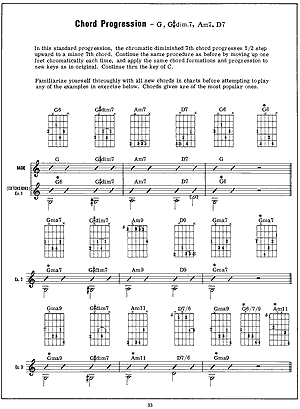
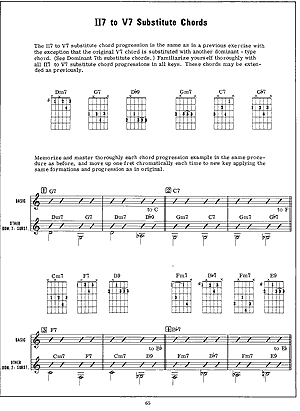
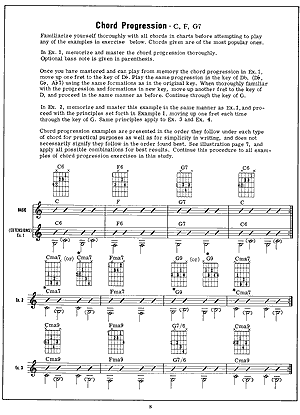
Deluxe Encyclopedia of Guitar Chord Progressions eBook + Online Audio - Mel Bay Publications, Inc. : Mel Bay
This book takes a couple of years to complete. While studying these grips and changes, learn your favourite tunes (Misty, A Train, Sweet Georgia Brown...) and apply what you learn in this book to them. Don't forget to also play the chord forms as arpeggios. (Add in the missing tones , of course.)
You get the modern changes compared to the basic changes. It covers tritone subs, extensions, chord synonyms, altered extensions, Rhythm Changes, common substitutions, standard changes... Complete this book and apply it to your repertoire and you'll soon be busking or playing solo at the local watering hole.
I think it has this CD included:
https://www.long-mcquade.com/files/7...0000090050.mp3
https://www.long-mcquade.com/files/7...0000090051.mp3
Look into these several videos kindly played/shared by Rob MacKillop to get the idea:
There is no magic book or magic internet lessons... It's hard work and dedication. Mostly done on one's own. As for musical colleges$$ and lessons$$, there's no use going there unless you can read music notation and are serious about arranging. (Mel Bay's Modern Guitar Method is the best place for that.) Because jazz guitar is a way of playing music, not a musical style in itself. The actual music material consists of Broadway tunes, Dixieland tunes, or Big Band tunes played in the jazz style (syncopation, anticipation, dots & ties, extensions and alterations with carefully chosen inversions, back-cycling and substitutions). Even Bebop is played over contrafacts that are chord progressions from the same tunes above. You can pick up on this style by learning Rector's grips and changes.
And if you graduate, can you forge a career that will allow you to have a family?
Think at 20 as if you were 40. What you want today may be your life's regret.
Makes for a damn good hobby, though... Never ends.
::Last edited by StringNavigator; 03-27-2023 at 01:18 AM.
-
Arnie,
that's a good point which I should have mentioned. I only play for my pleasure (and hardly acompanying a singer). The main goal for me is having a song which I know by heart and be able to play it whatever want... once as a ballad by Bill Evans, once as a gypsy swing, once as a blues tune. Once in E flat, once in C major.... always when I ask anybody how to rescue from my stuck stereotypes, I'm told learn pentatonic scale, than other scales, then arpegios, then licks... I realized very late I need to be able to play, what I'm singing (hearing in my head). I don't want to play "their scales and their licks", I want to play MY music. But now I understand, I need to know all these things first. Otherwise I keep repeating the same mistakes...
I've followed some of Sandra Sherman's arranges (at YT), which fits best my level of skill, but learning songs for me often is a dril without understanding, what is behind (that's why I quit playing classical piano, even if I love that music). It is playing of something strange, uncommon, not understood.
Sorry for my english, by the way.
Thank you for understanding, Jaroslav
-
That's the cold hard truth of it.
 Originally Posted by StringNavigator
-
His name is Chris Whiteman. Look no further.
-
for anyone looking for a shortcut like i was..and without much theory..you tube has lots solos..with backing tracks for tenor sax...just play them 2 frets up..try this one..lots others...get playing stop playing scales...
-
What do you mean Play It? Originally Posted by himself
-
read my comment above.learning scales dosent make you a musician .. Reading does
-
One should be done before the other. Learning the alphabet doesn't make you a writer, but it sure as hell helps to know. Just like it helps to know three stacked dots is a chord and a chord is thirds and a stacked thirds starting on D is D F A. Originally Posted by voxo
Really, I support your claim but think it has some prerequisites because of how I learned to do it. Maybe the Levitt books teach scales and basic theory through reading, I don't know. I can't see how you can read without a basic fundamental like scales.
-
I don't know if your original question was ever addressed here. It sounds like you're looking for a step by step by step approach. In other words first do this then do that. Originally Posted by Campos
I don't think you've given us enough information though. A path leads to something. What is it that you aspire to ultimately do? Learn jazz guitar can mean many things to many people. What do you see yourself doing at the end of the path? Fusions? Tradjazz rhythm? Bebop? Do you want to rip like Mike Stern? Do you want to just play rhythm in a big band like Freddie Green? Gypsy guitar? Etc.
Those are all different paths.
-
How I did it:
I started with the Mickey Baker Book 1..not many may realize it, but its a two year course!
One lesson a week
Starts with basic chords then lines to play over them.
Now it is suggested that you also write out the lines in all keys (which I did) it started me to be able to read basic notation in a jazz flavor context
when you finish the lesson a week (all 52) he suggest that you start over from lesson 1. Which I did.
At the end of the two years I could read and write and play basic jazz tunes.
I found others to play with and learned much more by doing this as it forced me to learn more about theory and harmony.
I then found a teacher who I studied with for two years and this increased my harmonic and theoretic knowledge immensely
Its a solo journey and you can only digest so much at one sitting..it takes years to be comfortable with applying
what you studied to actual playing in a group setting. Or even playing with chord fragments on a tune.
one thing I strongly suggest..learn all the four note chord inversions on all string sets and apply this to creating diatonic chord scales on all string sets and positions.
I realize this is a lot of work..but for me it was worth the effort.
-
Hell yeah, this is worth it's weight in gold. Originally Posted by wolflen
Or, just 3 note triads but, might as well the four note chords.
-
I have some bad news for you …….. Originally Posted by voxo
-
WHAT!?? IS TOYOTATHON CANCELLED THIS YEAR??????????? I KNEW IT WOULD HAPPEN. Originally Posted by pamosmusic

-
uh oh... Originally Posted by pamosmusic
-
Wow that was interesting
but really it’s just that reading doesn’t make you any more of a musician than playing scales does
-
agreed just being silly Originally Posted by pamosmusic
-
1) Memorize a few Charlie Parker heads and be able to play them at mid tempo with a metronome.
2) Get a Real Book and play the changes to your favorite songs, restricting yourself to frets 1 through 5. Then play the same changes using only frets 6 through 12.
Then transpose the changes by ear to all 12 keys.
3) Play walking bass lines to your favorite Real Book tunes. Then play the walking bass lines with chords put in between the notes, wherever you can.
This is what works for me.
-
Top things most students coming fresh into jazz don’t like to do in my experience
1) play on their own or with just a metronome
2) sing ideas and play them by ear
3) tap or clap rhythms
I think it’s a good idea to get all these things into one’s comfort zone for any type of music.
Sent from my iPhone using Tapatalk
-
Interesting. Those all sound so easy, fun, and natural. To think that students don’t like to do them says something. Originally Posted by Christian Miller


 Reply With Quote


JJ music sales Ontario canada
Today, 04:01 PM in For Sale