


-
I've been thinking how my practice routine has been in need of some serious spring cleaning so to speak. A while ago I started a thread on quitting practising scales in isolation - my alternative was to spend that time practising the basic cadential movement outlined by scales, which would be one step closer to playing the kind of harmony most of jazz comprises. But now, I am of the opinion that it just makes more sense to go straight at it and use the time to practice a tune. So this afternoon and evening I've been brainstorming ideas for a new practice schedule mostly consisting of stuff to practice for a tune.
I am lucky that for the time being at least I am able to throw four hours (at least) a day at this stuff. Suggestions welcome. Thanks to forum member PMB for the Autumn Leaves exercises.
Aside from a 15/20 minute warm up for the left and right hands in the morning, this is what I intend for the rest of the day...
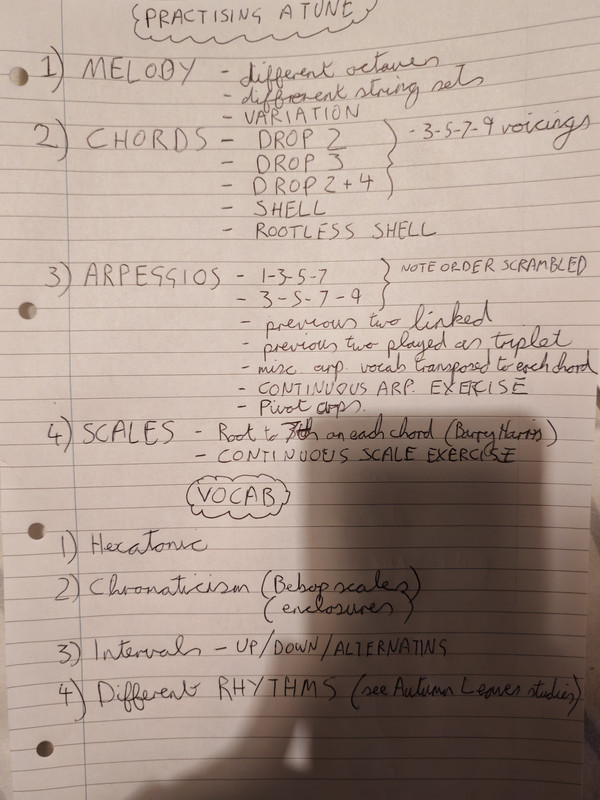
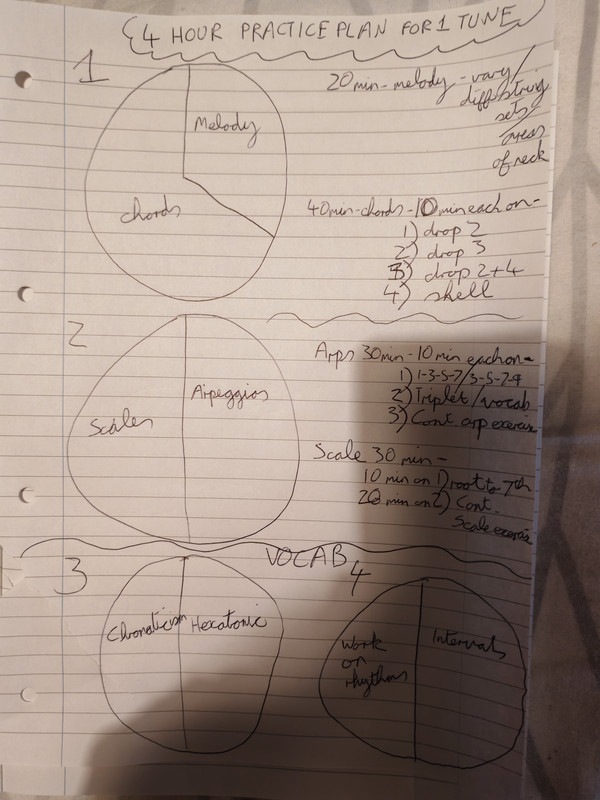
-
05-01-2026 04:26 PM

-
fairly easy tunes
Play in three keys
Play the inversions of the chords--learn how to insert chord tones in the melody if not used
three different tempos
three different styles
If your a working musician this will help keep you working
-
Good plan, concentrating mainly on playing Jazz songs, has always been the best advice.

-
Why isn't there a dedicated time for deep listening?
While you're loading up on the left brain mechanics of proficiency and lexicon (which IS important), don't neglect the development of your critical listening ear. This is one thing that any serious player/artist needs...because it provides perspective, sense of purpose to a line, embraces the emerging sense of how and why to use these tools of line, time and density that you're assimilating.
It used to be a given that one's education was informed by a LOT of listening. It takes skill and awareness to discern the way an artist tends to make choices. This is the perspective that a player chose to convey on one day in the studio; something you can learn through deep analysis as well as real time enjoyment of a recording. There is a perspective that comes from developing your own awareness of contributions of other players, of reading a room, of making a different line because of a different playing circumstance. This can be very different from the linear approach of you in a practice space. It's not to be ignored nor marginalized because this is your own personal sound realized through space; and not merely the production of notes.
Space is found between notes, but it can be found between phrases, between themes, through development, through the framing of motif and the soloist's constant relationship with the head of the tune. Just for starters.
One thing I've known as a given in old schoolers and is a revelation to kids even at the best music schools is the resource of sound, sound crafting and the listening to the dialects of historical improvisation. Yeah you may know the changes to Out Of Nowhere, but that tunes has a LONG history: Prez. Fats. Miles. Lee (Konitz). Lee (Morgan). Into the linearity of Henderson, Scofield, Kurt, Monder and Jules.
Yeah you can throw a song on Spotify but how deeply can you appreciate the language of framing and approaching something as simple as placement of the tonic?
This takes a LOT of listening and a LOT of time. Not just YouTube for 3 minutes but hours listening to out takes of Clifford Brown and Dexter to Dolphy. It's not so you can show off a solo passage you've memorized, but so you can achieve a broader concept of what you hear and can hear given the shifting and evolving use of space through the eras of the music.
You have the greatest teachers at your literal fingertips to show you sides of yourself you'll never realize by not having perspective.
If your goal is to become a complete musician, you'll play with others. When you can hear, everybody knows you've got something.
Just sayin'
-
Thank you for taking the time to write this. I appreciate it.
 Originally Posted by brent.h
I've never been to a jam session. I am aware of a jam session in a relatively close by city, Birmingham, but a few factors dissuade me from attending it - it starts quite late and therefore doesn't leave me with much time to play before having to make a dash for the last train back to the town in which I live - so it costs money to get into Brum and costs to attend the jam session which always takes place after a gig. Ideally I'd find one that takes place earlier in the evening.
As for my proposed routine being a bit over-ambitious - yes, you may be right. I think three hours a day may be enough on one tune - and I can cycle through different things on different days. We'll see.
-
Thanks for taking the time to write this, I appreciate it. Originally Posted by Jimmy blue note
Yes, I didn't include the time I spend on transcription, and the time I spend on listening which lately occurs while I'm on a walk in the morning and in the evening at home in my room.
I totally agree with what you say. It's very important for a musician to be 'well-heard' (as it is for a writer to be well-read) and there are no excuses now that we have access to so much that's just a few clicks away.
-
I hope you can find opportunities to play with others. Your videos are great Originally Posted by James W
-
James,
With your potential, it's essential that you get together with other local players, even form a Jazz guitar Duo with a like minded kindred spirit.
There's must be other local Jazz players around your area. It's just a matter of finding them.
-
You know I wonder with having a practice routine there's a danger of feeling like you don't have time to do everything.
I think it's good to set short term goals. If you are aiming to learn a bunch of repertoire, or master arpeggios or chord shapes or something, you can put that into rotation and throw lots of small bits of time at it until it is done. But after it's learned you don't need to keep learning it.
Other things can be more open. If he mood takes you to write a bunch of music, you can do that. Or you may have a deadline coming up, which honestly is the only way I get anything done lol.
Listening is important. If I hear something I like, I dig into it. That seems to work.
-
+1 Christian
Best
Kris
-
4-6 hours a day on one tune in 3 to 5 different keys is worthwhile and what I been doing!!!
-
Originally Posted by Christian Miller
Perhaps. I like to have a routine and can hardly imagine not having one - I'm not sure why I feel like I'd have more time to do stuff if I didn't have a routine. But anyway the point of the thread was to announce (for some reason, yes ) a change in direction of my routine - I already have a routine but much of it is what I'd describe as abstract - that is to say, scales and technique, things that are important but are things that you do prior to practising actual music. I think it's got to the point where most my time can be devoted to practising tunes.
Originally Posted by Christian Miller
True. And yes, I agree about the rotation thing - or what I call cycling. I've been doing something like that with the hexatonic scales since the year began and am on schedule to complete this in a couple of weeks' time. Probably just need to refresh one's memory on this stuff from time to time.
Yes. From time to time I'll ignore my routine and spend a few hours in an afternoon writing some music, which mostly consists of experimenting and improvising with chords and rhythms etc. Originally Posted by Christian Miller
While I like to have a routine, there is definitely a time and place for ignoring it and going deep into something that takes one's fancy.
-
Originally Posted by wolflen
For some reason I've never taken a tune into different keys. I know that things like Autumn Leaves, On Green Dolphin Street, Stella By Starlight are or can be in different keys. But I have tended to be of the opinion that time spent taking one tune into another key is time that could be spent on shedding another tune. OTOH it wouldn't hurt to know Autumn Leaves in E minor as well as G minor... Originally Posted by DawgBone
As for knowing a tune at different tempos, yes - Stella for example, or ATTYA. Different tempos mean different rhythmic vocabulary. It's important to be able to do that...
-
I am in no position to criticize or support your plan, since I've never really taken that approach.
But, a few thoughts come to mind. They're based on my experience and may not apply well to anybody else.
Enough caveats.
1. Jazz is often broken down in the ways you described. But, at its core, soloing is the ability to think of a good line and make it come out of the speaker. I'll take the second part of that first. Can you play a melody that you imagine -- instantly? If not, that's a useful skill to work on. All the scales/arps/etc will help as they get your ear and hands accustomed to what they need to do. Basically, it's time on the instrument, but maybe the process can be accelerated.
The first part is thinking of a good line. Maybe you can already scat sing great lines. If so, all you need to practice, for soloing, is playing what you imagine. But, if you can't scat lines you like well enough, or consistently enough, then how do you develop that? Probably transcribing lines you like would help. And so would transcribing the chords -- since part of thinking of a good line is hearing the harmony - not just what's in your head, but what the rest of the band is doing. This builds jazz vocabulary -- and depending on your goal, it may be essential.
2. Putting on a backing track of a tune and deciding to use a particular device(s) for the solo can be a fine thing to do, but, it seems to me, that it's important to use the scales or arps to make melody, and not just to run them. Don't ask me how I know, but if you practice scales too much, you'll have trouble avoiding them later when, inevitably, your fingers take charge over your imagination.
3. If I had it all to do over again from the beginning, the main thing I'd change would be ear training. I'd sign up for semester after semester with the most demanding teacher I could find and suffer through it. Transcription is the traditional way of learning jazz for a good reason.
-
Originally Posted by James W
James...learning a tune in a different key IS learning a different tune! The chords are going to be different and may require a different string set placement..same for Originally Posted by James W
the melody.
When you are comfortable with the new key try and use part of the melody in the old key against the new chords..and then recover in the new key.
Do this with arps of each chord and their inversions.
The goal of this kind of thinking is not feeling lost ..experiment with playing the melody of one key against the chords of another.
Try scale fragments..melodic patterns any harmonic or melodic device you know..connect the chords in both keys if you can.
This takes some work and time but well worth the effort.
-
This is a fine post, rpjazzguitar. I am reminded of something from Martin Taylor's book on single-note soloing - his exercise called thinking, singing, playing - where you are meant to imagine a line or perhaps just a few notes before singing it and finally playing it. I should spend more - by which I mean some - time on this. Originally Posted by rpjazzguitar
Yes transcription is very important. I agree with everything you say here...
-
I read about something similar which Lennie Tristano would get his students to do, he called it ‘slow improvisation’. The idea is to practise a tune at a sufficiently slow tempo that you have time to think of each phrase just before you play it, and still play it in ‘real time’ i.e. at tempo. Obviously not easy, hence a very slow tempo may be necessary. Originally Posted by James W
The goal is to improvise more from what you hear in your musical imagination, and less from what your fingers already know and want to do.
-
Very ambitious and I wish you success. You must be young?
Some studies have indicated that for older (me) learners smaller bites can aid retention.
I seem to do better with 30 minutes each on four or five tunes with short breaks.
-
Thanks! I'm 38 years old. Pretty much middle aged then. Originally Posted by Aiq
 But, I have far fewer responsibilities than most 38 year olds, I think.
Yes, this routine is a deep dive into a few tunes - diving deep into one on a single day. I may experiment with alternative routines in the future, such as the one you describe.
BTW, regarding the jazz jam session, I have discovered one that takes place on the last Sunday of each month in the afternoon in Worcester. So that's good, but I won't be able to attend this month because the trains won't be running nor next month since I have a gig on that day, so July and thereafter it is...
-
Just a thought James, I have found that many ambitious practice routines are based around some idea of what music is about and what it takes to get to some ideal.
More often than not, a huge routine based on ideas that later turn out not to be true can lead to a misguided imbalance of necessary skillsets.
I'd say talk to people who are accomplished and self realized players, or masters if you can, and ask them about the areas of study and mastery they consider most important. Work with focus and dedication, but also with a realistic allowance for gauging your own success and progress.
Keep a journal. Gauge your progress regularly and have enough flexibility so your own regimen can reflect your own learning style and growth. Don't lock yourself into a routine as a newbie to something that will not serve or even harm your progress as your perception grows.
Teachers at music schools have told me TOO many stories of students being derailed by ideas about practicing like athletes only to do themselves physical harm or becoming products of an immature set of expectations.
Remember you're growing and the story of what makes a good musician changes.
Be realistic. Be real. Know yourself and make music with that knowledge. It will be different with everyone when it's the end of the day.
-
Ok, you're sceptical. Fair enough. I will try to strike a balance between consistency and flexibility, and make allowances for myself to do whatever at times (as I have already said). Originally Posted by Jimmy blue note
I don't intend to practice like an athlete. My proposed new routine (which I have yet to implement, since I haven't quite finished with the current one, due to be complete in two weeks) is replacing one with an emphasis on technique and scale work - which is not to say I don't already practice tunes, just not as much and as in depth as I what I intend to start doing - to one involving a thorough exploration of a particular tune in a day. So I see it as moving away from calisthenics, if anything.
I have a penchant for systematically practising tunes, what can I say? But of course, once I have mastered the various types of chords that I write in the pictured bits of paper in the OP for a particular tune, just for example, it will be time to move on and do it for another tune. I like the idea of a well-rounded practice schedule encompassing chords, scales, arpeggios* etc. etc. Three or four hours isn't actually that long if you break the time down in a more bite-sized way. I am curious if you would offer more specific criticism of my proposed routine, since you think it looks imbalanced?
It might be a case of cycling through this stuff over the course of more than one day, IDK. Some of it every day, some of it only on particular days.
Thanks for the tips and encouragement anyway. As I've already said this routine isn't everything I do or will do. It's possible I'll change it. One of the strengths of my current routine is that it was planned to last a specific number of weeks. This one is more open-ended. As I've said, I will still continue with transcription and reading. The ear is super-important to develop, and obviously we need to connect it to the fretboard and our hands.
*I realise some might think this translates to 'just running scales or arpeggios' but these ingredients, if used imaginatively, provide an inexhaustible source of material with which to come up with ideas, there is lots more to them than just the Barry Harris root-to-seventh thing or the continuous scale or arpeggios exercises etc.
-
I mentioned doing something similar with 3-4-5 hour practice sessions. I usually go in 45 minute blocks, then break for 20 minutes or sometimes more. If I can knock out two hours before noon I can usually put in a longer day cause I tend to fall into my best playing in the evening hours. I always figure the first hour is basically a warm up session..... Originally Posted by James W
The only other thing I can offer is that if you stick with your routine for 8 or 9 months (maybe less, I dunno), give yourself a few months of light duty, just staying flexible on the instrument, and allow it all to digest. I put in about 3-4 hours per day from oct '24 to nov '25 and once I gave it a rest over the holidays it started to actually show up in my playing automatically since I was no longer "thinking" about doing it. Gigging off season is usually the winter so it seems to make sense to do that, I'm just not sure if a break would benefit me more if I did it sooner since I'm trying to stay in top form for the playing season which ends around Thanksgiving i.e late Nov.
-
There’s a Barry Harris story of dropping in to see Monk in the bright early morning, seeng Monk work on a tune, saying goodbye, coming back later in the evening, after being gone all day, seeing Monk still at the piano, working on THE SAME TUNE he was playing in the morning.
I’m fortunate now that my entire practice routine consists of learning and shedding tunes. I’ve been working so long, I can practically sight read a tune. I’ve been working so long, I know how to play a tune in my version of what solo guitar should sound like, heavily influenced by the Barry Harris harmonic system (V7-I, with the dim chord representing theV7, the family of four dominants and four m6 chords built from each diminished, etc). Blowing on the tune as a chord solo, working out rhythmic patterns like a drummer for each chord solo, blowing on the tune with intervals (Wes octaves, 3rds, 6ths, 10ths,etc), using minor line cliches on the tune, using contrapuntal counter point lines on the tune, mixing and matching a little of everything I just listed, in an integrative manner, hopefully more seamless with more time.
And then forgetting all that structured, limited practice on the tune and just playing
Life is short, a repertoire of hundreds of tunes takes a long time. Once one gets a repertoire of hundreds of tunes, no one accuses that person of not being able to play
I feel like after years of working , I hope I know what I am now doing
-
someone else tells the same story in Ken Burns Jazz. Originally Posted by Navdeep_Singh
-
05-12-2026, 02:18 PM #25JazzKatua Guest
I practice lines from J.S. Bach's "Das Wohltemperierte Klavier", like for instance the prelude or the fuga in C minor (Book I). Such lines are uncommon to play for guitar, but if I see the execution on keyboard it also seems uncommon.
It takes practice to execute it and such practice breaks common 'jazz-patterns' like constant 1-2-3-5 exercises which I did a LOT in the past, but didn't help me in a musical way and I found them VERY BORING.
By coincidence today I remembered Jerry Coker's book: Patterns for Jazz which I practised a LOT in the past.
But retrospectivally speaking this book is totally USELESS to really learn the Jazz Idiom.
So my 3 hour daily practice schedule consists of listening to the Masters (J.S. Bach DAILY!) and Tristano's School (himself, Konitz, Marsh, Peter Ind [Amazing bassplayer!!!]) for their 'loose' and free improvisation and get this MUSIC into my playing.



 Reply With Quote


JJ music sales Ontario canada
Today, 04:01 PM in For Sale