
-
Does anyone know any more than two ways to play a m7b5 chord???
I'm not really looking for amazing modern sounds (although others may be), but rather a collection of stock grips that Jazz guitarists use, covering the various areas of the neck.
Any help appreciated!
Thanks Heaps!
-
-
these will all be an Am7b5
5 x 5 5 4 x
x 12 13 12 13 x
x x 7 8 8 8 (and of course, in A you could use the open fifth string)
11 x 10 12 10 x (one of my faves, esp. when going to the V)
x x 10 12 13 11
x x 1 2 1 3 (this one isn't my favorite in "A", but in other keys, it's nice)
5 6 5 5 8 x (do a thumb strum here...you'll feel like wes)
these are some i use pretty regularly...for more, see ted greene's "chord chemistry." i don't have my copy here with me right now, but he's got about 25 other voicings, of various usability, but cool all the same.
-
Awesome!
I knew about Numbers 1 & 2 and I've seen number 3 before, but none of the others. Thankyou!!!!
Also Chord Chemistry seems like the book. I've heard it mentioned many times before.
Thanks!
-
hey tal...just realized i must have been a quart low on coffee yesterday...
this one: x x 10 12 13 11 doesn't have a root...i guess i was thinking that for an Am7b5, i'd play the open A if i wanted a root...but try this one...
x x 10 12 10 11 (movable, to any key)
that gives you b3, b7, R, b5...
not to say you need a root in you your voicing...
-
you could do them in inversions too, which i use a lot, take for example em7b5( i dont have a guitar here, so i`ll have to trust my instincts )
)
x x 2 3 3 3
x x 5 7 5 6
x x 8 9 8 10
x x 12 12 11 12
-
Hi Tal,
could be interesting to check out the inversions in every stringgroup.
for an example the stringroup 6432: 5x554x // 8x788x( Cm6 )//11x101210x//
3x121x//. Do it the same with the stringgroups 5432 // 4321( sinister 81 do it for you ) and the last one 5321. You can do it with every seventh - chord.
I t gives you more possibilties for comping and soloing.
Greetings Frank
P.S. Thats my first post here, sorry for my bad english.
-
: Hi Tal,
sorry I forgot the stringgroup 6543.
Greetings Frank
-
Yeah that is an awesome concept!
I learnt that about a week ago (sorry!) for the first time, but I have since been inverting everything from Triads to Breakfast ( ).
).
What makes that so great is that:
A) 1 voicing becomes four (sweet)
B) Suddenly you know chords that cover the whole neck (without a super-mega-chord dictionary)
AAANNNDDD
C) You can see how some phat voicing you learnt that you spent months trying to create is really just a simple inversion of one you learnt in your first guitar lesson 
Thanks for all the posts, and welcome to the forum Frank Bechlarz!
-
Take a Maj7 chord and raise the root. You now have a m7-5 one semitone higher than the original chord. Cmaj7 = C#m7-5 The reverse is true of course but some voicings just don't have enough of the major sound (to my ear anyway) for a satisfying resolution.
-
I use a similar way of thinking!
I start off with dim7 chords though - easy since all the intervals are minor thirds.
Then to get a m7b5 you can raise any of the four notes by a semitone.
And to get a dominant 7th you can lower any of the four notes by a semitone (or just play the diminished for the 7b9 with no root trick)
And vice versa etc. etc.
My favourite m7b5 shape at the moment is x 5 5 3 5 x
It's an odd inversion (root is on top) but I find it pops into my head because it reminds me of a m9 shape flipped around (x 5 3 5 5 x) 
It's handy for a minimal movement minor ii-V-i
x 5 5 3 5 x (Em7b5)
x 4 5 3 5 x (A7b9 no root)
x 5 3 5 5 x (Dm9)
-
Why not just take a minor 7 chord and just flat any 5 you are using in the chord. Same for the arpeggio.
When I think of a m7b5, I just visualize the intervals for a m7, but then just flat the 5 wherever it appears.
That way you can just create any voicing you desire in any position you desire (provided you can actually finger it).
-
-
One partial I find useful is
Gmb5 xx866x. It works nicely in a two five - xx866x -> xx865x
-
Have we got to the point where we can add extensions?
If I have say Em7b5:
xx2333
I tweak it to make:
xx2335 (Em11b5)
and
xx2332 (Em9b5)
And here's one from Chord Chemistry:
x77333 (Em11b5) -- worth the stretch!
-
And bear in mind that any minor 6 chord voicing will also be a min7b5.
-
And Bm7b5 chord can also be seen as a rootless G9, so all those shapes do for 9th chords as well.
-
...and there's also old guitaristic fun...
you just take 4 notes of the chords and start searching on the fretboard where you could play them together)))
-
having fun with guitar pro...first two lines have lots of 9s and 11s, if too crunchy for you you can replace the 9 with root and replace the 11 with b5 or b3.
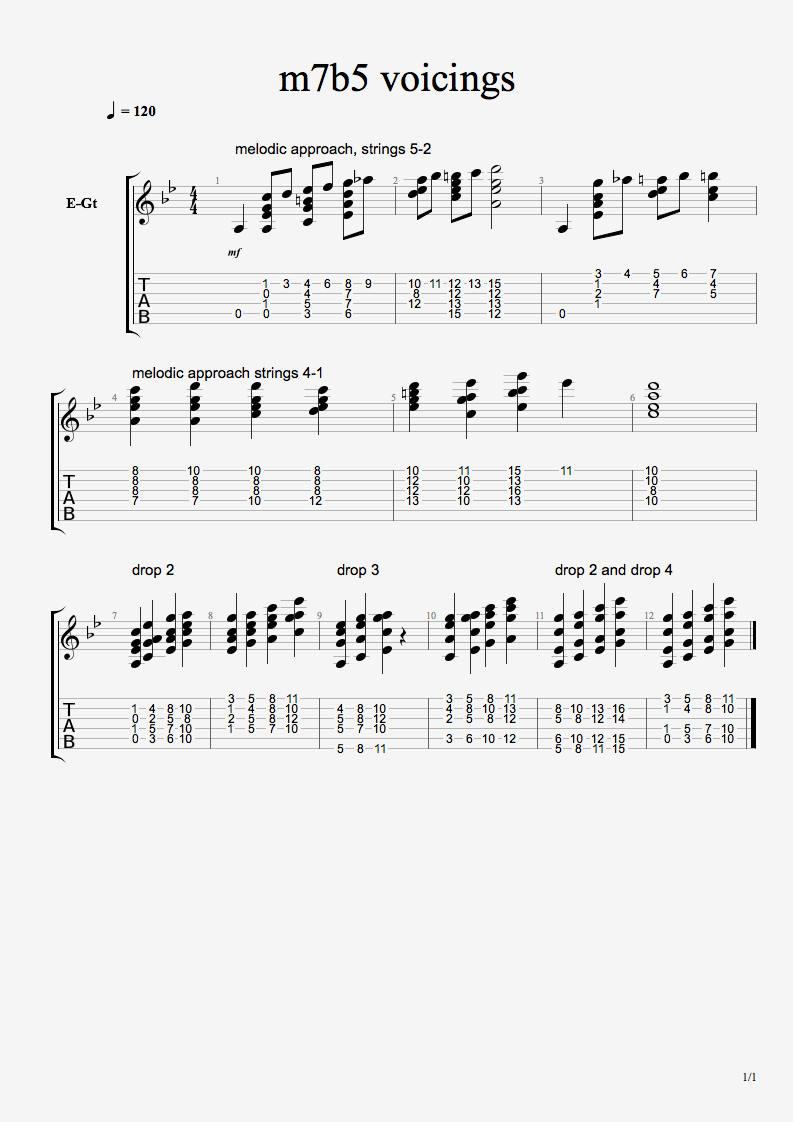
-
I don't know if this one's been mentioned already:
Dm7b5: x.5.x.5.6.4
moves nice to x.5.x.4.6.4 (G7b9) for a ii-V
-
Cool thread.
I am beginning to realize that m7b5 voicings open up countless possibilities in expanding one's chord vocabulary.
This video is the cherry on the cake.
Among others, Morten uses this shape
x.8.9.7.10.x
(basically Bm7b5) and gives it a whole bunch of different functions, like:
G7 (rootless)
Db alt
F maj #11
The last one is a bit of a stretch but it can work as a passing chord. The notes are F-B-D-A (1-#11-6-3).
I think that the reason why it works is that by moving the B to a Bb we get a Bbmaj7 (x.8.8.7.10x), the fourth degree of F maj that can be used as a passing substitution.





 Reply With Quote


New LEDs Day
Today, 07:28 PM in Other Styles / Instruments