

In this lesson, you will learn how to combine chords with a walking bass line over a 12-bar jazz blues in F. The goal is to make the guitar function as both the harmony and the bass. This approach lets you keep the groove moving and outline the chord changes clearly.
A walking bass line moves through a chord progression, one note per beat. It outlines the chords of the progression and moves smoothly from one chord to another, while keeping the groove alive.
Walking bass in a band is usually played by the bass guitar or double bass player, but being able to play walking bass lines is an essential skill for jazz guitarists when playing without a bass player.
Walking bass on guitar is usually played fingerstyle. Use your thumb for the bass notes and your other fingers to comp the chords. The challenge is keeping that bass line going while comping the chords.
Being able to walk a bass line and comp the chords at the same time is an invaluable skill to have and one that will allow you to work in situations where other guitarists cannot.

Table of Contents
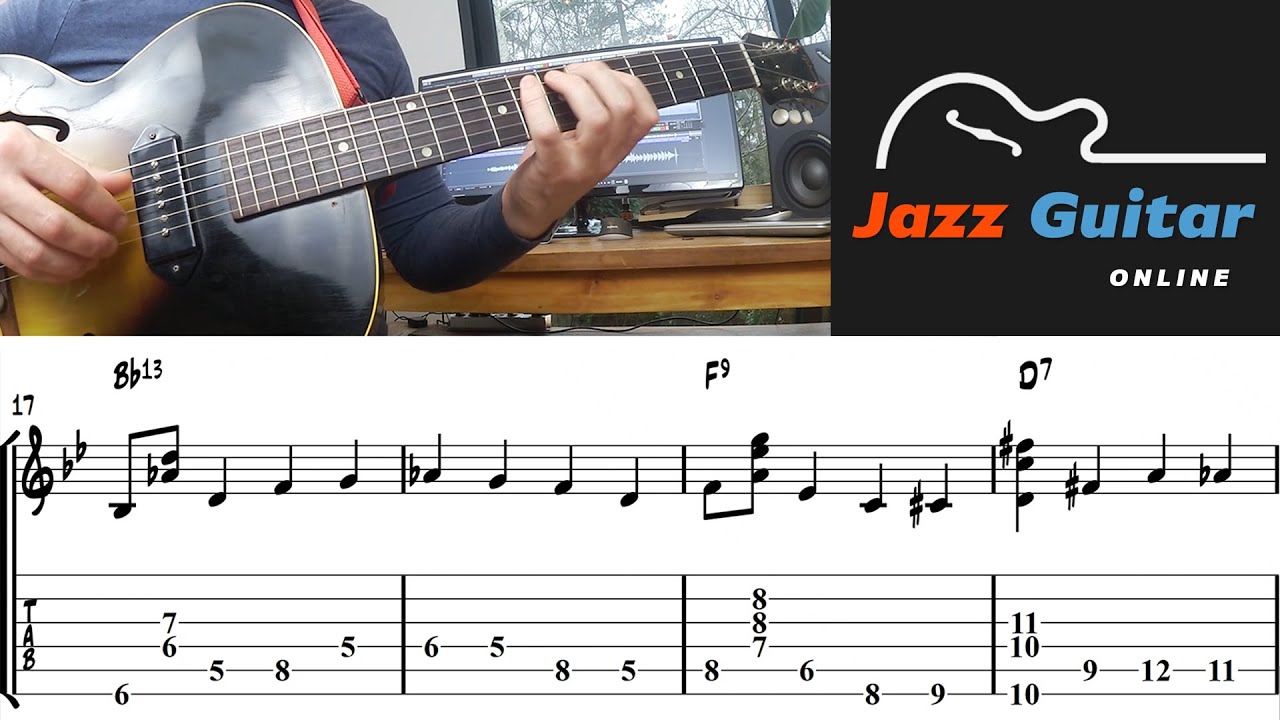
Video – Jazz Blues Walking Bass
Drum Backing Track
Listen & Play-Along
Step 1: Playing the Roots
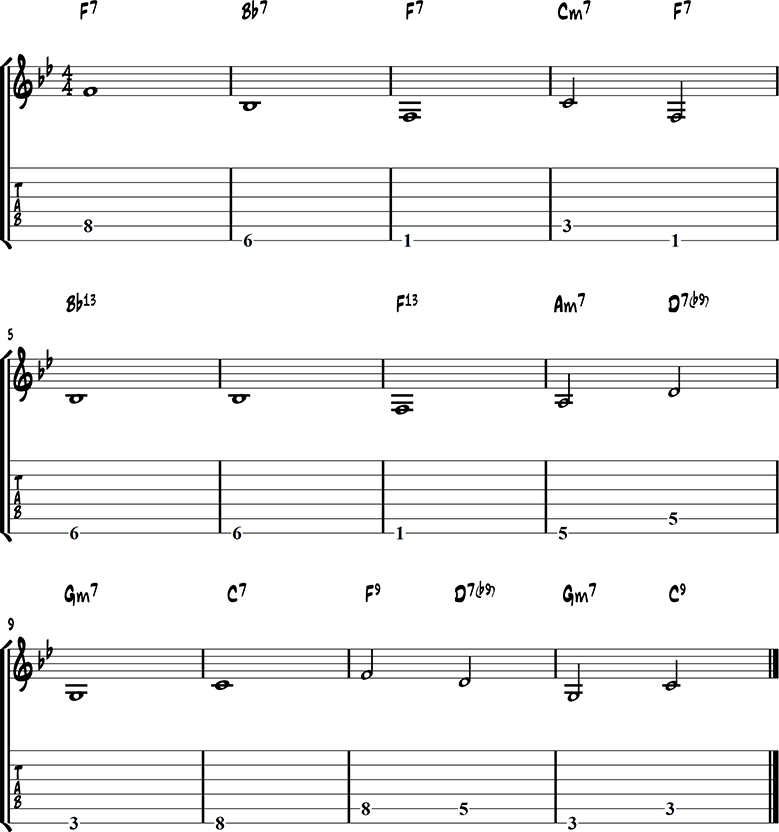
The very start in learning how to walk a bass line is being able to play the root note of each chord on the lowest two strings (A and E strings) of the guitar.
In most walking lines, the root note is usually the first note of every bar.
Below, the roots for the entire blues progression are written out on the lowest two strings. Play them slowly and make sure you can find each one without hesitation before adding anything on top.
Step 2: Half Time
Next, we move on to what is called half time, where the half note is the rhythmic focus of the line.
You do this by adding a second note on beat 3 of each bar for a duration of two beats.
This note can either be:
- A chord tone – the 3rd, 5th, or 7th of the chord. The safest and strongest choice because these tones outline the harmony clearly.
- An approach note (AN) – A chromatic note that leads into the next chord by either a half-step (one fret) above or below the root of the next chord. For example, if the next chord is an F7 chord, the two chromatic approach notes of the target note (F) would be E (below) or Gb (above). Using chromatic approaches immediately adds that classic jazz voice-leading sound.
- A diatonic note (DN) – A scale note that isn’t a chord tone. Less strong than chord tones, but great for variety.
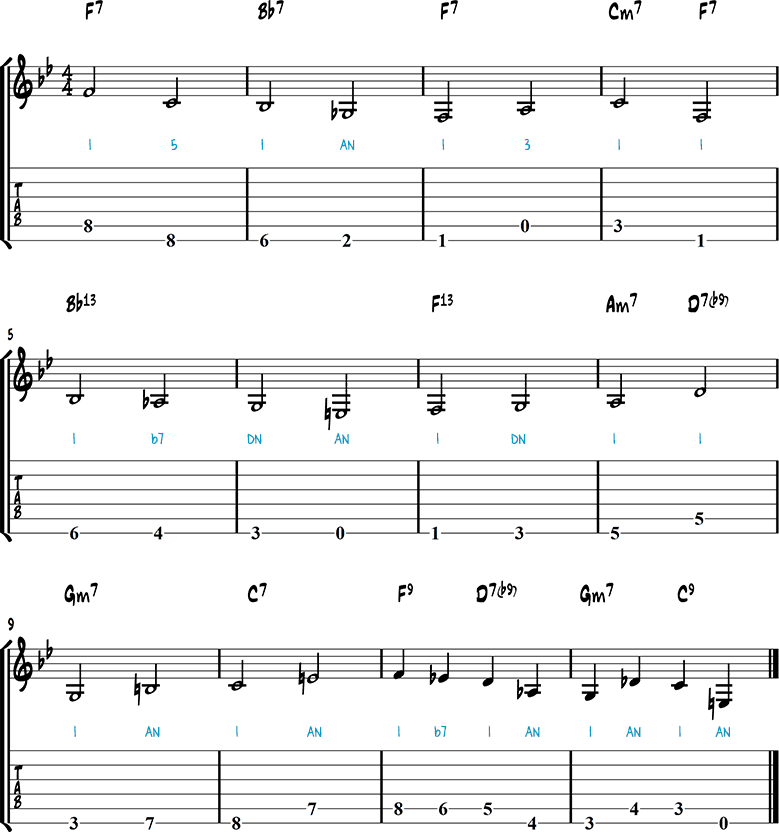
Notice the rhythmic change in the last two bars. Because each bar has two chords, we switch to quarter notes for the approach tones.
This leads us nicely into step 3: walking time, where everything locks into a steady quarter-note pulse.
Step 3: Walking the Bass
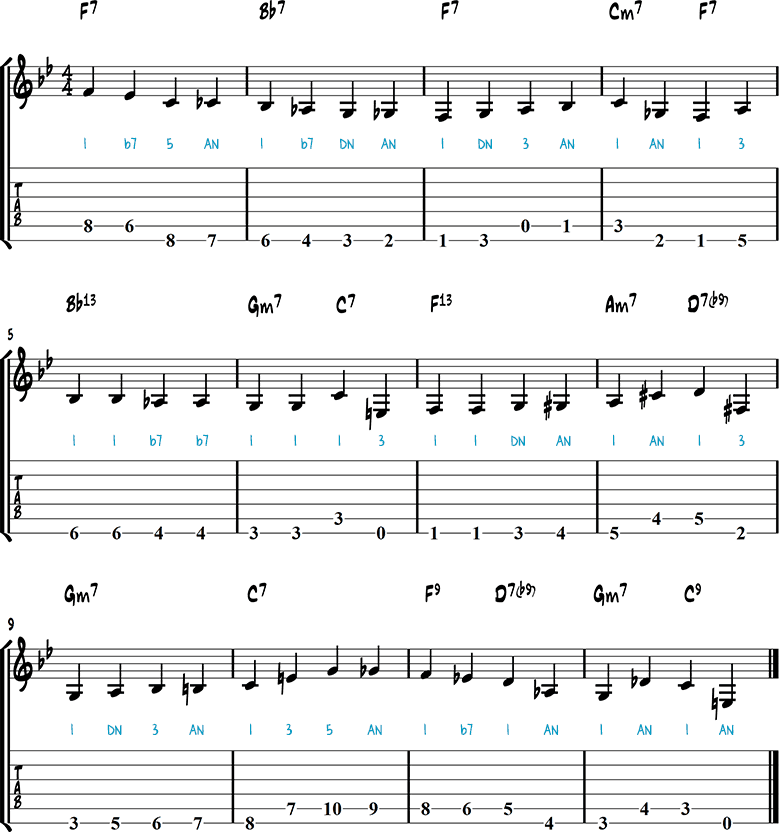
In this step, we extend the quarter-note pulse to the rest of the blues progression. This is where the line actually “walks”.
Two things to keep in mind when adding the extra notes:
- The note right before a new chord is usually an approach note, played as a quarter note.
- We can use any note from the diatonic scale or arpeggio to fill in the remaining quarter notes.
Step 4: The Chords
Now that you can build a walking bass line, it’s time to add chord voicings.
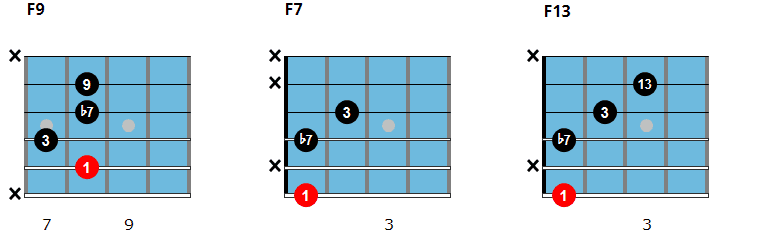
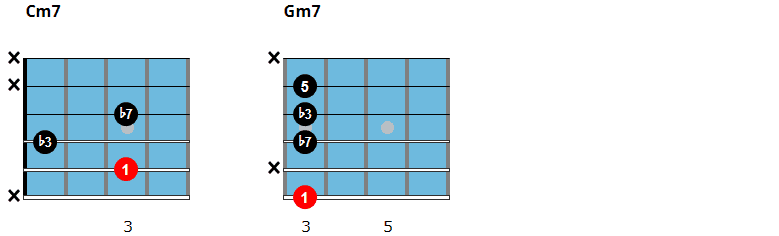
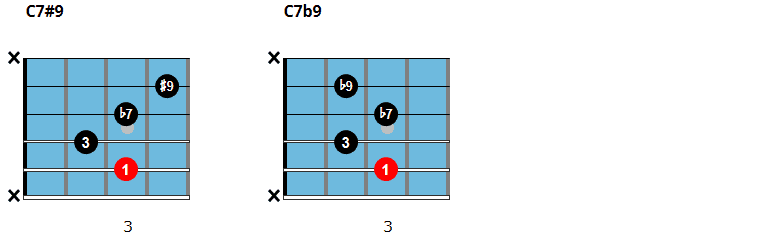
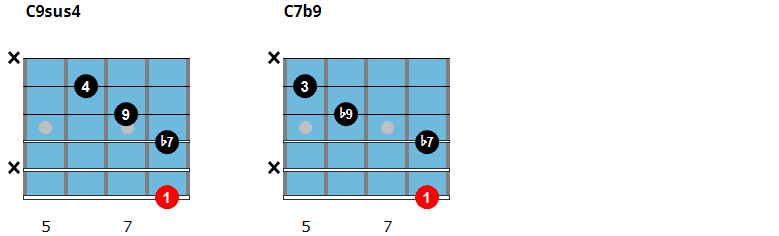
Shell chords are the go-to choice of voicing for walking bass lines, but drop 2 and drop 3 chords are used as well.
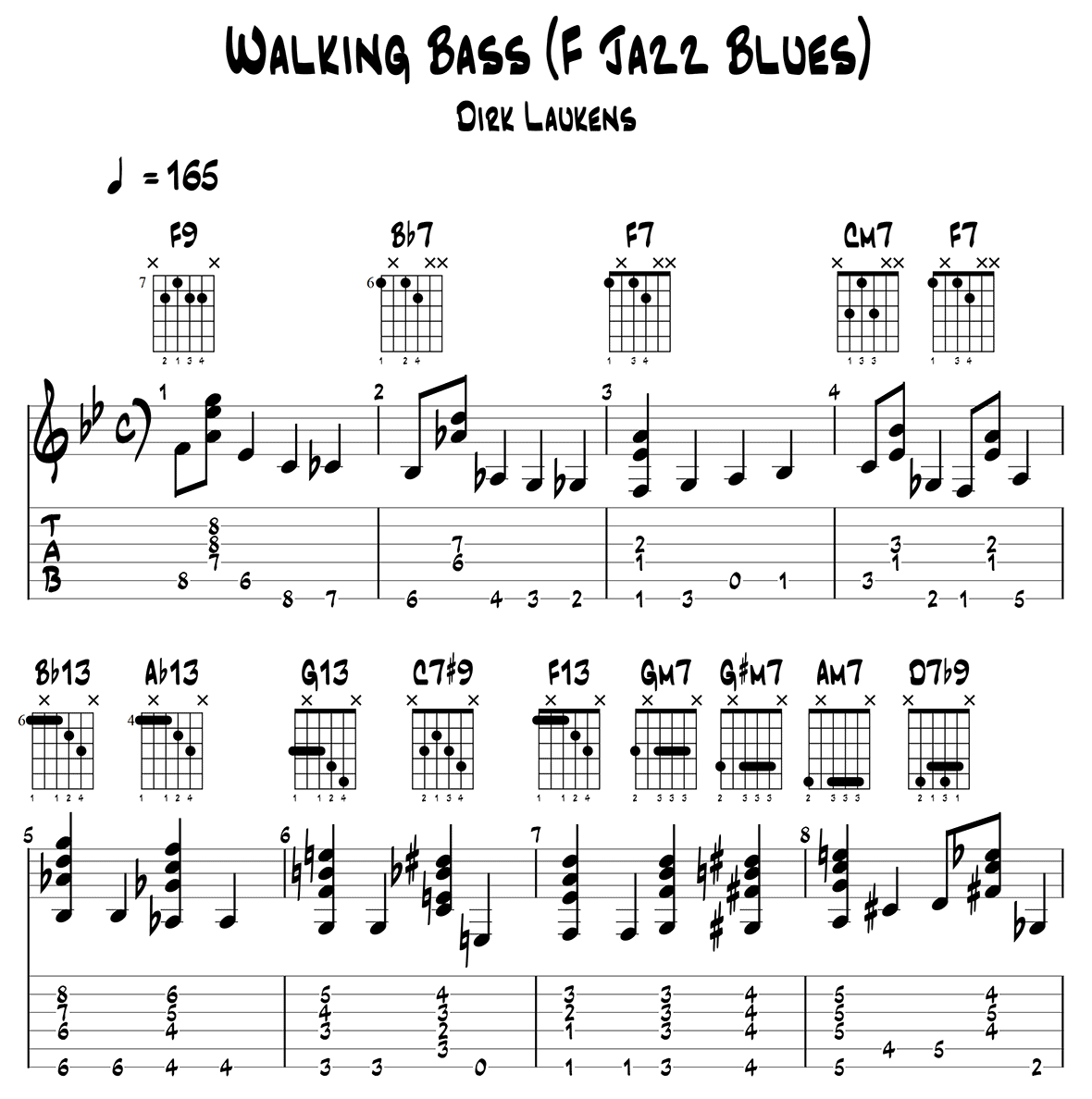
Here are the easy-to-grab chord voicings we’ll use:
Step 5: Combining Walking and Comping
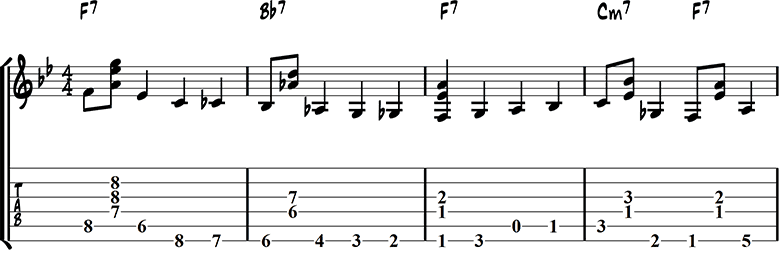
Now that the bass line and the chords are under your fingers, it’s time to put them together.
A common approach is to place the chord stab on:
- the “and” of beat 1 (as in bars 1 and 2)
- on beat 1 (bar 3)
- on the “and” of beat 3 (bar 4)
These placements sit naturally on top of a walking line and keep the groove clear without getting in the way of the bass movement.
Once you’re comfortable, feel free to move the chord hit anywhere in the bar. The important thing is that the bass keeps walking.
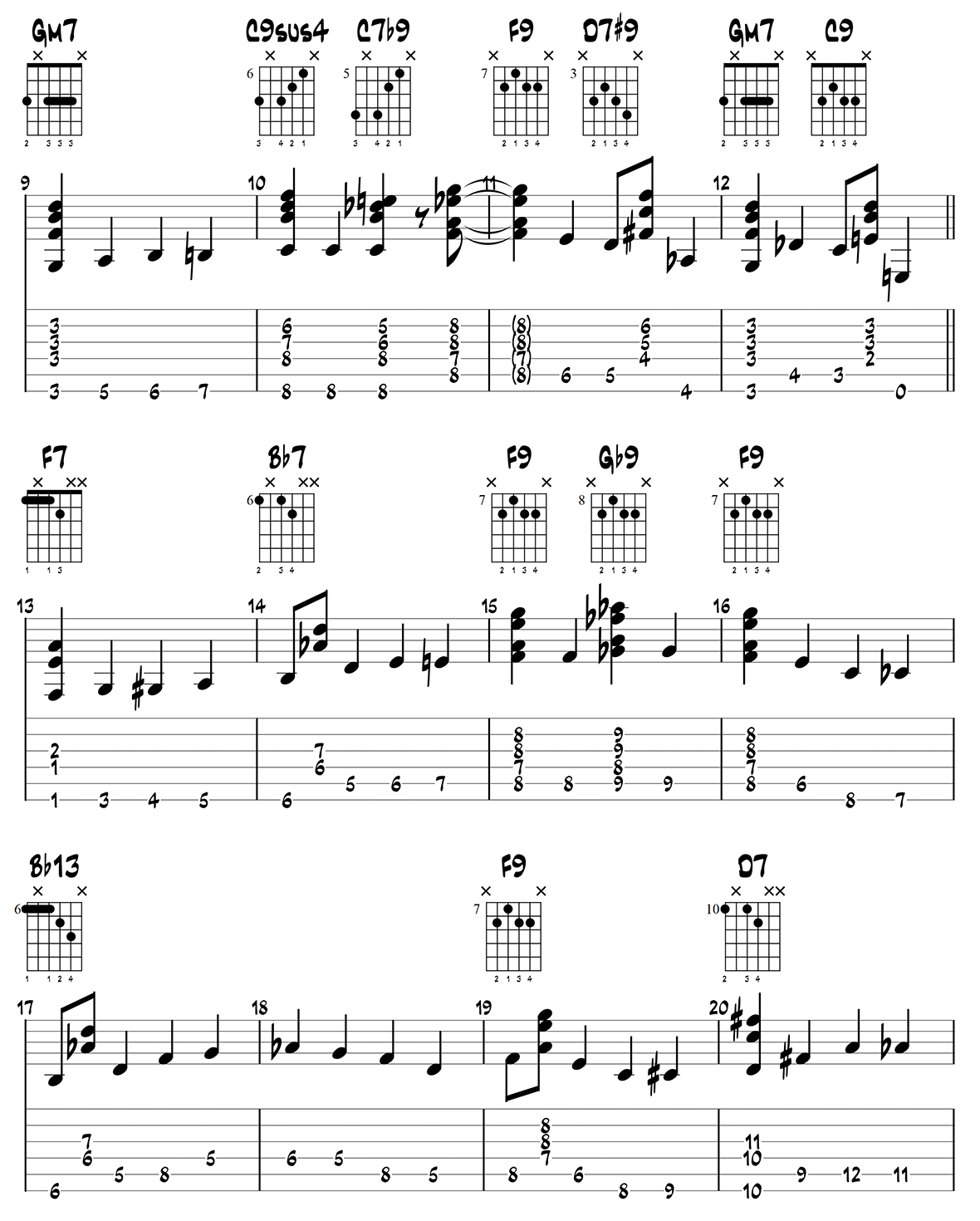
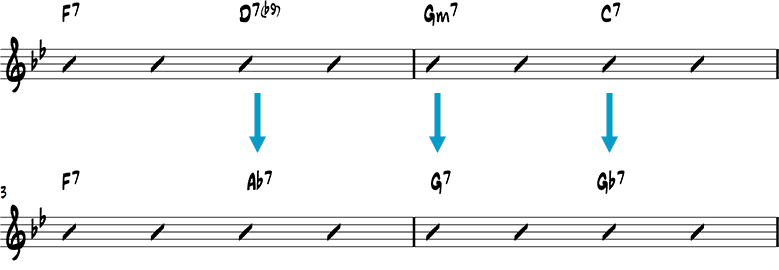
Step 6: Adding Chord Substitutions
Now that the bass line and chords are solid, we can add a few substitutions to give the progression more color and variation.
Chord Substitution 1 (Bar 5)
Instead of sitting on Bb7 (or Bb7 → B°7), we run a descending dominant line:
Bb7 → Ab7 → G7 → C7
- Ab7 acts as the tritone substitution of D7 (the V of G7).
- G7 → C7 forms a II-V back to F7. Normally, this would be Gm7 – C7, but in a blues, you can make every chord into a dominant-type chord.
Chord Substitution 2 (Bar 10)
C7 is delayed with a C9sus4.
Adding a sus chord before a dominant chord is an effective way to create more movement in your chord voicings.
Chord Substitution 3 (Bar 15)
Here, I play a Gb7 after the F7.
Gb7 is the tritone substitute of C7 and is another way to create movement in the chord progression.
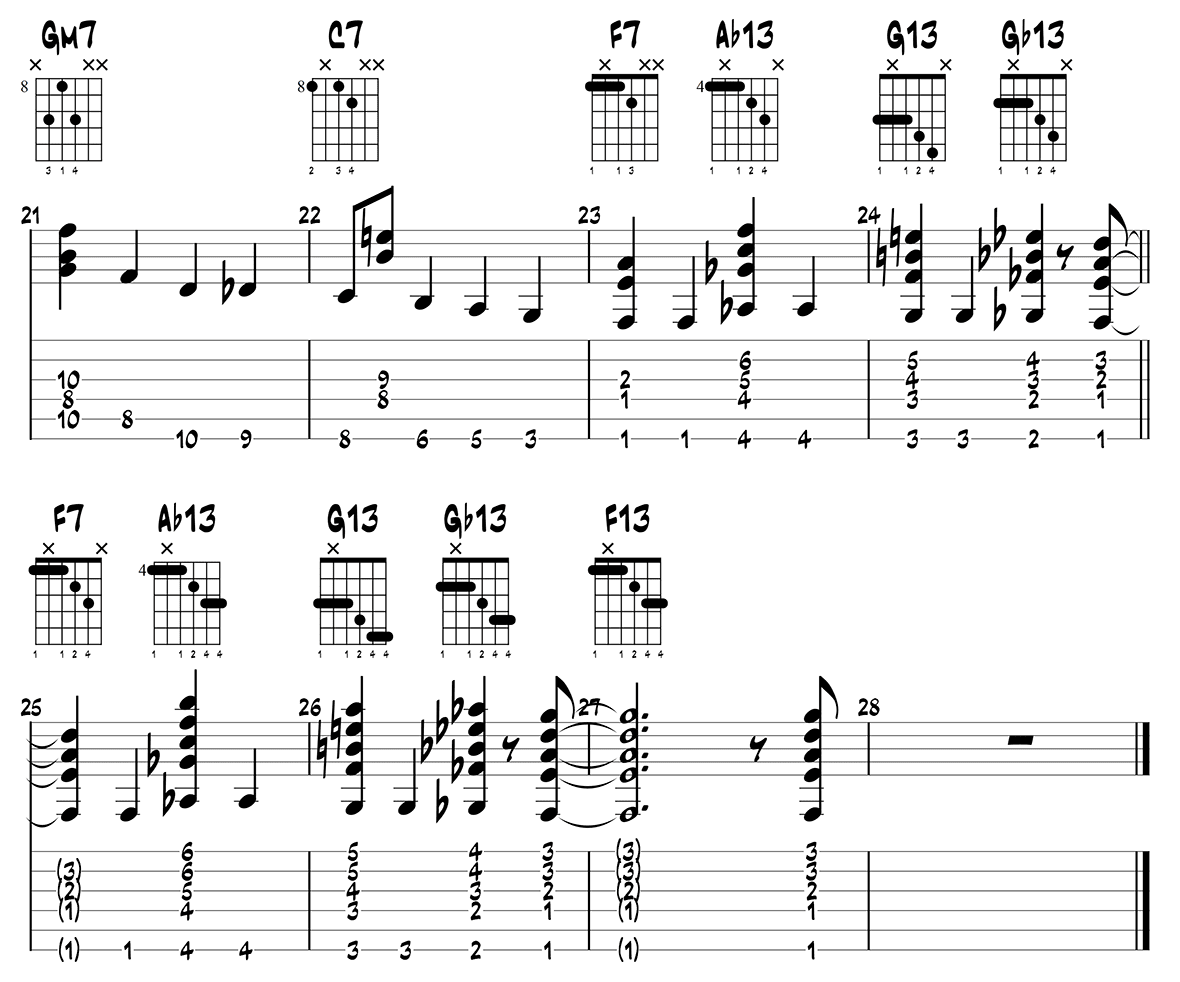
Chord Substitution 4 (Bar 23)
The descending line of 13th chords comes from stacking tritone subs through the turnaround:
- Ab7 is the tritone sub of D7.
- Gm7 becomes G7 (you can turn any chord in a blues into a dominant chord).
- Gb7 is the tritone sub of C7.
Walking Bass Line Patterns
Here is a set of walking bass patterns grouped by chord type (major, minor, dominant, and half-diminished).
Learn these shapes, get them under your fingers, and they’ll make it much easier to improvise walking lines over jazz standards.

Now we can take these steps and apply them to any jazz tune, be it a blues tune or a standard 32-bar tune such as Autumn Leaves.
At first, write the steps out so the process is clear. Once it feels natural, start walking and comping on the fly.
Thank you! More of this!!!
Excelente aula!
That is an outstanding lesson Dirk. I really enjoy your work
Hey Dirk! As it happens I have a Squier VI, which is the updated version of the original Fender Bass VI here. It’s basically a full six string guitar that is pitched an octave down. — As a result, this lesson is excellent, for both playing on my regular guitars and on the bass. Very cool. Thanks.
Très belle walking bass
et bien sentie !
Never could get it until this lesson
As a fairly old player, again, on top of the actual issue here, I see some good teaching, thanks Dirk!
I purchased the JGO+ download pass, but don’t see where to download the lesson.
Help please.
Hi Robert, thanks for joining JGO+! Go to your download page and you’ll see it listed as “Walking Bass Lines”: https://www.jazzguitar.be/courses/lessons/jgo-download-page/
Muchas gracias
Me gusta la lección
Very Nice.
Lovely lesson. That works beautifully. Thoroughly appreciate your lessons, many thanks
GREAT SITE EVERY LESSON IS VERY WELL DONE AND INTERESTING
Dit is geweldig! Dankjewel.
Hi Dirk
What an amazing lesson! JGO has got to be the ‘Go to’ Jazz guitar website! Please keep this website going. It is so invaluable to beginners and pros alike.
Thank you!
Thank you very much ,a very instructive lesson to understand how to progress step by step .
Dirk, love your lessons, really strong and really good methodology. Would be so great to have the GIF files, all the lessons you send out with them go straight into soundslice, which makes it so much easier to learn, sort and organize for later practice, speed up, slow down, loop and manipulate for self study in other areas. If possible, would be amazing. thank you, Jere
Hi dirk, This jazz system of yours is the best I have seen for learning jazz.
and jazz can get complicated as we all know. Your system is very well explained
and easy to follow, even for people that haven’t had much music theory.
I am an older person have played jazz numbers with a trumpet and sax
players on organ piano and guitar. I first downloaded the chord and scale
theory for my son who is starting on guitar. He is getting there slowly so
can,t push to much down his neck to quick. Anyway thank you for your
effort to put such a great Jazz learning system together. Thanks
Gran lección, muchas gracias por compartir
A walking bass line lesson! Thank you so much Dirk –
you are a STAR!
This is really outstanding. I have purchased…and love your Jazz Patterns course. This is a great bonus!
Thanks Dirk
Great lesson MMO
Best wishes
Max
Thanks a lot!!!
This is very clear and well explained. Thanks, Dirk.
Heel duidelijk, hoewel ik er nog lang niet aan toe ben, ik ben pas begonnen in chords geven deze mails een extra stimulans om door te gaan. Bedankt!
Wow you make it sound easy but harder to do.Ria
Slow it way down and take it a couple of bars at a time and after a week, maybe 2 you’ll have it under your belt and can then work on speeding it up. You can do it!
Thanks again
My head is exploding 🤯
So awesome. I have some practicing to do.
Vielen Dank, klasse erklärt.
Grazie, spiegazione eccellente, tutto ha un senso logico. Grande maestro.
Thank yo Dirk for your share, very educational.
Bellissima e interessante lezione Grazie
Excelente trabajo!!!
Muy bueno, muy útil.
Muchas gracias!!!
Quite enjoyed this walkingbass lesson and explanation. Made clear and good to follow. Thanks
Nice Lesson. Split octave subs: Ab7(-5) for D7 is very jazzy.
Muy buena lección, gracias 👌 👍
Très instructif une fois de plus.
The magic behind walking bass finally revealed ! Thank you very much (from France)
Wow. It seems so easy.
Very cool stuff. Thank you
Thank you Dirk. Look forward to using this. Thank you again!
Excellent!
Very sound people. Appreciate
Very nice. Love it.
¡¡¡¡¡¡¡¡¡¡¡¡¡¡EXCELENTE!!!!!!!!!!!!!!!!!!
precious as always.
What a great lesson !!!!!! Thank you.
As always a pleasure. Thanks a lot
Very educational. 10X!
Great lesson! I was waiting for it!!! Thank you!!!
Excelente lección. Muchas gracias.
Bravo maestro!
Hello Dirk,
very helpful ! I greatly value your systematic and to the point approach. And it is a topic which up to here I have never found treated in a stand-alone lesson. Thank you a lot for this and for all the other online lessons you publish and help making progress as a jazz guitarist.
Guido
Eupen/Belgium
Thank you. Very useful ! Also to learn how to play the bass, just in case.
A really great piece of work. Thank you for sharing this knowledge.
One of the better explanations/lessons on walking bass I’ve seen. Look forward to digging into this, thanks!
Ottima lezione
Terrific overview – many thanks!
Vielen Dank !!! Ganz toll umgesetzt diese Lektion…
Excelente Lección
Thanks Elias!