

All of Me was written in 1931 by Seymour Simons and Gerald Marks and later became a jazz standard. It’s especially popular with gypsy jazz players, but it works in any style.
The harmony of All of Me moves slowly (most chords last two bars), which makes it a good tune for beginners.
In this lesson, you will:
- Break down the chord progression (harmonic analysis)
- Learn the melody on guitar
- Build a simple single-note solo over the changes

Recommended listening:
- Django Reinhardt – Nuages (1940)
- Billie Holiday – Love Me, Love My Dog (1941)
- Frank Sinatra – Swing Easy! (1954)
- Sarah Vaughan and Her Trio – Swingin’ Easy (1957)
- The Oscar Peterson Trio – A Jazz Portrait of Frank Sinatra (1959)
- Ella Fitzgerald – Ella Swings Gently with Nelson (1962)
- George Benson – The George Benson Cookbook (1967)
- Biréli Lagrène Ensemble – Routes to Django (1980)
- Stochelo Rosenberg / Romane – Gypsy Guitar Masters (2005)
- Biréli Lagrène & WDR Big Band – Djangology (2006)
- Rosenberg / Lagrène / Debarre – The Alternative (2013)
All of Me – Video

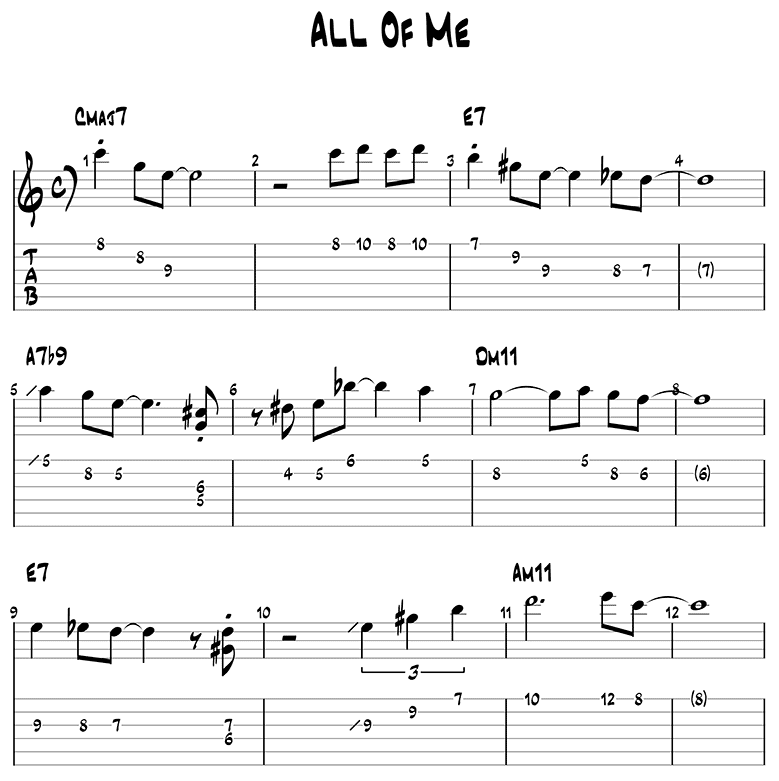
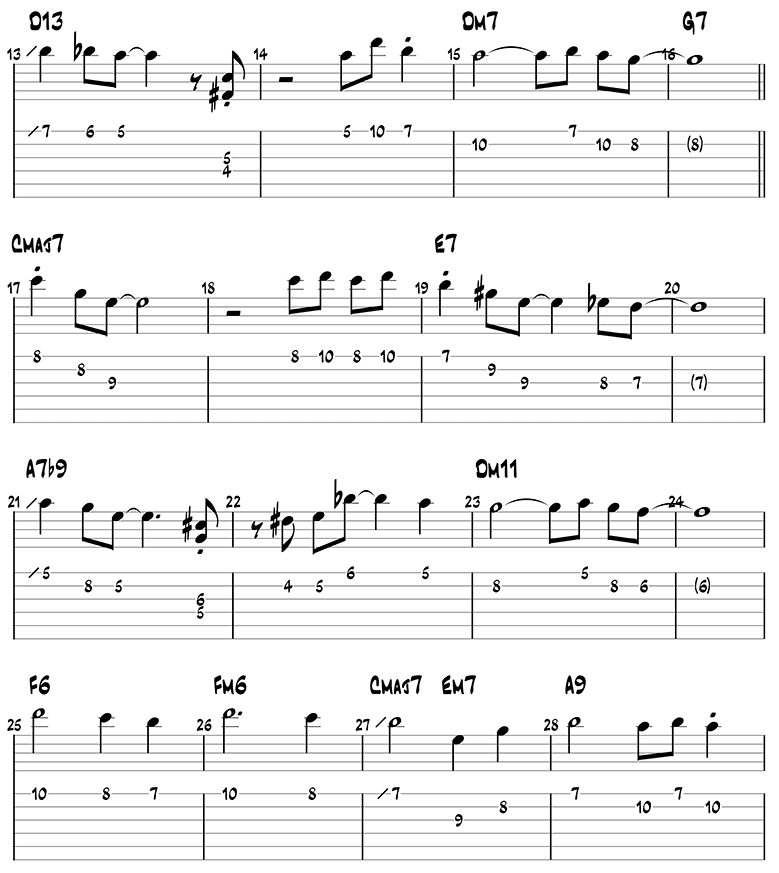
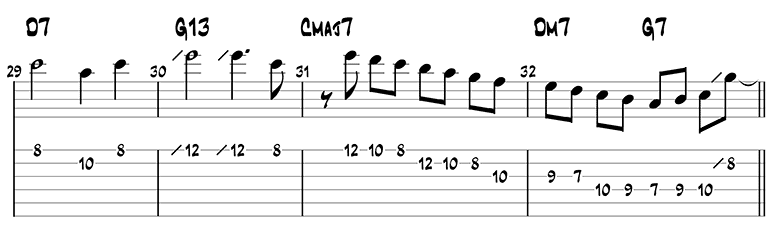
All of Me – Melody
We’ll start with the melody of All of Me. It’s built from clear, singable phrases and mostly moves stepwise, which makes it easy to memorize and great for developing your feel and phrasing.
Guitar tabs and standard notation are included below.
Backing Track (made with Band in a Box)
Listen & Play-Along
All of Me – Analysis
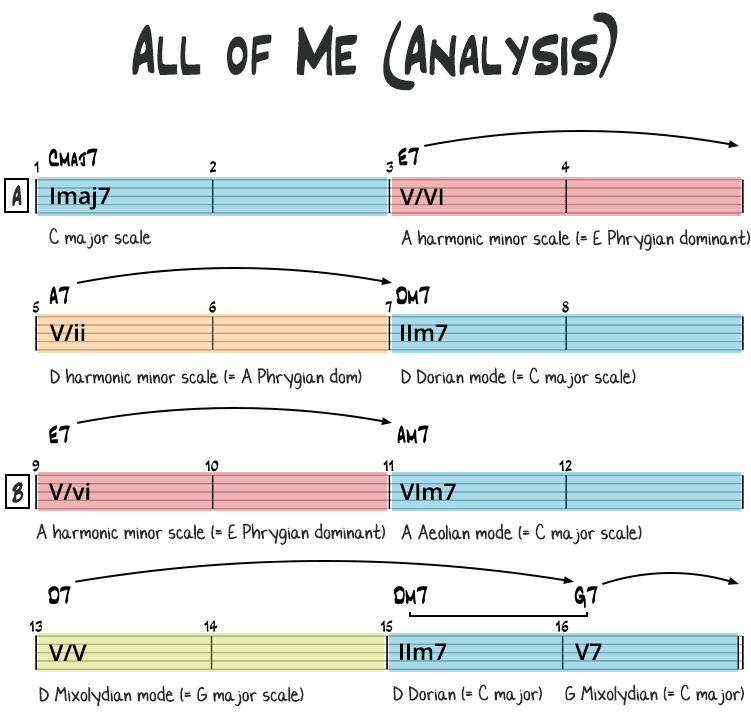
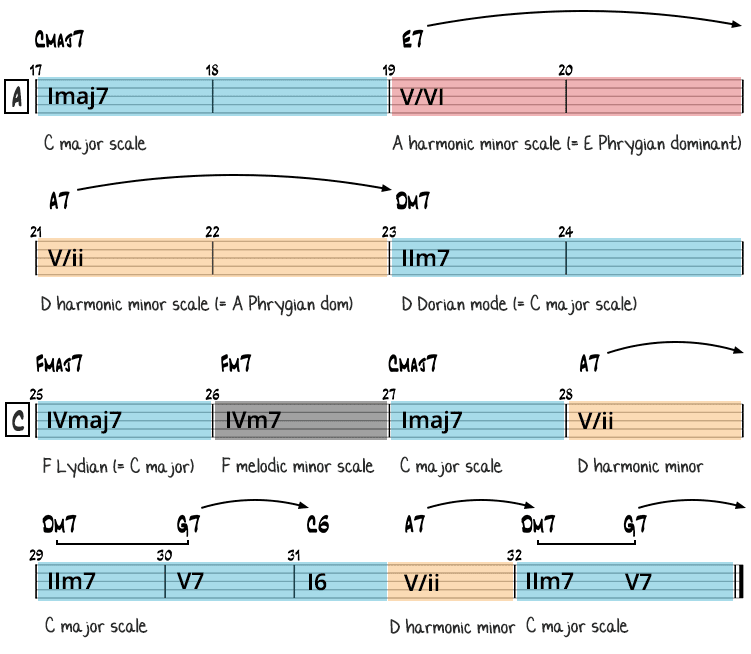
Before we go on to the solo, let’s look at the harmonic structure of All of Me and the scales you can use over the changes.
The harmony is straightforward and built largely on secondary dominants and movement in fourths (following the circle of fifths), which makes it an excellent tune for understanding functional harmony and chord resolution.
Form: The tune is 32 bars long with an ABAC structure. The two A sections are identical, which makes the form easy to recognize once you’ve played it a few times.
Key: The Real Book version is in C major (as is the version in this lesson). The original recording is in Bb major.
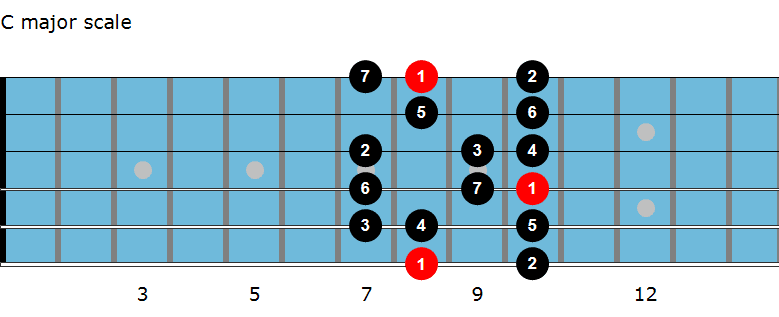
C Major Scale and Bebop Scales
The C major scale works over all chords marked in blue in the analysis chart — these are the diatonic chords of C major.
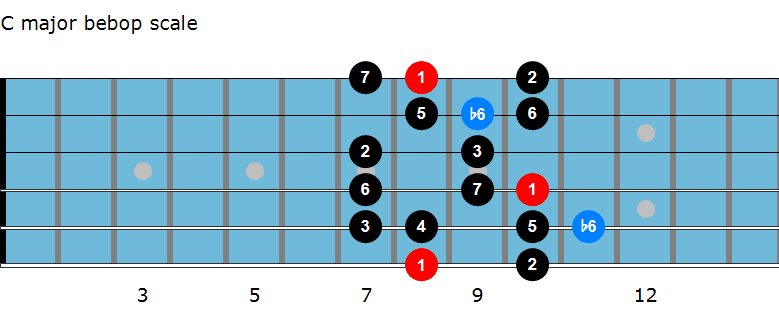
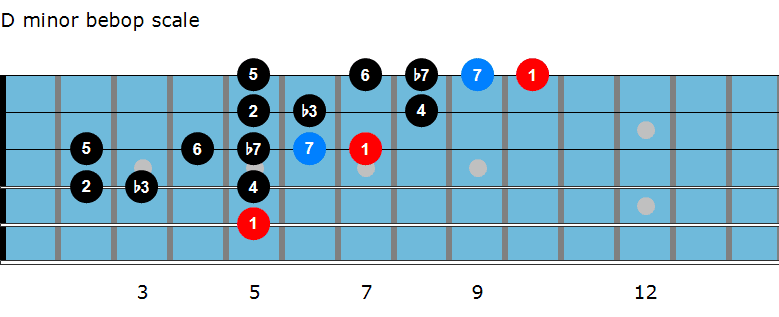
As an alternative to the plain major scale, I use bebop scales in the solo. They add a passing tone, which helps create smoother eighth-note lines.
On major chords, you can use the major bebop scale (major scale + b6).
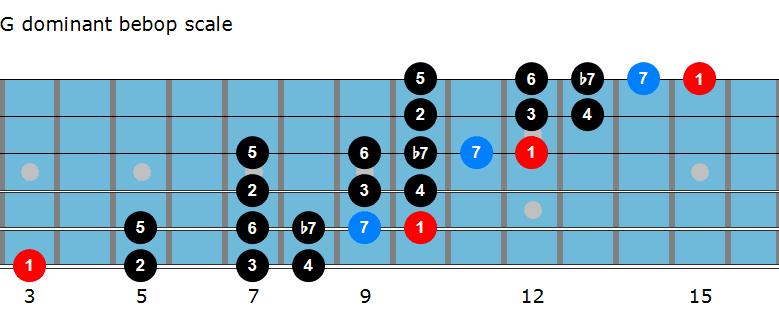
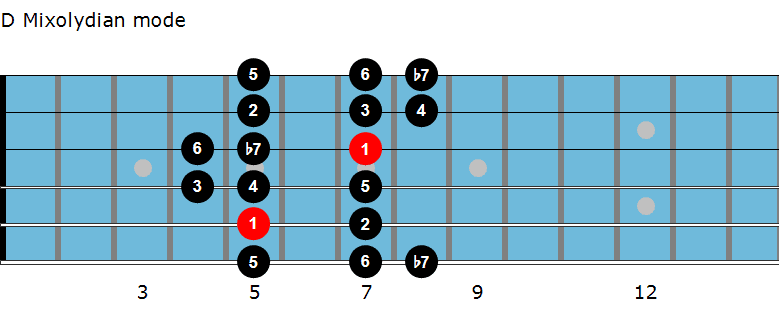
On dominant chords, use the dominant bebop scale (Mixolydian mode + natural 7).
On minor chords, use the minor bebop scale (Dorian mode + natural 7).
A Harmonic Minor Scale
E7 (bars 3-4, 9-10, 19-20) functions as a secondary dominant chord.
From Cmaj7 (bars 1-2), the progression moves to E7 (bars 3-4), which is the dominant chord of A7 (V of A7 or V/VI).
This I → V/VI movement is common in jazz standards and appears in tunes such as:
- Someday my Prince Will Come
- After You’ve Gone
- Come Rain or Come Shine
- I’ll Be Seeing You
- Basin Street Blues
- I Should Care
- On a Slow Boat to China
Two possible resolutions:
1) E7 → Am7 (bars 9-10)
When E7 resolves to Am7 (bar 9), it is called a secondary dominant and is notated as V/vi.
A secondary dominant is a dominant chord that resolves to any chord other than the tonic (I).
2) E7 → A7 (bars 3-4, 19-20)
When E7 resolves to A7 (bar 3), it is called an extended dominant and is notated as V/VI.
An extended (secondary) dominant is a dominant chord that resolves to another dominant chord.
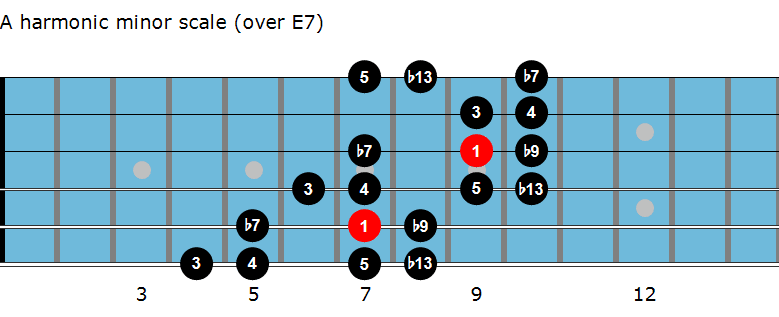
The scale of choice to play over E7 is A harmonic minor, also known as E Phrygian dominant or the E Mixolydian b9 b13.
This gives you the characteristic b9 and b13 tensions that define the sound of this dominant.
| A harmonic minor scale | A | B | C | D | E | F | G# |
|---|---|---|---|---|---|---|---|
| Played over E7 | 11 | 5 | b13 | b7 | 1 | b9 | 3 |
D Harmonic Minor Scale
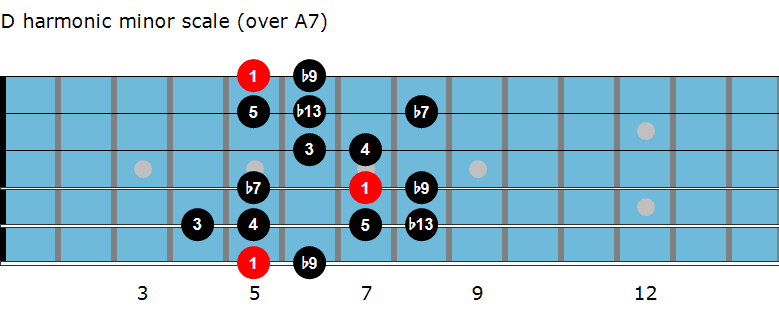
The A7 (bars 5-6, 21-22, 28, 31) is a secondary dominant that resolves to Dm7 (IIm7).
The scale of choice here is D harmonic minor. When played from A, this scale is also known as A Phrygian dominant.
D Mixolydian Mode
D7 (bars 13-14) is the classic secondary dominant in the key of C major. It is notated as V/V (the dominant of the dominant) because it resolves to G7, which then resolves to C.

This V/V → V → I movement is extremely common in jazz standards. You’ll find it in tunes such as:
- Days of Wine and Roses
- Don’t Get Around Much Anymore
- Just Friends
The scale of choice over D7 is D Mixolydian, the 5th mode of the G major scale.
F Melodic Minor Scale
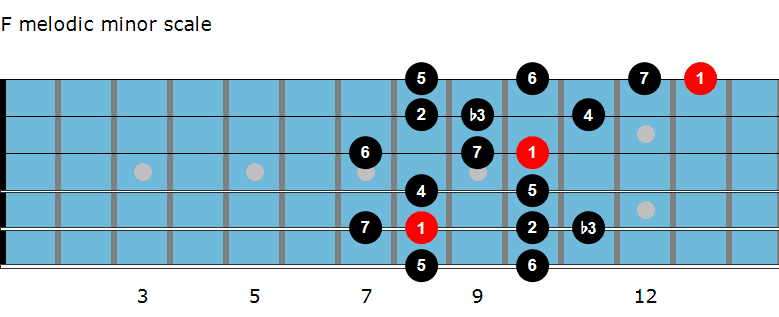
The Fm7 chord (bar 26) is the iv minor (ivm) in the key of C major and is an example of modal interchange.
This chord is borrowed from the parallel minor key (C minor). Borrowing the ivm from the minor key is very common in both pop and jazz. It appears in standards such as:
- Fly Me to the Moon
- How Deep is the Ocean
- How High the Moon
It’s often placed between IV and I, creating a smooth chromatic voice leading:
- A (3rd of Fmaj7)
- Ab (b3 of Fm7)
- G (5th of Cmaj7)
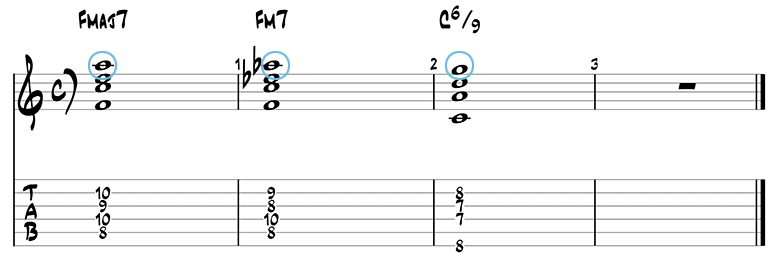
The scale of choice to play over Fm7 (as a ivm) is F melodic minor. This scale highlights the characteristic Ab (b3) while keeping the natural 6 (D), which gives the chord a slightly brighter minor sound.
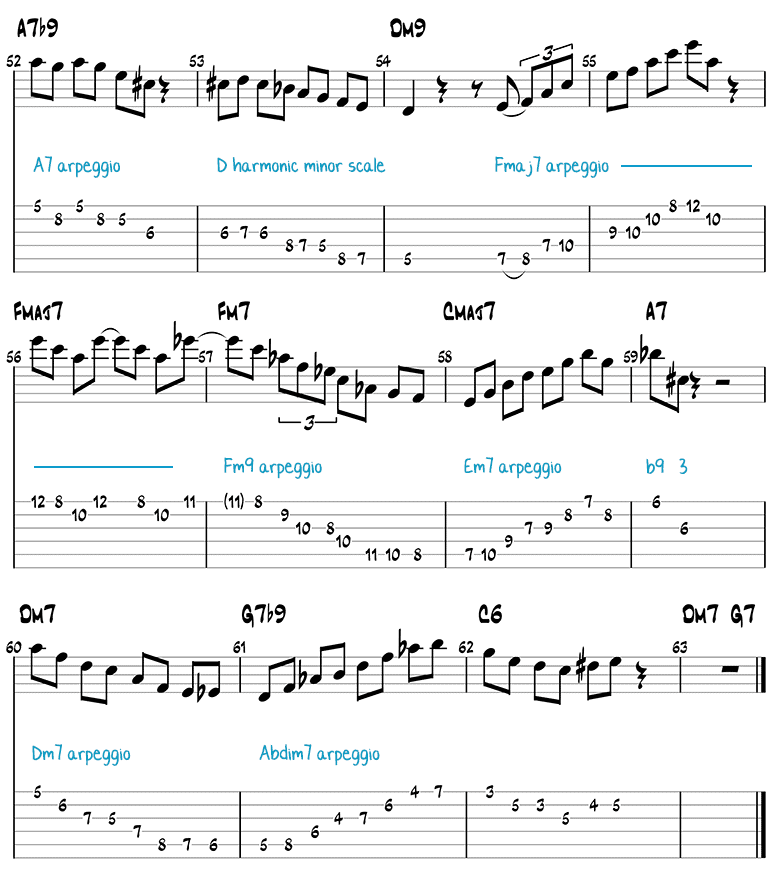
All of Me – Solo
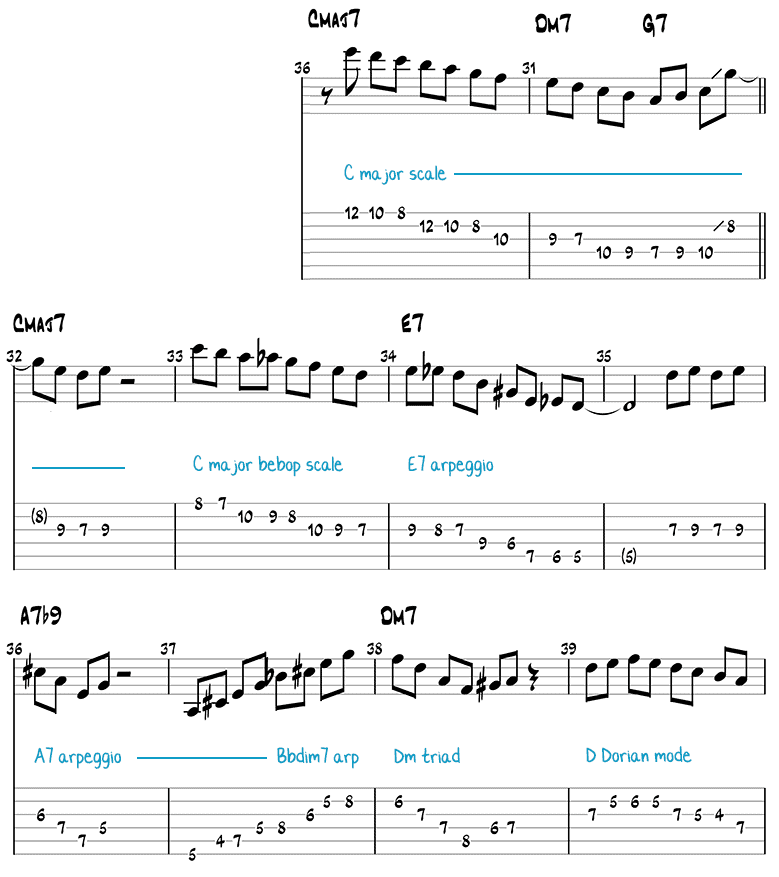
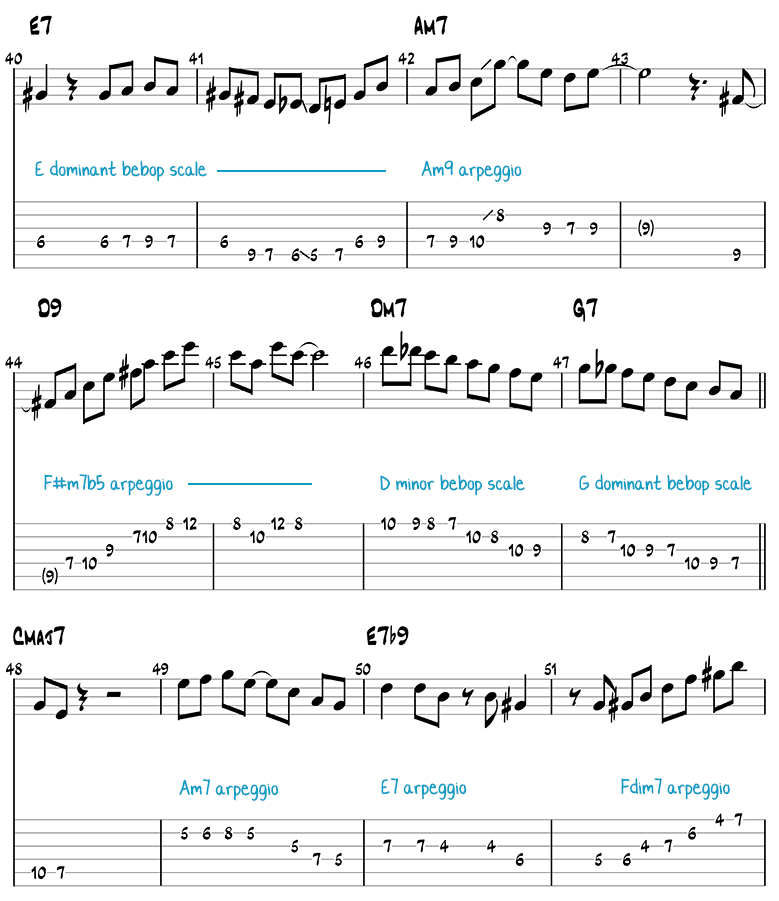
This solo is built primarily from arpeggios and bebop scales, keeping the harmony clear and the lines simple.
Só tenho que agradecer muito, muito ao Dirk Laukens.
Há bastante tempo, venho tentando encontrar uma lição perfeita como esta.
e, de uma hora para outra, o Dirk nos manda uma aula completa sobre esse tema maravilhoso.
Harmonia e análise harmonica, solo e Improvisação. Não sei como agradecer, sinceramente. Comecei a estudar agora.
Obrigado, um abraço!
Whata wealth of information you present here. This is hands down the best Jazz site on the internet. A straight forward no nonsense approach that works flawlessly. Thank you so much.
Its the best one on the web, thanks bro
Complimenti finalmente ho le idee chiare su tutti questi passaggi e tecnicismi jazz …grazie
It took time but I got this solo down. Thank you so much Dirk for this rob! Canada!
Thanks my friend I enyoy this lesson
Thankyou for this .I told myself that I would learn this type of soloing and I did .It reminds me of George Benson and Joe Pass . Thankyou again for this Dirk ,rob ! Canada !!
Hi Dirk, should the D7 on measure 28 in the LEAD SHEET in fact be a Dm7? That would bring it in synch with the harmonic analysis and the solo.
Great materials!
Hi Dave, I messed up the bar numbering, it’s fixed now.
Beautiful lesson , I play it usally with alto flute but not with such sophisticated improvvisation. The analysis is great, it encorages to step into this world
Would it possible to have a pdf score format to play with alto flute (I transpose, or musescore)?
Best regards and thanks
G.M. Federici, Milan, Italy
Thank you so very much Dirk!
You teach us so many useful things with your lessons.
I play pedal steel gtr…and I’m going to try learning this tune and your variations.
I love your improvisation!
THANK YOU!!!!
Great solo I will learn this one!
i have the solo down and now to play it behind the backing track for phrasing . Reminds me of a joe pass solol !!
Thank you very much for your time and effort. As self-taught beginner guitarist that interested in jazz, I found your content is very very useful. Thanks again.
Thank you so much for making all that wonderful material available. I’m looking forward to learning “All of Me”. Cheers, Ray (Australia)
Nice work
Thanks a lot Dirk! Awesome lessons! Such generosity! What academic talent! Clear, concise, didactic. I am a really newbie in Jazz Guitar (guess in whole guitar lenguaje! 😀 ) and your material is invaluable for me. Thanks again! Cheers from Argentina!
Dirk …your tuition material is probably the best one can get . I really appreciate it and think many others to . Keep up your hard and very good work .
I love this tune and look forward to working through the lessons. Thank you.
Am playing for many years. Best lesson and analysis I have ever found on internet. Amazing amount of work put here for our pure pleasure ! Thanks a lot.
Hi Marc, thanks for the kind feedback!
Dear Dirk, Thankyou very much for all the incredible work and playing that goes into your lessons and books. I greatly appreciate it.
Hola Dirk, justo lo que necesitaba , primera vez que encuentro una pagina que explica todo tan claro y sin ocultar informacion, exelente trabajo
muchas gracias !!!
Curious about your vibrato. I am a cellist learning guitar and my natural instinct is to do vibrato by rocking my finger back and forth (as on a cello) instead of the string bending type of vibrato I see in many of the guitar tutorials. Yours seems to be more of the finger rocking style. Am I seeing that right? Do you have a video explaining your approach to vibrato?
David,
I am a violinist and a guitarist. Because the guitar is fretted the vibrato is almost inaudible and the note sounds almost exact. The undulation in notes on fretless instruments is to imply “tune” to the listener. I would not worry about using a vibrato unless you want to create that sound which is done at bar if your rig has one.
Keep playing!!!
The back-and-fourth finger vibrato works better on guitars with with high frets. It works will on my Gibson Les Paul Studio with the jumbo frets, not so much on a telecaster. Place finger in center and rock towards the fret. Not as dramatic as on a cello but noticeable.
Thank you Dirk,
Been playing for 45 years and your lessons have explained more theory and musical concepts to me than any other endeavor . As others have stated , your technical abilities on this site are phenomenal .
Thank you for your excellent analysis. As an ear player, this is going to make a lengthy but enjoyable study for me.
That was a great read! Thanks!
This is wonderful! Always appreciated! Thanks so much!
PS-I learned “Stompin at the Savoy” from your lesson.
Dirk, you are a master.
In fact I’ve bought your material. And it’s brilliant.
As a relatively new(er) jazz guitarist (but familiar with scales) I have a hard time knowing where is the right place to start with your collection.
Dirk, Thank you for all you do for all of us.
I love this lesson and bought the jazz patterns and phrases course which is amazing.
thank you very useful
Merci Dirk pour le partage de ces précieuses informations à la fois mélodiques et harmoniques sur ce grand standard.👍🎶🎸
This is exactly what I needed to learn…The scales that fit the chords in tight cohesive phrases. Your organized, detailed harmonic analysis has helped tremendously to fill in the gaps in my limited knowledge of the fretboard. Great for the visual learners..Infinite thanks.
Hello, im beggining with gypsy, can you explain a bit why over the IVm “Fm” whould be a good choice to pick the melodic minor instead of the C minor scale? is it because personal taste or it is related to the estability of the IV grade to look at it as a tonal center? Because in the last option, F melodic minor, it will turn the C in the Mixolidyan b6 mode, as far as i can understand. thank you so much in advance it is a great post, machts gut!
Dirk, I searched and watched many YouTube jazz learning videos. I have watched a few of your work. They are the most useful learning tool for me at my stage of learning. It helps me to understand the reasons behind all the mystery of jazz music. Now I can at lease started to play and feel better for myself having understanding it. I like the way you analyzed every phrases. I sincerely hoping that you will do more songs. I am willing to enroll to your courses like this if they are available.
Very good explanation! The first chord of the song is a C69 Chord. In the melody there is the octave. It doesn’t sound good if you have a b9. That is the mistake which is often made in the Realbook. I prefer also an F#07 instead of an Fm chord but that is a question of taste.
Surely D harmonic minor over A7 in the C section can’t make sense. The melody has a B natural, perhaps mixolydian flat 6 would work better?
Hi Nic, D harmonic minor (=A Phrygian dominant) is a common scale to play over V/ii. You don’t have to stick to the melody when improvising…
Dirk,
Great tutorial with All of Me as it demonstrates the relationship between the use of different modes, scales and arpeggios used in the solo to the underlying chord changes. It’s all starting to make sense to me now.
Best,
Howard
Brilliantly explained.
Someone told me that ‘All of Me’ was a good place to see the ‘Circle of Fifths’ used.
I was baffled because the 7th chords weren’t actually in the key of C.
So ‘Secondary Dominants’!
Which I had heard of, but this was the first explanation of how they are used and their relationship to the key of the song.
Plus, you showed the scales to use for each chord.
The Analysis of the tune is an astonishingly informative infographic.
I’m not just blowing smoke, I have taught classes on using graphics to explain technical information. This page is perhaps the best I have ever seen on the Internet.
Dirk, Boa tarde.
Obrigado mais uma vez. Suas aulas são excelentes.
Sinto-me como estivesse em uma aula presencial.
Obrigado mais uma vez.
Wellington Farias
Dirk, you provide so many good ideas to build upon in this song, All of Me. I’m going to study this one and get it embedded in my brain. Thank you.
Thanks a lot! Very useful and pedagogic. Any tips for how you create etudes in Guitarpro? Just got it and cannot find any good tutorials on how to setup jazz standards and write solos like you have done.
Hallo Dirk,
Dank u voor deze prachtige les.
Maar waar zou ik ergens de bass lines kunnen vinden ?
Dank bij voorbaat,
Johan
Vielen, vielen Dank dafür, dass du diese Dinge zugänglich machst! Ich (Bass) spiele manchmal mit meinem Bruder zusammen, der als klassischer Geiger notierte Soli braucht 🙂
Hallo Sebastian, sag deinem Bruder, er soll improvisieren, es macht mehr Spaß!
man can you !!!!
Parabéns. Com essa didática, não tem como não aprender. Parabéns. Ensino perfeito. Não tenho palavras para agradecê-lo. Que maravilha de ensino.
Very interesting with professional content. Thanks and congratulations for what you do and participate in others.
You’re welcome, Francesco, thanks for the kind feedback!
Thank you for this, a tune I have always liked and the lesson was well good to follow.
Thanks enjoying learning this
thank , grazie . ciao from Italy .
Great work! Very good show of simplicity of complexity! Nice sound and good phrasing in solo.
Thanks Igor!
Very nice. Great interpretation of this standard. Thanks so much for posting this.
Thank you so much, Maestro. Your work really builds musical culture and spreads knowledge. This deserves admiration and gratefulness from everybody.
Really enjoying this, thank you. its a lot of fun to play.
Great, very inspirational for a beginner!
Maravillosa lección. Muchas gracias maestro.
precioso tema.
muy bien escogido para que tambien podamos practicar los que no tenemos un grado avanzado en ‘jazz-guitar’
me anima a persistir en el camino de aprender
Excellent interpretation, congratulations teacher!
Awesome
Lessons are super
This is a great collection of elements to make a really helpful lesson. Thank you!