


-
I don't own a massive collection of Gibsons. I only own one carved body Gibson, at that. However, I have _played_ over a 50-year period a rather large number of Gibson carved archtop guitars. A child of the rock era, I was drawn to the archtop guitar due to the fact that my first instructor, in Hawaii as it happened, played a D'Angelico non-cutaway that sounded sublime. No acoustic guitar that anybody had--my parents were both players and their friends were players, so the house was always filled with people playing music--sounded half as good as my teacher's guitar. As I got better as a player, I discovered that old L5 and L7 guitars, as well as old Epiphone guitars, often approached the sound quality that my teacher's guitar punched out. Over a 30-year period, from 1965 until about 1995, I was on a quest to find the "right" guitar for me--a carved, acoustic archtop for personal, home use. My ideal: D'Angelico New Yorker non-cutaway (for pure tone)--purely unaffordable. After playing an exhaustive number of guitars over that period, I discovered that I was most pleased with Gibson L5 and Super 400 guitars--although some Epiphone Deluxe and Emperor guitars were beautiful sounding and playing guitars, too. Heritage and Guild (AA) guitars were very viable, but for me, at least, the subjective "best" tone was to be found in the L5. In particular, I discovered that the X-braced L5 guitars from the 20s through the mid-30s sounded the VERY best. The 20s guitars were either unaffordable, or needed much luthiering to bring them into great shape. The 30s guitars were perfect, until my head was turned by a Kalamazoo Award guitar that I mentioned elsewhere in this forum. It turned out to be truly sublimely toneful. I deeply regret having let it slip through my fingers, especially given that within a few years of my backing out of the purchase it sold--yes, that very one--for _ten_ times the price I was quoted.
I was never looking for an electric archtop, at that point. However, I would add that in my observations the very best sounding carved archtops, Gibson or non-Gibson, featured DeArmond Rhythm Chief pickups--with the sole exception being the original issue Gibson ES-150. That has been (I have played three, to date) the best sounding electric guitar I have ever played. Other than the 150? L5, Super 400, D'Angelico, and Guild AA guitars all with the Rhythm Chief have been the most satisfying _electric_ guitars for an acoustic/electric tone, IMO. Qua _electric_ guitar, though, I would still stick by the ES-175. Dry, dull, dead? Nope. Pick up a pre-Norlin 175. Heck--they sound halfway decent as acoustic guitars. Listen to "Virtuoso" by Joe Pass. That's his early-60s 175 recorded acoustically, believe it or not, because the engineer messed up the DI track. The album sounds pretty good, to me.
-
07-21-2014 02:44 PM

-
 Originally Posted by Groyniad
I certainly can't take credit for it... the first person I heard use it was my 12th grade English teacher...he had us write a short paper of quips and observations on life, in the style of a writer who did a newspaper column in the same fashion, mostly list-based...I'll never remember what that writer's name was, unfortunately...anyway, that line was one of my teacher's examples...
Back to the thread: 175's becoming less popular? I know at least three players in the last year that have dumped a lot of other gear to snag a 175. And they're all pleased with the decision.
-
" I discovered that the X-braced L5 guitars from the 20s through the mid-30s sounded the VERY best"
minor correction Greentone:
Gibson L-5s were only X-braced from '34-mid '39
-
Wintermoon is a faster typist than me.

The original L-5 is tone bar braced, and to my ears remains the sweetest, most versatile acoustic archtop until modern times when the market exploded with custom builders able to make you nearly anything. The early L-5 feels like a concert level classical guitar in its precision and response.
Getting into a greater degree of esoterica, the L-5 from its inception until about 1929 has carved braces that are an exact fit for each top, whereas after that they began kerfing the braces to save labor. This distinction further stratifies the market value of various generations of L-5. And of course, the earliest (1923-1925) guitars actually signed by Lloyd Loar are at the top of the heap value-wise.
Not that any of this has to do with laminated guitars. But I can relate to Greentone's sentiments because my personal taste has led me to a similar place.
-
I stand corrected on the bracing pattern vis-a-vis 20s and 30s L5 guitars. (Live and learn--especially from this forum group). What I can say, based upon personal experience--including long-term loan of a '28 L5 about 15 years ago--is that without exception the 20s L5 guitars I have played have been the most exceptional archtop guitars, ever. They exude what, to my mind and ears, are _perfect_ highs and clear, articulate lows. The high end exhibits a natural reverb, too, that seems lacking on all other guitars I have played, except some of the 30s 16" Gibson archtops. The mid-30s L5 guitars (and L7) have a different, but also exceptional sound. For solo chord melody work, I am not sure that an early L5 can be knocked off the top of the hill. However, for big-band chording it comes down to 30s L5s, 30s Super 400s and pre-war Epiphone Deluxes and Emperors--all preferably non-cutaway guitars. Maybe Stromberg and D'Angelico can whup 'em, but my experience, here, is too limited to permit anything but repeating what I have read elsewhere. I have, however, played bunches and bunches of Gibsons and Epiphones. (Dealer in my hometown was an old Epiphone--New York--dealer/collector; although his personal guitar was a 30s non-cut L5. He had the most extensive collection of Epiphone acoustic archtops I saw in the pre-vintage collecting days...1960s. He enjoyed the fact that a youngster actually liked archtop guitars.)
-
"without exception the 20s L5 guitars I have played have been the most exceptional archtop guitars, ever"
+1
"However, for big-band chording it comes down to 30s L5s, 30s Super 400s and pre-war Epiphone Deluxes and Emperors--all preferably non-cutaway guitars"
also a +1, though having owned quite a few of those models from all eras, I feel the early postwar Gibsons, '46-early 50's, are overall the punchiest sounding 17" and 18" acoustic guitars Gibson produced and make for excellent big band type guitars.
the 30s Gibsons are generally a bit warmer and mellower due to the X-bracing
Epiphones were always parallel braced, punchy sounding guitars can be found in all of their pre-Gibson aquired eras
-
fascinating stuff greentone
i too have been blown away by the es 150...
my last gibson laminate was a '53 es 175 which I gave up for a sadowsky (in the name of efficiency really)
have you an opinion on campellone guitars in particular - since his whole motivation is to capture the classic gibson magic - and he's made around 500 archtops now i bet? most if not all the hand-made archtops are meant to be developing the design of the instrument post D'Aquisto and Benedetto (aren't they?) - if that's right, then mark is quite unusual in his explicit commitment to preserve and replicate the classic look/sound/feel.
-
Wish you had the serial number, just for kicks. Or photos. Originally Posted by Greentone
Here's a fun site to view a bunch of early L-5s and read some trivia about them.
-
Buddy of mine still owns the '28. It is his "it's going to the grave with me" guitar. He records with it, but plays mostly other guitars, otherwise. I don't blame him. He also let me borrow for extended periods a '37 ES-150, then a Recording King M-5 that had had the pickup from a Roy Smeck model installed. I still have a picture of that guitar:
I have only played one Campellone, at a guitar show about 10 years ago. It was a blonde model that was clearly patterned after a L5c. It was a superbly made guitar. It played like proverbial butter. I thought the guitar needed to open up, though. It was still too young and needed to have about a million chords played on it. Single-line work sounded dreamy on it, however. I am afraid to judge on the basis of a single observation. No...my friend doesn't own most of the guitars that I have described--he buys and later sells. (I should have bought the Recording King from him.)Last edited by Greentone; 07-21-2014 at 04:37 PM.
-
Me wonders if Mrs. Beaumont is privy to this conversation? Originally Posted by mr. beaumont

And, did someone mention Emperor's - AARRGH- restraint!
https://reverb.com/item/199661-epiph...idden-controls


Last edited by 2bornot2bop; 07-21-2014 at 04:54 PM.
-
I sure do love Epiphones. You know, that Emperor is somewhat emblematic of the design values that the Stathopalou Brothers built into the line--at least the ones that I have played: Zenith, Broadway, Triumph, Deluxe, Emperor, hmm? I know I am leaving some out. Compared to Gibson, the Epis are LOUD, virtually without exception. They really project. They do this in the tonal range that you hear in the video you attached--upper mids and highs. This is a good thing because in a rhythm setting it really adds the ka-ching to the time in the band. The archtop in that setting is truly a tuned drum. There is nothing like an Epiphone non-cutaway for that job--and nothing like an Emperor, in particular. To my ear, the Deluxe was always a little bit more refined than the Emperor, in terms of tone. I would rather use a Deluxe than an Emperor for chord melody. However, I'd rather have an Emperor than anything for doing the Freddie Green gig--even though I have an old, blonde Gretsch for that (just because it looks like the one that Green used--it, too, favors the timbre that "cuts" through a band.) Withal, for personal jazz playing and accompaniment of a singer, a la Eddie Lang/Bing or Joe Pass/Ella, I would rather use a Gibson L5--it is "sweeter" sounding than an Epi, IMO. Disclaimer: this is subjective as heck. All this said, I was virtually hypnotized each time I would enter the back hall of my home town dealer's shop and see the wall of old Epiphones hanging there. The only other place to see so much figured wood in one location was in an Antebellum mansion on the Mississippi River in Louisiana, or perhaps in Charleston.
-
I have been very lucky to be able to play many fine archtops over the years. While I do like the sound of the pre-Advanced Gibsons, I particularly like the voice of the pre-war, short-scale, x-braced, 17" Gibson archtops. I also prefer the voice of the pre-war 17 1/2" maple-bodied Deluxe/Triumph to that of most Emperors. Here are two are remarkably different yet equally wonderful instruments from the same time-frame (@1938):
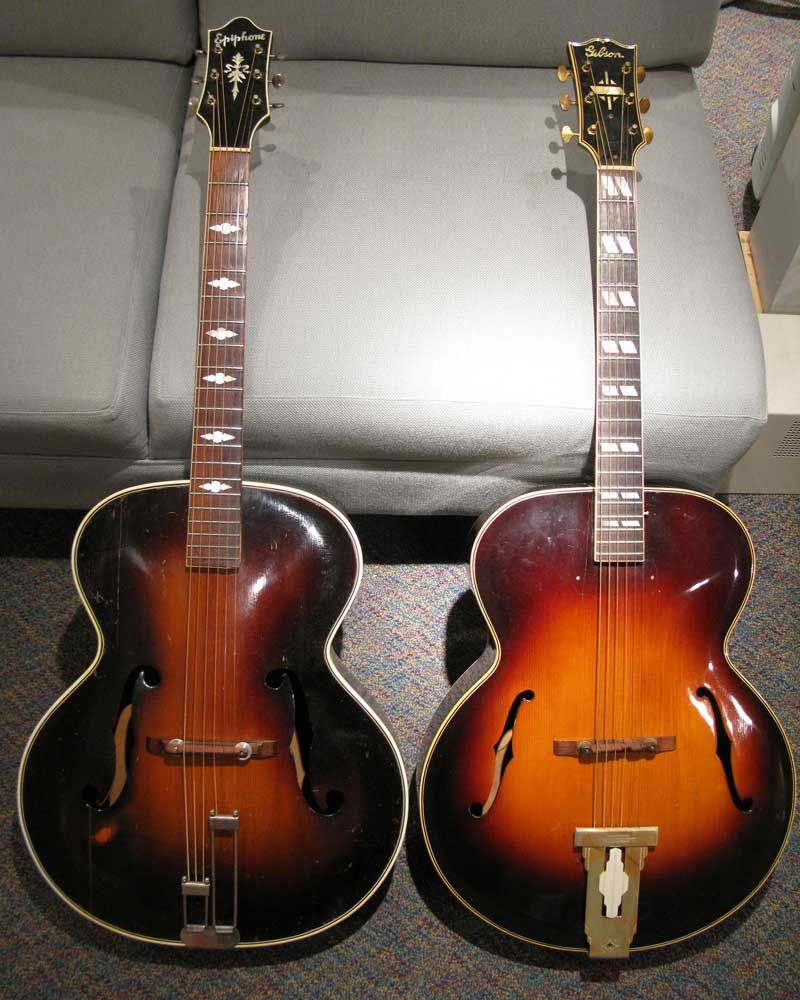
Last edited by Hammertone; 07-22-2014 at 08:40 PM.
-
Originally Posted by Greentone
I believe that is a D'Angelico New Yorker. Originally Posted by Patrick2
I'm going to ignore the silly stuff about the L-5 photo, but thanks for the support from those of you who did, except for the comment about wrinkles--as you can see here, I don't have any:

Danny W.
-
I think you are correct. I saw Burrell in concert in the 70s and he was playing a New Yorker. My bad. The guitar sounds great on that album...very acoustic-electric.
Danny...looks like a band that plays my kind of music. You guys do "But Beautiful?"Last edited by Greentone; 07-22-2014 at 08:46 PM.
-
That's definitely Kenny's Super400ces...built-in humbucker. Listen to the sustain of the 'ol tunamagic bridge! You can't judge a tone by an album cover photo... Originally Posted by Greentone

The 1100 is a lighter & brighter single coil tone (which is a cool sound too, not knocking it!).
-
The tone that guy is getting with the blond 400 and 1100 is to die for.
-
We have a book of about 400 tunes, but I don't remember doing that anytime recently Originally Posted by Greentone
I was talking about the photo on the jacket, not the contents. My Burrell collection has over sixty recordings and I think he sounds great no matter what guitar he uses, including the flattop. Originally Posted by Tom Painter
Danny W.



 Reply With Quote


Got some picking exercises?
Today, 01:17 PM in Guitar Technique