


-
I think I've got a fret lifting up. There a sharp spot on the end, I can feel it, but I can't seem to file it away with an emery board. It's not getting any better. I'm wondering if the fret end is lifted up. I took some pictures with my kids microscope. Any tips would be appreciated.
In this one you can see a dark spot at the top of the fret, maybe it got knocked just right to loosen the fret?
-
03-28-2026 09:19 PM

-
Absolutely not sure of this, but clearly the file/abrasive has to be harder than the thing you're trying to remove material from. I'm not sure that an emery board would be harder than a fret.
-
High magnification of reflective metal will produce illusions. In order to have something to compare, I used magnification to examine my own frets. The first thing I noticed is the apparent dark edges along the line of the frets when viewed from above... which disappear when viewed from a lower angle.
I also felt the fret tips and found that the only ones that had any trace of a sharp feeling were the last two or three at the very high end of the finger board; all the rest have been worn smooth over the last almost fourty years of play.
Your fret's "key" in the finger board's slot does not appear to have dislocated - there is no gap at the key's embedded tip. I would expect a lifting fret might reveal a little gap at the bottom of the key. I don't think the dark edge of the fret indicates lifting; see if changing the light location or the angle of view makes it show itself to be an illusion.
Is this something that you just noticed?
-
Its possible that you are just missing the sharp edge with the emery board. Those boards can easily curve inwards at the edge so you end up filing above the point you aim and miss the bottom. Maybe a fresh emery or one of those soft centered ones sold at sallys beauty shop (its a national chain in the US) might do the trick. If its not stainless it doesnt take much to remove material.
-
-
No, but I did just figure it out.
 Originally Posted by pauln
This is the first fret on my guitar and it rubs the outer edge of the first joint on my index finger. I had assumed the discomfort was the beginning of arthritis pain, which runs in my family. But then I grabbed the guitar by the neck and felt it with my palm.
-
This the classic time of year for 'fret sprout'. The wood shrinks a tiny bit during the heating season, and the metal does not. It's happened to me.
-
My guy said to bring it over tomorrow or Tuesday.
-
I picked up a fret and file from Stew-Mac a few years ago and now take care of this myself. I'm not exactly bold when it comes to taking abrasives to my guitars, but I found it pretty straightforward and now take care of fret sprout myself as needed.
-
1. Tape off the neck around that fret end.
2. File the fret.
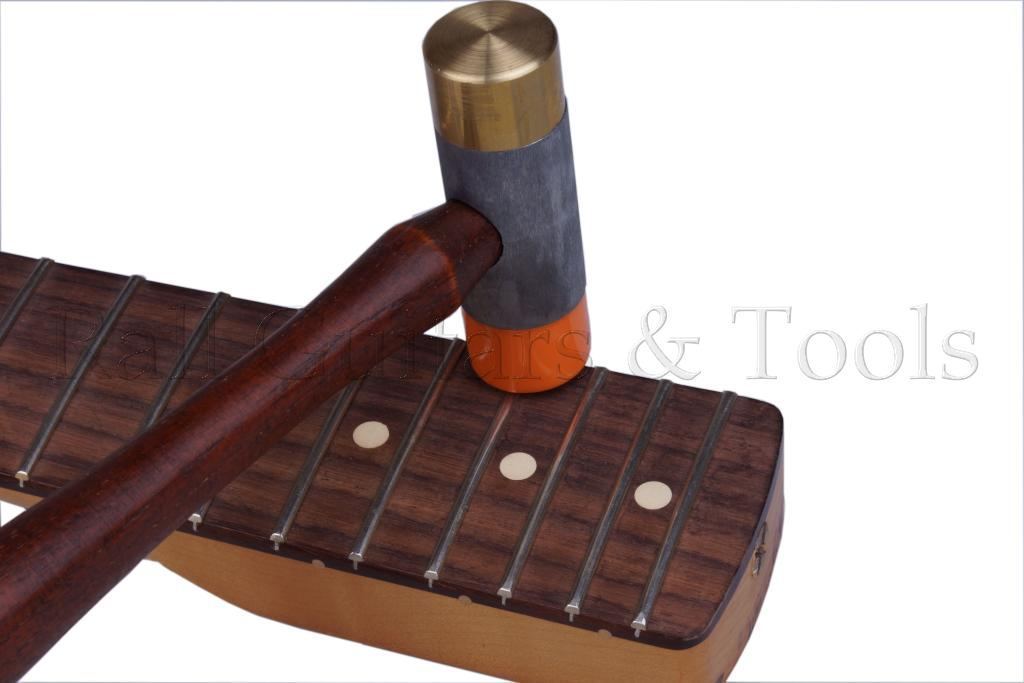
3. Push or pound the fret back down.
4. Use 600 sandpaper on a hard sanding block to get it flush.
Will end up flush and smooth.
-
It was fret sprout. Couple of minutes with a series of files and he was done.
-
He showed me how to handle it next time, if I get my own files. Originally Posted by John A.
-
No 600?! Originally Posted by AllanAllen

-
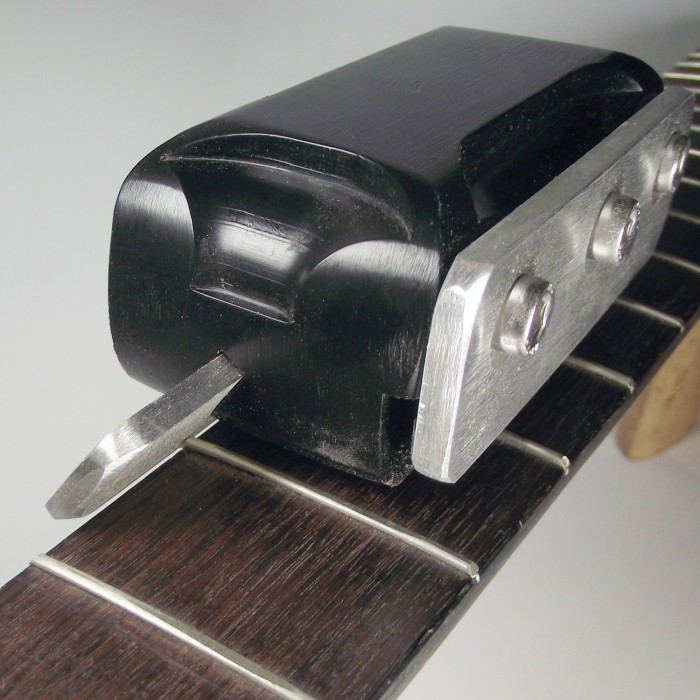
I have one of these tools for fret ends:
-
^ I used to recommend quarter round files to round the ends (or just work down the shard), but I can't find any online anymore. Hrmm.
-
Here's what I found to be helpful and cost effective. Find the loose frets and mark them. Take the strings off. Make an appointment with your luthier. Tell him which frets need tapping and glue. Ask him to address the fret sprouts. That is usually quick work. Sometimes I ask if he'd let me know when he's going to do the work and see if he minds me watching. Very often with quick work the luthier says I'll do it now.
That is the most respectful of his time and should translate to a faster service at a lower cost. Plus you'll learn.
Both sharp fret ends and popped frets are easily addressed, but I really recommend you watch someone do the work while you can ask questions before trying it yourself. Even better, watch some YouTube videos before you watch your luthier do the repairs.
-
The best, easiest, and most exciting method of repair is to buy a new guitar

-
If only... Originally Posted by Rob MacKillop
-
I guess I'd use the old one for firewood! Originally Posted by Rob MacKillop
-
Did it require removal of the strings? I always seem to notice problems immediately after I install a new set of strings. Originally Posted by AllanAllen
-
That's known as Murphy's String Law, a corollary to it is that the strings are likely to be the most expensive strings you've ever bought. Originally Posted by FourOnSix
-
No the same strings are on there Originally Posted by FourOnSix


 Reply With Quote


ES 125 Help Id
Today, 06:25 PM in Guitar, Amps & Gizmos