


-
ive had some not so cheap strings on my Eastman 403 ce archtop and struggled with intonation.Compensating to get as balanced as possible.Then i found a set of a little more expensive strings in my stash put them on didn't adjust bridge or any thing tuned it up and intonation is,well as good as a this guitar has ever been almost right on.Does a set of strings really make that big od a difference?
-
12-17-2024 04:39 AM

-
Yes, it can. Try putting on a set of tape-wounds on a guitar that intonates well with most sets and you're probably going to be in for a surprise.
Nylon string players tend to get a lot more "fun" out of this though
-

-
FWIW:
 Originally Posted by EarlBrother
From what I've seen, all Eastman archtops come with a saddle that lacks micro-compensation and is thus a priori more suited for string sets with a plain/unwound G string. This alone can make a huge difference in intonation if you put a set with a plain G on a micro-intonated saddle or vice-versa, and then try to get the best compromise by moving the bridge. Or even if you don't move the bridge (= correct the intonation of the 2 E strings at the 12th fret); a sufficiently "off" intonation on the G string probably ruins most chords.
BTW, I often prioritise the A string intonation at the 12th fret over that of the low E, because I'm there more often and the A string tends to have more power "up there" too.
-
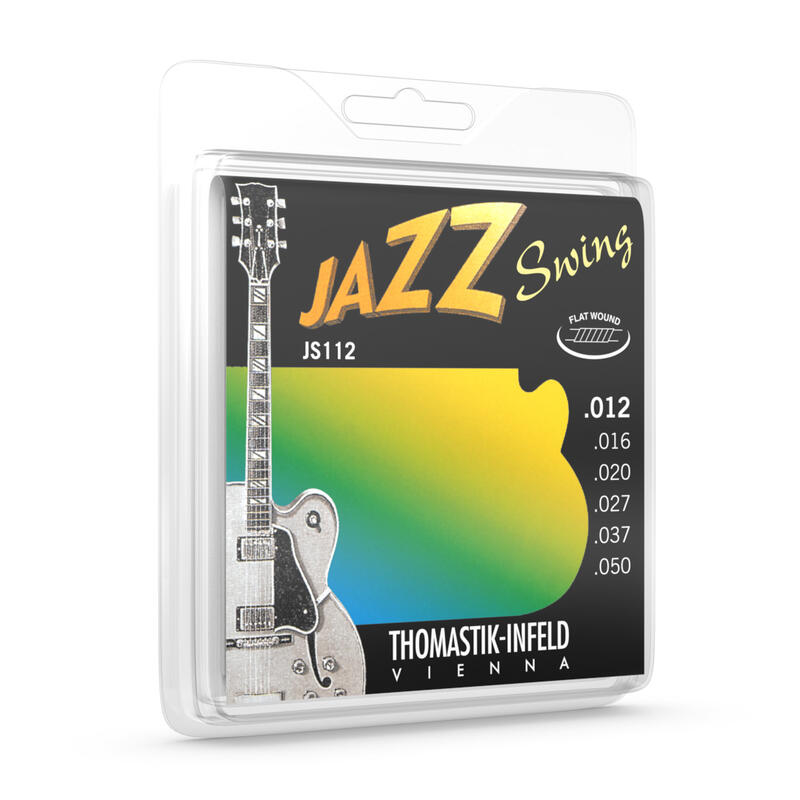
Yes i love the Jazz Tapes but the intonation was 'fun'.I have no patience to work on the guitar or adjusting my amp to get a tone.I just can't seem to get it right.So i put these TI swings i found on replaced the 12 with a 13 and 16 with a 17.Now i just notice there is a bit of a relief bow in the neck.How much should it bow.I am not sure i can trust the local luthier. He a folk,bluegrass guy.The bow looks like almost as high as the fret wire is.like 1 or 2mm i think.Then i got the bridge to maybe lower.I might go ahead and let him look at it.anyway sorry about this.Go help somebody that can be helped.HAHA Thanks for everything.
-
To assess the relief, hold an E string down at the 1st fret and at the neck join fret (12th or 14th) and measure the action under the string at the centre.
Enough that you can play without unnecessary fatigue or buzzing. You don't need to go to a luthier to get that right: just get the allan key that came with the guitar (or any 4mm one that's long enough) and tighten the trusrod bolt in quarter turns (count them!) until you start getting fret buzz. Maybe wait a day for the instrument to settle, then back off 1 or 2 quarter turns to get rid of the buzzing again. If your relief was really too high you may end up with easier to correct intonation but there are no guarantees beyond that in my experience. Originally Posted by EarlBrother
-
Different gauges and different windings can certainly make a difference in intonation, that's no secret.
My personal preference for relief is zero, or a perfectly straight neck/fingerboard. More relief means more intonation issues, because fret slots are calculated assuming a straight neck, not a bent one. In practice, I do tend to set a tiny bit of relief, just enough to be able to tell there is no back bow, which is worse than having relief. It's a balancing act, and requires perfectly level frets, which is all too often not the case. Poorly dressed frets can also cause intonation issues - the top of the fret must be over the center, not to either side. But with a straight neck and perfect frets, very low action is achievable, more so than having relief, and acceptable intonation is certainly possible. Different people have different points on which they are willing to compromise, and that's just my personal preference. I almost never turn a truss rod nut a quarter turn at a time, usually not even an eighth of a turn. A little can go a long way, and I prefer taking longer but getting a better result. Also not all truss rod nuts take 4mm Allen wrenches. Some use larger or smaller, many require sockets. But use whatever is necessary to fit the guitar.
-
This is a very self-aware comment. Originally Posted by EarlBrother
-
In my experience strings can make a difference. So can these. I use them. There is science behind the concept if you like science.
Amazon.com
Amazon.com
-
EarlBrother:
Unwound (plain) strings are slinkier, stretchier. So if the 3rd string (G) is unwound it requires more length. If the 3rd string (G) is wound and the 2nd string (B) is unwound, then that 2nd string needs more length.
Bridges like TOM are designed to intonate each string separately, finely adjustable.
Regarding solid bridges, you can choose from two differently compensated for each situation. See attached picsLast edited by ArchieHollow; 12-19-2024 at 05:16 PM.
-
It could be that you had a defective set/string. Any kind of damage or defect or dirt can cause intonation problems, that's why old strings can have poor intonation. Sometimes you get a dud string in a new packet. If you contact the manufacturer they might send you a replacement?
-
Funny, once I couldn't get my 3rd (G) to intonate. Then I discovered that the ball-end wasn't set securely in the tailpiece. That was an easy fix.
-
hmmmm, it affects just the open string intonation but not the fretted strings - does it? Originally Posted by lammie200
-
But, they're an excellent idea, if you only use open strings. Originally Posted by JazzNote

-
That is a common misconception. They change the length of the string, so they affect every note. Think of it this way. Put one of these on your guitar and tune it properly so that every note along the entire scale length is (very nearly) in tune. Now if you could magically remove the compensated nut and replaced it with a straight cut nut without retuning your guitar every note along the entire scale length will be (way more) out of tune. Originally Posted by JazzNote
Compensated nuts just give you an additional layer of adjustment over compensated bridges alone. The difference is that with compensated bridges the static point is at the straight cut nut. So the compensation needs to take into account the entire scale length. With the addition of a compensated nut the static point can move to (nearly) the mid point of scale length. Thus the compensated bridge will adjust intonation for the upper octave and the compensated nut will adjust intonation for the lower octave.
I use compensated nuts and really like them. Some people have other opinions. It's a big world.
-
Yeah, see what I just posted. It's science, but I recognize that people have opinions. Originally Posted by GuyBoden
-
Science Originally Posted by lammie200
Scientific methodology includes the following:
- Objective observation: Measurement and data (possibly although not necessarily using mathematics as a tool)
- Evidence
- Experiment and/or observation as benchmarks for testing hypotheses
- Induction: reasoning to establish general rules or conclusions drawn from facts or examples
- Repetition
- Critical analysis
- Verification and testing: critical exposure to scrutiny, peer review and assessment
-
A compensated nut only changes the length of open strings. The vibrating length of the string is what determines the pitch, and the plucked string vibrates between its fixed ends. When you fret, the string ”ends” at the fret and the bridge saddle. The distance between each fret and the bridge saddles is the same regardless of where the nut is located. Originally Posted by lammie200
The very slight difference in open length when using a “compensated” nut could affect harmonic resonances excited in undamped open strings. This could slightly affect perceived intonation for notes or chords struck without fretting or damping one or more strings. And a compensated nut could affect (for better or worse) the “beating” that’s audible between a fretted note and the same note on an open string when the two are just a tiny bit out of tune with each other. But it wouldn't affect single note intonation in isolation.
-
With all due respect I think that you are parsing words. When I say that they change the length of the strings I say that because that will affect the tuning of the entire string, not that string length changes from fret to fret. Originally Posted by nevershouldhavesoldit
Your second paragraph has some interesting hypotheses. Like I said, they aren't for everyone. This guy likes them.
-
I had trouble getting agreement between strings on the low frets of an electric mandolin, and tried compensating at the nut, given that the bridge's effect is least there. Later it turned out the frets were better dealt with by a slight shortening on of the fingerboard, so that the low frets were not sharp. Strobe tuner analysis shows my mandolins generally were sharp at the second fret. Whether bad arithmetic for fret location, or inherent in the instrument due to short scale and break angle at the nut, it solved the problem, such that I get sweet chords from first fret all the way up.
i never had trouble with guitars. Assuming equal-tempered pitches are acceptable I see no need for weird frets or nut. Using distortion can exaggerate slight differences from perfect intervals but equally slight finger pressure up or down the fingerboard will tweak the chord to very sweet.
-
I already tried to explain the science of compensated nuts somewhere above in this thread. It has to do with changing the ratio between the inert and the sounding segments of the useful string length. Compensation at the saddle works by changing (mostly) the length of the sounding segment w.r.t. the inert segment (which can be 0). Compensation at the nut works the other way round. No formal proof here, but my experience is that the former tends to have an effect that increases the higher up the fretboard you go. While the latter has more of a constant effect. See my description on how I stumbled upon the principle while tinkering with auxiliary frets myself.
-
The usual cause of intonation problems near the nut is a nut with slots cut too high. The slots should be cut so that the distance from the bottom of the slot to the top of the fretboard is the same as the distance from the top of the frets to the fretboard. In other words, the fret slots should be the same height as the frets. You wouldn't want the first fret to be higher than the next one, and the nut shouldn't be higher than the first fret (well, the slots, anyway). You will never see slots cut like that on a guitar straight from the factory, because it's time-consuming and expensive in multiple ways, because cutting just a tiny bit too deep means you have to start over. But perfect intonation requires perfect nut slots, along with perfect frets and a perfectly radiused saddle, and a perfectly straight neck. All those are hard to attain, so you won't find them on factory instruments, and indeed not on all boutique or custom-built instruments. Most players seem to live with poor action and intonation. Since I'm old and have little else to do, I refuse to live with them. It doesn't require compensated nuts, or even compensated saddles, to get acceptable intonation. It just requires a really good setup and appropriate strings, because strings greatly affect intonation. At least that's one of my opinions, and I have several others.
-
Agree with all. I first worked on slot height, but even when the strings were barely clearing the first fret the second fret was quite sharp. Strobe showed first nearly correct.
The solution of shortening the distance to first fret meant that one would be slightly flat. A higher nut slot counteracts that while allowing good intonation at the second fret and beyond. As a bonus, the slightly high nut yields powerful open string tone and something slightly different about the fretted notes, maybe that stretch behind the fret.
By now I've done this fix on two of my Buchanan acoustics, my Almuse electric and my Ryder electric. Mandolin is very fussy, little room for error with crowded frets and short scale. I needed nearly perfect intonation in order to play chords, especially the close-voiced ones that require high frets on the low strings against low frets on the high strings.
A guitar tech told me Taylor shortens the distance to first fret on their guitars.
-
Just remember this and never forget. The prefect action at the nut with the first fret requires you to get to a point that even 1 small swipe of the nut file will leave you a buzz. The amount of error is almost nothing. The size of the strings has much to do with it and must be set up with the normal strings you use. On my set up I use either a .12. or .13 high E. With that I probably could go to a .10 and have no buzz but I never use .10 sometimes an .11 and this works fine.
-
Also weak technique may easily affect tuning at the first frets. Fret each note separately and they are on tune, then form a barre chord or even a regular chord and check intonation again. If you've never done this you may be surprised..


 Reply With Quote


ES 125 Help Id
Today, 06:25 PM in Guitar, Amps & Gizmos