

Mr. PC is a classic minor blues standard in C, written by John Coltrane and first recorded on his 1959 album Giant Steps. In this jazz guitar lesson, you’ll learn how to play the melody and how to improvise a solo over its chord changes.
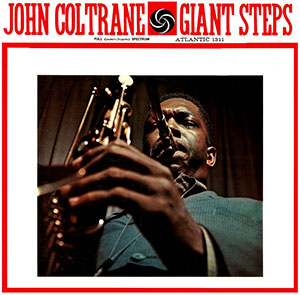
The tune is dedicated to Coltrane’s longtime bassist, Paul Chambers, hence the initials P.C.
Mr. PC is a standard 12-bar minor blues in C and a great study piece for developing your soloing skills.
You’ll get to explore the minor scale and minor blues scale, as well as more advanced scales such as the Lydian dominant and altered scale.

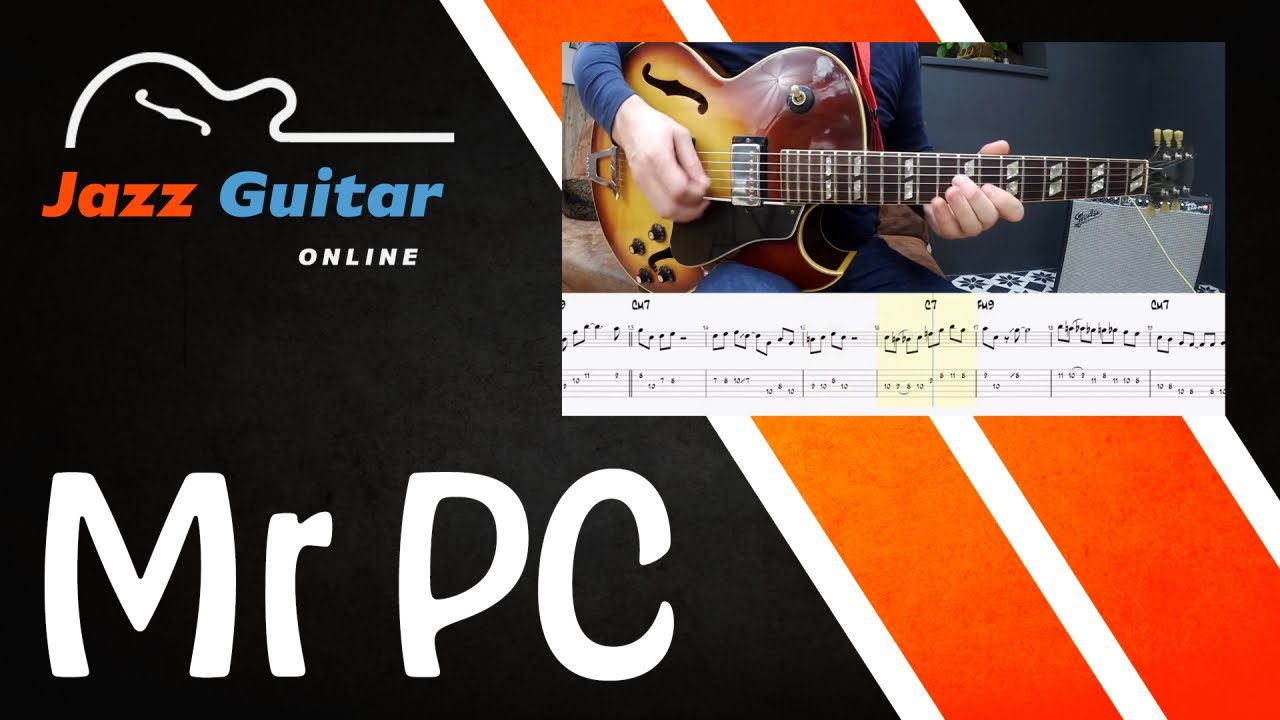
Mr PC – Melody
Here are the lead sheet and guitar tabs for the melody of Mr. PC.
From the start until bar 7, the melody is based on the C natural minor scale (C Aeolian mode), one of the guitar modes. From there, it shifts to the C minor blues scale, giving it that classic bluesy edge.
The final bar serves as a pickup into the solo.
Backing Track
Listen & Play-Along
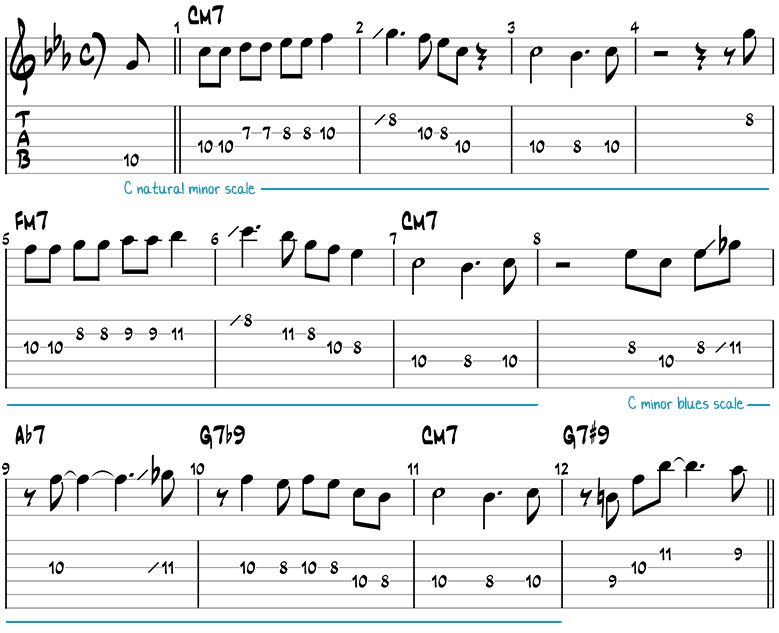
Mr PC Backing Track Video
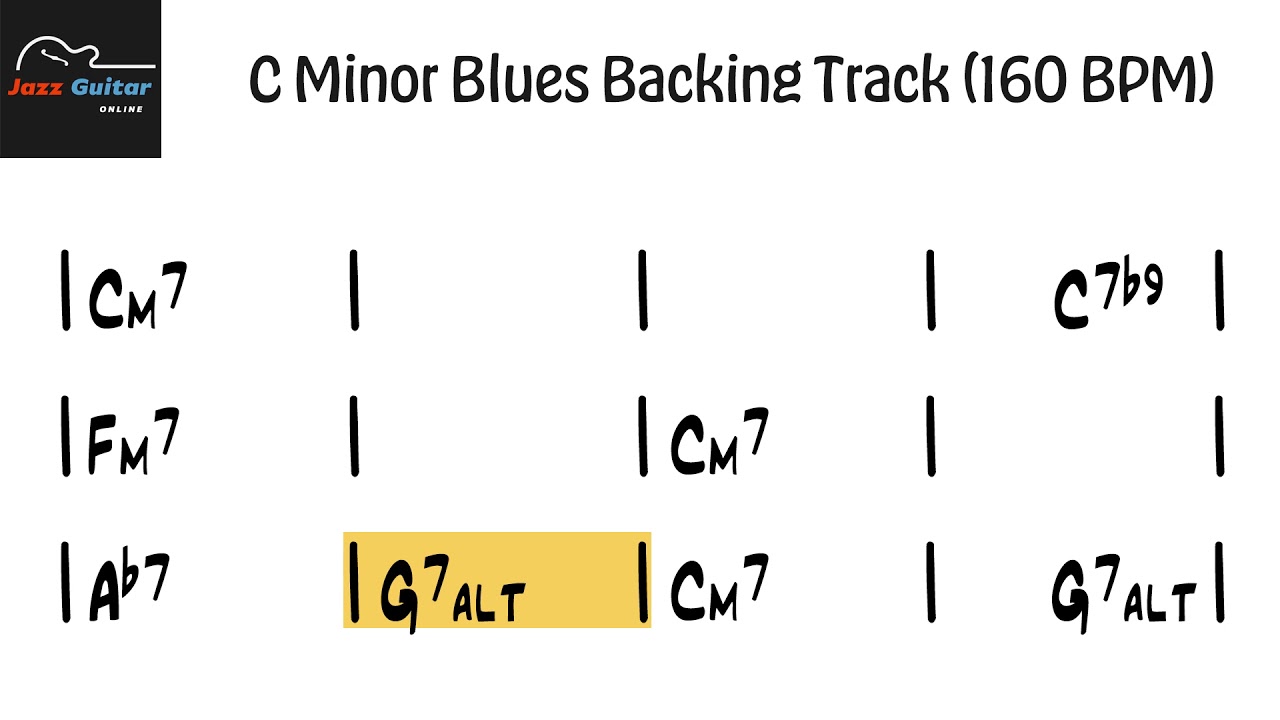
Here is a backing track video you can use to practice the scales and solo below.
Mr PC – Scale Choice
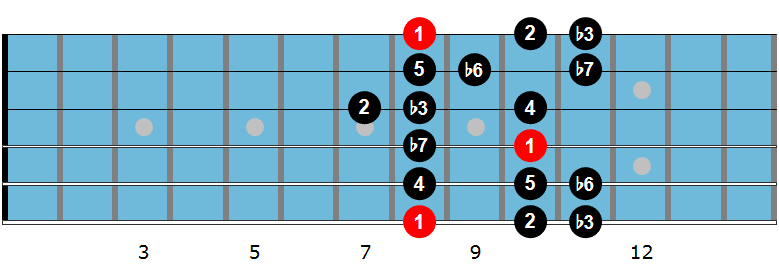
The main scale to improvise over Mr. PC is the C natural minor scale (aka C Aeolian mode).
C Natural Minor Scale
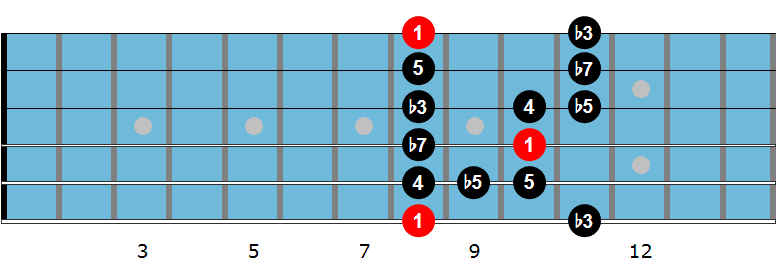
Other solid choices that work over the entire chord progression are the C minor blues scale and the C minor pentatonic scale.
C Minor Blues Scale
However, sticking to just these scales can get repetitive. Below are some additional options to bring more color and variety into your solos.
Cm7 (Bars 1-4 / 7-8)
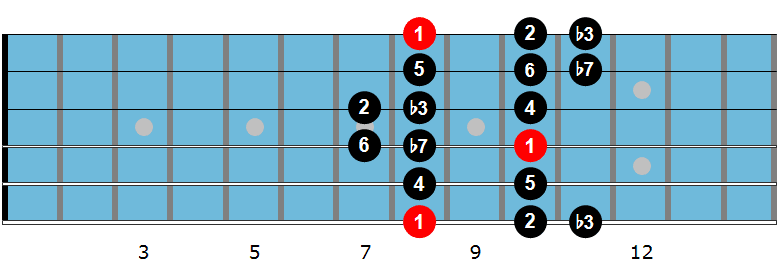
Besides the C Aeolian mode and the blues scale, you can also use the C Dorian mode here.
The key difference is the 6th degree: C Dorian has A, while C Aeolian has Ab.
Using Dorian here helps distinguish Cm7 from the upcoming Fm7, since that A in Dorian resolves to Ab over the Fm7 chord.
C Dorian Mode
Fm7 (Bars 5-6)
The natural fit here is the F Dorian mode, which uses the same notes as C Aeolian.
F Dorian Mode

Ab7 (Bar 9)
The Ab7 is a tritone substitution of D7, the V of G7.
The go-to scale here is the Ab Lydian dominant scale, which you can think of as:
- Mixolydian with a #11, or
- The 4th mode of the melodic minor scale
Ab Lydian Dominant Scale

G7 (Bar 10)
Here are two great choices to play over the G7:
1) The G Phrygian dominant scale, which is the 5th mode of the C harmonic minor scale.
G Phrygian Dominant Scale
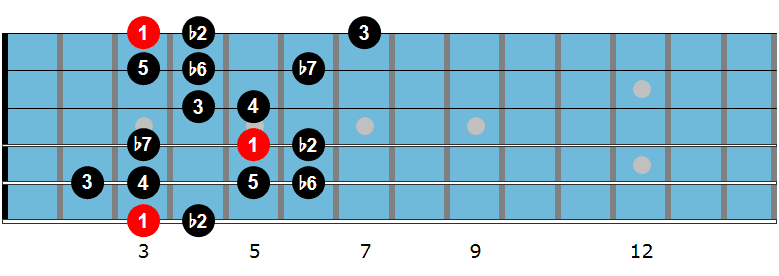
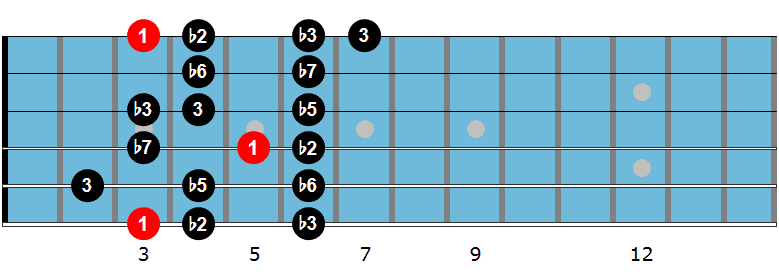
2) The G altered scale, the 7th mode of the Ab melodic minor scale.
G Altered Scale
Mr. PC – Jazz Guitar Patterns
The guitar solo contains four common jazz guitar patterns that are worth memorizing.
To learn more classic jazz guitar patterns like these, check out our course Jazz Guitar Patterns & Phrases Volume 1.

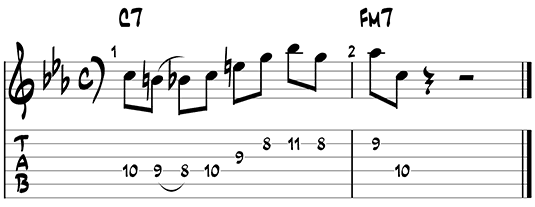
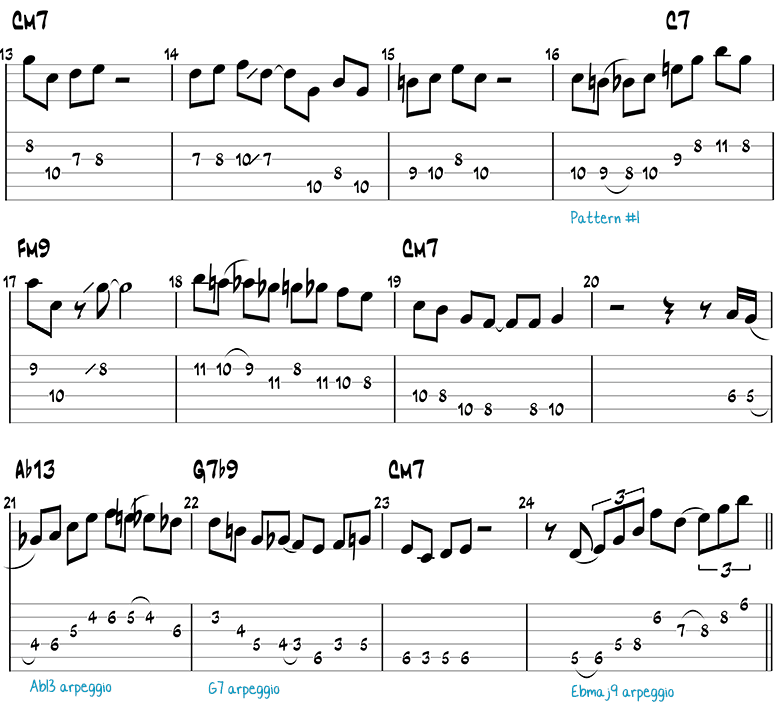
Pattern #1 (Bar 16) – Dominant
This dominant pattern is a C7 arpeggio with a chromatic note between 1 and b7.
The same chromatic movement comes back in bars 20, 22, 33, and 44.
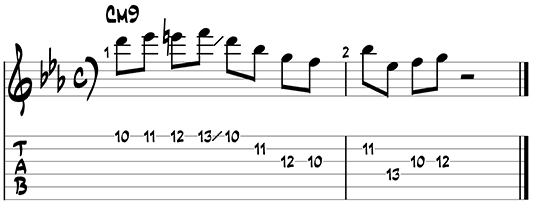
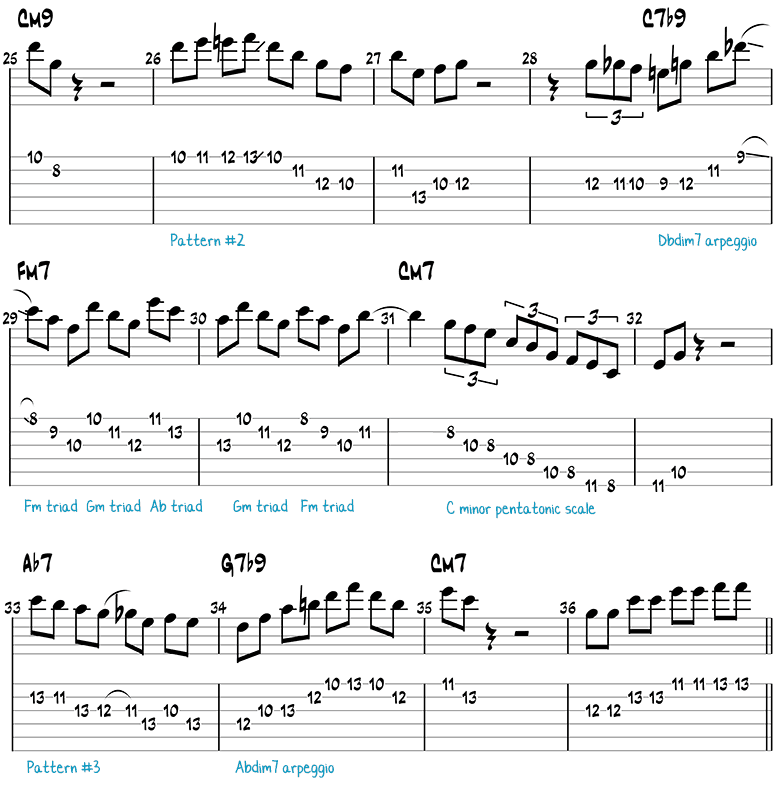
Pattern #2 (Bar 26) – Minor
This minor pattern is built around an Ebmaj7 arpeggio and can also be used over an Ebmaj7.
Pattern #3 (Bar 33) – Dominant
Another dominant pattern with a chromatic movement between the 1 and b7.
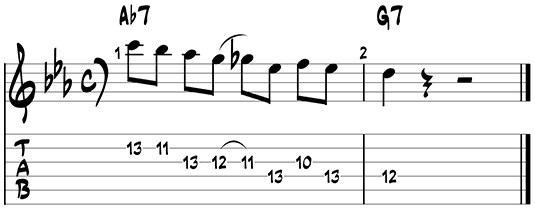
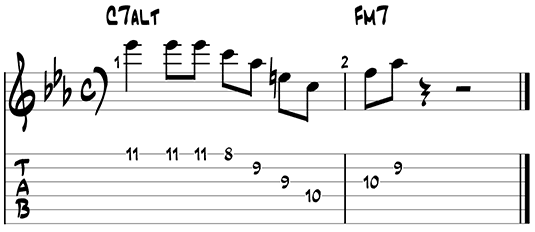
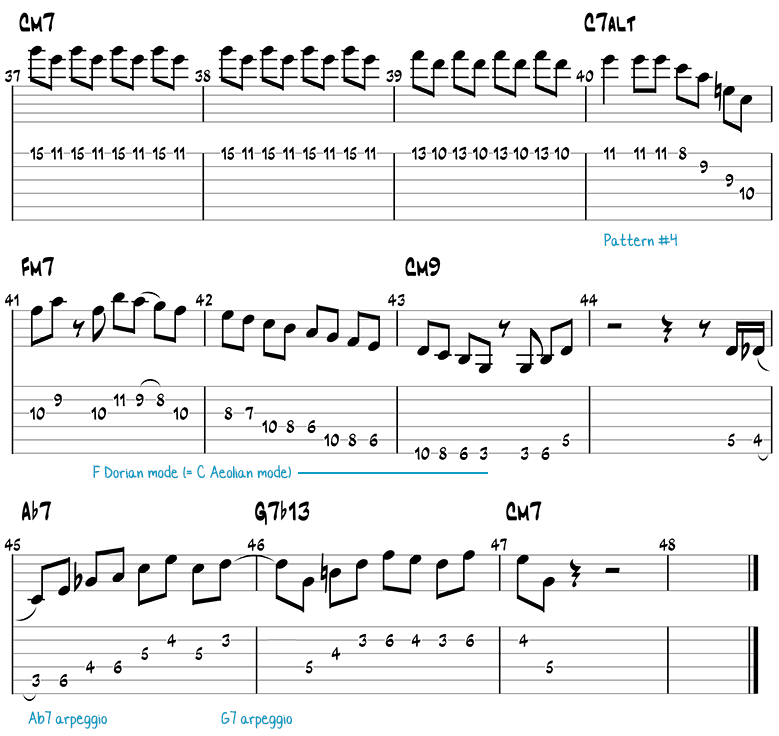
Pattern #4 (Bar 40) – Dominant
This altered dominant line starts on the #9 and continues with a C augmented triad, forming a typical bebop pattern.
Mr. PC – Guitar Solo
Here are the tabs and notation for the guitar solo.
Listen & Play-Along
Related Lessons
Love this lesson. Been following for a few months and slowly getting it. Well done indeed. Thanks for making this information available.
HI Pierre, you’re welcome, thanks for the feedback!
Amazing mate
thanks
but diagram for Galt scale is wrong (repeat of G phryg)
should be G-Ab-Bb-Cb-Db-Eb-F-G?
Thanks for letting me know, Ned, fixed it!
Great lesson,
thank you
Great lesson! Thanks!
excelente. perfeito. muito bom .
Great ! Could you share a comping lesson for this tune please ?
Seeing this as an Aeolian mode sure simplifies things as im a newbie when it comes to being exposed to jazz music but this is definitely in my capabilities etc being a heavy blues rocker ,only mode I didn’t learn however was melodic minor etc for some reason. Appreciate the 🎶 ic and tabs, kind of you helping out like this! Thank you….
Very Nice!
Bella canzone! Stimolante.
Grazie!
Merci maestro !
I love it!
Thanks a lot I’ll continue reading and learning about everything until I reach my goal.
Super ! mille mercis !
Love your playing Dirk!! Soo smooth!!
Nice !! Thnxxx
Gran lección y excelente material. Muchas gracias maestro.
Good material !!!
Hi Dirk
I am wondering why the Ebmaj7 arpeggio sounds so good on a Cm7? What is its relation to the key?
Thanks
Hi! Ebmaj7 is the bIII of the C natural minor scale and a common substitution. Both chords have 3 notes in common: Eb, G, and Bb. The Ebmaj7 adds a D to that, which is the 9 of Cm7.
Thanks. Now I get it!
Play a seventh chord but omit the root and start on the third. You will get a nice sub every time. Try Fmaj7 instead of Dm7
Substitution tritonique …
C minor is the relative minor of Eb major. Also there are a lot of notes in common between this arpeggio and the Cm7 chord.