


-
That's where the other electric controls come in, the ones on your amp. You may need to turn your amp louder to have access to the full dynamic range of an archtop. Some of the the energy from the strings goes to the acoustic resonance, so pickups are less efficient but that's what gives you the more dynamic headroom in archtops.
 Originally Posted by docsteve
Exactly! You can have compression or dynamics, you can't have both. Originally Posted by docsteve
-
12-08-2023 09:06 AM

-
Gottcha yes this makes sense Originally Posted by Tal_175
I do have the amp loud ….
and play chords fairly gently
then play harder on single note lines etc
A lot of people dig teles for jazz
that’s also cool , to each his own
vive la difference !Last edited by pingu; 12-08-2023 at 12:09 PM.
-
I have Tele's and archtops. I can be comfortable with and get good tones from both.
-
Ooh, I'm not sure if I agree with that... Originally Posted by Tal_175
-
A piece of gear can have a good compromise of both (maybe that's what you mean?), but by definition compression means the reduction of dynamics. If what you like about a guitar or pickup is that it provides compression when you dig in, the trade off there is the dynamics. Originally Posted by mr. beaumont
-
What kind of archtop are we talking about? 18” all solid woods acoustic archtop? 17” solid L5? 16” laminate ES-175? What about a Thinline hollowbody like the ES-330 or the smaller bodied ES-275? PRS hollowbody anyone? Shall we push further and even consider the ES-335? What about the Les Paul?
I am not sure how one might compare one guitar model to a whole range of instruments…
This said and FWIW, I’ve owned a few archtops of different types, as well as a telecaster. I still own a few archtops of different types. I do not own a telecaster anymore.
Love hearing them. Did not love playing mine.
-
I just play whatever the voices tell me...
-
My experience is that with a band, if you are going to be playing rhythm guitar, solid bodies do NOT cut it.
-
It’s not a simple dichotomy - you can’t generalize to “Telecaster” (or even all solid bodies) and “archtop”. And you can’t base anything on properties wrongly presumed to be identical among all of them in either group. Telecasters vary widely in characteristics, sound and feel. So do archtops. Teles can be as different as Ed Bickert, James Burton, and Danny Gatton. Archtops are as different as Scotty Moore, Johnny Smith and Chet Atkins.
Physical comfort is a combination of a player’s physical characteristics and preferences. Even among “real” Telecasters, there’s great variation in contour, weight, body edge sharpness, control types and layouts, etc. Toss in the many “T type” clones and imitators and you have a very wide range. With strong preferences like sit vs stand, left leg vs right, low carry vs high etc, some body sizes / edge treatments / weights etc are uncomfortable for many players.
Neck basics like scale length, size, contour, radius, fingerboard (bound? capped? wood?), fret choice etc strongly affect how much we like a given guitar. All of these are variables under our control, yet we generalize about a model based on the ones we see without considering the many available options we might prefer.
The amplified sound of the guitar also varies widely among “Telecasters”. Despite the common misconception that it’s independent of acoustic properties, the mechanical properties of the guitar strongly affect its amplified sound. A pickup will turn whatever acoustic waveform it senses into an electrical analogue. Whatever harmonics and resonances are generated acoustically will be in the output signal. The physical wave envelope will be reflected in the signal. Attack, rise, sustain, decay etc will all be manifested in the output signal. Longer acoustic sustain means longer amplified sustain, pure and simple.
Physical compression is present in every guitar. Each one reaches a point at which picking harder no longer produces a louder note. And some need more force than others just to produce their quietest notes. But this varies among archtops and it varies among solid bodies. Thick, laminated archtops with heavy finish layers and bracing may compress more and sustain less than solid bodies with great design and construction.
Turning the amp up does not change the dynamic range of a guitar. All other things being equal, it makes both the bottom and the top of its dynamic range louder in roughly equal amounts (remembering that perfect linearity is purely theoretical, so there are multiple small energy losses in amplifiers and speakers). A very light pluck on a heavy, relatively nonresonant archtop may not produce an audible acoustic note despite generating enough electrical signal in the pickup to reach the amplifier and be audible through the speaker. So an archtop can have a wider dynamic range electrically than acoustically.
I’ve had at least one Tele since 1970. I bought it after 10 years with just an archtop (175), and I put a lot of effort into choosing it. Today, my Tele is a Raines 7 that complements two carved Eastman archtops (16 & 17) and a laminated Ibanez. If I could have just one, it’d be very hard to choose since I still gig. But the Tele could handle every gig and I can’t say that for the archies (although the laminated Ibby comes closest). My Tele has tone, feel, and responsiveness to rival many fine archtops, and I love it a lot. I put Lace Alumitones in it, but there are many fine pickups out there (HB, SC, and alternative designs like Lace Sensors & other noiseless).
If faced with the OP’s posited question, take the time to experience the wide range of both types available to you. Don’t settle for what’s on the rack at GC or what others like. Do the work and reap the benefit.
-
i agree with everything you said
there Never
except (and sorry to be a Pedant)
”A very light pluck on a heavy, relatively nonresonant archtop may not produce an audible acoustic note despite generating enough electrical signal in the pickup to reach the amplifier and be audible through the speaker. So an archtop can have a wider dynamic range electrically than acoustically.”
i agree …. but doesn’t that imply
a narrower dynamic range electrically than acoustically ?
-
Where do people stand on string gauges on archtops versus Teles? I have to admit that if the Tele is intended for jazz, I like 13 or 14 gauge sets on it. Just don't hand your Tele to someone who's used to 9s!
Why heavy? I don't know. Maybe I like the tension. It's harder to pull strings out of tune on tricky chord grips, that's for sure. And really light sets feel like noodles to me.
-
No. A guitar’s dynamic range is the range in sound pressure levels between the quietest and the loudest audible notes it can produce. Some archtops dissipate all the acoustic energy of a very gently plucked string through mechanical vibration of the wood and other components - so a very gentle stroke may produce no audible sound from the guitar itself. But the faintly vibrating string may still generate a signal in the pickup that sends an audible tone through the speaker. Originally Posted by pingu
Similarly, every guitar reaches the point of maximum stimulation at some picking force and simply can’t vibrate any more - so it won’t get louder acoustically. But higher picking force can still generate a higher electrical signal if the string and pickup are not maxed out and the string doesn’t break. So the sound coming from the amp will get louder with yet more picking force even after the acoustic sound of the guitar will no longer do so.
This all varies from guitar to guitar and is not absolute or common to all. But those guitars that don’t respond linearly to a light touch and/or a heavy touch can have a wider electrical DR than mechanical. This also assumes a fairly linear amp.
So the acoustic dynamic range of the above described guitar will be narrower in dB than the electrical DR. The bottom of the acoustic range is higher and the top lower than the bottom and top of the range of electrical output.
-
Solid body guitars don't absorb as much of the strings energy as hollowbodies, therefore there is a more abrupt, immediate response to picking. In fact, if a hollowbody guitar and a solid body guitar have pickups with a similar output, the hollow body guitar will sound quieter through the amp due to less energy of the strings being available for the pickup to detect. Originally Posted by nevershouldhavesoldit
So what's that got to do with amplified dynamic range? Theoretically you can have a huge dynamic range with any electric guitar, just max out the amp and control your picking from barely audible to very heavy. In reality playing quietly when the amp is maxed out is very hard. Having groove and musical phrasing while barely touching the strings is unnatural. But when it comes to hollowbodies, because some of the energy of the strings by-pass (so to speak) the pickups, the response curve to picking is smoother and it's a lot easier to control quieter dynamic range through a louder amp. That's been my experience anyway.Last edited by Tal_175; 12-10-2023 at 03:35 PM.
-
I grew up hanging out in a Gibson Epi dealer's store in the 60s. At that place mentioning fender drew laughter. Howard Roberts, Kenny Burrell, Johnny Smith, Wes, etc were gods. Then I saw HR live in 68 at 17 and all I could think about was getting an archtop . Thoroughly imprinted. No way would I even touch a solid body... I did country, blues,cover gigs, you name it with archtops. But in around mid 80s I got a theater gig that required more twang and bought a japanese squire strat and was amazed at how musical and versatile it was. Then sold a handmade carved archtop and got an 85 G&L asat special and did everything with that. So as long as you dig what you're playing that's all that matters. Eventually went back to Archtops but have an old knock off sx tele just in case I get an urge.
-
And also, tube amps set at their sweet spot compress naturally, one of the things we love about tube amps that solid state have trouble duplicating. Originally Posted by pingu
-
To me, what appeals about an archtop over a solid body for jazz is the note envelope. The note, since it has some acoustic properties, rises and falls approximately the way it would on an acoustic guitar. Especially on a carved guitar, somewhat less so on a laminate. Solid bodies have more sustain, the note lasts longer, it's a less natural envelope to me. Also, regardless of the science involved, the dynamic range ie soft through to loud feels more acoustic-like and natural as well.That's why I prefer an archtop for jazz, and a solid body for those styles which call for more sustain.
I have an excellent old telecaster, and it's great for a lot of things, but I wouldn't say that jazz is one of them. Obviously it works for a lot of jazz players, and I would probably feel different if I had it set up for jazz with heavier strings etc. But then it wouldn't do the other things I like to do with a telecaster.
-
"One ring to rule them all . . . ."
Tim Bram (@ Music Emporium):
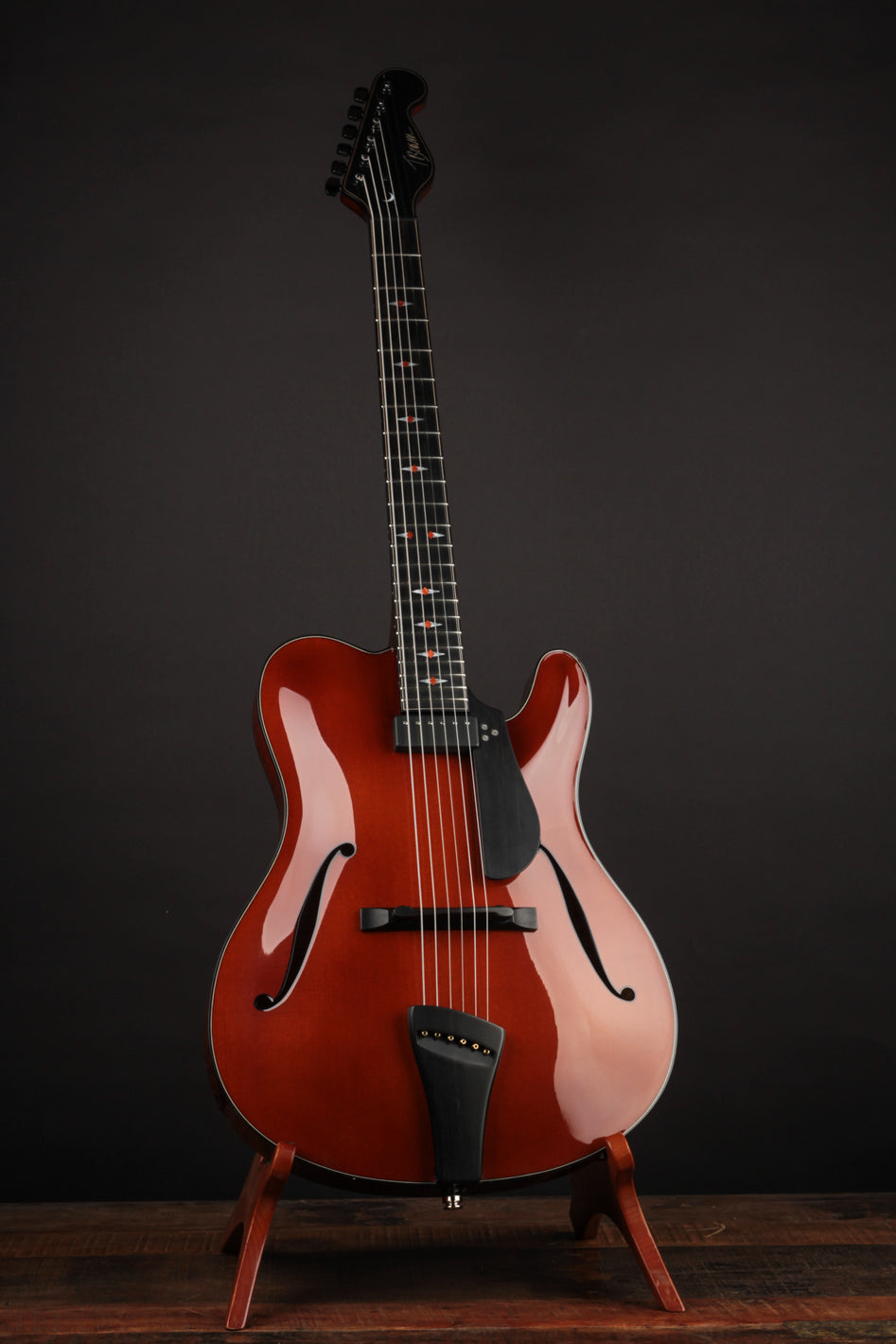
Eastman Romeo (with Lollartrons installed by the previous owner):

-
If I were to recommend one guitar to somebody who doesn't know what kind of music they're going to play on it, I might well recommend a Tele. A guitar that can sound like Steve Cropper, Ted Greene, Bobby Bain and Bruce Springsteen shouldn't exist, but it does.
That said, I've never found one with a small enough neck to be comfortable in my hands.
The best guitar sounds I've ever heard live were from archtops. That includes Wes.
Yet, archtops feel too big, although I could probably get used to a smaller one. I don't play one, because I need more sustain in the high notes and I was never good at controlling feedback.
-
I don't make my living playing the guitar so I can play what I want. I do not like solidbody guitars. They feel cold and too small. It is not like I am really one with the guitar. I was originally drawn to big jazz guitars as young 12-year-old. This was at the time of 1973 and classic rock was going on yet, I was never taken by the gear. The look and the feel of an archtop was just irresistible to me. I have never gotten over that draw to these classic guitars.
I played with a large jazz orchestra, and I can attest what SS says that rhythm guitar in those situations only a hollowbody really works. As for playing solo and sitting around with others I like the idea of the guitar that I can grab it and wrap myself around the body and feel the vibrations. Tele's are ok but really, I have never been drawn even to the sound. Ted Greene played one and truthfully, I am not attracted to the sound he got out of the guitar. His playing was great but sound is equally as important. If you look at the big, big, sound produced by someone like Kenny Burrell or Kessel you just cannot get that on a Tele.
One exception is that a Les Paul set up with heavy strings like a jazz guitar and the rhythm pickup, you can get a pretty fine bebop sound and it works for some chord melody. I have never been a Fender player they just don't do a thing for me. In fact, they feel awkward to play. I hunch over the guitar to play. On my Super400 though, I just sit right in the seat and the guitar meets me in the best spot. To me it feels 10 times easier.
I don't think Elvis was much a player, but he sure looked a lot better the few times he used a Super 400. I can’t say if sounded better though and we are talking about sound?Last edited by deacon Mark; 12-10-2023 at 07:35 PM.
-
I have a ~2008 Squier Affinity Tele which has a 1 9/16 nut. Even though I generally prefer a 1 3/4 nut, I find that easy to adapt to within a couple of seconds. I don't know if the current versions of that guitar have such a small nut. Originally Posted by rpjazzguitar
-
As Tim Lerch ably demonstrated in one of his videos, we listen with our eyes. If we don't know what kind of guitar is being played, it is exceedingly hard to accurately guess whether it's an archtop, Tele, ES-335, whatever. Jens Larson also has a video on YouTube showing a very similar thing.
But I get the jazz romance of the archtop (which is why I have two, after all). Even if a hardheaded pragmatist might well identify the Telecaster as the most effective option in the broadest range of situations. But jazz itself has never been about pragmatism; heck, it's basically almost impossible to make a living at it now.
-
Its a matter of taste or personal preference. I love both worlds but these days its either my T type or my old classical guitar that has been with me for the last 4.5 decades. With that said , since we are talking about jazz , a beautifull Archtop will make any of us drooling all over it and forcing us to pick it and play it.
-
That's well thought out. Originally Posted by Tal_175
To mimic the response of a hollow body with a solid body, I call it "let the string win over the pick" which means the way the energy is transferred from the pick to the string must result in the feeling of a loosely held pick being deflected by the string rather than the feeling of a string being deflected by a firmly held pick. The larger tighter strings on a hollow body tend to naturally feel this way (the string winning over the pick).
After being picked, the string experiences some first milliseconds of chaotic wave motion as the string seeks to physically determine its sounding length setting up the nodes for the vibration of the fundamental, overtones, and harmonics. When the string wins over the pick that chaos is heard as thump. On a solid body, if you let the pick win over the string, that initial chaos is extended into an anomaly that is heard as twang - so hollow body guitars are resistant to twang and do thump, and light strings on a solid body will tend to twang if you play it like a jazz box.
Bottom line is that for Jazz tone on a solid body you pick lightly enough to let the strings win (bigger strings helps). That increases your dynamic range above, which can be improved further by using all the gain available for tone stack insertion loss recovery - you do that by maxing the mid range and minimizing the bass and treble on the amp tone controls. Then based on your picking firmness and how loud your amp is playing, use your guitar volume to take the edge off any residual twang to find the response you want.
-
This makes total sense to me ....
The jazz Tele/solid body players with good jazz tone
that I know if , tend to pick lightly , Ed Bickert etc
I tend to pick heavy so a jazz box works better for me
Aha !
Thanks
-
This must be the best explanation I have read on twang and thump! Thank you. So I understand to increase thump on a tele go as high gauge as possible (with as low action as possible). Would you agree with this? Originally Posted by pauln



 Reply With Quote


Got some picking exercises?
Today, 01:17 PM in Guitar Technique