


-
Out of respect vinnie I don’t want to thread Jack this thread by posting my pictures
I’ll start another thread in a day or so when my eyes are strong and I put up pictures of all five
 Originally Posted by bluejaybill
-
12-14-2021 11:38 PM

-
Front and back plates.

-
That quilted maple……OMG
-
Actually, quilted maple is not necessarily very hard - some is quite soft - rather, it's all the grain direction reversal in the "bubbles" that makes it difficult to work - Originally Posted by vinnyv1k
-
Sure has a 3D look. Can’t get prettier than that. That is a nice clear piece of spruce too.
-
I apologize for the misinformation. When you told me it was really hard to carve I assumed the wood was a very “hard” wood. Originally Posted by MCampellone
-
Hi,
This thing is going to be a cutaway model right?
Can´t wrap my head around the fact that this guys over there build a non-cutaway in first place and than actually "cutting away" a part of the body!
Is this a cost cutting approach? Why not carving the plates to become a cutaway from the start? That would be the proper way to do it and the binding in the cutaway will not look that makeshift as it does in the end. Here a random sample of top carved to be a cutaway model from the start (made by somebody who knows his trade)
yep guys - I like it to hear already a estimated 99% of the forum members scream arghhhhh - what a complete idiot I am and there is no better way than genius Campellone does it... (taking the risk of being kicked out here because of a sacrilegious post)
Cheers
-
Quilt figure is most common is Bigleaf Maple which is a soft maple, but I have also seen it in Hard (Sugar) Maple as well.
Aside from tear out worries, its long grain to short grain stiffness can be quite different from a quartersawn maple so contouring of a back plate can differ to compensate this. Quilt figure found in flat-sawn maple and is produced by an uneven contour of the annual rings which have knoll-like elevations. This figure is thought to be caused by irregular growth. The main tree trunk below the larger limbs of leaning trees are under great pressure which is thought to cause the fibers to form corrugations in the grain. When the log is cut tangentially, this beautiful quilted figure is presented.Last edited by iim7V7IM7; 12-29-2021 at 09:02 AM.
-
Is the reinforcing strip on the top center seam a common design element for acoustic archtops? I don't think I've seen that before.
-
Not among older American archtop guitars but it's a great idea, can't tell you how many open seams I've seen on guitars over the yrs. Originally Posted by ggjaguar
The only question is will the wood crack somewhere else in the top or back if allowed to dry out too much.
-
For me first seen on a Heritage archtop.
-
No you are not an idiot and despite your self-characterizations, nobody will kick you out. They might not even notice or care. There are multiple ways to do things, some prefer one, some the other. The hand-carved tops don't have to be altered in the carving pattern to make the cutaway in the traditional manner. You have one carve pattern and can carve tops/backs and do cutaways or not per client orders. From the L5c, Heritage Golden Eagle, and Campellone it's clear that the tone is not hurt at all by doing it the traditional way. The way you prefer also works well, but for a cutaway requires a different carve geometry and maybe some luthiers don't find that optimal. Originally Posted by alteklampfe
Most don't really think the binding appearance on the traditional carves looks "makeshift" but for many of us, it looks lovely. I've had both kinds and have no passion invested, but I generally prefer the traditional style. My L5ces certainly has not suffered in tone or appearance (IMO) from being made in the traditional manner.
But your preference is legitimate, and you can go out and buy any carved archtop you wish. Post the pictures, post clips of how great it sounds, and we'll all celebrate with you.
-
+1
Spoken like a true gentleman with class and knowledge..
Originally Posted by lawson-stone
-
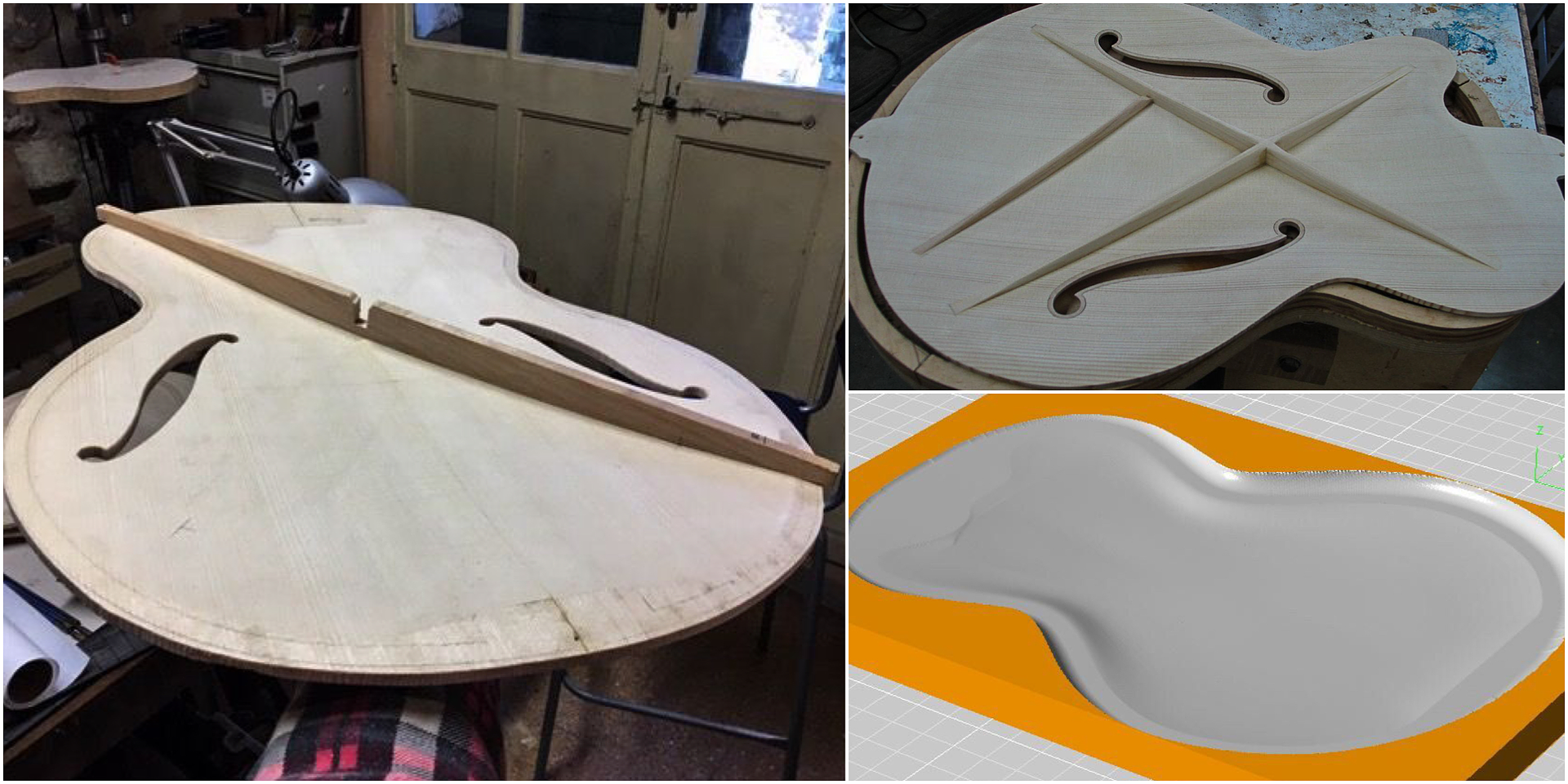
Like many who rough carve manually or by using a duplicator to carve the plates, the master pattern reflects a symmetrical profile of the inside and outside of the arch. The cutaway is created serially by subtracting the cutaway from the plates. Builders who have incorporated CNC into there rough carving of plates create the cutaway and arch resolution in the initial carve. This is purely an aesthetic impact. The upper bout near the cutaway is not an “active” portion of the top with either approach.
Here are some photo examples below. The image on the left shows a traditional carve similar to what Mark does but for an x-braced not a parallel braced guitar by luthier Bryant Trenier. The image on the upper right shows a CNC rough carve of a top by luthier John Buscarino. The image on the lower left shows an example of the inside arch CNC rough carve by luthier Bill Comins. You can see the contours of the arch in the pattern.
Bottom line: Either approach works fine. What is important is wood selection, contouring in the “active” portions of the top and the bracing pattern/contour. The resulting variation in binding thickness is an aesthetic preference.
-
Rims….beautiful wood.
-
Originally Posted by ggjaguar
Originally Posted by wintermoon
Mark can comment, and how he builds his guitars is certainly germane to this thread. I have asked him this question as well - he suggested that it's a prudent approach and mentioned Martin as well as Heritage. Originally Posted by vinnyv1k
Last edited by Hammertone; 12-30-2021 at 04:44 PM.
-
Gibson's vintage L5P top plate is carved and joined in a manner that has consistent binding thickness at the cutaway. Originally Posted by iim7V7IM7
-
Steve, she is still looking good. Originally Posted by skykomishone
-
Quality ala Campellone
-
Hi GG - I didn't use a center seam reinforcement on my early guitars because I'd never seen it on a Gibson (though I had seen small diamond shaped "cleats" used for center seem reinforcement on Guild Artist Award backs) - the first time I'd seen a continuous strip used was on a Heritage archtop and thought it made good sense - especially since I'd seen a number of old Gibson archtops with center seem separation issues. Originally Posted by ggjaguar
-
Very inspiring thread! So much craft and dedication involved. Awesome.
-
Future great jazz box
-
Next comes the binding
-
It’s going to be a remarkably beautiful guitar just like every guitar that Mark Campellone has made
I am one of Marks biggest fans
-
Notched for binding


 Reply With Quote


What is it?!? Why am I still at it?!?
Today, 04:53 AM in Everything Else