


-
FWIW Epiphone used rosewood instead of ebony on their top of line Emperors from the late 1940s onwards.
-
02-13-2014 07:58 AM

-
anyone who's every played lenny on two identical strats, one with rosewood and the other with maple fingerboards probably feels differently. I know I do. Just my opinion of course.
 Originally Posted by GNAPPI
-
, Originally Posted by GNAPPI
When it comes to arch top guitars, (which is pretty much the only type guitars I've cared about for the past 2 years)virtually everything has much to do with sound. As it relates to finger board materials affecting tone . . I remember over at HOC, Kuz would always go to war . . fight to the death . . in his belief that he could easily hear the difference between a rosewood board and an ebony one. Of course, he also claimed to have dog like hearing . . lolol. But, I'm with Kuz and Jack on this one. I do believe the finger board material has a direct impact on tonality. However, much toi the same effect, one piece of ebony will more than likely sound different that another piece of ebony . . . just like spruce tops will differ in molecular structure and therefore differ in tone as well.
-
In my experience, others may differ, at restoring a good many guitars from as far back as the 1820's (when there still was the best Ebony), those with Ebony fingerboards have invariably, all other things being equal, suffered more from the ravages of time and wood movement than those with Brazilian Rosewood or ebonized maple (Maple fingerboards can regularly be found even on the obviously high end as well as not so high end instruments of the era). And much of the damage to the neck and fingerboard area can be attributed to ebony being the choice of material. Originally Posted by jzucker
I'm certainly not against Ebony for fingerboards, I use it on all my instruments except for my student models but I also recognize that it is the least stable and least predictable of the desirable natural wood choices for plucked string instruments.
I agree that one would want the luthier to choose materials with the best possible sound/tone in mind. But, speaking for myself, I'd want my luthier (which is usually me Originally Posted by jzucker
 ) to also be mindful of the technical needs, stability and longevity of the materials in the instrument as well. It's all fine and good to have an instrument made from "the best sounding materials" (another topic which generally leads to heated exchanges in some circles) but I think that is of dubious value if it is in the shop for repairs or adjustments more than needs be. This is a general comment about guitar materials not just fingerboards.
Well, we mostly paddle/sail in fiberglass boats these days so I expect you're correct and we'll all be strumming fiberglass guitars before long...time to buy up those Ovation stocks Originally Posted by jzucker

Edit: It's started already...I just noticed the thread concerning a Carbon Fiber arch top...we're DOOMED!Last edited by Scot Tremblay; 02-13-2014 at 12:34 PM.
-
How did you ascertain that? Originally Posted by Scot Tremblay
I dunno. There are enough great L5s and Super 400s and Les Paul Customs made over the last 70 years that I think ebony has done just fine. Your random sampling of instruments based on ones that need repairs is a skewed data point IMO.I agree that one would want the luthier to choose materials with the best possible sound/tone in mind. But, speaking for myself, I'd want my luthier (which is usually me) to also be mindful of the technical needs, stability and longevity of the materials in the instrument as well. It's all fine and good to have an instrument made from "the best sounding materials" (another topic which generally leads to heated exchanges in some circles) but I think that is of dubious value if it is in the shop for repairs or adjustments more than needs be. This is a general comment about guitar materials not just fingerboards.
OTOH, i'm fine with other materials but any wood product is going to end up on the short supply list eventually so we should be looking at phenolics and other man made materials.
My Composite Acoustics Xsi sounded great and was all carbon-fiber.
-
>>> How did you ascertain that?
Of course I have no idea what observations Scot has made, but I guess we all know that wood shrinks and swells with moisture changes.
There is the green to dried shrinkage, and more importantly to us, there is the in-service swell and shrink.
In service I have noticed all ebony varieties to move far more than all rosewood varieties.
Now in practice, the actual grain orientation of the wood will also have a significant effect - most woods move significantly more in one grain direction vs. the other (Rosewood is something like 2X the movement in tangential vs. radial). So how the FB is cut can, in principle, matter sometimes more than the species.
With modern lacquers, and of course Gibson Goo finishes, you do not get as much checking at the edges of the FB - but I do agree with Scot that it is a fair generalisation to say that Ebony is the most troublesome of FB woods. If a guy here and there loves his trouble-free ebony experiences, that is of course just great.
And while the wood industry all but ignores longitudinal swelling and shrinking in wood (from the ground to the sky in the tree), we experience this very notably in some ebony FB guitars. Take one of them there Hofners with a mile of neck sticking out of the body, or a 7-mile long Gypsy-Jazz guitar and you may well need to adjust the truss rod twice a year as the ebony moves.
I have one crazy-black FB piece left for my eventual stealth cross-over nylon string project. But I'll gladly go with rosewood, Richlite, and whatever varieties of Ebony remain reasonably available.
For a one-off builder, the cost of the FB wood is pretty insignificant. For Gibson, the fully-burdened (a sometimes hilarious calculation is you can stand it) cost increase of even a slight amount can be an accounting problem.
More or less randomly listed opinions.
ChrisLast edited by PTChristopher2; 02-13-2014 at 01:21 PM. Reason: spelling - But I always write "spelling" here. Really I just edited because I wanted to.
-
Valid point, Jack. However, the great L5s and Super400s from the past 70 years, you refer to, are the ones which have survived in a reasonable condition - which may be less than half of the total number produced (?). Therefore they too represent a biased sample. The ones we see now (for sale or people actively playing) are the ones which haven't developed fretboard cracks and/or other serious defects. For good reasons we can't know the fretboard condition of those which have beeen thrown away after selfdestructing or are kept in peoples lockers as nonfunctional, damaged memories of the past. Originally Posted by jzucker
But there seems to be consensus between luthiers that rosewood is more stable and less temperamental than ebony. Ebony tends to swell and shrink more than rosewood with seasonal fluctuations in humidity.
-
my points are :
As a repairman you are getting instruments in that need problems. You are not seeing a random sampling of instruments to draw a valid conclusion about if *that* is your data point. And secondly, my question of how he ascertained that was in reference to the claim that it was the ebony's fault when the neck twisted or had problems. I would think it would be difficult to ascertain whether the neck or fingerboard was at fault
My datapoints are that I've owned over 100 guitars, many with ebony fingerboards and have not experienced any more issues with ebony boards as with rosewood ones.
However, having said that - I've also heard that ebony was not as stable as rosewood or pau ferro but I've also heard that this is because much of ebony you see showing up on new guitars was kiln dried and relatively new as opposed to the old fashioned way of using wood that is 50 or 100 years old.
Originally Posted by PTChristopher2
-
It's very true that just as Doctors mainly see sick people, instrument repair persons mainly see sick guitars however, after seeing many hundreds of sick and healthy instruments over nearly four decades as a luthier and restoration person one gets a feel for the source of the problem. I'm not intending to imply that the ebony fingerboard is the sole contributing factor to damage but after seeing as many antiques as I have it's pretty clear which materials have a negative impact on the health of the instrument and which don't. Again, in my experience, ebony fingerboards have been present in most (not all) of the most severely damaged instruments (where the damage can be traced to fingerboard movement, warping etc...), Rosewood being a distant second and Maple an even more distant third. Originally Posted by jzucker
Modern innovations such as bound fingerboards, lacquered boards etc have alleviated these issues somewhat by sealing the wood to some degree from moisture absorption and truss rods have made for easier adjustments for seasonal changes but these things have not totally cured the problem. In the "Old Days" things like fingerboards were considered replaceable elements of guitars and violins so in fact a good number of the playable pre 1900 instruments have shaved or replaced fingerboards. This is not so much the case these days but IMO it might not be such a bad idea.
I don't want to belabor the point as many are very pleased with their ebony fingerboards and have had stellar experiences...that's as we all hope it would be. My reason for even mentioning the topic was merely informative and not to diss any choice or preference. As a luthier, I want my clients to be pleased with my instruments and get as many trouble free years out of it as possible. And as much as I love the look and feel of Gabon Ebony and other highly prized exotic materials on my instruments, deep down, I cannot help looking forward to the day when these materials are not so desired and more less problematic materials become the most highly prized. But, that's the builder side of my psyche speaking which doesn't necessarily agree with the player side...
-
Fair enough Scot. We all appreciate your input. As I've said several times, I personally don't mind man-made materials and in some ways feel that they may be superior to wood due to the structural integrity , strength to weight ratios, etc.
For example, the Composite Acoustics Graphite guitar I had was able to have a thinner top with no bracing. I recently posted that I was interested in a carbon graphite archtop guitar.
-
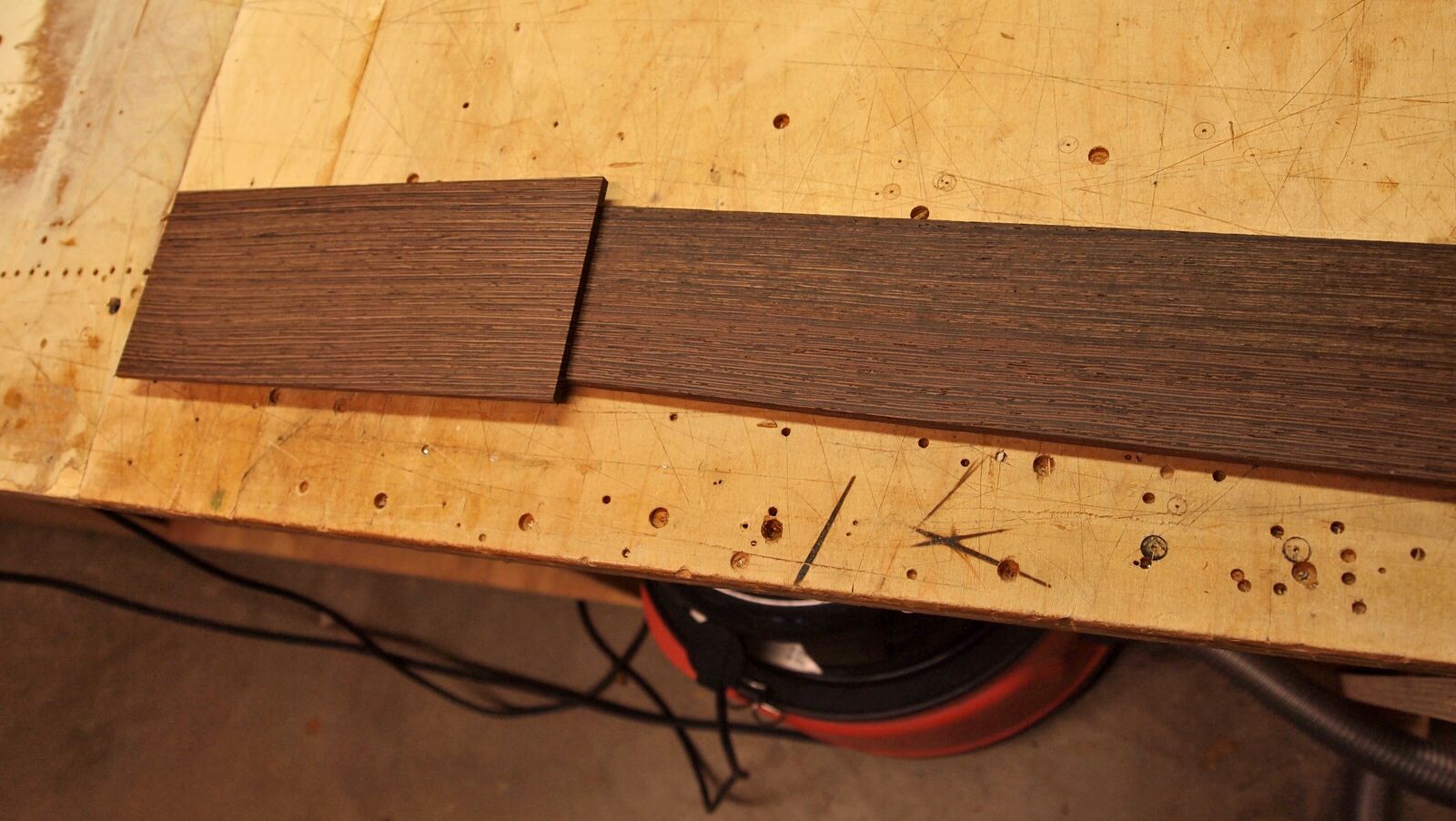
Right now, I have a flat top being built by a luthier with a Wenge finger board. Fortunately, there are many excellent alternative woods out there.
-
seems an odd choice. I had a bass with a wenge board and felt that it was splintery feeling. Wenge is about as hard as some varieties of pine so I wouldn't think it would be a good choice for an archtop . What made you pick that and what will it sound like?
I'd be curious what a maple fingerboard would sound like in an archtop?
Also, I know a few bass luthiers who are using epoxy infused fingerboards. Not sure if they use a vacuum process or what but using epoxy infused fingerboards they are able to stabilize birdseye and spalted maple. Still could be a problem down the road for refretting...
Originally Posted by iim7V7IM7
-
Hi Jack,
Here is my take on how someone may view their experiences:
>>> As a repairman you are getting instruments in that need problems.
Yep. All sorts of problems from loose screws, to fretwork, to finish repairs.
Some are also around for FB wood issues. One is free to look over the guitars in general regardless of the primary excuse for a visit - it is commonly done.
>>> You are not seeing a random sampling of instruments to draw a valid conclusion about if *that* is your data point.
Note that a "random" sample is not actually a part of the premise toward the original conclusion.
For laughs:
If one sees 100 guitars for ebony FB trouble and 35 guitars for rosewood trouble,
AND
Guitars are more or less 50% ebony and 50% rosewood, then the conclusion that ebony is more prone to trouble is not thwarted by this 135 guitar subsample.
If ebony is less frequently used than rosewood, then the 100:35 ratio becomes even more compelling.
Now one reasonable argument for a "selected" sample skewing the view would be that owners of ebony FB's are somehow more observant and critical of damage than owners of rosewood FB's.
>>> And secondly, my question of how he ascertained that was in reference to the claim that it was the ebony's fault when the neck twisted or had problems. I would think it would be difficult to ascertain whether the neck or fingerboard was at fault
I understand. Please note that sorting out the cause of a problem is a big part of the job. Explaining it at length may be less so.
Also, to continue with my cartoon example:
If one sees 100 guitars with neck trouble that are ebony and 35 that are rosewood, then one may reasonably wonder about the instability of ebony as a possible contributor.
(My 100:35 ratio is only here as an illustration of the logic.)
>>> My datapoints are that I've owned over 100 guitars, many with ebony fingerboards and have not experienced any more issues with ebony boards as with rosewood ones.
I understand. Now a look at the history of your guitar selection may well raise the other use of the word "selection". Or you may have stored and handled the guitars in a better than typical way. Or 100 may not be so many as it seems. Or all of the above.
>>> I've also heard that ebony was not as stable as rosewood
One may look to data to see that ebony is less dimensionally stable than rosewood under changes in moisture content.
>>> I've also heard that this is because much of ebony you see showing up on new guitars was kiln dried and relatively new as opposed to the old fashioned way of using wood that is 50 or 100 years old.
Now the myths and TGP gas may seem flow freely.
As oldane notes (and he works in Psychiatry, so is arguably qualified to observe both of us,...) any view of old working instruments is a likely extremely skewed sample.
To try to comment on the TGP gas over drying, seasoning, etc.:
Wood is a matrix of cellulose fiber and resin, with a level of moisture content and ambient temperature exposure that affects its size, its dimensional stability, and the distribution and resolution of internal stresses.
Broadly stated:
If you kiln dry a log, it has gone through a simple movement from "green" to "dry".
Now if you saw this wood into pieces and start making guitars, you have used "dry" wood. But this wood will now be exposed to in-service cycles of temperature and humidity. These cycles can allow internal stresses in the wood to be resolved as the cellulose fibers move relative to each other. Even though dry wood limits the movement of fibers compared to green wood, they can still move over time.
If you take wood and let it dry gradually in logs, a.k.a. "seasoning". The wood will not simply dry, but will also move through cycles of more and less moisture content. This can allow some of the internal stresses to resolve to a greater degree than kiln dried wood.
But there will be many stresses that are stable in the log, but will become unstable once you make boards from the log.
So a picture of a pile of logs sitting out to season, is quaint but not compelling in my opinion.
Now, if we cut these "seasoned" logs into guitar-use boards, and season the cut wood through cycles of ambient air changes, then we have something.
But this would be the same for kiln dried wood (logs or boards) that are then "seasoned" as cut, application-specific sized boards.
Wood (even cut to application-specific sized) that is stored under controlled air conditions will not resolve internal stresses as well as wood that is cycled through ambient changes in moisture and temperature - as "seasons" might do.
Soooo, a TGP claim that seasoned logs are somehow superior, are well in the "I read somewhere" or "I heard somewhere" range, in my opinion.
If one has clear data that wood is stored as application-specific boards in a way that allows cycling through changes in ambient air, then that builds a reasonable basis for expected improvement in stability in an instrument.
I do not notice a careful and complete analysis of the wood in most common "kiln-dried" vs. old-time-goodness commentary.
In my opinion, kiln drying is every bit as good as seasoning for the first step in the process.
********************************
But yes, quaintness has its compelling aspect.
Despite living in the modern world, there is a wood mill 6 miles from me where you can still buy 14" to 16" wide pine boards that are laying in an unheated barn after being cut. It makes you want to build something,...
All in my opinion.
ChrisLast edited by PTChristopher2; 02-13-2014 at 04:07 PM.
-
Personally, I can't picture any of my current or future arch tops with anything other than ebony finger boards and ebony or African Blackwood bridge assemblies. As we used to say back in the day when collecting flame top Lesters was still within the reach of those with meager incomes . . . "If it ain't got the wood . . it ain't no good".
But, realistically . . I'm sure we'll all be dead and burried for quite a while before ebony is no longer available.
By the way . . I've been buying, selling and collecting arch tops for close to 3 decades. Probably some 50 or so guitars have come and gone. Still currently have quite a few. Can't remember ever having an insurmountable issue related to an ebony board.
When I got my L5 Wesmo a couple of years ago . . I had a local luthier (at his recommendation) apply tung oil to the ebony fret board and buff it out to a moderate luster. So now, the back of the ebony fingerboard is glued to the maple neck . . thereby sealed in that area. The edges have plastic binding glued to them . . thereby sealed in that area. Now, the top of the finger board has a sealant (of sort) in the form of the tung oil. Moisture can't get in . . . moisture can't get out. I love the look and the feel of it. I may have it done to all of my archies.
Some people have advised against this, saying that wood needs to breath . . and tung oil is too much of a sealant . . even though not being a topical coating. My research tells me that the form of tung oil being used by Steve Hayes is more of an impregnator than a topical sealant. As such, the wood seems to be just fine.
Scot and PC Chris . . . any thoughts on this?
-
Bob Taylor on ebony. For anyone who's interested in the future of tone wood, I highly recommend watching this in full.
-
>>> any thoughts on this?
Sealed wood will take longer to stabilize at a moisture level based on ambient conditions, but it will eventually.
Oil as an impregnating sealer vs. a polymerizing top coat depends on the oil. Some things (more than some in the case of "oil") are not always what the description may suggest.
Wood does not breathe. It does gain and lose moisture based on ambient conditions. In my view wood does not particularly need to breathe.
An impregnating sealer may reduce the change in net moisture content based on ambient conditions.
A surface coating may slow, but will not stop the change in net moisture content based on ambient conditions.
In my opinion.
-
There have been several studies of wood aging that are interesting. There's more too it than moisture content.
For example:
http://www.chemistryviews.org/detail...i__Part_1.html
and
http://www.swissinfo.ch/eng/news/fea...ml?cid=7613464
Originally Posted by PTChristopher2
Last edited by jzucker; 02-13-2014 at 04:45 PM.
-
>>> Bob Taylor on ebony.
Man, that guy can drone on and note himself as the center of all.
In the mid-70's I was struck buy someone's comment that we will never run out of oil. It will simply become so expensive that we will prefer another source of this energy.
In my opinion, we will never run out of FB materials. We will simply be compelled by the cost, politics, or arguably responsible husbandry of the environment to use less ebony.
Or maybe something else will simply be seen as a better technology.
The stone age did not end because they ran out of stones.
-
This is absolutely true. I have done this experiment several times with both strats and teles specifically to compare between the maple and the rosewood. Otherwise, the guitars were identical. There IS a difference. The maple sounds much brighter and more "sparkly" than the rosewood. Personally I like the rosewood. At any rate, I am convinced that different material on the fretboard makes a difference in the tone. Originally Posted by jzucker
-
I also understand that the legions of TGP armchair quarterbacks who can hear the difference between alkaline and zinc-carbon batteries and brass/nickel plugs, lol
-
Jack,
First off, it is a flat top and not an archtop guitar. There are a number of design issues that are beyond the scope of this wood conversation that drove the choice of woods used in the instrument; but my luthier, whom I trust feels it will be fine (or he would not have recommended it). Wenge is as you suggest both porous and notorious for splintering (people who work with it curse a lot at it) but he knows how to work with it.
Bob
Originally Posted by jzucker
-
Hi Jack,
In my opinion, and maybe less tediously stated:
If you kiln dry some wood to get the moisture down from "growing tree" to "ambient", this is not at all the same as long-term seasoned wood.
But if you save time and cost by first kiln-drying wood, and then seasoning it as application-specific cut boards, then the initial step of kiln drying is not inferior to an initial step of slower air-seasoning.
If you air-season logs, then cut them up and make a guitar with no seasoning of the cut boards, this is more time-consuming and inferior to kiln drying the logs and seasoning the cut boards.
Other opinions may differ, but I specifically feel that kiln-drying is not a "tone killer", as they say (and I wish they would stop).
ChrisLast edited by PTChristopher2; 02-13-2014 at 04:58 PM. Reason: spelling
-
>>> Wenge is as you suggest both porous and notorious for splintering (people who work with it curse a lot at it) but he knows how to work with it.
I once made some 19th century style flyrods from Greenheart. This would splinter while you were asleep, break into the house, and wedge itself in your fingers.
But a 12-foot Scandinavian style overhead casting rod from heavy Greenheart is a blast to use.
-
Most luthiers have their favorite fingerboard sealant. Many Classical and Steel string builders swear by the cyanoacrylate glues for sealing the main part of the fingerboard with the sides and ends sealed with whatever finish they are using. I know luthiers who seal the entire body of their acoustic instruments with CA before applying a finish but I've never tried that. I do seal the fingerboards on many of my instruments this way and have had positive results.
Lacquer, oil (Violin varnish) and spirit varnishes (French Polish) actually are porous enough to allow moisture flow between the wood and the atmosphere, and do help a lot to to control this flow. Which to my way of thinking is preferred as you'd want the wood of the fingerboard to move along with the neck wood, top if it's attached etc but at a controlled rate.
I don't believe the polyester or epoxy finishes allow any movement of moisture but I could be wrong. I don't use them so haven't spent any time researching them. If anyone knows for sure please do correct my assumption.
Patrick2, I don't know what type/brand of tung oil your luthier used but it's interesting to note that very few of the brands advertised as "Tung Oil" are actually 100% Tung oil. In fact most of the items sold as "Tung Oil" contain no real tung oil. Even those that do contain this oil in the formula are what is called a "wiping varnish" meaning that they are a blend of varnish and oil. "Tung Oil" has become an advertising twist rather than a statement of actual content...unfortunately.
If I were to guess, I'd say it was one of the common wiping varnish varieties which work pretty well to seal the wood from excess moisture and are still porous enough to allow some movement between the wood and environment.
Some of the problems with pure tung oil is that it dries/cures very slowly, takes many coats (six or more with several days cure time between each coat) to obtain sufficient protection and the end feel is still a bit rough when compared to bare wood or a linseed finish.
I personally wouldn't use pure tung oil or linseed oil on an instrument but I do use one of the wiping varnishes on the tops of some of my 19th century reproductions (may of the originals had bare wood or very lightly oil varnished or bees waxed tops) and some modern classical luthiers use these finishes as well. For fingerboards I think they are fine but some brands may feel a little "oily" or sticky until they are well cured (up to a couple weeks sometimes...usually not).Last edited by Scot Tremblay; 02-13-2014 at 05:44 PM.
-
that's where the article I posted differs in opinion. I guess I'm inclined to think that there is more to wood aging than simply removing moisture content. Did you see that Martin now has some process which removes sugars and moisture and ages the wood in a way that they claim is more akin to long term aging? They are going to be using this process on their high end instruments.
Originally Posted by PTChristopher2



 Reply With Quote


Interesting Acoustic-Electric 7-String
Today, 06:32 PM in Guitar, Amps & Gizmos