

One of the most common chord progressions in jazz is the blues. A straight 12-bar blues typically consists of three dominant seventh chords (I–IV–V). In jazz, this basic form is expanded with added harmony, such as ii–V–I progressions and more sophisticated turnarounds. Jazz blues also uses a more advanced melodic language and phrasing, which is the focus of this lesson.
Soloing over a straight 12-bar blues often relies on pentatonic and blues scales. While these sounds can still work in a jazz blues context, relying on them alone will quickly start to sound repetitive. To create more authentic jazz lines, you need additional tools such as arpeggios, scales, and chromatic phrasing.
In this lesson, you’ll learn eight jazz guitar patterns over a jazz blues in F, drawn directly from the bebop language. These short melodic cells and clichés appear frequently in the solos of players like Charlie Parker, Charlie Christian, Barney Kessel, Wes Montgomery, George Benson, and Joe Pass.
If you want to go deeper, check out Jazz Guitar Patterns & Phrases – Volume 1, and learn 87 classic jazz guitar patterns that serve as practical building blocks for your jazz guitar solos.

F Jazz Blues Guitar Patterns – Video & Sheet Music/Guitar Tabs
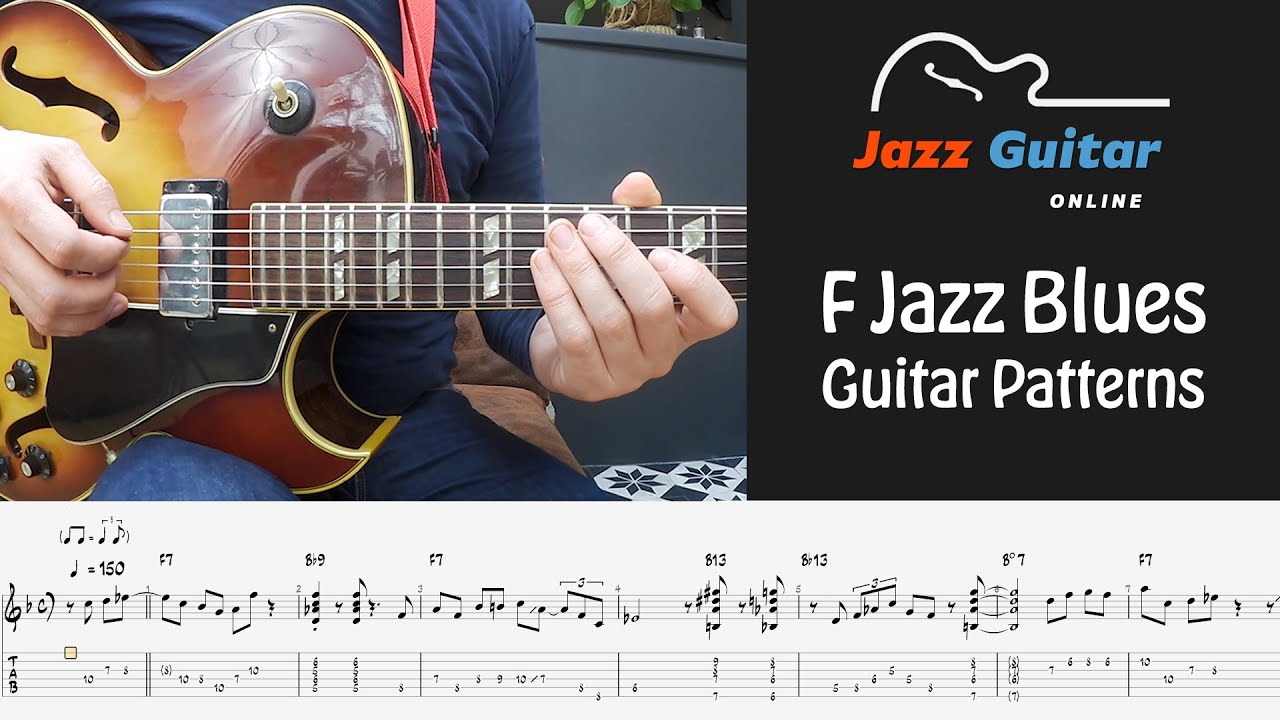
Backing Track
Listen & Play-Along
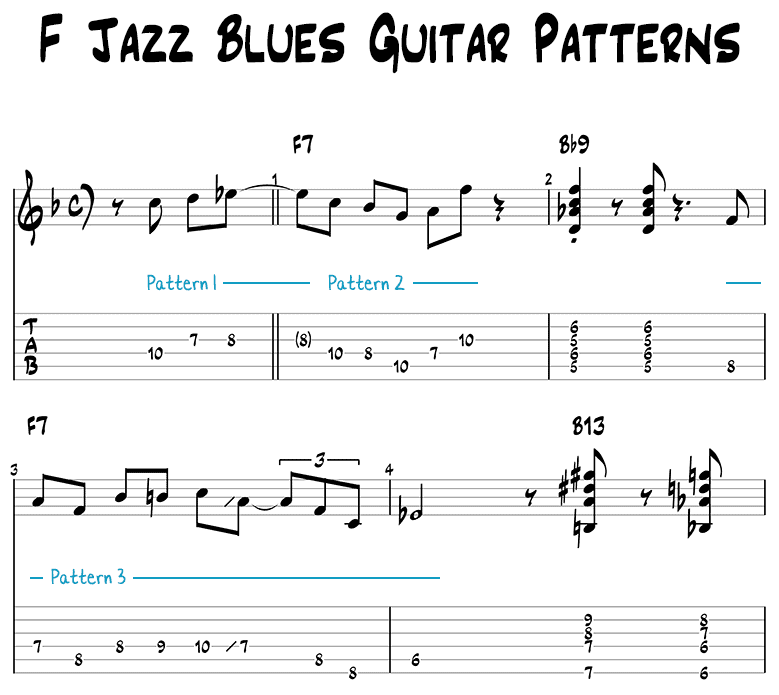
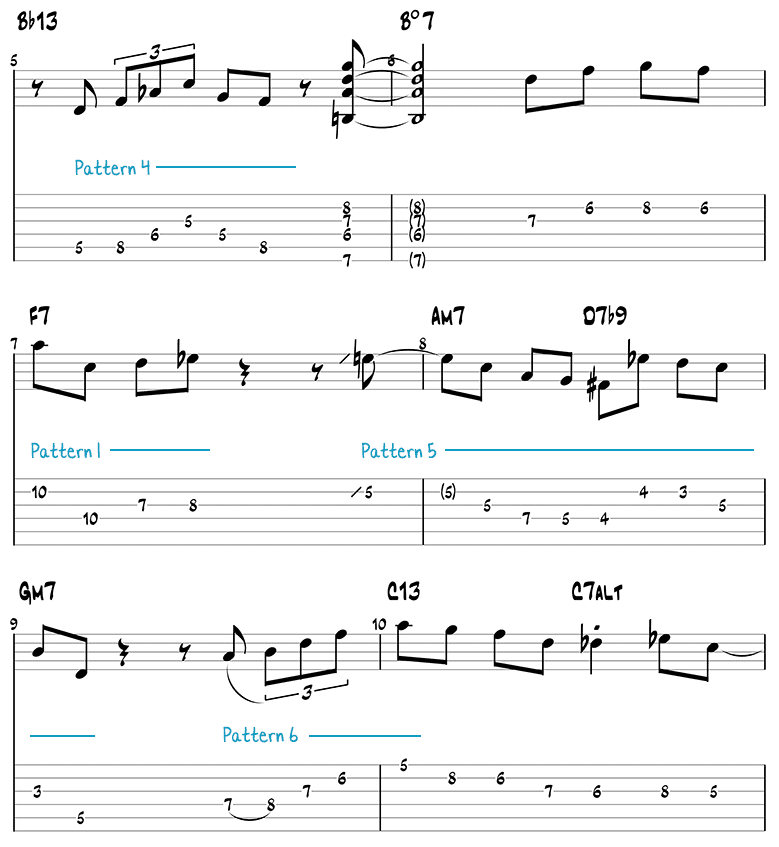
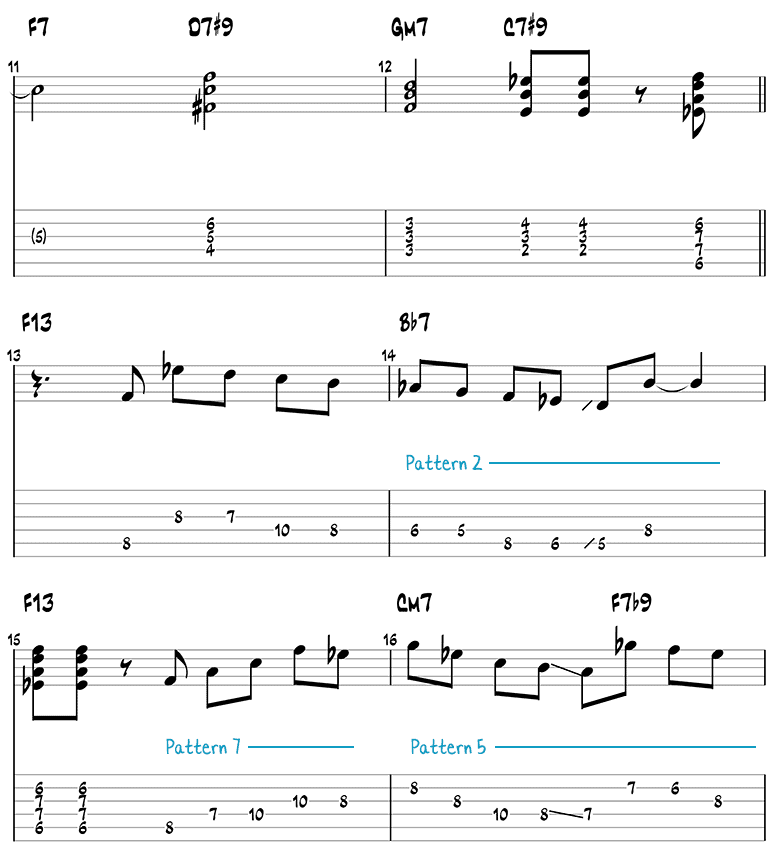
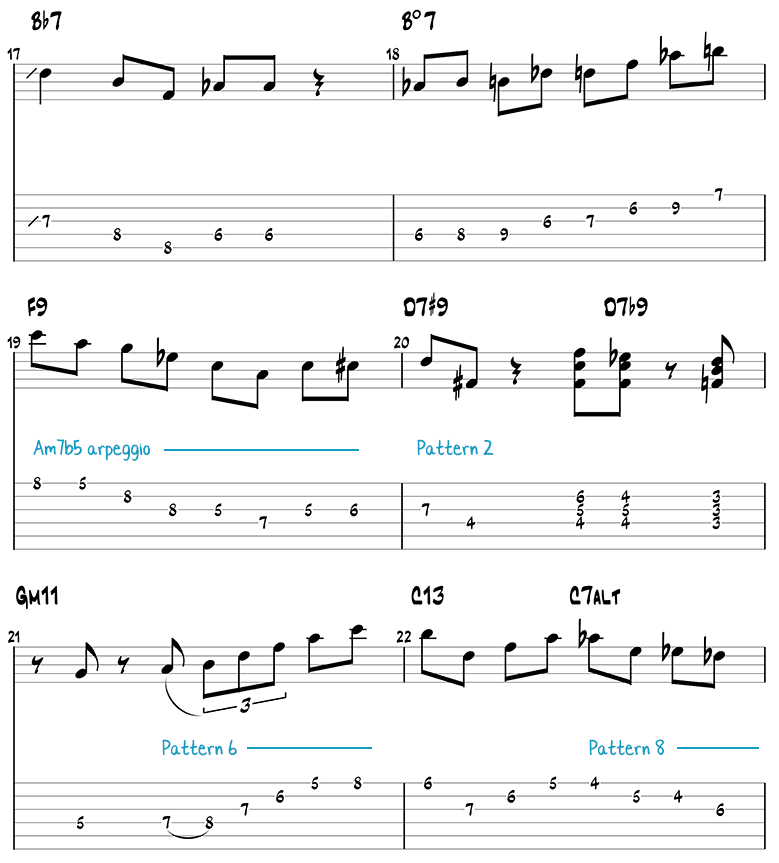


Jazz Guitar Patterns
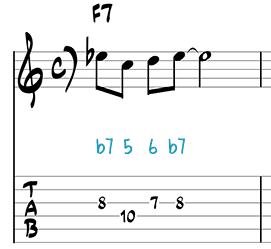
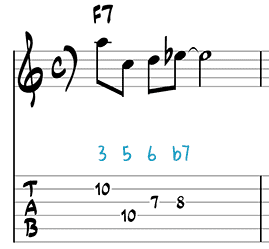
Jazz Guitar Pattern 1 (bars 0 and 7 in the study above)
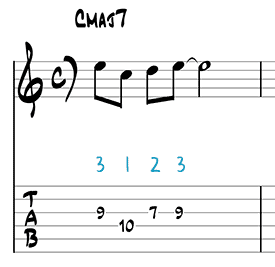
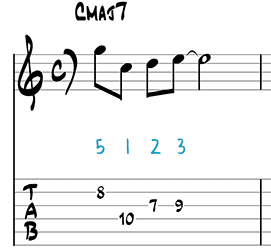
This is a simple, versatile pattern with three variants: dominant, minor, and major.
Each version highlights a key chord tone:
- The ♭7 over dominant chords
- The ♭3 over minor chords
- The 3 over major chords
Dominant
Minor

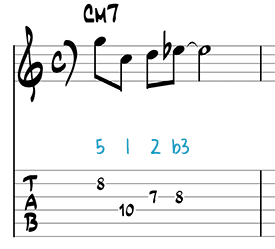
Major
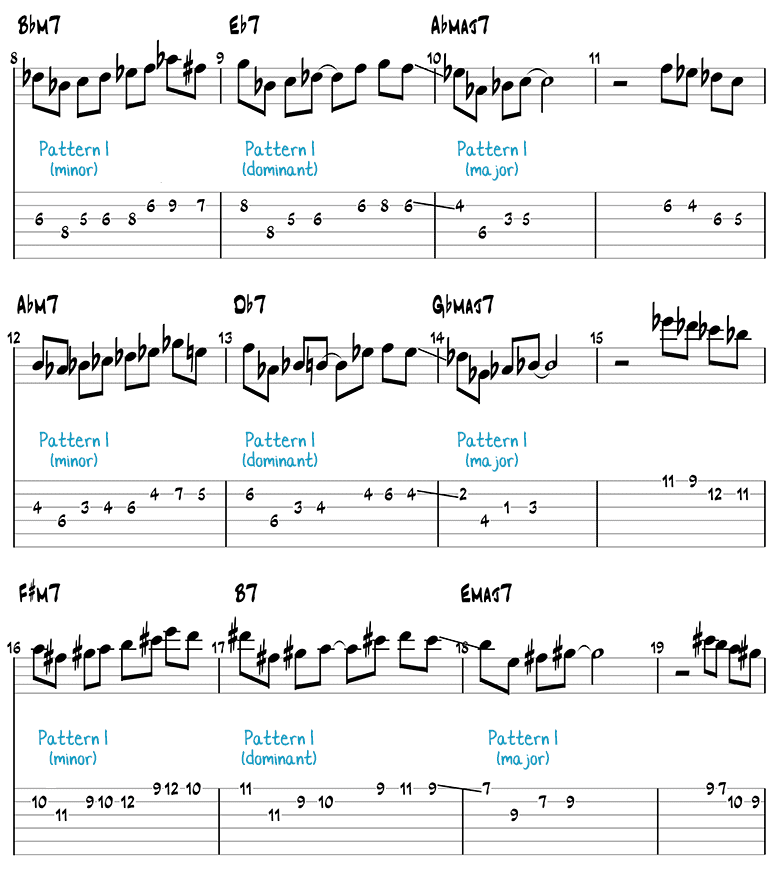
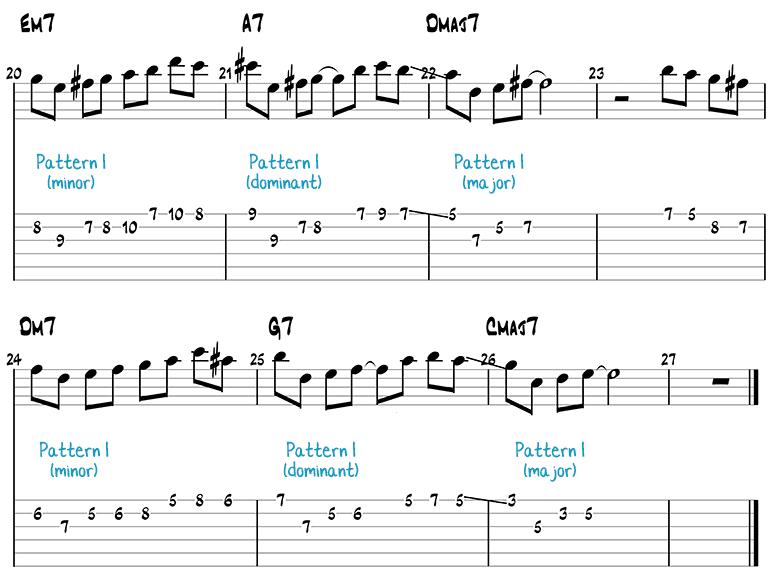
Pattern 1 Exercise
Below is an exercise using a series of ii–V–I progressions to help you get this pattern under your fingers and into your playing.

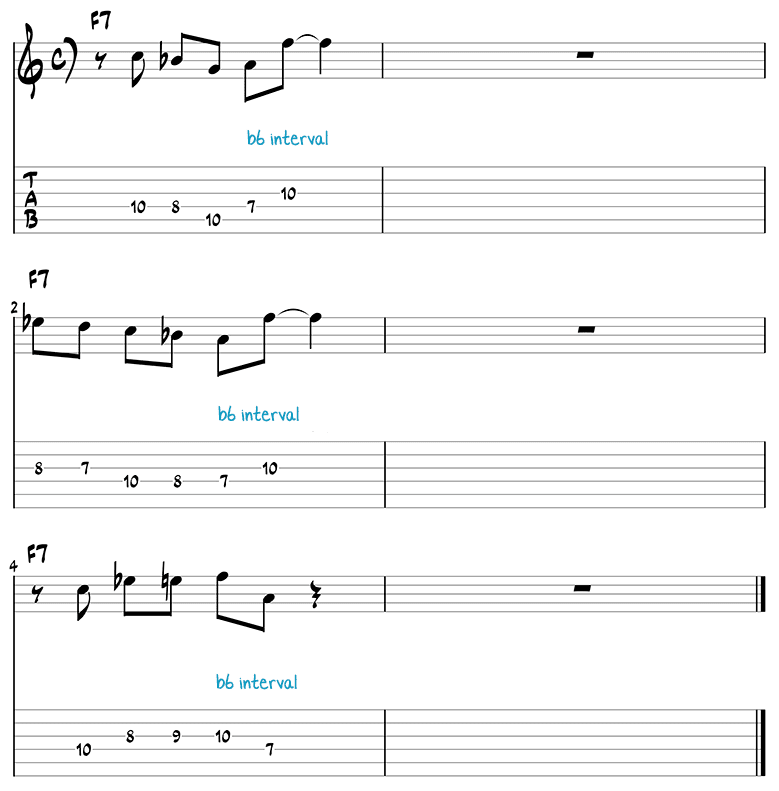
Jazz Guitar Pattern 2 (bars 1, 14, and 20)
Pattern 2 begins with an enclosure of the 3rd and finishes with a ♭6 interval, a characteristic blues color.
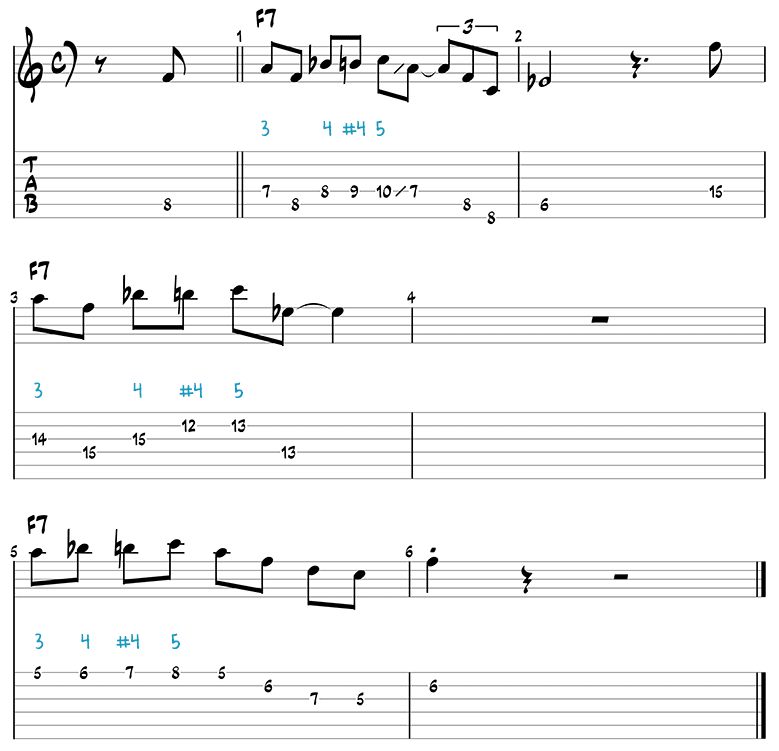
Jazz Guitar Pattern 3 (bars 3 and 24)
Pattern 3 uses a chromatic approach from the 3rd up to the 5th of a dominant chord, a common bebop device.
Jazz Guitar Pattern 4 (bar 5)
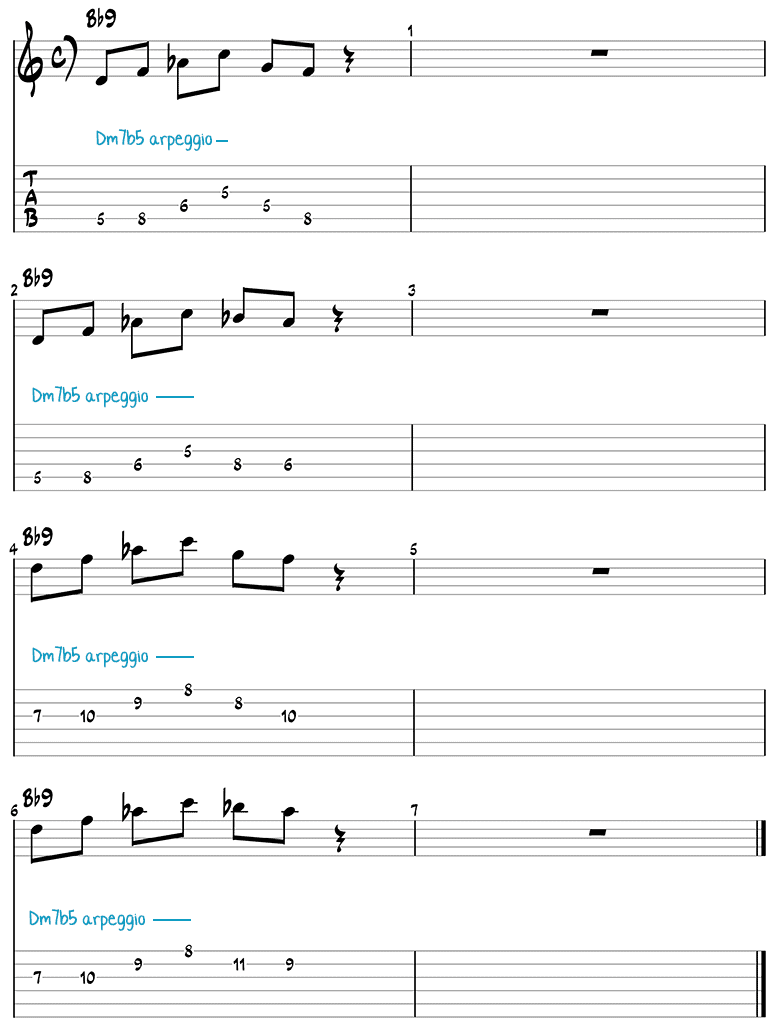
This pattern uses a common substitution for dominant chords: a half-diminished arpeggio starting from the 3rd of the dominant chord.
Playing a half-diminished arpeggio from the 3rd of a dominant chord emphasizes the 9 sound.
For example: Dm7b5 over Bb7
| Dm7b5 arpeggio | D | F | Ab | C |
|---|---|---|---|---|
| Played over Bb7 | 3 | 5 | b7 | 9 |
Below are two variations of this pattern:
Jazz Guitar Pattern 5 (bars 8 and 16)
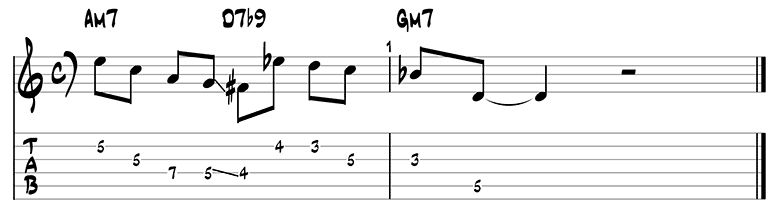
This pattern outlines a minor ii–V–i using a classic bebop lick that begins with an Am7 arpeggio and targets the b9 of D7.
Jazz Guitar Pattern 6 (bars 9 and 21)
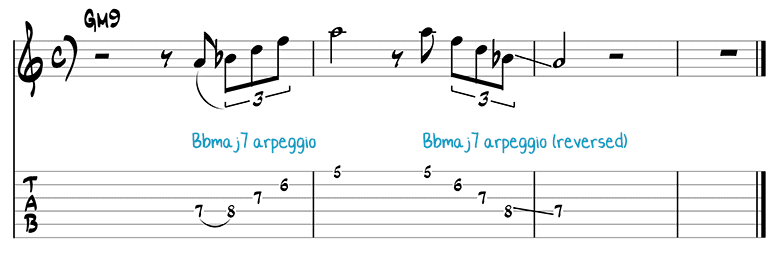
Pattern 6 uses another common minor-chord substitution: a maj7 arpeggio starting from the 3rd of the minor chord (this is called a 3 to 9 arpeggio).
Playing a maj7 arpeggio from the 3rd of a minor chord highlights the 9 sound.
For example: Bbmaj7 over Gm7
| Bbmaj7 arpeggio | Bb | D | F | A |
|---|---|---|---|---|
| Played over Gm7 | b3 | 5 | b7 | 9 |
Jazz Guitar Pattern 7 (bar 15)
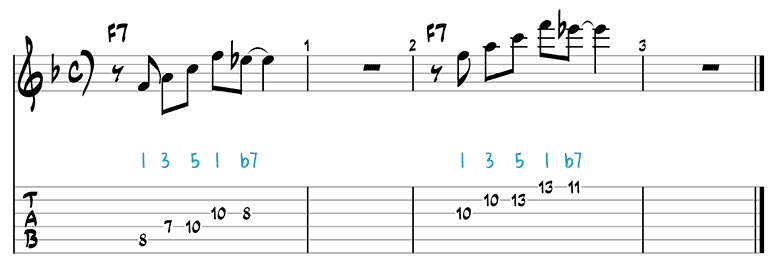
Pattern 7 is a simple dominant arpeggio with the last two chord tones reversed.
Pattern 7 Exercise
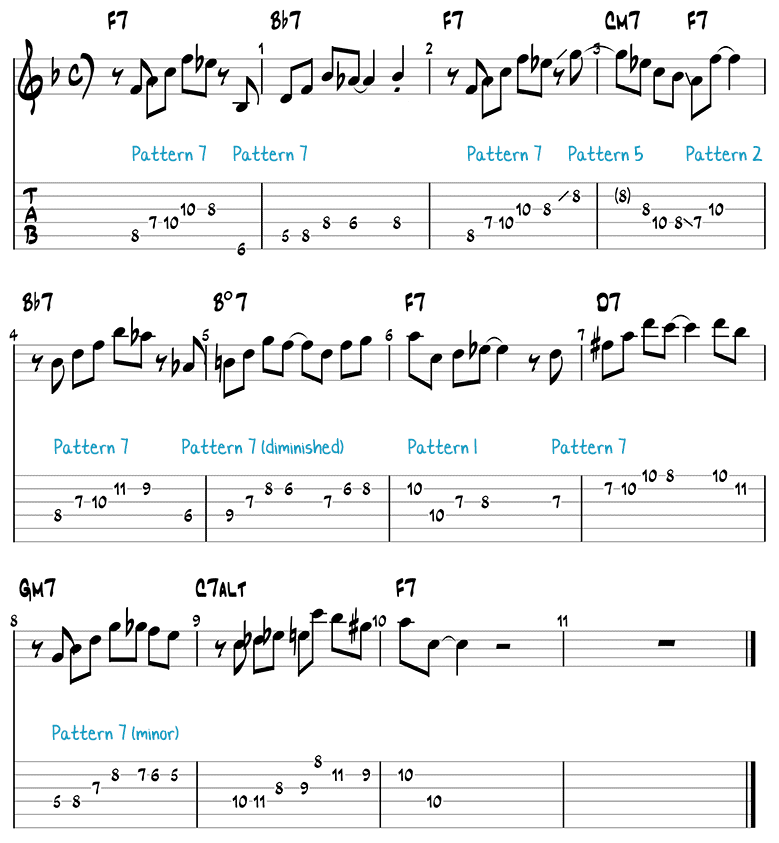
This exercise applies pattern 7 over a blues in F to help you get it under your fingers.
Jazz Guitar Pattern 8 (bar 22)
Pattern 8 is known as the Cry Me a River motif, named after the opening melody of the famous jazz standard.
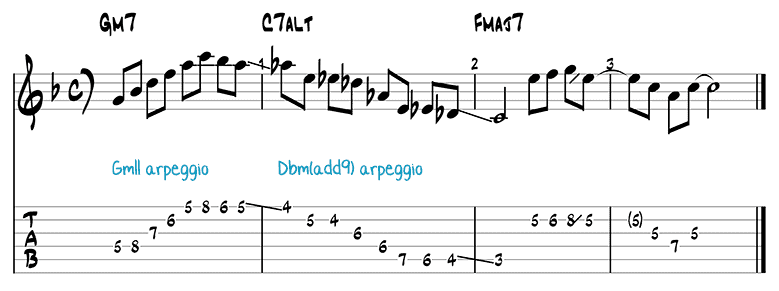
This pattern uses a Dbm(add 9) arpeggio played over a C7 chord:
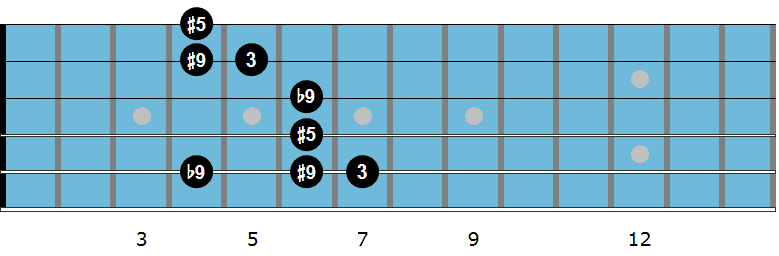
| Dbm(add 9) arpeggio | Db | Eb | Fb | Ab |
|---|---|---|---|---|
| Played over C7 | b9 | #9 | E | #5 |
In this lick over a ii–V–I in F major, pattern 8 appears in bar 2.
This is excellent. Its deceptively hard to play at full speed. But I’m getting there slowly but surely. Thanks for everything Dirk, it’s really helping with my playing.
Sempre Buona Musica Amico Tanti ottimi consigli per chi ama il suono della chitarra Sicuramente tanta Professionalità passione lavoro da parte tua Dirk per sempre Grazie
Hi Dirk, whilst having Jazz&Blues Guitar 1 on the table, I always like to have a look at your tips &tricks here.
Well done, graphics, text, and awesome sound.
Thanks!
You’re welcome Teddy, thanks for the kind feedback!
Hi Dirk,
I purchased your patterns course but I’ve been memorizing this Jazz Blues in F piece first to see the way you’ve applied your patterns to it. It’s a great transcription of the jazz giants vocabulary. When I get back to the course and memorize the patterns I’ll be working to apply these in various standards. I think I’m on track with the process and I want to thank you for putting the program together. I’ve tried for a long, long time to make scales and arpegios to sound like jazz but it just wasn’t happening. I’ve heard of a method called L I S T for Listen, Internalize, Sing and Transcribe but I think putting it on paper is best as you can go back later to memorize what youve heard from a jazz artist. So given all this, what software do you use to transcribe this “Jazz Language”,
Thanks
Thank you very much. Very good work
Thanks!!!!! Dirk
Hi Dirk, this is Ronald I apologize for not posting that often. I have been working hard on the stuff that I have received so far from you. My fingering picking is coming along real well and also my Hybrid picking. I have been practicing the way I have always wanted to by not getting in any hurry. Thanks again for the course Dirk.
Wow! great solo and practice session. Thanks for all the work you put into these
cheers
paul
thanks. I’m virtually a beginner to
guitar. I find the study of jazz
worthwhile.
thanks for your lessons (picking out
the fairly easy bits at the moment)
Thanks Dirk.
These work great on chromatic harmonica.
Mick
Superb!!! Bravo!!!
Boa tarde Dirk ! Afetuei minha assinatura no JGO,+… gostaria de parabenizar pelo excelente conteúdo de guitarra jaz disponibilizado…
Excelent article, as always, Dirk. May I ask how to open and print gp extension archives?. I can’t find the way. Thanks a lot!!
Thanks Roberto! .gp files are Guitar Pro files, the notation software I use: https://www.guitar-pro.com/
Veel dank, Dirk. Deze les heeft mij zoveel inzicht gegeven.
Hartelijke groet,
Maarten Meester
Fijn om te horen Maarten!
Great lesson Dirk! Thank you very much. Dirk, I purchased Jazz Guitar Patterns and Phrases, that includes Pattern 7 and Pattern 9 with examples of blues in F. So with three exercises of blues in F, it’s hard to remember how each one starts. Trying to use the intros to jog my memory, I see that this one starts with an eighth rest followed by three eighth notes, so to me it seems that time equal to a half rest is missing. Please school me. I’m not very adept at reading notes and prefer tabs, but with 3 blues exercises in F, the ability to read notes helps in discerning between them. Thanks!
Tolle Lektion Dirk! Vielen Dank.
The three eighth notes at the start of the piece correspond to a count of “and-four-and” and would be called pick-up notes. They are like an inhaled breath that comes just before the “1” downbeat of the next measure. To play them, you would first count to yourself “one-and-two-and-three,’ then play/count the first three notes as “and-four-and”. You’re correct to say that the first measure only shows two beats’ worth of notes instead of a full four, so it’s technically two beats short, but that is just a convention of how to notate the pick-up notes that begin a piece: the rest beats that occur before the music starts are implied by the time signature, but are not usually written out.
Great lesson Dirk ! Many thanks !
Dirk,
I am adding these to my vocabulary. Thanks for a practical and useful lesson.
This is great, thanks!
Hi Dirk,
in bar 6 you use a chord with B, A, D and G, it sounds great but it is not the Bdim7 I expected to find, can you explain ?
best regards
Wilf
Hi Wilf, that’s a pretty common diminished voicing. If you have to put a name on it, that would be Bdim7(b13).
He plays B♮, A♭ (!!!), D and G … which also can be named/heard as B♭13 ♭9 (with the ♭9 as bass note) …
A really awesome, generous master class. Very well produced. Thanks a lot.
Thanks Pedro!
Excelente lección. Muchas gracias maestro.
Gracias!
Great lesson using the “Patterns” formula from the course.
Hey Ray, thanks for buying our course!
thx for your great work. I have all of your Books…
Thanks for buying our eBooks, Timo!
Great lesson…thanks
Hi Antonio, you’re welcome!
Great Lesson…Thanks so mutch
Fantastic stuff, thanks! Is this in the “Jazz Guitar Patterns & Phrases Volume 1” course?
Hi Mike, this study in particular is not, but there are other blues studies in the course, as well as a lot of other standards.
Thanks !!! Great it class
Great stuff !! Thank you!!
Gran bella lezione, bel materiale, grazie Dirk, complimenti.
This is awesome! Thank you.
Hi Dan, thanks for the feedback!
Thanks. This was a great solo, and a great lesson!
Thanks!