


-
I had a business, a small shop where I made custom guitars. A while ago I found that there were many more players who wanted a good solid wood guitar than I could ever build so I started a line of guitars where I helped a player decide what kind of wood, specs and details they wanted. I then had those guitars built in China. I used 4 shops two of which are handled by Lora. I'd get them back stateside and complete the details (sometimes re-wiring, sometimes minimal fret work after climate settling, sometimes detail work). My setups were the final step that is often done in a custom shop and honestly, when I worked at Ibanez, I had to do a lot of this work on guitars that came from the far East before they hit Stateside retailers.
I did this additional work and sold these guitars for my cost plus my labour costs for what I put my time in for. It was still a steal.
I've often contended that Chinese workshops like Wu and Yunzhei did some of the finest work by very high level craftsmen BUT there are set ups that are a given once they are delivered. These are NOT Fujigen or Gibsons (which too require set ups to be honest) and any good custom guitar shop does this "dealer prep" without the customer being aware.
So I get these guitars, and I do finish and custom fitting because I'm a luthier. The customers that bought through me got their dream guitars that only got better over time.
It's not actually a "play it out of the box" operation, but these guitars, given the post build attention they need to become a truly custom guitar are true players' guitars of a professional caliber for an absurdly fractional price tag.
A while ago Mr Wu actually closed up his operation because he couldn't built hand made instruments for what he charged. I was pleased when he was persuaded to build again.
If this is a disappointment to hear, and you really want a custom guitar for a great price, go to Mark Campellone's site and get one from him (as long as you don't play 7 string).
Lot of options out there. If you got a Wu and the issues are ones that can be addressed by a good luthier, have them bring it up the spec. They are serious guitars worthy of that effort.
-
06-06-2024 02:04 PM

-
There are only two guitars I have owned that did not need a setup when I bought them:
1. 1995 Gibson Citation
2. 2023 Emerald Kestrel carbon fiber archtop
All I did with both of these was lower the bridge to my liking. Any other guitar I have brought it to a trusted shop and had the nut slots filed, any frets leveled and any adjustments to the saddle/bridge and whatever other adjustment a skilled tech would do. I suppose one could say that Citation should not need anything, but the guitars that I got setups on, cost didn't seem to be a factor.
I have never played a guitar by the luthier being discussed here, so my comments are simply that a setup seems to be normally expected.
Tony
-
I hope I haven't asked this before: how well were the frets usually installed? On my huge and oh-so-representative
 Originally Posted by Jimmy blue note
 sample of 3 China-built guitars even the >3k€ one has 1 or 2 that aren't as well seated as you could expect, one had slightly more ... that were more or less seated all the way.
I'm not a luthier and haven't yet done any fretwork myself beyond filing rough ends but it seems obvious to me that those things have to be pushed in all the way... (and that you better not glue them in place if you know your "fret person" can't be bothered to get that aspect right 9x-100% of the time).
-
In the days when all frets were hand set and hammered in, it wasn't uncommon to see frets where there wasn't a perfect metal to wood seamless mate; the important and essential point was that the tangs were securely and firmly seated and the tops were filed, leveled, crowned and polished to perfection. In other words, between the tang and the top of the fret is the fret itself but it's the tang, or root of the fret, and the top, which interfaces with the string, that's most important. Originally Posted by RJVB
Yes, a well seated fret with no visible gap, or possibly evidence of some kind of filler or glue (I don't glue my frets in) is more aesthetics or testament to the luthier's eye to detail, but if the fret dressing is meticulous and well done, it'll play like a million.
When I get one in from China, the frets are generally very well leveled, no high frets, but weather conditions, wood settling, and the neck finding its new home, WILL cause shifts. It may play perfect when unboxed and set up but I always told customers: Come back in 6 months when you know your set up for this guitar and I'll take the frets and action to where you want. That's a custom guitar. And if I see frets that aren't perfectly seated, I'll take the time to do that and level to that point.
Modern factories with fret setting machines do wonders to assure a beautiful set. I don't know what they have there but in answer to your question, sometimes I see evidence of a human fret set coming from Chinese guitars but the height of the fret job is first class.
We used to have a term way back in the day, "Japanese standards" which meant the attention to superficial detail was inhuman. Even the clumsiest knock offs had great detail to them. This could make the most masterful craftsmanship of the top Spanish classical luthiers look clumsy in comparison but the Japanese proved that looking perfect made up for not actually being perfect.
Hope this gives some perspective.
-
I don't know. My experience suggests that fret installation is left a bit too much as an afterthought, compared to the attention to detail that's evident from the woodworking quality. And if I noticed the few not ideally seated (or the hardly less few more or less correctly seated) frets it's not because I took out a magnifying glass or a rocker "for fun" but because I experienced fret buzz or string slapping. Symptoms that may have been masked by a factory set-up with its usual high-enough-to-prevent-buzzing action. Originally Posted by Jimmy blue note
(And FWIW, John Buscarino did confirm that "high frets happen" on the Eastman Cabarets he gets.)
-
Oh I don't disagree with you there. Very true. When it comes to the law of diminishing returns and engineered inexactitude, frets are an area where the amount of time to "get it just right" for a discerning player is disproportionate to the man hours spent on the rest of the guitar (maybe excepting the time needed to do a really good finish that doesn't impede the vibration of a top). Originally Posted by RJVB
When I worked for Ibanez I was always getting into trouble for making guitars more playable before they went out to the dealers. I argued "If a player picks this up and it feels easier and plays truer, they'll know and they'll buy"
But my managers told me "It's going to take 15 minutes to lower the action and take the frets down to eliminate the high frets and polish them back up and it's probably going to a kid who's not going to be playing it 6 months after he or she gets it. That's like a 30% loss in your time that we're paying you for."
So yeah, there is a purposefully high action in factory guitars to mask the fact that getting fret height to professional standards is deemed a waste of man hours.
But I was saying that having a fret set with visible gap between the fret and the wood doesn't necessarily mean this translates to a high fret because it's all ground level at the top end of the fret. Just because a train track is laid on a less than perfectly flat landscape doesn't mean you can't get an absolutely flat ride on the rails.
Whether a fret is seated flush at the factory has less of an effect than the drying of the wood and acclimatizing between a factory in Beijing and Tampa Florida. All inequality, when addressed once the guitar is stable, is eliminated by a good quality set up.
That's all I was saying.
-
Of course. But I can't help but think that seating frets all the way is not going to add 15 minutes to the whole procedure. It may also not make that much difference on the initial set-up if the fretboard isn't as ideal as the looks of the woodworking suggest it should be. But it is going to make a difference in the long run for guitars that can be expected to have one (say the >1k models). And that's all the more true when slender frets are used, like e.g. on my Loar. Its 1st and to a lesser extent 2nd fret aren't properly seated in the centre forcing me to keep action and relief comfortable than I'd like to avoid an annoying buzz on the G string, and my luthier already warned me that there isn't much material to remove from the frets. Originally Posted by Jimmy blue note
-
If some frets aren't completely seated, it's not that difficult to use a small hammer, preferably a dead-blow, to seat them better. I would do that before I started filing off the top. Naturally you don't want to hit the frets as if you were trying to drive a nail, just gentle taps will do.
-
Tried that. Even bought a holder plus appropriate inserts (normally used in a press) so the blows get distributed over the entire fret. Had my luthier give it a try too. Thing didn't budge (or a subliminally so on the Eastman). Originally Posted by sgosnell
Guess why I added the "and don't glue them in if you can't guarantee they'll be installed correctly" bit above ...
-
Realize though, that this may lower the height of the fret at the top and you could introduce a buzz when you fret that note (it's lower now and it needs to clear the higher fret from that new angle). Of course if the whole fret is high, yeah that's good, but if it's just a matter of it appearing not to be seated, that could be a detrimental move. The level of the tops of the frets are what determines what action you take once the fretboard has been dressed. Originally Posted by sgosnell
I have a device called a fret kisser, it's like a fret rocker but it's got diamond grit embedded within. Find the high fret, a few passes and it's the fastest way to take down a high fret. Then polish the top and it's good. Hammering down a high spot is also a little tricky because it may be high in one area or under a single string but hammering a fret down can bring the fret down beneath other strings, introducing the forementioned problem to other strings.
Once the frets are set and leveled by the builder, I find it's generally a good idea to proceed with caution in the future when dealing with fret height. It's a delicate system where changing one fret can have far reaching effects on the fret beneath other strings and the frets lower and especially higher.
Hope I'm not discouraging anyone from trying their own solutions. Just sharing what I've experienced.
Go to it! and good luck!
-
Another thing that I am conscious about when using that fret hammer: the opposite end might come upwards when you hammer the other side down (the Cabaret has a 30" radius fretboard, and I suspect they installed straight fretwire for standard classicals seeing how the few issues are all at the extremities).
I suppose you could turn any fret rocker into a kisser by wrapping a length of fine grid sandpaper around it, or does it have the be only at the centre? Originally Posted by Jimmy blue note
Reminds me of setting brake pad clearance on a MC ... they should kiss [the disk] but not french kiss
-
I've done plenty of re-frets and I can tell you one thing, removing a glued (or superglued or epoxied) fret can wreak havoc on a fingerboard. You're pulling up end grain and wood that has dried over time at that. Pulling up a glued fret can take disturbing amounts of fingerboard wood with it. You think it looks bad seeing a fret that's not hammered flush? Originally Posted by RJVB
This is a clean and easy one, imagine the surrounding wood being pulled free with glue holding the tang down:
-
Yes, but a fret kisser is very localized. Expensive but for a shop tool, invaluable. Only in the centre portion. REALLY handy tool. They are so focused in the area being taken down that I don't even need to remove the strings. Somebody comes in the shop with a high fret, I use the rocker or straight edge, find the offending high fret, a couple of swipes of the kisser, a swipe of the fine fret eraser and voila! I don't even have to charge for the time. Originally Posted by RJVB
-
ah.chem: Would it be possible to share some pictures of the neck, bridge, etc. to better understand what you're dealing with?
-
I run a bead of fish glue it the slot. It doesn’t hold frets like ca glue but acts as a filler. Ed Schafer gave me the tip used to use titebond but fish glue better. Sometimes frets need glue down at ends.
-
I don't have a doubt, and the luthier I now go to didn't seem very reassured about the prospect that I might ask him to do a refret... Yet there are plenty of videos showing how to apply some very thin CA very meticulously... Originally Posted by Jimmy blue note
And no one ever mentioned there was something fishy about the work you did for them? Originally Posted by deacon Mark

-
You can use CA glue even StewMac recommends this, but you have to wax off the fingerboard. In an ideal world the frets would just get hammered in or pressed nothing else used. On new FB is much easier and usually all that is needed. I like to hammer frets in I think they seat better but it is technique and no one way to do it, many times combined both methods. You have to hammer over the neck extension of the FB. Last I spoke to Mark Campellone he glues his frets in.
-
Where were you last year when I broke my fish? Originally Posted by deacon Mark
It started when I ordered a bass online. I was quite surprised when I opened the box and a largemouth flopped out. Clear across the floor and off the deck where it hit the ground and broke in two.
I didn't know where the nearest Fish Center was but I knew this was beyond me to repair.
Never knew about fish glue. Thanks!
Pardon the fish story...
-
I have one of these “kits” Originally Posted by Jimmy blue note
https://www.jsbguitars.com/shop/guit...-leveling-kit/
The leveling tool is a narrow block of wood with a fret-shaped slot. You wrap it in sandpaper (first 220 grit, then 400) to simultaneously level and crown, then polish with steel wool. It’s less efficient than a Fret Kisser, but if you only need to use it occasionally, a decent option (only $20).
Of course if you do you use it you then discover that fixing one fret exposes another high one, and then another, and another … And you eventually graduate to doing level/crown (and buying those tools) rather going at it one at a time.
-
Similar to a tool I have, this tool: Originally Posted by John A.
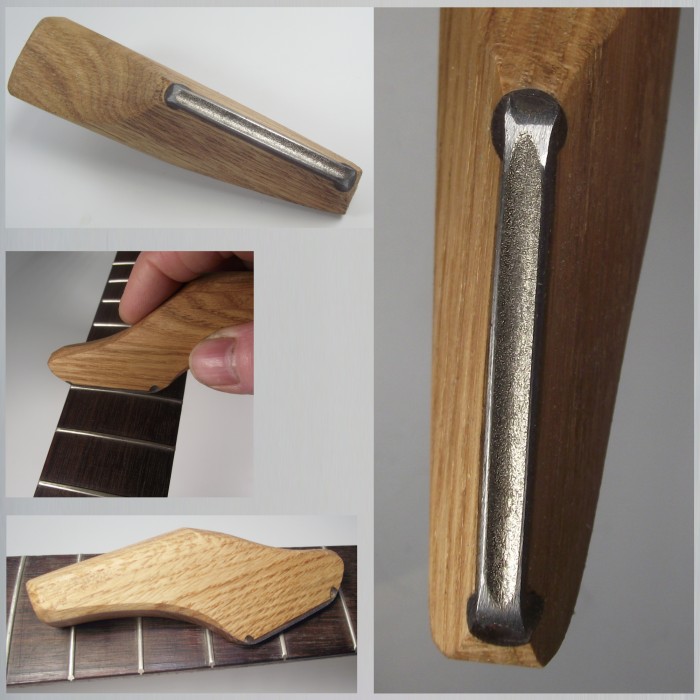
With a diamond fret crowning file, the fret will be crowned too, not flat on top.
-
Originally Posted by Jimmy blue note
Do you still do this? Or this is a past life?
-
When I moved to CT a year ago, I left my on site location but I am here for anyone who can get a guitar to me, or wants a custom or custom modified Chibson or ...what do they call Chinese Martins?... Originally Posted by Zlwilliams7
Working guitars for working guitarists.
-
FWIW, John Buscarino does the same with the Eastman Cabarets he sometimes gets to sell on.
-
I’m in NY, basically neighbors! I think I could handle basic setups…but this thread kind of scared me off of ordering one. The only tempting part is not spending so much money on a beautiful archtop
-
I'm in NY. So id say we are basically neighbors. I think I am fairly competent in basic guitar setup but this thread has me feeling wary of giving it a go. The only thing keeping me thinking about it is being able to get a nice archtop for an even nicer price. Originally Posted by Jimmy blue note
Chibartin or maybe Martinese??


 Reply With Quote


Interesting Acoustic-Electric 7-String
Yesterday, 06:32 PM in Guitar, Amps & Gizmos