


-
A couple of observations on tuning stability -- which I define loosely as the number of times I have to retune during a set.
My cheapie Yamaha Pacifica 012 with the bridge locked down hardly ever needs tuning (replacement tuners). It is incredibly stable.
My Comins GCS-1 has to be retuned multiple times over the course of playing for 2 hours. And, not just one string.
Why is that? I use the same technique for fastening the strings to the posts.
One other tuning point. I got a new Fender American Standard Stratocaster a few years ago. First guitar I ever had with a tremelo bar. It could not be tuned. As a trem bar guitar it was useless as delivered. Eventually, I put in 5 springs and screwed the claw as far as I could. Now it stays in tune. That Yamaha, in contrast, would stay in tune even when I had the bridge floating. I understand more about this tuning problem, having to do with friction in the nut and saddles, but I don't understand the GCS-1.
Thoughts? Tips?
-
08-07-2019 03:55 PM

-
Why does one guitar stay in tune better than another? I think it's mainly because of differences in thermal and humidity-related expansion/contraction due to differences in material and design. My Godin hollowbody goes out of tune a lot (and the action also moves up and down) with changes in the weather. It has a metal trapeze tailpiece, a wood bridge sitting on a lightly built top made of different wood (finished on only one side), coupled to a neck and fingerboard made out of two more wood species, with a fingerboard extension. This stuff is all expanding/contracting differently. My D'Angelico semi-hollow holds tuning substantially better, but it too has a trapeze tailpiece, which I suspect moves around with temperature changes. I was once playing it in a room where the temperature changed radically each time the A/C kicked in and out, as in it went from sweltering to freezing in a matter of a few seconds. I was tuning in the middle of one of those cycles, and without touching the tuning keys, I watched the pitch change on my tuner.
 Originally Posted by rpjazzguitar
My American Standard Strat holds tuning about the same, or maybe a little better than my semi -- up to a point: it Strat will go out of tune under heavy bending and/or whammy use, but If I'm just playing without much of that, it stays in tune. I have it set up with 4 springs, and a very small amount of float.
John
-
A solid plank covered in plastic is going to be more stable than a hollow box with thin sides which have holes in them. Temperature and humidity changes cause the top and back to move very slightly, and it doesn't take much movement to change tuning. There is a video on YouTube with Wes Montgomery complaining that his guitar wouldn't stay in tune. I don't know of a way to fix this, and I wish I did, because someone who can come up with one can make a fortune.
-
Jumping on this thread (thanks RPJ !) to ask a question long unanswered to me :
I always wondered what was the ratio between the wood contracting/expanding and the strings contracting/expanding as a cause for tuning instablity.
For example would a baked neck, or even better, a carbon fiber guitar, provide near 100% stability regardless temperature and humidity changes or would it be significantly mitigated by the metal of the strings moving ?
Regardless nut/saddle friction etc ... of course.
I never had a chance to play a baked neck or a carbon fiber guitar and i am still wondering if purchasing one would radically change tuning problems.Last edited by xuoham; 08-08-2019 at 01:07 AM.
-
I use the same brand on the guitar that stays in tune and the guitar doesn't. Different scale length. Same gauge strings. So, if it was the strings causing the problem, why does one guitar stay in tune? Originally Posted by xuoham
Do all hollowbody guitars have to be retuned several times per set?Last edited by rpjazzguitar; 08-08-2019 at 03:53 AM.
-
I definitively have an answer for this question. I currently own two hollowbody archtops (one is a Eastman ERO and the other one a Jaen Jamaica) and both stay perfectly in tune. Sometimes there is almost no variation from one day to another, though I live in a rather wet place. Originally Posted by rpjazzguitar
The only trick I use is to pull up the strings several times when I restring my instrument before fine tuning them.
-
Well, when you say that your guitar stays in tune, do you mean even with temperature or humidity changes ? Originally Posted by rpjazzguitar
From your original post, you sound like your tuning problems are more mechanical (tuners, nut, saddle ... ) than temperature or humidity related, so, sorry, maybe i should have posted my question somewhere else.
Could it be that the one piece mahogany neck on your Comins is moving ?
Forgive me if i miss the point.
-
I don't know why. I play both guitars in similar situations, which include some changes in temperature and humidity. No matter what, that Yamaha stays in tune. The Comins isn't terrible, but it seems rare that I check tuning and I don't have to adjust it. The Comins has a set neck, the Yamaha is bolted on. I'd have thought the bolted neck would be less stable, but the opposite is true. Originally Posted by xuoham
-
Funny, but my Godin 5th Avenue is one of my most stable guitars. My Cordoba GK Studio (flamenco) need tuned between every song, My Hamer solid body is pretty stable, but gets played more aggressively, so thanks probably why it needs tuned often. But my 5th Avenue is highly stable, with stock tuners and D’Addario flat wound chromes. I wonder how much the tuning head string wrap has to do with this. I double wrap the D, G, B, and high E strings so they go through the hole twice, and make sure I get 2-3 good complete wraps around the post. I also made sure the nut slots were not binding on the strings when I changed to the chromes by using a round wound string as a file to smooth out the slots. Originally Posted by John A.
-
I replaced the original tuners on mine with hipshot locking tuners (for no particular reason, just because I felt like experimenting and they were cheap). I don't notice any difference in tuning stability since doing this. Regardless, I'm quite sure that the tuning instability I experience with this guitar is not because of stringing technique or friction. It just is what it is. Originally Posted by zcostilla
John
-
All my guitars - solid, semi, and hollow, have good bridges, tailpieces, and tuners. I lube the nut and saddles when I change strings, and after an hours worth of playing the tuning stability is exceptional.
I don't have to retune my hollowbody during a two hour big band gig or rehearsal.
-
Hideo Kamimoto showed me how to attach a string to the tuner post. He recommended that up and under move so that the string presses itself against the post as you wind it on. Originally Posted by John A.
But, when the Comins arrived, new, it didn't have that. Rather, the string was neatly wrapped around the post maybe 6 times or so.
-
I've tried all the different ways, and I don't think it makes a difference how you string. Originally Posted by rpjazzguitar
John
-
I've never lubed the nut or bridge. What do you use? Originally Posted by cosmic gumbo
I found this video about making your own lubricant by mixing petroleum jelly with graphite, from a pencil.
-
Pencil lead on it's own is usually enough.
-
If you have a trapeze tailpiece (and of course if you have a trem) also lube the saddles.
Graphite from pencils is nice and smart and cheap but can look black and messy on a white nut.
Big bends nut sauce works wonderfully, not cheap but lasts long.
Silicon grease is more economical and is fine too, ime.
Even with a properly cut nut, a little lube goes a long way, especially for the G string, the black sheep of guitar.Last edited by xuoham; 08-09-2019 at 05:46 AM.
-
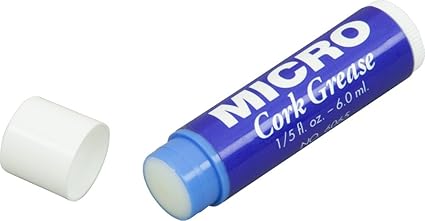
I use a tiny little touch of 3-in-1 oil on my metal bridge saddles, and use woodwind cork grease, Blistex, Chapstick, etc., in my nut slots, using a pointy wooden toothpick to apply it. Been working great for decades. Originally Posted by rpjazzguitar
-
the black sheep of my swimwear too, lol Originally Posted by xuoham
In all seriousness, you can get Teflon power lube in white if you need it to match the saddle/nut. It’s messy to use, but it won’t discolor your parts.


 Reply With Quote


Got some picking exercises?
Today, 01:17 PM in Guitar Technique