


-
I will start by saying the ONLY thing I have against tube equipment is the weight and expense, they sound great.
Before my question, I studied electronics for two years in 1970 - 1972 and have a AAS degree. I worked in industrial electronics for 39 years before retiring, I have seen and repaired all sorts of electronic equipment.
The question: What is the attraction, in electronic terms, for "hand wired point to point construction" vs circuit board? I will grant that the heat from improperly cooled equipment may heat char/stress a circuit board and solder joints. Other than that what else?
Is it like when Gibson back in the 60's marked the volume 0 to 11?
-
03-02-2019 01:41 PM

-
Heat is the only stumbling block for circuit boards. Tubes work with high voltages they are hot, the transformers are hot. Turret boards are heavier and the connections, components to wires, more robust. Some say they sound better this makes no sense to me. That said I'm sure a heavy circuit board with the right gauge foils would serve as well. No manufacture will spend the money on that.
 Originally Posted by BBGuitar
-
It's not just heat. Circuit boards can fail from mechanical stress as well as heat, and both reinforcing each other makes things worse. The most common symptom of mechanical stress is defective solder joints, not actual breakage of the board. Minor flexing over time can cause both loose solder joints and loosening of the traces. Point to point wiring without a board involved mostly eliminates the problems. Another issue with circuit boards is placing controls and jacks on them, which puts even more strain on the board. Having the controls, jacks, etc mounted directly to the chassis helps a lot with this. Point to point wiring is not necessarily a panacea, though. It requires skill and care to get everything wired neatly and correctly. In a factory situation, with relatively unskilled workers, circuit boards are cheaper and more reliable out the door.
-
The main thing I don't like about PC boards is when components subject to mechanical forces are soldered in to the PC board.
So, for example, the input jack or pots are soldered right into the board on many amps. Eventually, normal use will cause the solder joints to fail. If you reheat the solder joints, the problem is solved, but that can be an unpleasant job, depending on what you have to do to expose them so that you can re-solder. This is true, for example, on my Roland JC55. I've had to do this repair twice.
If, on the other hand, the hardware (and tubes) are chassis mounted and connected to the PC board with wires that can flex, I don't see why a PC board would sound worse -- at least until a component fails. But, even in that situation, PC boards can be repaired. You can get a soldering iron with an attachment designed specifically to remove components from PC boards.
If I understand the difference between Point To Point and turret board, I think I'd rather have a turret board. Keeps things neater, better organized and doesn't require anything in awkward positions. I have a 55 year old Ampeg with a turret board - and it never had a problem with the board. It's very solidly built.
-
BBGuitar, one thing about guitarists is that we tend to firmly believe we can hear the inaudible when it comes to amplification. That includes P2P vs. circuit boards, PIO vs. ceramic caps in the tone circuit in guitars, nitro vs. poly on a Les Paul or Tele, etc. So people will insist that CB amps sound worse than P2P amps (and in some cases they're right, for their purposes, because the circuits aren't equivalent and are voiced differently- a Blues Jr. and a Twin, for example).
-
If a PCB based amp were left in a static environment like say a studio, or home, I see no reason that a PCB tube amp would have any more problems than a hand wired model.
OTOH, PCB amps that I've repaired are IMO ill equipped for lugging around. Their interfaces / connections to pots, transformers and other PCB's are more suited to table radios than heavy transportable equipment.
Thin glass boards, thin trace thickness and insufficient separation between the traces are all designed for economy of scale and fast assembly. Add to that heavy / large mass devices like caps being poorly secured cause pad cracks and solder joint failure and make PCB's less than wonderful for transportable equipment.
If an amp had chassis mounted pots / transformers and other PCBs that were hand wired to the PCB instead of hard mounting to the PCB, or using fragile push on connectors, as well as attention to portability in design of the PCB itself there's no reason a PCB amp wouldn't last as long as a hand wired amp.
Hybrid tube / SS amps are yet another story in reliability I could go on for a L-O-T longer :-)
-
Well, them old amps had some of that old time cloth covered wire instead of that space aged plastic coated stuff. The cloth stuff sounded more organic, because it was organic.
-
A badly done hand wired amp is a bad amp. A badly done PCB amp is a bad amp.
When done right, both are great and I see (hear) no difference.
Electronically, a circuit is a circuit. But with a PCB amp it takes (a lot) more effort to make it reliable and sturdy enough to withstand heat and mechanical stress from transportation. Effort that is not sadly not made by most manufacturers of modern production PCB amps. Not putting tube feet, pots and inputs directly to the PCB is a minimum requirement IMHO.Last edited by Little Jay; 03-03-2019 at 08:50 AM.
-
Here are some pics of old Guyatone amps with PCB done the right way. But I guess it would cost almost as much to produce nowadays as a hand wired amp:


-
Originally Posted by BBGuitar
Well, it’s not that pcb based amps can’t sound good. It’s more that the decision to use pcb, is usually only one of many cost cutting measures the company chooses to make. Thin traces, surface mount components, wave soldering without real tight qc, coupled with less than the best components, etc.
As opposed to a hand wired tube amp where they’ve either selected the best materials (new boutique), or were talking proven vintage specimens (old fenders).
There is also “repairability”, ruggedness, and I’m sure a few other things that slip my mind at 6 in the AM.
And the sound, the amazing sound...
-
P2P certainly more serviceable and much easier to modify and mods are very reversible in most cases.
-
What Rpjazzguitar said. I would have nothing to say about pcb wiring were it not for the fail rate of input jacks in particular on cheaper amps using pcb. Seems like an inordinate amount of amps I plug into at studios (Hot Rod, Deville, Traynor ycv40, Vox AC30) have flaky jacks. Has to be not only the pcb, but cheaper everything used.
-
I don't know anything about 'robot-wired' amps. Do they exist?The question: What is the attraction, in electronic terms, for "hand wired point to point construction" vs circuit board?
Point-to-point can be easier to make, as you don't need to make the board. It can be easier to repair compared to an amp on which the board needs to be removed to replace components. However, I prefer to have the components on one or more boards because the boards can be assembled in advance.
-
PCBs are not made by human hands. On many, the components are installed by 'robots', especially newer models with SMDs and ICs. They are likely more reliable than those made entirely by human hands. The only downside to printed circuit boards is possible mechanical stress, and that is mostly in older amps. Newer, state of the art amps seem to be very reliable, and sound good. Tube amps tend to be older, and sometimes of questionable quality in build and design, and subject to more frequent failures. I know there are people who love them, just as there are people who love LPs and tape, but I'm not one of them. Technology advances apace.
-
I have soldered and re-soldered many thousands of solder joints on all forms of electronic construction.
A good solder joint rarely if ever fails, on the other hand a poorly made solder joint will almost always fail.
Removal of the old solder and re-solder with new solder is essential for a good repair. A lot of repairs don't use enough heat resulting in the "cold solder joint".
I have found repair or modification to be about the same in any form of construction. I have done them all, point to point, PCB, multi layer, surface mount, wire wrap, did I leave any out?
-
the military uses PC Boards so the ability to withstand shock and vibration is not the issue. It's not the PC Board that's the problem. The problem is that when companies like fender switched to PCBs they also switched to the absolute minimum rated components and used the absolute cheapest suppliers with super thin traces, super thin boards, jacks, switches and tubes mounted to the boards, etc. Often times in a recent fender amp, a single part failing results in a domino effect where voltages increase over the rated one for the circuit and the result is a cascade of blown up parts.
Mesa Boogie MK I, II and III also used PCBs but mounted the jacks, switches, pots on the chassis like they should be. There are many companies who make PCB amps that sound great.
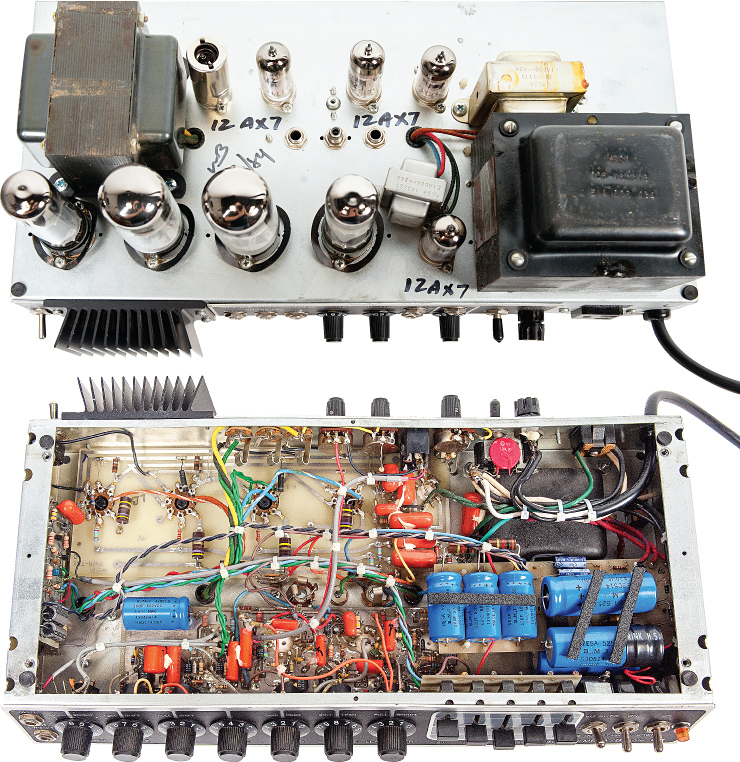
Hand wiring is no guarantee of quality. This is from a morgan amp who is reknowned as being a boutique, high end, hand-wired tube manufacturer:
-
Your background sounds like mine to some degree except after 25 years as a tech I became a nurse (long story). Anyway, I've tinkered some with my amps as I have no fear with that sort of thing. One of the amps was a Blues Jr (tweed version with the Jensen 12N). I liked the amp ok stock then heard about the BillM mods and started doing them with good success, the amp got better with each mod to my ears at least. A few complications were the ribbon cables and the traces on the pwas which are very easy to damage when soldering. The ribbon cables I replaced with straight wire and I was able to fix the one or two damaged traces. The final nail in the coffin was the power board, the contacts needed to be re flowed several times due to noise..a common issue with blues jrs. Eventually I had enough and tried to replace the entire power board with a kit from Hoffman. It was a pain in the butt and I had mixed results. Originally Posted by BBGuitar
All that was enough for me to really appreciate the logic and ease of maintenance of a point to point circuit.
Tubes are also a labor of love, the new ones are not great, the old ones are high priced and rare. I love the tone of old school amps though.
-
My tube amps happen to be hand-wired.
I'm pretty sure Andy Fuchs, though, makes his with PCBs, and they are $2000-4000 amps that people love, so he must be doing something right!
-
if you ever decide to make a circuit change on your new fender amp and end up removing all the nuts on all the jacks, switches and pots and then on the circuit board in order to flip the board over so that you can get to the trace side, you'll understand why people like hand wired amps.
It's great for playing in the store though!

-
If that came in the shop where I worked the reaction would be. " oh boy a easy one". Originally Posted by jzucker
-
Tone King Amps are another example of a boutique builder using pwa boards with good results. Originally Posted by marcwhy
I don't think that is a Blues Jr but it sure looks familiar. Dreaded ribbon cables and all. After you pull the chassis and squeeze the board out the cables can get stressed and break at the connection points..especially if you remove them more then once..don't ask how I know ha ha. Originally Posted by jzucker
-
After modifying my PCB-Fender Blues Deluxe - like the one jzucker posted - I loved working on my old German Framus Strato 345 (got it used and it needed maintenance before I could use it on stage):


Real point-to-point!
(Btw, the modification of the Blues Deluxe turned out great, that amp sounds beautiful now! But it was a PITA.....!)Last edited by Little Jay; 03-04-2019 at 02:33 AM.
-
I'd like to see the robot that wires these amps. Does it solder too? Or just plug-in the connectors?
-
I have built a fair number of amps over the last 45 years, or so. I have studied electronics formally and informally.
Tubes do what they are designed to do, and they do what they are not designed to do, and they do both jobs well. (That is, they operate over both their ranges of linearity and non-linearity with useful outputs.)
They are, however, inefficient as heck. 50% of the energy applied to a tube is dissipated as heat. Solid-state devices are MUCH more thermally efficient.
Heat can be a problem for PC boards, as can physical flexion. PC boards are capable of being designed well, however, and can make quite useful MI (musical instrument) amplifiers. Consider the boards on old Ampeg amps--e.g., VT-22. They are tough as a good old pickup truck.
It's silliness that you can hear the difference between a well-designed PC circuit and the same circuit done with tag board or hay wire.
-
By memory, referring to the JC55.
Wiggling various things causes bad noise. I never figured out which solder joint was at fault, so I reheated all of them.
Unscrew the various screws that hold in the chassis. Remove all knobs and nuts.
Wriggle the chassis out so you can see the board. The input jack has it's own little board. The pots are on a different one. All of this hardware is soldered into the board. No wire leads which can flex and thereby absorb mechanical stress. That's why we're doing this job.
Unscrew the board, because you have to turn it over to see the solder. This requires making sure you don't break anything or pull any wires too hard. It may be necessary to unplug some connectors. That's always a little scary because they're hard to get out and you don't want to break anything that small.
Don't drop any of the screws, nuts or washers. Don't lose them.
Touch the soldering iron to any solder joint that looks like it might be mechanically stressed. There are undoubtably people more expert than I, but I wanted the solder to flow and look shiny. Can't say that that's all there is to good technique, but the amp worked afterward.
I can't recall if I was able to test it before I put everything back together. It certainly would make things easier if the thing needs a little more heat.
I had to do this again after a couple of years. That amp was treated well, but ridden hard with a lot of moving it around.
Best to do the repair before it breaks on a gig. Don't ask me how I know this.


 Reply With Quote


Got some picking exercises?
Today, 01:17 PM in Guitar Technique