


-
ssia, i was thinking about adding one to my VB guitar. Been doing a little research on what to get, i know these two are my options i guess..My guitar has a single Kent Armstrong in it. Love the guitar, just wish i had a little more control on the tone knob if needed. If i want a darker sound i have to almost have it all the way rolled off. So if anyone has any ideas let me know..thanks
.022uF
.047uF
-
12-22-2018 01:04 PM

-
Caps are caps, although tolerances vary. If you want the treble to roll off more quickly, use a linear taper pot instead of audio taper, and a larger cap.
-
Think about that the cap does: it shunts a range of frequencies to ground, which means they aren't sent to the amp. You don't hear the signal that goes through the cap. There is a whole cult of people on the internet religiously believing in the superiority of one cap over another for tone- apparently believing they can hear something that isn't heard. What matters for tone are the frequencies left over in the signal that aren't sent to ground. The value of the cap affects the range of frequencies sent to ground, not the construction of the cap.
The value of the specific cap affects the signal sent to ground in conjunction with the pots. The traditional approach is to use 500k pots with .022 mfd caps for humbuckers, 250k pots and .047 mfd caps with single coils. I had a KA 12 pole floating PAF-0 on my guitar for a few years and struggled with it being brighter than I wanted. Kent suggested using a 500k volume pot, 250k tone pot and playing with cap values to tailor the sound. I ended up with an .050 IIRC (now I have a different pickup on that guitar). The 250k tone pot brought the highs down quicker than the 500k.
My taste in tone has changed since then, now I prefer a bit brighter tone over the "blanket over the amp" sound I used to go for. Maybe just my ears aging and losing some top end hearing.
Also, do you have a linear taper or audio taper pot? The former might be linear mathematically- I don't actually know- but it is not linear in tems of sound as you roll it down. Most of the audible cut appears at the end of the range. Audio taper pots ironically sound more linear to the ear.
-
Hi thanks. Ya im not sure if its audio taper or linear in this guitar. Ive actually come to like the brighter sound to with this guitar as well, i always have played my L4 with flatwounds, so this is a different sound with the wound rounds. just looking for more control of the tone pot when i Need it to be warmer/ darker.
 Originally Posted by Cunamara
your info is what i have read too. .022 for humbucker and 0.47 for singles.
Ill also look to see what pots i have 250k or 500k...thanks
-
great chart
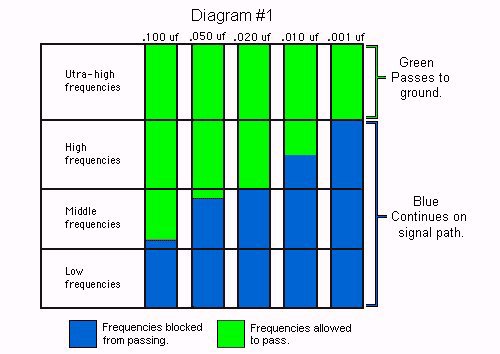
cheers
-
my basic understanding of caps (via youtube, mind you) is that the values matter, but the materials don't, exactly. there are the tiniest of variances between them, but not really worth the effort. since i yank all my stuff anyway, i tended to go with whatever was included in whichever kit i bought (pio and i don't know what from rs electronics and orange drops from tv jones). i don't know that they sound better than the .05 cent ceramic caps that were already in there, but i'm only doing it once, so why not?
90% sure that most of my caps are .022, regardless of the pickup, though i think one rs harness i bought uses a .015 at the neck. that includes, humbuckers, filters, minis, p90s and floaters. not sure if that is advisable, but that's what i did. content.
if you want more tone from the tone knob, i'd replace that, instead. well... also, in my case. rs superpots have been my go to forever, but have been curious about the emerson stuff, too.
-
For tone caps in guitar the value is what counts. Matarials are mambo jambo. It’s your money, but I wouldn’t waiste it on PIO caps in a guitar.....
And in your case I think your problem would be solved with a different taper pot, as suggested.
-
-
The value of the capacitor only matters when the tone control is rolled fully off. Wide open, the capacitor isn't doing anything, so the value makes no difference. A .047 will give you a darker tone than a .022 when both are fully off, but you'll get the same tone from the .047 as the .022 somewhere in the sweep. I don't get much concerned about the cap value, because I never turn my tone control all the way off. I use whatever came in the guitar, or whatever I have on hand for a new installation. I can get an acceptable tone somewhere in the sweep.
-
I had categorically decided that my next jazz pickup would be the KA 12 pole as everyone seems to love it here. Originally Posted by Cunamara
But having read your post now I'm not so sure!!!
-
Capacitors are capacitors as long as they are within tolerance, properly insulated, and operating within the voltage rating. Any advantages of paper-in-oil are imaginary. Here’s an extensive comparison of frequency responses with various caps, including the overpriced PIO products.
The Truth about Tone Capacitors | Atlantic Quality Design, Inc. Musical ProductsLast edited by KirkP; 12-24-2018 at 01:57 AM.
-
Most of the setups with that pickup seem to be darker and more PAF-y than mine was. My particular one was almost single coil in its clarity (I bought it from Joe V at archtop.com) and I was looking for rather dark and soft. I've heard a lot of other people get tones I really like with them, though- you can find quite a few examples on YouTube. What I'd suggest is dealing with Kent directly- he will wind it and choose magnets to the sound you want to get. And the price will be very competitive with wherever else you can get that pickup. Originally Posted by garybaldy
-
The impedance of the tone control circuit interacts with the impedance of the pickup, so the capacitor value does effect the frequency response. The effect may be negligible with the control set very high, but I think it can have audible effects at lower settings. You can’t calculate the effect of capacitor unless the pickup impedance vs frequency is known, so most people cut & try and stop when it’s “good enough”. Originally Posted by sgosnell
-
Thanks Originally Posted by Cunamara
I'm in the UK and have had email dialogue with his son, Aaron, who operates here. I believe he provides exactly the same service as his father.
-
To summarize:
1) You MIGHT hear a slight difference between two caps of the exact same measured value but different materials if you operate them near their rated limits (i.e. 200 or 400 or 600V or whatever);
2) A guitar pickup, even the hottest, doesn’t come anywhere near that limit;
3) The signal through the tone capacitor is bled to ground, so:
4) draw your own conclusion.
Differences between two caps are most likely due to differing real values (see tolerance).
I use whatever is in my parts drawer that has the right value and fits physically.
Feel free to buy into any mojo argument you want. Whatever makes you happy.
Steven
-
I put some pio caps in a tele and my archtop at one point and I did not like the result at all. Very muffled and bland sounding.
-
Sure PIO caps is the way to go for a good jazz tone, but it depends on the type of oil !
I prefer 15w40
But for strong winter, 20w50 is better
-
I figure if you spend $1000+ on a guitar a $10 cap for fun is not a big deal. Look good sound good.


-
ok forget the pio cap for now..what tone pot would you suggest to roll off faster. Linear or Audio taper? 250k? thanks
-
By rolling off “faster” do you mean having the tone go from bright to dark with a very small turn of the knob? That could be useful for Danny Gatton style wah wah effects, but I think most jazz players want a more gradual taper over the full range of the pot. Originally Posted by jazzgtrl4
Edit: Rereading the top post, I think you want the tone control to be able to roll off more highs than your current circuit. I don’t think of that as “faster”, but I think I get it. In that case, I think you might want a higher value capacitor. Don’t go too high though, since increasing capacitance can interact with the inductance of the pickup and mess up the frequency response. I think audio taper is usually preferred to provide a gradual treble rolloff instead of having most of the rolloff at one end of the pot.
Also, if you looking for a darker tone and never have a desire for bright, you might consider a lower resistance value on both the tone pot and volume pot, as they both work together to affect frequency response. Here’s a technical document on pickup theory that has some frequency response plots with a few different values.
https://www.springer.com/cda/content...350-p174104272
Edit— Attached are a few calculated frequency responses from that document for a couple of types of pickups and volume & tone pot resistances with a 0.022uF tone cap. Note that some values of resistance can create a bump in the response. If you prefer a fairly smooth somewhat dark response, you probably want to avoid that! Unfortunately, these curves depend on the pickup impedance as much as the tone circuit, so they would be difficult to generate for your own setup. But they might at least help you guess what capacitance and resistance changes might get you closer to the tone you’re looking for.
Last edited by KirkP; 12-29-2018 at 02:08 PM.
-
First, don't run the volume knob at 10. Unless there is a treble bleed circuit, turning the volume down to 6-8 will roll off some higher end highs. Turn the amp up to compensate. This will warm up the tone without making it muddy.
A 250k audio taper tone pot will roll highs off faster than a 500k pot; audio taper will do so earlier in the rotation than a linear taper. Kent Armstrong recommended a 500K volume pot, 250k tone pot and .033 mfd cap to me. Too much tone knob rolloff will make the tone muddy.
Use the amp tone controls- if you've got a Fender amp (blackface or silverface, tweeds are voiced differently), to get a nearly flat response run the treble and bass at about 1 and the mid, if there is one, at 9-10. The jazz tone not only de-emphasizes the highs, it also brings up the mids and Fender amps are designed to cut the mids.
Listen to Charlie Christian, Barney Kessel, Kenny Burrell, Peter Bernstein- great jazz tone is not necessarily dark.
-
That’s good advice. I became much more satisfied with my tone since adopting this approach. Originally Posted by Cunamara
Seymour Duncan has short article along the same lines.
Stop Ignoring Those Knobs | Seymour Duncan
-
Volume and tone knob really make your tone! (No! Really? Yes they do!) This is why I came to like 50ies wiring so much: it has such a great variety of tones in it. The funny thing is: volume controls treble in huge way and the tone knob is more of a gain knob that adds presence when you open it up.... get it? Work for me!
-
Mate, don't (orange) drop down the rabbit hole (ha ha ).
Don't spend major coin on little plastic thingies.
The tone control on a guitar is to cut treble. Set your tone on your amp and then cut and boost treble on the guitar to taste.
PIO caps are my faves but no more than $5-£3-€3.
-
If you are referring to the tone pot, I wouldn’t describe the difference as “faster”. If you change out a 500k tone pot for 250k, you’ve simply lost the top part of the tone control’s range. If the tone controls were linear, it would eliminate all the tone options between 5-10 on the old pot, and spread what remains over 1-10 of the new pot. With more common audio taper pots, the tone options you are eliminating might be more like the 8-10 range on the old pot (just a guess). But the 250k tone pot gives you no new tone options. If someone is looking for darker tones there is no benefit to changing out the tone pot. Originally Posted by Cunamara
I think replacing the volume (not tone) pot with a lower value will give new tones, as it will roll off more highs while possible smoothing the upper frequency response.

(Source: 20 Gretsch upgrades, mods & tone tips - Guitar.com | All Things Guitar)
But going to a larger tone cap value is by far the easiest way to to get a darker tone control range. These opinions are mostly based on basic circuit theory & calculations I’ve seen—I haven’t tried these mods myself.Last edited by KirkP; 12-30-2018 at 09:59 PM.



 Reply With Quote


What is it?!? Why am I still at it?!?
Today, 04:53 AM in Everything Else