


-
I apologize if I sound like a shrill for Positive Grid and their product Bias Amp 2, but I've had my head immersed in their new release for a couple of days and wanted to share a personal revelation.
I've been using amp modelers for a while in both hardware and software (plug-in) formats. I've had good experiences with many and have seen an exponential improvement in sound and feel over the years. I've realized the thrust of my time spent, and I see this in others that use modeling, is spent evaluating and getting the models to be as close to the real thing or least configuring them into something that sounds great to my ear.
I think we've all been there; does my modeled Princeton sound like the beloved Princeton, etc...? Kemper is all about this. Bias Amp and Fractal has a tone match capability. There are tons of videos on Youtube that compares modeled amps to real amps. There are also videos comparing modeled amps between modelers.
The funny thing is, if tube amps were perfect and met all needs, there would not be so much turnover, modifications and dozens of companies building Fender, VOX and Marshall clones. Many of us are guilty of chasing a better tone, the grass is always green.
With Bias Amp, I've taken a somewhat different approach. Rather than search for ultimate Princeton, AC15, Dumble, I can just build an amp that reflects a tone I have in my head and ears. I do not need to build an amp that works great across all my guitars, each pickup and cab. I can build an amp specifically for clean that works with my Tele's bridge pickup.
Bias Amp allows you to build your own amps by selecting and adjusting components. One can mix and match combinations of preamps, tone stacks, power amps, rectifiers and cabs. Each components has additional adjustments and configuration. Preset are provided that help set you on the right path.
This allows me to build a "Princeton" like amp but one where perhaps I set a second gain stage to get some preamp dirt, remove some shrillness by placing a low-cut circuit after the preamp, change bias to make it less hot. I can modify compression and sag in the power amp. In the end I've potentially created and amp that I cannot correlate to an existing amp but who cares if it sounds and feels good.
So rather than chase the next greatest amp or find the closest thing to a vintage AC30 or sort through everyone's idea of what something should sound like, why not just build what sounds and feels good to you.
Positive Grid does not do such a good job promoting their software in this manner. They have tone matching capabilities but I have not found any amps that were built using it really sound good. They ship and allow you download a 100 of common amps for free. To my ears, none of these sounded really great either. It is the ability to highly customize or build from scratch amps that they should be touting.
Thanks for your indulgence.
Regards,
Rick
-
05-04-2018 10:50 AM

-
I guess I'm just 'old school' but, if I can plug my guitar into an amp and it gets louder and has a couple tone controls, I'm a happy camper. I tend to sound like me regardless of what I'm playing through and I really don't care about sounding like somebody else. Of course YMMV......
-
I am sure there are many like you and that is a good thing.
 Originally Posted by Skip Ellis
-
This is the philosophy behind the Yamaha THR100 series. They can be used effectively without (or with) a computer connection and they lack presets. Originally Posted by rickjazzmister
"This is another unique element of THR's amp models," added Ward. "While they are based on classic amps as a starting point or reference, they're not designed to be a perfect simulation of another amp. Instead, our engineers create the best sounding amp based on that type of circuit they can make – just like amp modifiers like Mesa Boogie, Splawn and a host of other boutique amp companies (who mostly started by making amps based on either modded Fender or Marshall designs) – but our engineers have a VCM software toolkit instead of a box of components and a soldering iron."
-
I tried the mobile app through my AER and thought the joyo American sound sounded much better, though I could also pick up Magic FM on it.
Is the laptop app loads better?
-
Yeah, the digital modeling is getting better and better, I guess, since even pros are using impulses and what not on stadium stages. Not having access to that expensive gear, I have tried almost everything available in terms of computer software, and although I would be impressed at first by how much 'realistic' and 'amp-like' it sounded, very soon I'd end up disappointed, especially when playing along to some tune or a youtube video. My sound is always lost, empty, hollow, nasal...something's simply missing and I cannot put my finger on it, no matter how much and how long I play with the many parameters there.
And yet, every time I plug into my tube amp, heck, even when I plug into a small solid state amp that I've built and that I use only to test stuff that I build - the sound is always there.
-
I am to old school to deal with the Digital guitars and amps. I love my two DRRI'S, I know them and love their tone. I am not big on pedals I am no tap dancer. I play all styles of music and brought a Katana and many effects, just find a thin sound on Modeling amps.( Lacking headroom). I will soon be 69, but love playing Clapton, and early 60's and 70's music.
Sent from my iPad using Tapatalk
-
I'm very happy for the OP about PG BIAS products being of his liking, as I find'em overhyped, overpriced and I find their economic model being shady, to say the least.
I use Scuffham Amps S-Gear since 2011 and I effortlessly get the tones I need, without that inherent shrillness present on the PG products, that simply can't be dialed-out without killing the intended tone.
YMMV.
-
Over the last 20 years I tried so many modellers. The result for me was always disapointing after a while. My old trusty Mesa and the Peavey Bandit always delivered what I wanted. I would never gig with a modeller, they never sound right to my ears, especially when played with an archtop guitar. A good tube or transistor amp is what always worked in every room and every bandsituation I played. That is my opinion.
The question for me is: Why do all these fancy companies try to emulate the classic amps?
And every year a new modeller comes up that claims to sound better then everything before...
-
Could you explain that about the economic model please? Thanks! Originally Posted by LtKojak
-
Yes, for VST plugin users ScuffhamS-Gear is really good, i tried the demo, but finally didn't buy it because of
the lovely Vermilion by Kuassa (Indonesia !), affordable ($39), no latency and very tweakable.
Fulfills all my needs.
Worth a try for Audio Interface / Computer users !
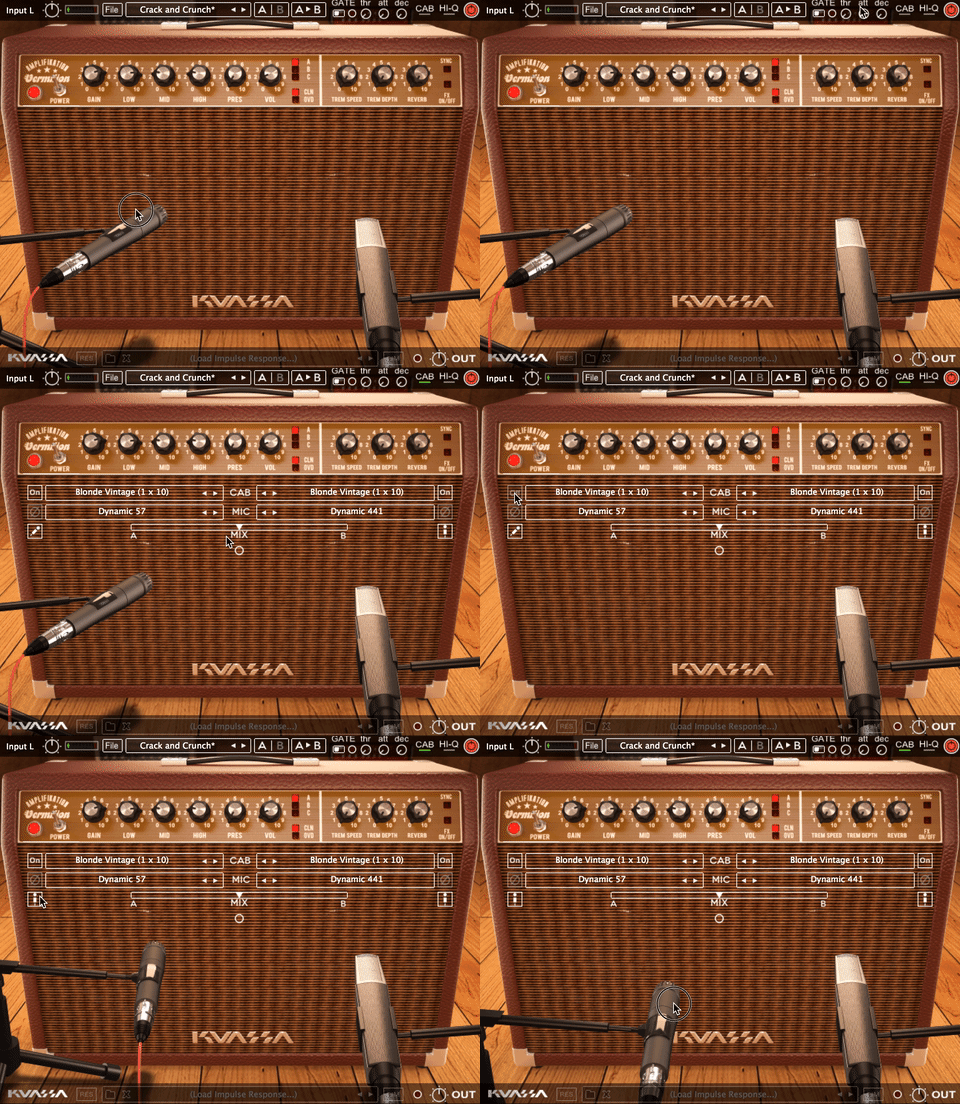
edit: sounds great and you can load your own impulses.
edit: no affiliado.
-
Who said anything about sounding like someone else? I love my fractal AX8. I'd never go back to tubes. I can play at *ANY* volume level, utilize FOH if it's there or crank up louder than a 2x4x12 marshall 100 if there's no FOH or I can use a 23lb alto 800w cabinet. It's like having a princeton that can get up to cranked marshall levels and sounds pretty much the same at any volume level other than the typical fletcher-munson thing. Originally Posted by Skip Ellis
Plus, with modelers, you're never stuck with just the eq in the amp. If you *DO* run loud enough to experience fletcher-munson, you have many eq options available.
-
Playing most of my gigs through a Bose Compact, I find modeling rigs very useful, since the Bose is a super-clean hi-fi rig without effects. with a little time spent on tweaking, I can get a great classical/flamenco tone from my nylon-string guitars, and any number of great electric guitar sounds, from AC-30 to old Twin to custom settings that please me and sit well in the live mix, all from multi-effects pedals costing no more than $200 and weighing very little. The Bose distributes the sound throughout the room or outdoor area much better than a conventional point-souce amp, enabling me to use less volume overall. My goal is to please the audience as well as myself, so this approach is what I settled on as soon as the Bose L1 series was introduced. I don't own a conventional amp except for a couple of small battery amps for outdoor weddings or sailboat gigs. Another advantage of the Bose is that the rest of the band can hear it clearly.
-
I am happy for you as well. I am interested in what you find shady about their economic model? I am going to purchase the Bias Head and am interested in your concerns. Originally Posted by LtKojak
-
I should also mention, if you cannot get a good sound out of today's modelers the issue is you. I've had no issue with shrillness or buzziness in Bias or for that matter any of the modern plugins I use. In PG you can shape the sound throughout the the signal chain. I am not just talking about dropping a HP/LP filter before and/or after the amp. I am referring to filters present in the pre-amp and power amp as well as bright selections. Originally Posted by LtKojak
I've had the chance to play through Fractal, Kemper, Line 6 (Helix), Rack Eleven, TH3, Amplitube, Vintage Amp, Bias Amp and probably a few I've forgotten. With tweaking all can get some awesome sounds. Some are better than others in different areas and serve different workflows and needs.
-
Just to reiterate the point of my original post, perhaps the perfect amp for some of us has yet to be built. I was just promoting Bias Amp on the basis that you can really roll-your-own and that may be a valid approach for those who have just been chasing the ultimate recreation of a physical amp but have not found it.
Last edited by rickjazzmister; 05-09-2018 at 01:26 PM.
-
For the most part I don't use many effects.
I have the Boss GT-100, but use it mostly for Distortion.
I really love the tone of a clean guitar.
-
who's talking about effects? 90% of the time I my only effect is reverb. Originally Posted by viccortes285
-
Like I said, "it's just me" - if I can plug in, get louder, have a couple tone controls and a little reverb, I'm a happy camper. I do mostly theater these days plus an oldies (50's-60's) duo and I just don't need all that stuff and I don't care for or play music that requires it. Now, if a pit gig required it, I'd provide what was called for and sell it afterwards. I know some think of it as another voice for the instrument but I, personally, don't care for anything but the sound of a clean guitar. Same reason I won't put a pickup in an acoustic guitar - it's a good mic or nothing. Anything else is a compromise and someone else's idea of what the guitar should sound like. Of course everybody plays different music and expects different things of their instruments so, as always, YMMV.
-
Ellis, I do not mean any disrespect, but this thread is just not relevant to you because of your use case. I tend to have multiple needs as I play in multiple situations that require different treatment. Originally Posted by Skip Ellis
-
Originally Posted by rickjazzmister
Well, excuuuuuse me!
-
Why, did you burp. All joking a side there are plenty of players that have found a permanent rig such as yourself. Given the amount of threads about amps, there are also plenty of people that are looking for the right solution for them. I own about 10+ amp and would like to reduce that footprint. Again, no disrespect intended. Originally Posted by Skip Ellis
Last edited by rickjazzmister; 05-09-2018 at 01:53 PM.
-
I'm not sure what makes folks come onto a thread like this and post negative remarks about modeling. I wouldn't dream of going onto a princeton reverb thread and stating that they are horrible amps, antiquated technology and not versatile enough. Originally Posted by rickjazzmister
-
It is true we are all here to share our thoughts and show new items like Kemper ( never seen one ). Who could bad mouth it if never tried it?
We all have our opinions and way of doing things.
We just need to not be rude, if you have no input don't post there.
Sent from my iPad using Tapatalk
-
There is definitely a nerve that gets struck for some when the topic of modeling comes up. Often these threads turn into discussions/arguments about comparisons between modeled amps versus real tube amps. For me, I've moved beyond those discussions. If one has used quality modelers and has spent the required time learning them, it is apparent that the argument is wasteful. Time is better spent on discussing Use Cases, comparisons between modelers, peripherals such as FRFR solutions and the future of modeling. Originally Posted by jzucker
Whether modelers are viable has already been answered by the plethora of pros in almost every genre and situation that are using modeling.Last edited by rickjazzmister; 05-09-2018 at 03:11 PM.


 Reply With Quote


Got some picking exercises?
Today, 01:17 PM in Guitar Technique