The Jazz Guitar Chord Dictionary
Reply to Thread Bookmark Thread
Page 2 of 2 FirstFirst 12
Posts 26 to 30 of 30
  1. #26

    User Info Menu

    Quote Originally Posted by goldenwave77
    Monday morning quarterbacks are better than Tom Brady.

    What Henry J. did was entirely rational...he took a grand company out of the Norlin doldrums, capitalized on a temporary US demographic bulge in demand, and used that as a springboard to diversify out of what was going to be a losing game long-term. (There are only SO many high-priced Les Pauls you can sell. Baby Boomers are now outnumbered by Millennials, and the latter aren't' terrifically impressed by Les Pauls, or even guitars for that matter.)

    Moreover, he tried to make the best out of a US high cost-producer situation, and leverage its history, and its traditions to sell worldwide---"US made....World played." The jury is probably still out on this, I think.

    How many guitars does Collings sell? Let's see where they are in 10 or 20 years. The reality is that even Orville Gibson didn't have that much to do with the Company we know, or the guitars we prize. HE was forced out, pretty early on. His idea....violin-style guitars and mandolins... caught on. Many more instrument companies (Gretsch, Epiphone, Vega) bite the dust than survive. And boutique makers of fifty years ago...how many besides D'Angelico and D'Acquisto are known, except among guitar aficionados?)

    (The above comment re: cash cows and unprofitable guitar ventures is contradictory, on its face....but the explanation is the US demographic one. Now that card has been dealt and played, and it is a new tougher game that Gibson faces.)

    That Gibson's diversification strategy didn't pan out is easy to say now....you might as well say that the giants of print media, brick and mortar retailing, major network television, & popular music were also stupid as well. None of them foresaw, or dealt well, with digitalization and its far-flung effects.

    Maybe a US-based custom shop and Asian production is the way to go. I'm still bothered, though, by that 335 Orville I had. Stunningly good cosmetic copy, but the darn thing was just DOA--sound wise...dull and muffled. Shipped from Japan in good order, but a huge disappointment. The Memphis Gibson 339 I have is 2X the guitar, and a keeper...I bought it a few yrs. later for $1400, used, while the Orville was $1000, used. And my 2003 L4-CES is stunningly good. Again, a definite keeper. (My '78 Aria Pro II, is actually a very good gtr., and I well recognize that there are many good Asian instruments.)

    Anyone know what Gibson's fiscal year is? Curious to see year-end financials, if these become available, or are reported on, in press.
    I don’t entirely disagree with what you’ve said, but Gibson is a very good example of how diversification just for the sake of diversification doesn’t make sense.

    Some of the purchases were really bad ideas and I think they would have to be emotional purchases, as it wouldn’t have taken much to see they were not likely to be fruitful. For example, the Baldwin Piano purchase in 2001, is a prime example. As much as I would like to see American piano companies thriving, it’s not likely to happen. Even Steinway struggles, and they are really the indisputable champion of concert grands. Asian companies dominate most of the rest of the market and that market isn’t really that big anymore.

    Cakewalk was a fiasco too. There are 50 DAWs to choose from out there and none of them are really very profitable. There isn’t exactly a huge market and an awful lot of people can just use Garage Band to do everything they need.

    While we are at it, what was it that was spent on developing automatically tuning guitars? Wasn’t it something in the tens of millions?

    Personally, I would like to see a serious restructuring toward a much smaller, very sustainable company that focuses on making high quality stringed instruments and takes care of employees more like a family, rather than just another easily replaceable cog in a machine. It might mean that sometimes demand outstrips the ability to supply and people have to be on a waiting list. That’s not always a bad thing.

  2.  

    The Jazz Guitar Chord Dictionary
     
  3. #27

    User Info Menu

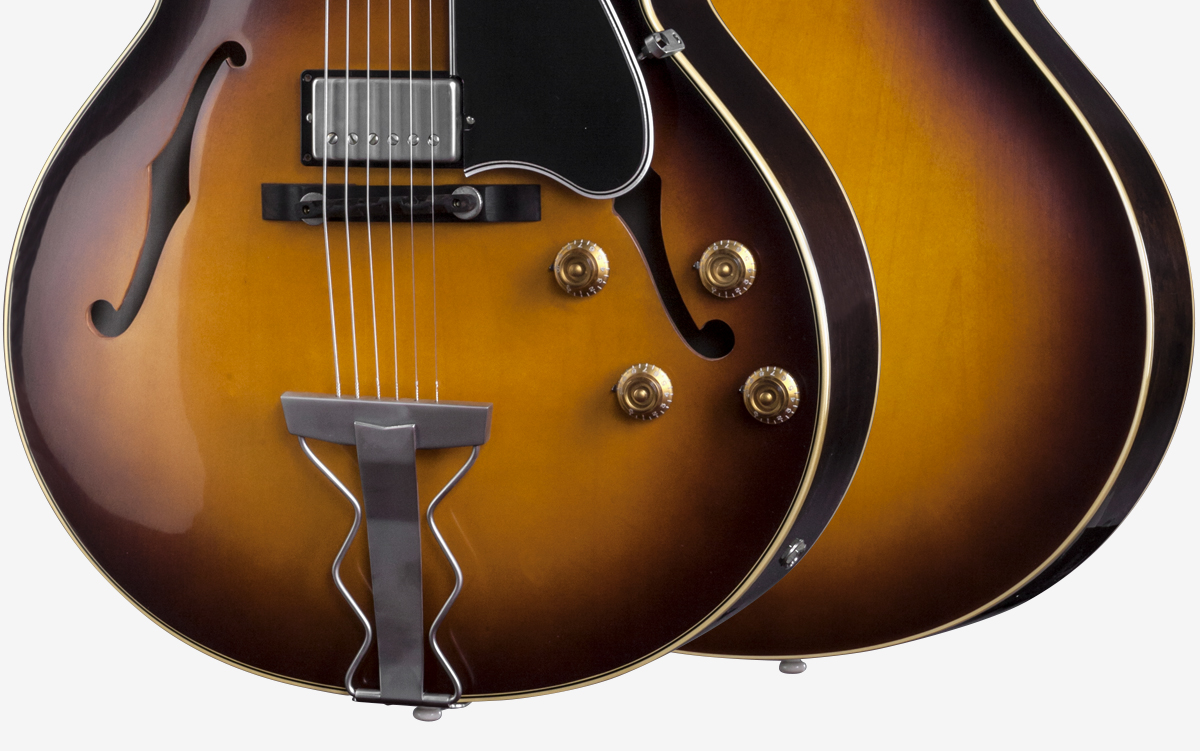
    How are the bridge set ups on the 59 VOS ES 175s intonation wise? I suppose any wooden bridge is a compromise to some extent. My experience with them is limited.

    Are they pinned like the ones with the ABRs? Or, for that matter are they easily converted to a wood base? They appear to be two pieces with a base that might accept an ABR. It would be interesting to have both options available. Thanks.

  4. #28

    User Info Menu

    Yes, intonation is a compromise, but you can get it close enough for jazz. The bridge has two pieces, the base with the adjusting screws in it, and the saddle which rests on the adjustment wheels. It's easy to change the saddle to a tune-o-matic (ABR or other) as long as the hole spacing is the same. It's not uncommon for that to be a few millimeters off, so you need to measure carefully before buying a replacement. If you already have one or more on hand, just see if they fit. Personally, I don't like TOMs, and think the wooden saddle sounds better and intonates well enough, but others prefer them. It's just a matter of personal preference.

  5. #29

    User Info Menu

    I don’t think you have to be American to appreciate the importance of the brand being American. I would be devastated if it was no longer a US brand. It would seem wrong.

    Gibson is part of the fabric of American music. I always wanted one, because that was the guitar to have. Little slice of the American dream.

    I hope it remains a US company somehow and finds its roots again.

  6. #30

    User Info Menu

    Quote Originally Posted by icr
    Gretsch is a USA company and I'd never buy a Gretsch that was not made in the USA. If I want a Japanese guitar I'll buy an Ibanez or Yamaha (and I have them).
    I agree with this. I have no problem with guitars coming wherever, but they should be themselves. Otherwise you always feel like you have a counterfeit.

    That might not be rational, but there you go. And isn’t this how most guitar players feel about the famous brands?

    (Actually I think some of Gibson’s dilution of the brand through things like the Les Paul Tribute and - good god - the M2 was a crazy idea for exactly that reason.)

    That’s a great bit of capital to have so to speak, although neither is it a license to print money. The pricing has to be right... TBH Gibson’s pricing was - to me - a little bewildering... all the variants of guitars with similar specs but different finishes etc at different price points, pricing seeming to change year to year as well.

    I think a simpler range would be better. Not try to be all things to all men. Keep the LP Es though. I like that guitar.

    Anyway:

    Eastman’s for instance are their own things. I think they are desirable on their own terms. Even their copy of a 175 is kind of it’s own take.

    I do play a loar 600 which is a copy of an American made guitar, but if I could afford an original 20s or 30s L5, I would obviously prefer that.