


-
I've seen this come up on other forums, but i just wanted to get some opinions here. I'm going to get myself either an Epiphone Triumph or a Gibson L-7 within the next year or so. Having played several Gibsons and owning a '35 Kalamazoo, I feel that Gibsons are more sweet sounding, if that's the word. I do a lot of plectrum style Van Eps and Carmen Mastren (Both Epiphone players, incidentally) chord melody improvisation and rhythm playing with my vocals. I'm more interested in small group playing as far as ensembles. I like the Gibson sound more, and they seem to be quite a bit more plentiful in the Midwest where I am. The thing with the Gibson is the price at the moment. You can get as good or better built guitar in an Epiphone for nearly a $1000 less in some cases!
Anyone else have opinions regarding vintage Gibson/ Epiphone acoustic tone? To me, the Epis are dryer and crisper sounding in most cases. Gibsons have some kind of mid range sweetness or something. Just wanted to here what everyone thinks.
-
04-05-2016 09:51 PM

-
You are talking about several different versions of these guitars which sound different from each other for various reasons. These models evolved continually over an @15 year period. If you are playing in a small group setting, I think any of them can be suitable and it's best to evaluate individual instruments. Are you interested in the smaller-bodied or the larger bodied versions? Big differences.
YMMV of course, but:
-post-'38 spec L-7 guitars do not have the "sweetness" of the earlier Advanced models due to their longer scale, parallel bracing and maple necks.
-IMO, 17 3/8" Masterbuilt Epis sound better than similar-sized post-war-style sloped-shoulder, small-f-hole Epis.
I generally categorize them as follows:
@1933-34, Gibson L-7 / @1929-34 L-10 / @1930-34 L-12
Scale: 24 3/4"
Bracing: parallel
Width at bottom bout: @16"
Typically Mahogany neck/rosewood board
@1931-37, Epiphone Triumph
Scale: 25 1/2"
Bracing: parallel
Width at bottom bout: @16 3/8"
Typically mahogany multi-piece neck/rosewood board
various changes to materials and specifications
1935-1938/9 Advanced Gibson L-7 / L-10 / L-12
Scale: 24 3/4"
Bracing: X-braced
Carve: double-hump
Width at bottom bout: @17"
Typically Mahogany neck/rosewood board, L-12 typically maple neck
1937 - sometime during/just after WWII - Masterbuilt Epiphone Triumph
Scale: 25 1/2"
Bracing: parallel-braced
Carve: single-arch
Width at bottom bout: @17 3/8"
Typically mostly mahogany 5-piece neck/rosewood board
1938/9 - postwar Gibson L-7
Scale: 25 1/2"
Bracing: parallel-braced
Carve: single-arch
Width at bottom bout: @17"
Some with laminated backs
Maple neck/rosewood board
@postwar - Epiphone Triumph - slope-shoulder body shape, small f-holes
Scale: 25 1/2"
Bracing: parallel-braced
Carve: single-arch
Width at bottom bout: @17 3/8"
Mostly maple 5-piece neck/rosewood boardLast edited by Hammertone; 04-06-2016 at 01:49 PM.
-
Thanks for the info. Was unaware of the fact that they were both parallel braced after a certain point. I'm looking into 17" rather than 16". So basically a post war gibson and epiphone would sound similar correct? I'm not hugely fussy on minute tonal differences but I'd like to not waste my money on a post war gibson expecting an x braced tone out of it!
and what exactly are the benefits of parallel bracing? Why the switch over? Cheaper to build?
-
Besides the obvious differences between the x and parallel bracing; I think Gibsons are more consistent from one to another, from my experience at least. With an Epiphone you'll find a (very) few dogs, most are on par with their Gibson counterparts, and then there are always a few that are breathtakingly good. I would have no problem to buy this over the mail at half the price of an L-5, if I didnt already have one (+ extremely broke right now
 ) https://reverb.com/item/2022167-epip...-1946-sunburst
-
It is really hard to pin this down without AB listening sessions with the same strings with dozens of guitars. I have owned parallel and x-braced L7s, and a few epiphones (but only one triumph, ie L7, level guitar). I have generally developed a prejudice in favor of pre-war non-cut 17" full scale guitars, but I am not hearing the bracing differences.
Go to Campus Five's blog; his recent shopping spree is the closest thing you will get to a Consumer Reports on 1930s archtops.
-
I'm starting to wonder if 16" archtops might be more what I'm looking for. Anyone compare 16 and 17 archtops? I've checked out some of stout's videos. I can definitely tell the difference between the 16" deluxe and the 16" l12 in his performance of ain't misbehavin on each. That L12 is so much richer sounding than the epi!
-
The L12 in that video is x braced. That will sound nicer, warmer, richer like you say. On the downside, it will have lesser volume, midrange can be boomy/muddy and youll have less cutting power when playing with others. Also, x braced tops hav a much greater chance of sagging in time. That is why Gibson abandoned x bracing after 39. Epiphone never made any x braced archtop at all. The x bracing sound was re-popularized by independent luthiers esp. Jimmy DAquisto and Bob Benedetto in the 1980s , as of course they sought a very rich and pleasing tone, and volume and cutting power were less of an issue now that we have pickups and amps
-
I haven't gotten to play that many good Epiphones lately, outside my own '32 16" DeLuxe, and only a couple wartime/post-war Gibsons with the long scale, so I'm finding it a bit hard to make the appropriate comparisons. But lately my feeling has been that Gibsons are certainly warmer than their Epi counterparts from similar time periods, but there's more to it than that. My '32 16.5" DeLuxe is definitely more nasal and boxy compared to my '32 16" L-5, but it also has more overall output. Also, I'd say the L-5 is warmer, but it also has a separately brighter top end due to it's ebony fingerboard (all Epi's have rosewood). I was recently in the studio and did some preproduction to figure out which guitar I was going to use, so the engineer had me overdub some rhythm guitar using each guitar into a previous recording session of mine. Both sounded great, but different. The sweetness and overall tonal composition (warmth, but with brightness) of the L-5 won out. Something about the overall tonal picture allowed it to cut through without having to boost it excessively. Still the Epi is great, and live, the added acoustic volume can be helpful.
Lastly, I'll say the Epi has profound note definition from string-to-string. Sometimes playing chord melody it can be odd that each note is so separated. It doesn't sound bad, it just surprises me how distinct each note is. Perhaps this is because I find the Epi has lesser "natural reverb" and is a dryer sounding guitar - however, the big caveat is that the Epi is a REFIN, and feel that the refin is pretty thick and hard.
Now the '35 17" x-braced L-12 is a different animal. It seems to be voiced slightly higher than the L-5, but it's rosewood fingerboard doesn't give it the same clear top end as the ebony-boarded L-5. It shares the natural reverb and general sweetness of the L-5. Live, I've found that it tends to fall into the background when played with more than a trio or quartet, or when the bass player is too goddamn loud. But, in a trio or quartet with a decent balance, the L-12 warm and smooth, and filled the sparseness of a small group nicely.
Fun time, I played two gigs with the same quartet, but in two different locations with two different bass players. The first I used the DeLuxe, and had a fantastic bass player of appropriate volume, and it was tiny, tiny restaurant where you could hear a pin drop. The Epi was almost to hard and punchy - it was never shrill or piercing, but the definition was a bit unnecessary given there was little to "cut through". The second gig I took the L-12, thinking it's warmth and natural reverb would fill out the space better. Unfortunately, this gig was at a venue with a louder and more reverberant crowd, so the noise floor was much higher, and then the bass player was too loud. The L-12 struggled to cut through. It's warmth was lost into the mud of the crowd noise and loud bass player. Before I got the L-5, I found that I enjoyed playing the L-12 around the house more, and the Epi on gigs more. The L-5 seems to have the warmth and natural reverb of the L-12, but something of the punch of the Epi.
Lastly, I will say the neck/width/radius of the L-5 is literally my favorite ever, and is the most suited to chord-melody playing of anything I've ever played. The Epi neck is slightly thinner, yet the string spacing feels farther apart, and so it's less satisfying for chord-melody playing. The L-12 is closer to the L-5 but the radius feels slightly different - if I go from the Epi to the L-12, I love the feel of the L-12 for chord-melody - but the L-5 still feels best of all.
If I were going to an acoustic jam session, where volume would be a challenge, I'd bring the Epi. If I were playing a big band gig with less than ideal acoustics where I were only playing rhythm or single notes, I'd bring the Epi. If I were doing a trio or quartet gig with good acoustics I'd bring the L-12, but even with bad acoustics the L-5 would still be good.
Because 16" Masterbilt Epi's are a bit of their own thing, and because I haven't played any 17" Epi's lately, it's hard to make the same comparisons directly to, say a post-war triumph. And I just haven't played one of those lately.
-
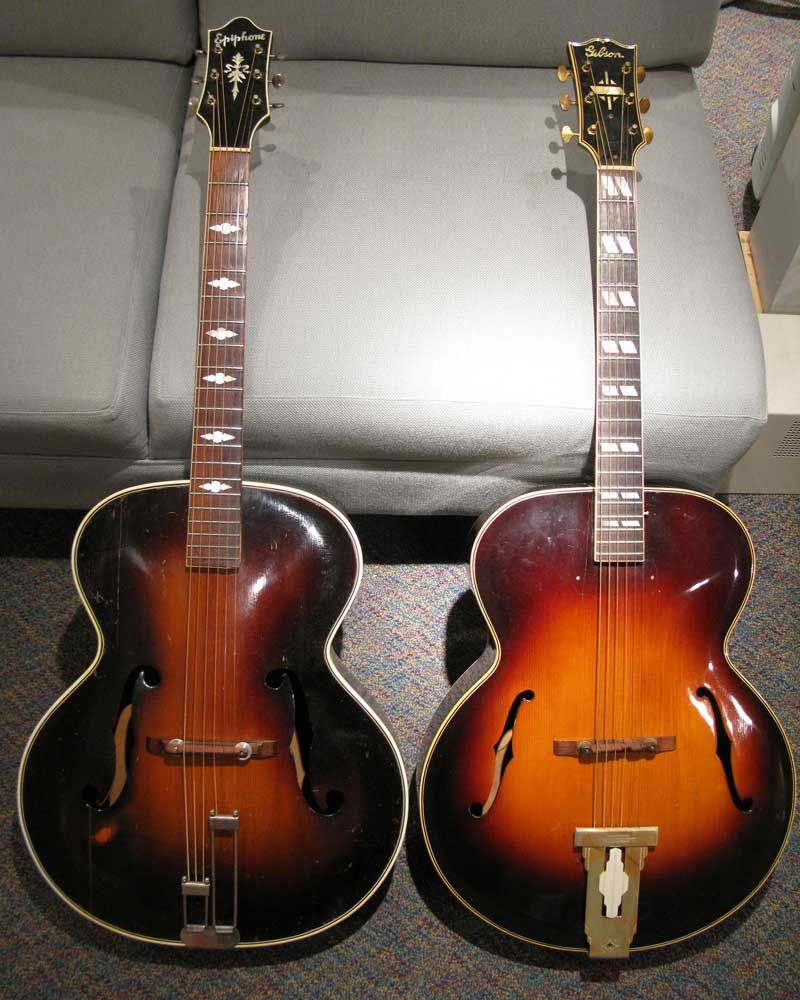
Since guitar threads without pix are useless, here's a shot of a '38 Epi Triumph next to a '38 L-12.
Both wonderful instruments that sound very different from each other:
-
I have AB'd 16 and 17 inch guitars (at one time, when I was single with money, I had a 1934 16 inch L5 and a 1936 L7, and also purchased and returned a late 1930s L4). There was a very noticeable difference in the low end, almost like punching the loudness button on a stereo. Not everybody likes extra low end (not everyone punches the loudness button). In a combo setting, the highs are the most audible, and the 16 inch might find a better spot in the mix. Playing chord melody in your living room, you might appreciate the extra low end of the 17 inch guitar.
One other issue that the L4 reminded me of is the distance from the strings to the top. The prewar L4 strings were closer to the top, which has sonic advantages, but rules out most floating pickups.
-
Cool info. It will keep me thinking! And nice photo Hammertone! I've looked at tons of photos of both guitars, an its really amazing how DIFFERENT they look when together!
-
It's also amazing how DIFFERENT they sound when together.
-
That is a nice photo Hammertone! One thing I noticed was the difference between the F-holes. The Epiphone seems to have larger openings placed higher and closer to the bridge. It is hard to say how much this effects tone but I am pretty sure it plays some role.
-
Here's a thread I can sink my teeth into. Gibson/Epiphone comparison. Oh, boy! I have played a good number of each. In fact, my first mentor had been an Epiphone dealer in the 40s/50s and had a back hall in his store just festooned with old, unsold acoustic and acoustic-electric Epis. For a budding jazzer...whoa! (Meanwhile, my mentor's personal guitar was a late-30s Gibson L-5.)
The sweetest of the old Epiphones was definitely the De Luxe. The other models--i.e., Broadway, Triumph, Zenith, etc.--get more "barky" as you go down the line, IMO. This isn't a bad thing, by any means. If I were shopping for a "swing" guitar that needed to punch three-note, inner-string rhythm chords right through a horn section, I wouldn't even consider an alternative to a good Epiphone. The De Luxe, however, is capable of being both loud, defined AND somehow sweet. A good De Luxe is a suitable alternative to a comparable period Gibson L-5 for making chord melody music, IMO.
The signature differences between Gibson and Epiphone persist right up through the big players: the Super 400 and the Emperor. The Super 400 acoustic is classy and deep. If you think of the L-5 as an operatic tenor, you could think of the 400 as a burnished, operatic baritone. Meanwhile, the Emperor comes off as more of a big-voiced jazz singer. There is beauty there, but there is a bit of a throaty rasp, too. The Emperor has a bottle in its back pocket.
Anyone who treasures archtops as acoustic instruments and can swing it should own both a Gibson and an Epiphone from the golden era.
-
.....That's as good an archtop ' primer' as one can get. Thanks.
....Then, I was curious whether you'd played any new L-5's, and how you feel they compare ? I'm still scratching my head after trying three- - are they sort of quiet ? Did I use the wrong room or ?? I have a '30's L-7, and I may just be spoiled.
Thanks and I enjoy your playing !
-
no disrespect to anyone that owns one, but I've never heard a modern acoustic L-5 that can touch a good vintage one.
-
Each guitar must stand on its own merits. I have played shrill vintage Gibsons and warm vintage Epiphones (and vice-versa).
I have played Triumphs that sound as good as a Deluxe and L-7s that sound as good as an L-5.
The one difference I would point out between Gibson and Epiphone is their necks. Epis have a slight V all the through to the 50's. Gibson stopped the V shape in the 30's. Neither is better, they are just different.
In general, Epis are louder and Gibsons are sweeter. But not always.....
-
Without dissing Gibson's current ability to create one that could (and that's a whole separate issue), I also don't think these modern craftsmen were really going for the same character or a real vintage L-5. As discussed in 10course's thread about his '34 RI, it seems like the builders were probably going for something more like a modern, post-D'Aquisto/Benedetto type of guitar - i.e. sweeter/rounder tone with less projection and volume.
 Originally Posted by wintermoon
Add to that the amazing wood that was widely available 80 years ago, 80 years of aging on that wood, and perhaps 80 years of "breaking in", it'd be hard for any modern construction to match a good vintage L-5.
I've seen many modern built acoustic archtops that have the same lack of real projection. Perhaps the only one I've played that does have a vintage-style projection, at least on the models where that is the goal, is Trenier and his Broadway model.
-
[QUOTE=Greentone;637913 The Emperor has a bottle in its back pocket.[/QUOTE]
Perfect.
-
Jonathan is onto something. I have talked with a couple of the guys building pretty well known modern acoustic archtop guitars. Neither is trying to recreate the golden-era sounds. They are consciously trying to get something closer to a big, crisp, Martin flattop sound out of an archtop. For the most part, I think they are succeeding. This tone is what the younger players expect when they pick up a guitar. They want that G-sus or D with the F# bass to really ring out. Thus, more sustain is expected, right away. More treble crispness, too. Fewer mids and more bass. BUT, with the volume of an archtop. This is clearly NOT what the Stathopoulo brothers were trying to carve into a 40s Epiphone, nor was it what Lloyd Loar was putting into the 20s L-5...well, maybe he WAS, but it was gone by the time the 17" L-5 showed up.
I agree that a Dana Bourgeois archtop, or a Benedetto archtop sounds quite a bit different from a golden-era Gibson or Epiphone. However, I think that they all sound pretty terrific. They are just radically different recipes for the archtop guitar. If I could have only one? Easy: a Loar-signature L-5, of course. (with a mandolin in a Loar-built double case)
-
Bob November (sadly no longer with us) told me years ago that he had two L5s for sale at the same time, a 1934 RI and a real 16 inch L5, both priced at 5K. The RI was shiny new, and the real one wasn't. In his opinion the guitars were not comparable, the real one blew the RI away in terms of sound. But the shiny new RI is the one that sold first.
-
Funny, I did a couple gigs where I've compared both my '35 L-12 and my '32 DeLuxe, and several more where I compared the DeLuxe with my '32 L-5, but never really compared the L-12 and the L-5.
I did a gig last night and brought the L-5 and L-12: https://www.instagram.com/p/BD7PfSbR4Tn/
Of course, it was very interesting to compare and contrast. The 17" x-braced L-12 seemed voiced higher and had a bit more acoustic volume, while the L-5 sounded smoother and clearer. I used my customary clip on mic, and switched between them every couple of tunes. Sadly, I didn't bring my own monitor, and the sound guy disappeared half way through the gig, so I was playing mostly acoustic for much of the gig. When I used the L-12 I had a bit more acoustic volume, but it was a bit quackier. Switching to the L-5, the volume dipped a bit, but the tone was great. It still managed to cut through, but I didn't have as much room to spare.
Still, it was fascinating to go back and forth.
-
Sorry if this has been asked - -but have you settled in on any particular strings ?? Originally Posted by campusfive
Thanks and I appreciate your input ! And enjoy your playing !
-
I keep bouncing back and forth from Martin SP 80/20's and Martin Retro's. All of the guitars seem to vastly prefer 12's, but I've been leaving a 14/18 combo on the high E and B regardless.
You can often just throw on a set of heavier strings or lighter strings, and either it won't really change the way it plays, or the neck will automatically respond to the tension change with a corresponding change in relief. However, I'm finding that I think some of the guitars would need to be set up completely to properly accommodate a heavier set. I threw 13's (keeping the 14/18 on top) on Epi, and it just felt too "hard" - but I realized after I changed back that I think the nut slots wouldn't accommodate the larger diameter strings, and so they sat a bit above where the should've been. The minuscule change at the nut just made the action unpleasantly high over much of the neck. Not enough to be obviously cartoonish, but just enough to feel hard to play. Given that pre-'37 Epi's don't have adjustable truss rods, you have to really nail the nut slot height as well as the bridge height.
-
Thanks ! Originally Posted by campusfive


 Reply With Quote


What is it?!? Why am I still at it?!?
Today, 04:53 AM in Everything Else