


-
how exciting. can't wait to see 'em.
 Originally Posted by nickyboy
thanks very much. That's an intentional tight framing on the Benedetto for a specific publication, and it is quite ok to not show the entire subject in this style of photography. Originally Posted by ArchtopHeaven
I shoot Pentax, mostly an older K-5(crop sensor) for onsite work (events, assignment, portraits, etc) and then I have the Pentax 645D(5yo model) medium format that I use for my landscape photography. #1 was the 645D with 105mm lens. #2 was the K5 with a 90mm macro lens, #3 was K5 with a $40 Russian Helios 58mm lens, #4 the K5 with a 31mm prime.
-
07-16-2015 11:49 AM

-
Thanks a lot for sharing that information. Some of it went over my head because unfortunately Im am still a real beginner. I have seen people use test cards and talk about white balance but its not something I understand yet or can use but I want to as I know its the right way to go. Originally Posted by Jonathan Levin
I understand highlights as you say and you will probably notice on the shot of the 175 that on the right of the body by the pots, you will see a small reflective white patch. This is a reflective screen I use to deflect light back on the top and sides as my 'key light' is only what comes in through the french doors to the left.
I have been watching portrait photography on youtube and have a basic understanding of of lights and how to use them. I want to use soft boxes and have main light and a fill light at opting angles so I can bring out the arch more on both sides. I also want to use a backlight (I forget what they are called) as this also helps create a separation between the guitar and its background (plus with shallow depth of field).
In regards to editing, I wouldn't say that I do any touching up there is not brush used or areas targeted for enhancement. I simply add a bit odd colour to bring the picture to life, a bit of clarity enhancement and sharpening. Maybe a little contrast but thats it.
The picture cant lie but that doesn't mean it cant be made to look as good as possible if you know what I mean
BTW I have that book from bob so have been enjoying your pictures for some years.
Thanks :-)
-
One thing I forgot to add: Don't shoot with any lens that is wider than 80mm (35mm film camera equivilant). It will make your guitars look like they a gastric reflux disease.
MikeSF maybe you are Mike Oria. So old. So confused....
-
yes, that's me. And don't fret, you're not as old as you'll be tomorrow...lol Originally Posted by Jonathan Levin
my website is: www.mikeoria.comLast edited by mikeSF; 07-16-2015 at 12:56 PM.
-
Just amazed you guys are taking the time to share your knowledge on the subject.
To both Mark and Mike, we owe you a huge thanks and if either of you are over in England, free board and lodging awaits (although I will pick your brains to death :-)))
-
Great stuff Mike. Bob Benedetto does make for a great subject doesn't he?
I almost like the bass picture with the reflections better than the one without. Maybe a compromise of the two. Has more depth. My clients would be up my ass with that, but it's just me, and my taste is better than theirs.
Did a polarizer do anything for you on this???
Jonathan
-
Lotta wisdom here from people who know.
I lurk on The Les Paul Forum. One of the owners, Charlie Daughtry, is justly renowned for his guitar photography. Check this recent thread if you're looking for examples or inspiration. If I get it right, CD's strong preference is clear, strong sunlight, outdoors, on a black velvet cloth.
I'm just a hack with a phone, but since people are putting up pics y'all can poke fun at my most recent NGD, a 1962 ES-330. This is how you do it wrong:
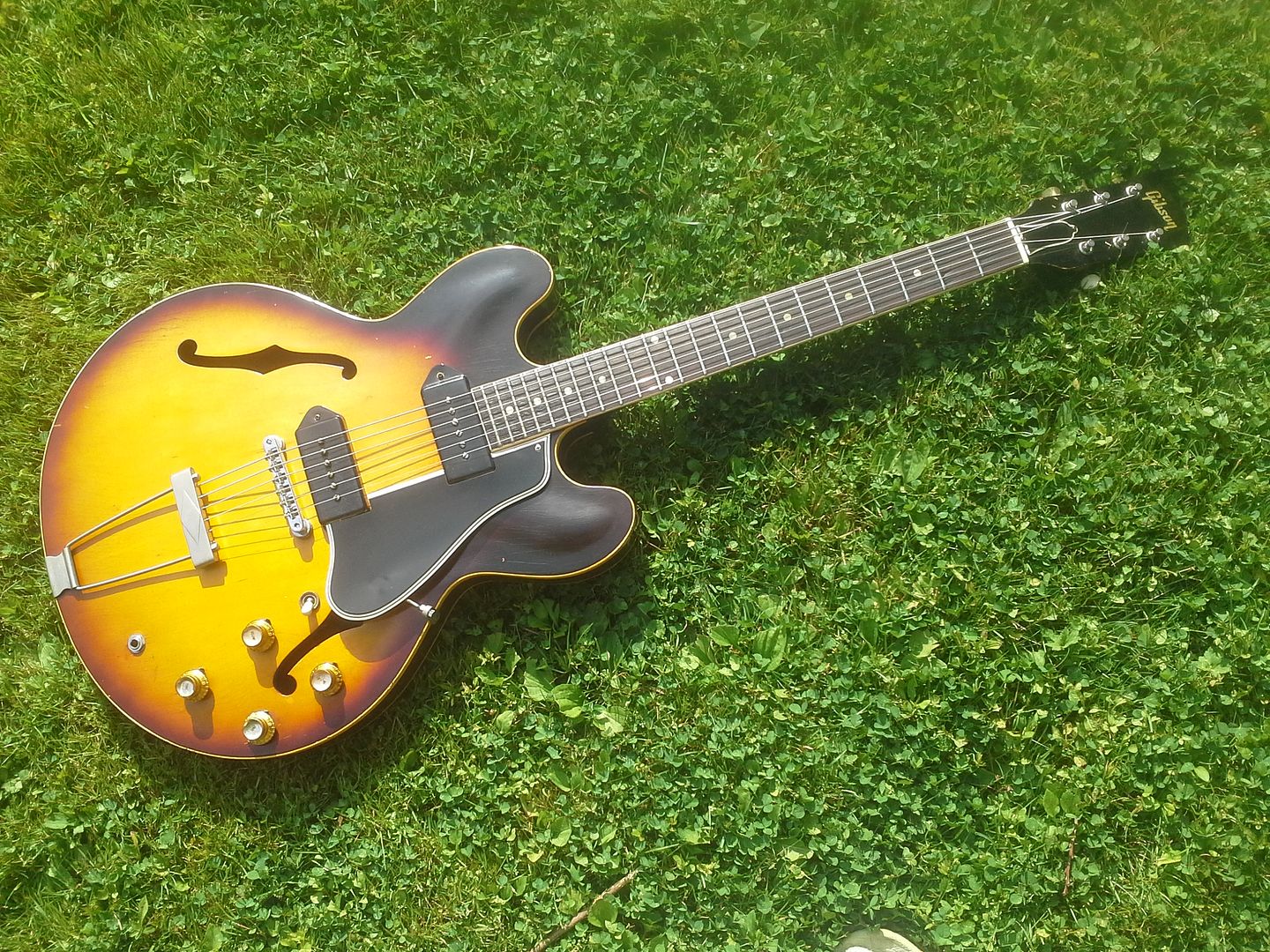
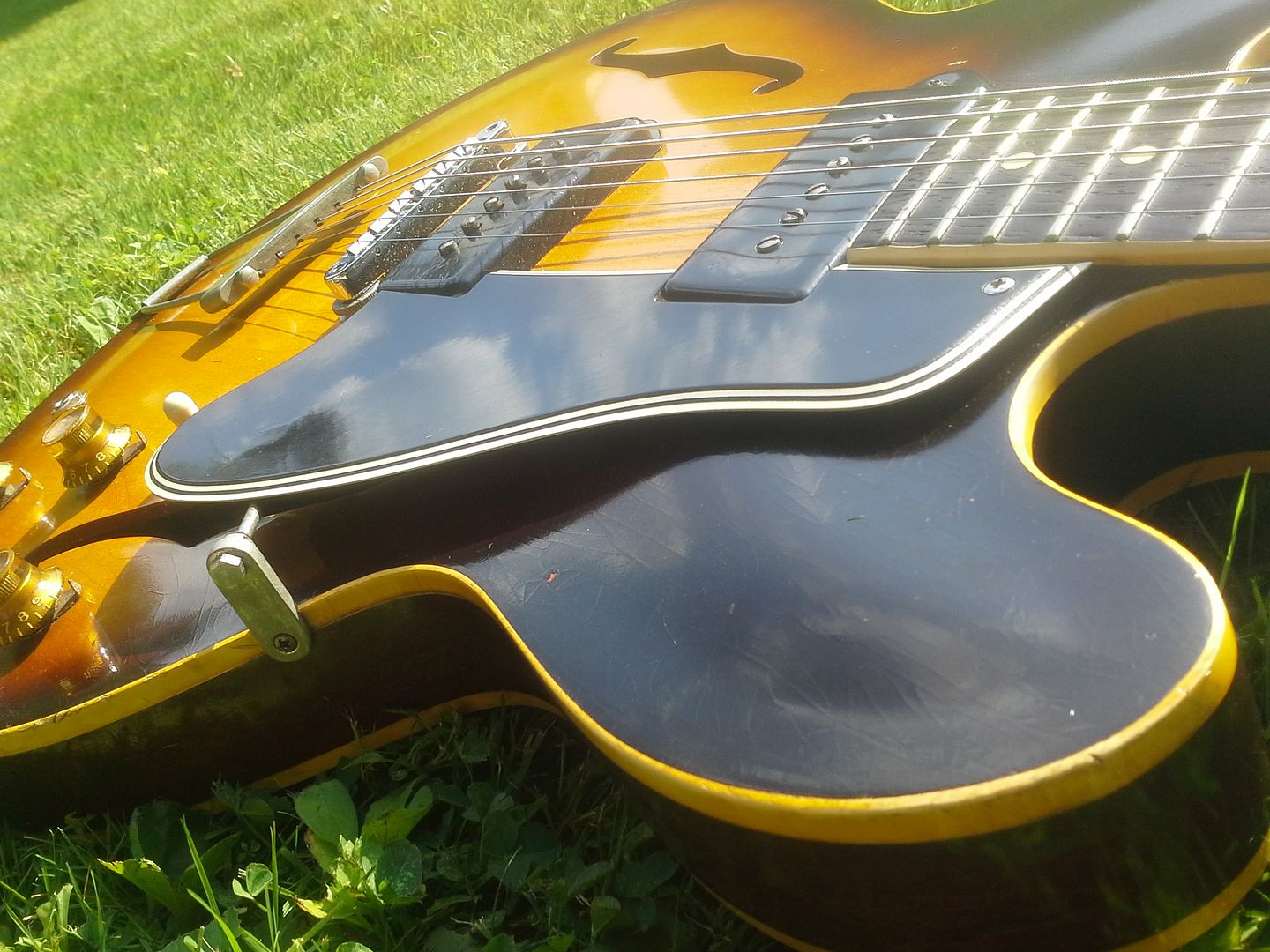
-
thanks and great suggestion to blend both for a mix. This is old and the record is in stores, lol, so I will definitely remember that for next time. That before shot was with the polarizer, btw. I do very often use a polarizer for cars and guitars (aka guitars and cadillacs). Originally Posted by Jonathan Levin
-
If anyone has had it with Adobe, there is a great new software that is really going to give them a run for their money.
For $40.00US, it seems unbelievable. The same company is working a vector program that is supposed to be much more like the intuitive but now defunct Macromedia Freehand. Adobe Illustrator is one of the most unpleasant work environments I've come accross since anything Microsoft.
Check out he image editing app:
https://affinity.serif.com/en-us/photo/
Cheers.
Jonathan
-
ha, he does indeed. Originally Posted by Jonathan Levin
A few random Benedetto pics:
 Headstock and X-mas Lights
I used a large aperture lens(f/1.2)which makes big circles out of the distant Christmas tree lights. Guitar was in complete darkness, light painted with a flashlight.

Living room grab in front of a large black fireplace screen. Window light situated to pop the gold logo.

It's amazing what you might find on the ground at the Healdsburg luthier's show. On camera flash.

My guitar in front of the Christmas tree. Dreamy f/1.2 bokeh effect. window light.Last edited by mikeSF; 07-16-2015 at 02:47 PM.
-
2b strongly agrees with JL on "highlight" reflections yielding positive results. A couple years ago I stumbled upon it and I've purposely gone for them ever since. Glare seems to add a creamy dimension that I like that lures the eye around the subject.
thanks AH for the thread. Since yesterday I've been knee deep in the Fuji X series. I'm leaning towards an X100 limited. Some suggest they prefer the it to the X100S. Thanks for turning me onto the mirror less generation. Many of them are pricer than my Nikon D7000 with 2 lenses kit was. Amazing.


Last edited by 2bornot2bop; 07-16-2015 at 04:50 PM.
-
Okay, so thanks for the inspiration of this thread to encourage 2b to begin the journey.
I'm starting the journey at David Hobby's, aka "strobist", website and "lighting 101." If it's been good enough for 4 million others who am I to question
Strobist: Lighting 101
-
Okay, 2b has an "off camera" flash question for you pro's in the audience.
What's the difference between using an off camera flash synched to your camera as it rests on a flash stand-umbrella setup...

versus not using a flash at all, but instead using diffuser lighting that can be easily placed in the precise location one desires to bounce light onto their subject? In other words, for indoor studio work, is it mandatory to have a flash, or does the flash provide one options that studio diffuser lighting does not? Or, does the photographer benefit from having both in a studio shoot?

-
2b, if i am understanding the question correctly, you are asking pros/cons of using a flash(such as a speedlight), vs a studio strobe, right? The diffusing devices(aka modifiers) such as a softbox or an umbrella are interchangeable no matter what light source you use.
I use battery powered flash with radio triggers, usually attached to softboxes, for a quick setup portrait or to light an interior. I find that rig very portable and not as intrusive if i am down in a tight area such as a wine cave, etc.
The larger strobe and continuous lighting solutions are typically more durable, more consistent, expensive. Have a heavy battery pack or require AC. more powerful. These are excellent in studio where you don't have to break it all down often. However, many photogs will bring a whole rig out on the job too for the benefits listed, so it depends on personal preference. Also, a continuous or modeling light allows you to see how your shadows are falling and allow easier adjustment vs snapping the flash while taking a pic and then reviewing. There are pros and cons of each.Last edited by mikeSF; 07-16-2015 at 07:28 PM.
-
Thank you for the response Mike. My first instinct was, controlled light, whether flash or continuous light via a softbox is still projecting light exactly where you direct it...just as an off camera flash setup would be directed to do. Originally Posted by mikeSF
That said, is it preferred to bounce light from a softbox light source to a backdrop that then is directed to your subject? Or, is there commonly enough glare reduction from the light within the softbox itself that one can aim the light directly at a guitar, such as the flash-umbrella setup where the umbrella is pointing directly at the young girl above? Perhaps it's all about experimentation to determine the preferred lighting effect one desires on their subject, guitars or otherwise? I'm just thinking out loud...thanks for your time!
-
Having fiddled around with taking photos since the days of the Polaroid Swinger....google it AH...and then onto something by Yashica...what ever happened to them?....anyone whose had an interest in photography over decades will enjoy this read "a camera walks into a bar."
Fuji x100s Review :: A Camera Walks Into A Bar ? Photography By Zack Arias ? ATL ? 404-939-2263 ? [email protected]
-
Im just about to grab a pair of Gemini 500's set of two for a Main and fill light. I want to use soft boxes and I saw that the closer you can get them to the subject, the softer the lighting is, which almost sounds counter intuitive.
Mike I'm loving your work.
-
a softbox is plenty soft all by itself. In fact, they often build a removable layer(or two) into the softbox that can be peeled away to attenuate the effect. Originally Posted by 2bornot2bop
re-reading your question, are you clear that the light sources are independent of the light modifiers? a flash or a studio strobe can be used with any umbrella or soft box or grid panel or scrim/gobo, etc. You would first decide what light source to use and then choose what to aim it through.
archtopheaven, the the closer the light source/modifier is to the subject, the more dispersed the shadows will be.Last edited by mikeSF; 07-17-2015 at 04:41 AM.
-
My preferred lighting for photography is outside on a very overcast day. Lot of bright reflection free diffuse lighting. I actually love photos taken in the rain however I suspect not too many are going to want to take guitar photos in the rain. I just love those saturated colors you get in the rain. I have never liked photos taken outdoors on a bright sunny day.
Danielle
-
I'll have to think about it. What will you use it for? Guitar shots? Travel? Family / party situations? What is most important: portability, quality, manual control? Originally Posted by 2bornot2bop
Funny enough I went through a similar (months long) search and ended up with a Panasonic GM5. I wanted to balance a travel camera with one that could shoot "pro"—manual controls, hot shoe, viewfinder. To me, it's a good combo of a snapshot camera for around the house and travel, but also plenty of control for studio stuff. Right now you can get them new for around $510—including a decent kit lens—with the price dropping every month from Amazon Warehouse Deals. This gives you the benefit of m43 lens selection too. I guess that would be my initial reco without knowing what you want to do. The Olympus OMD would also be a great contender, with even more focus on traditional film camera ergonomics, though I've not used it. I opted for the Panasonic for size reasons (so tiny) and my great experience with other Panasonic m43. I plan to get the Olympus 25mm f1.8 as an all around fast lens.
At double your budget I'm huge fan of the Fuji X100 series (now on 3rd revision, X100T). You are stuck with a 23mm lens (35mm equivalent after 1.5x crop factor) but they sell a telephoto attachment which gives you 50mm. Not as versatile but I loved taking pictures with it. It's very simple with real dials for aperture & shutter and the photo quality was fantastic. There are a few studio pros that use this for their work and you can find them talking on youtube about it (or blogging).
Thanks to Mike and Jonathan for all the great info and of course great photos.
@Jonathan Levin, I live / work about 10mins away from your studio in Belmont Cragin (Logan Square's Iowa). Next time you need someone to hold up a D'Angelico, or when Bob Benedetto wants to trade a guitar for graphic design services, you just give me a call.
Last edited by spiral; 07-20-2015 at 10:23 AM.
-
Honestly, there are so many good cameras out there for so little $$$, it's amazing. Really, you don't have to spend much to take good photos. Money is not going to buy imagination.
Don't get caught up in all the equipment mania. I've been doing some really creative stuff with my beloved IPhone 5S, both still and video of some guitar stuff. It all depends on what you WANT to do.
This of it like this: you don't need a 60000.00 D'Aquisto to play well. Crap, Charlie Parker played some concert where I heard that he used a plastic saxophone!
Spiral, give me a holler sometime and we'll drink 10-20 beers or something....
Jonathan
-
The problem i have and why I haven't pulled the trigger on a new Mirror-less is because I want one that does Great stills and video.
The Sony A6000 is currently the best option but I will leave to buy a prime lens for it as a zoom from Sigma would be nearly twice the price of the camera. The sigma E-mount zoom is for Sony E-mount camera (incl A series).
So yeh I might bite the bullet and get the sony with one prime lens for now.
Would Prime lens do you think I should get for my type of shots at the moment.
-
I did find a very sturdy guitar stand. It's made from redwood...


-
Yes. He used a UK made Grafton plastic alto at the Massey Hall concert in 1953 (with Dizzy, Bud Powell, Mingus and Roach - great music, still available on CD). According to Red Rodney, who was Parkers usual trumpeter at that time, it was presented to Parker from the Grafton company in the hope that his playing it would boost sales. He used it for a while on gigs but eventually went back to his custom made King Super 20. Ornette Coleman also used a plastic Grafton for years. Later he switched to a Selmer metal sax but had it laquered white to simulate the white Grafton which had become his trademark. Those Grafton saxes was never popular with repairmen. Even the posts holding the key axels were made of brittle plastic and they were a nightmare to repair if they broke. Many repairmen refused to touch them. I guess only a few have survived. One of them - Birds sample in fact - were sold for a big sum at a UK auction some years ago. The sale was likely commisioned by Parkers widow Chan (who lived for decades in France) or her daughter Kim. Originally Posted by Jonathan Levin
BTW, are you the Jonathan Levin who shot the (great) photos in Bob Benedettos book back in the 1990s. I bought the book in 1995 and learned a lot about archtops from it. A few years later I ordered a Fratello from Bob which I still have. They were more affordable back then.Last edited by oldane; 07-18-2015 at 04:36 PM.
-
Get a stand alone video camera on the cheap...or is this simply a generational thing to want one item to do it all?...I pulled the trigger on the Fuji X100T...I had to see what all the fuss was about with this rangefinder and it's about as good a place to begin as any. Originally Posted by ArchtopHeaven


 Reply With Quote


Got some picking exercises?
Today, 01:17 PM in Guitar Technique