


-
Lot of trouble to post all that Jazzbow.. thanks.
-
01-06-2015 05:51 PM

-
I had a free hour and green tea. My posts are more informative with green tea, with coffee I ramble on!
 Originally Posted by Spook410
I have loads of pics, this was the most recent refurb....
Major bellying of Ibanez electro acoustic presents massive string action.
Steam iron on full steam into sound hole. Weights placed onto bridge once internals are rehydrated. Ply construction and not a prissy high maintenance hand carved spruce top means you can be a bit brutal.
Reworking the bridge so as to ramp strings to lowered saddle. Notice the dried out colour on the 'wings' of the bridge against the planed fresh wood of the saddle section. There is a reason for this which I shall explain later.
That's phosphor bronze 12's with a low action, nice.
And the finished saddle. Note the string ramping for correct break angle over the saddle.
After gluing the few fret ends down and dressing the frets its time to polish the frets by hand and at the same time hydrating the fingerboard. Jazzbow uses and recommends GORGAMYTE for this (I am not affiliated in any way).
I buy old cutlery from thrift/junk/charity shops for the bone handles. You gotta find the right materials for refurbing where you can!
Old bone fork handle (Fork handles? nah, Four candles (old British joke on English language)).
Finished nut and still retaining the handle curve!
Anyhoo, why was this guitar so dehydrated? here's the story.
This Ibanez was taken to a hot dry war zone some years ago. As space on air transport is at a premium it never came back to the UK. Instead it was passed onto guitar playing soldiers starting their 6 month tour with the proviso that it was passed on to the new influx of soldiers. Eventually when everyone finally came home the present owner managed to bring it back and it eventually came to me.
I think it was there for about 5 years, 5 years of air conditioning then no air conditioning. Sweat, tears, intense emotions and finally peace. Knowing that I find inner joy and cessation of turmoil when I sit down and play any guitar I would like to think someone has had that pleasure with this guitar.
There is a barely legible name and rank written on the back but that's just for me to know.
I will not divulge any other information on this other than it was a 'no charge'.
I believe the phrase is 'A-ten-hut!'
-
Nervous? Aren't we all?
I've had 3 re-frets on most favorite guitars. Same guy, always different. I just assume that that's the way it is, like when buying an instrument. And one more by a different guy.
Being a carpenter, I understand that no two jobs can be the same. And picky I am !!!!!
Good communication is ALWAYS good insurance. And lessons will be learned.
But hey, it's only a guitar, wood and metal, easier than being a surgeon!
I say this because I usually don't like what comes back after a fret job. And i use the best guy!!!!
I get used to the low frets way before the fret job. I like the feel and the tone. My favorite guitars to play all had very low (worn) frets, and they had the best tone, lots woodiness and groove. Yes, there were problems with buzzing and fingering.
After new frets - tone was usually more metallic, and less groovy. YMMV
So, when I need new frets, they will be as low as possible
-
Which guitars did you have refretted, and what was the point in which you determined it was time to take in to have the work done? Originally Posted by Jimmy Mack
In my case, the frets have gotten so low and deformed that playability has become a problem, and there is significant buzzing in spots where leveling and dressing is no longer advisable.
-
Out of curiosity, how would the size of a fret impact the tone?
-
So well over a year has passed since my last post in this thread, and while I intended to have my old Epiphone Triumph refretted ages ago, I finally got round to it a few weeks ago. As noted, I went with the Evo Jescar frets and the results are excellent. Playability is better than ever, the tone is consistently good up and down the neck, and the frets look great.
Something I noticed about the Jescar Evo frets that I was pleasantly surprised by was that the bright gold color that they give off when new fades to a far more subtle vintage look once polished. I doubt that many would look at the frets and assume they were something other than the standard nickle composites.
-
It just sounds to me like a "parts and labor" differentiation. Not like he doesn't have fret wire, he's just having the customer buy the parts direct. Originally Posted by Eddie Lang
-
Congratulations on your refret, Klatu.
I've got Evo Gold Jescars on two gits & and am saving to do more.
I chose .055" (maybe .090" wide?) and I love the feel. This can be troublesome
regarding intonation, especially with the very lightest strings I am obliged to use.
So many things go into making a guitar easy or difficult to play.
I'm still learning about this and no two guitars are similar.
-
Cool. I was looking at the frets you chose but went with the .104x.047 because they were the closest to what I am familiar with in my Heritage guitars.
-
I have had two refrets done on 1940s Gibsons in the past several years. Both times I specified stew mac 155s (.080 width and .050 height), after a lot of Internet research. These are probably classed in the "medium" range, and I think are a good choice for a vintage Gibson. Refrets are about $250 down here, and I supplied the fretwire each time (I would not expect the luthier to have every kind of fret wire in stock). Very pleased both times.
-
Originally Posted by Klatu
Hi Klatu,
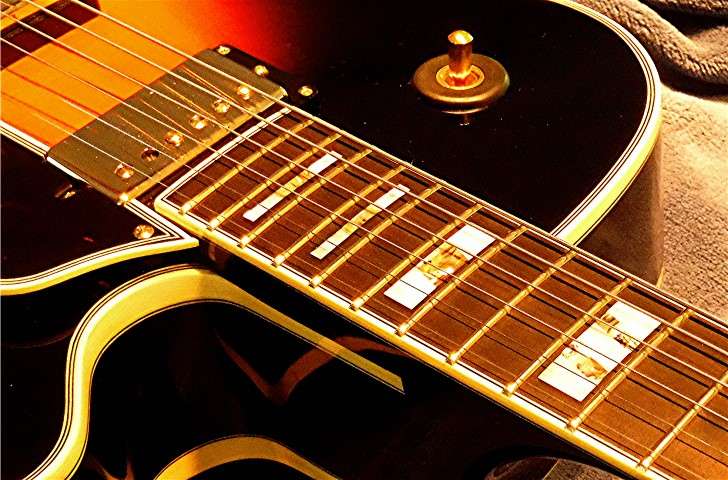
About the same time you began this thread (which I just noticed today), I had one of my guitars completely refretted with Evo gold (copper alloy) fretwire (.047" X .104"). The way the frets match the gold hardware is pretty awesome.
The project turned out great (Ibanez AF200) and was fussed over with Paul Reed Smith-like attention. The wire is harder that nickel/silver, but softer than stainless as you pointed out. It is my favorite fretwire, however the project cost a bit over $300.00. It plays about the best of any guitar I have owned. I have the same fretwire on a Warmoth Mooncaster. Please pardon the pool table lighting in photo:
-
Are you kidding? I'm jealous of your pool table! Looks good, by the way.



 Reply With Quote


Interesting Acoustic-Electric 7-String
Yesterday, 06:32 PM in Guitar, Amps & Gizmos