


-
Some of my guitars are much more stable than others when it comes to staying in tune. I can come back to some guitars after a month of not playing them and they are spot on. Others constantly drift. The one I'm playing a lot currently (Yunzhi, carved, reasonably well set up) is not only hard to get where it needs to be in the first place but then it wants to move about. Seems I'm constantly tuning it. Gotoh tuners (not loose), the nut is not binding, the intonation is pretty close (using a clip on and pedal Peterson strobotuners) and the strings are neither very new or very old. Right now strung with Newtone archtop's but this guitar has done the same thing with round wound TI's (.012).
So.. what are the characteristics that make some guitars rock solid and others a pain when it comes to tuning stability? Would like to fix it but kind of out of ideas.
-
12-16-2025 05:11 AM

-
The stability of the woods in how they react with environmental changes can be one of the things that has a big impact on tuning stability. I’ve experienced guitars that can sit for months or experience temperature and humidity changes with essentially no disruption in tuning. Others may shift and go out of tune with only the very slightest changes in temperature or humidity.
Some are also more susceptible to movement with small changes in string tension. Those can be harder to get all strings to hit their respective target frequencies so that they are all in tune at once.
Sent from my iPhone using Tapatalk
-
I find that temperature and humidity changes affect the tuning. Ebony fretboards seem to be affected more than some other woods by humidity. As the ebony absorbs moisture it expands, and the tuning can go sharp, and vice versa as the humidity drops. Temperature seems to affect the strings more than the wood, and I've seen tuning change after starting with relatively cold strings and then having them warm up from my hands and the energy absorbed from vibration. This is greater in the winter, because the house is colder, and if I tune before playing, the tuning can go a little flat as the strings stretch microscopically. If the guitar has been out in the cold and is colder than room temperature, the tuning will change to a greater degree. All I know to do is play for awhile without tuning and let everything come to temp, then tune. Or else tune and retune. All that said, I think some necks are just more stable than others.
-
I've wondered the same thing. My Yamaha cheapie Strat type stays in tune all year. My Comins GCS-1 requires some minor adjustment every time I check tuning, which I do a lot.
First thing I thought of was binding/sticking in the slots, nut and/or bridge. Tried nut sauce. Took it to a luthier. Slots seemed ok. No ping sounds.
Next I thought about the bridge wobbling a tiny bit on the posts. The Strat type bridge doesn't sit on posts, but the Comins' bridge does, like a Gibson tuneamatic. So I shimmed the bridge posts and got a tight fit. It's hard to move the bridge even by pressing on it. No improvement in tuning stability resulted.
Then I thought about the stop tailpiece. I had it screwed upwards to reduce breakover angle at the bridge. It could be moved with finger pressure. So, I screwed it down all the way and threaded the strings over the top of the tailpiece. Now rock solid. No improvement in tuning stability.
Strings attached to tuners? Current set was put on by a luthier. No change in tuning stability. Tuners slipping? Is that even a thing? I thought that worm gears were highly resistant to slippage. I don't know how to tell.
And, that brings me to unstable wood. Is it? I don't think it's temperature because it changes a lot faster than the temp in the room. But, something is unstable.
Overall, I have not yet solved the problem.
-
There are some astute replies in this thread, diagrams get extra points from me: Quora.com thread
From: Paul Gobat, former owner and head builder of Mirage Guitar Works LLC,
This was a main design concern on my guitars and it directly figured into my headstock.
In short, the straighter a string can remain from bridge to tuner and the better the angle of the headstock matching the natural flex of the strings the better it will stay in tune.
Once you get weird slot angles in the nut and start forcing strings with things like string trees your guitar will have increasing problems keeping things in tune. To try and eliminate the problem there have been many solutions that didn’t (or don’t) work well… things like locking nuts or headless versions or… you get my idea.
-
Not sure why but my Holdsworth Headless guitars with the older JCustom Steinberger type of bridge and head piece stay in tune the best of any guitars I’ve ever owned.
And that’s with regular guitar strings as well as double ball ones.
-
"Natural flex of the strings". Can anyone explain what that refers to?
 Originally Posted by Mick-7
And, is the problem that the angled strings create a tension point within the nut that strings bind on?
On my Comins, the G and D strings are angled much more than the others, but the tuning stability problem affects all the strings.
-
The more acute the angle of the string from the nut, the more difficult the tuning is, because the strings bind at the point of the bend. One fix is the String Butler: Just a moment.... It brings the strings through the nut in parallel, and then bends them afterward, around a bearing, which presents much less friction than a standard nut. I have a couple on different guitars, and I like them. Better is having a sensible headstock design which tapers toward the end instead of flaring. That perhaps doesn't look as cool, but it works better. Another factor is that with most string sets the D and G strings have higher tension than the outer strings, and thus there is even more friction when they flare widely. The guitars I play most often have tapered headstocks, thus relatively straight string pulls. But I don't decide to buy or not buy a guitar based solely on the headstock. There are ways to mitigate almost everything.
-
Archtop guitars with "Big Fat Maple Necks" have better tuning stability in my experience. (Obviously, with good build quality neck/body.)
With any custom builds, I'll ask for a "Big Fat Maple Neck".
On the solid body guitars, headless guitars have had better tuning stability, IMHO. (Again obviously, with good build quality neck/body.)
This is my experience, after owning a quite a few guitars.
Edit: Truss rod types?Last edited by GuyBoden; 12-19-2025 at 06:24 AM.
-
Interesting, it has good reviews but I would not want to put screws in my guitars headstocks. Originally Posted by sgosnell
-
You don't put screws in the headstock. The String Butler uses the existing hardware to hold it in place. You just loosen the nuts holding the bushings in place, slide the Butler underneath, and re-tighten. The worst part of installation/removal is that the strings have to be removed/reinstalled, but that's not such a huge deal to me. I'm not sure if the device is usable when the tuners have press-fit bushings. Originally Posted by Mick-7
-
I was looking at a version that suggested screws were involved, must be the truss rod cover version, turns out they make 5 different versions of it -- The String Butler Model Guide - Laplace LLC Originally Posted by sgosnell
-
They do make different versions for different guitars. The fact that there is no standard for headstocks complicates the situation exponentially. I hadn't seen the V1 model before, but it appears to be an ingenious solution for tuners with press-fit bushings. It looks like the existing trussrod cover screws would hold it in place, but I don't really know enough about that version to say. I have the original versions from several years ago.
-
Originally Posted by Mick-7
I found the above fascinating and in direct contrast to Heritage’s headstock design philosophy of straight line string placement.
-
For tuning stability, I've found the Headless system to be the best.
But, it wouldn't look very good on my archtops.
-
The guitars that have crappy tuning stability are the same ones I do not keep. Bye bye.
-
Isn't your Yunzhi a newly made guitar that is raw wood? Could be a mix of settling and environmental changes getting to it.
Or maybe I'm thinking of someone else who's got a new 18" archtop.
-
Are we talking staying in concert pitch or staying in tune with itself?
Ive never had a guitar that stays in concert pitch. Every night when it cools off My guitar shifts. The direction all depends on when I tuned it to pitch last. If it was late at night its sharp in the morning...but still generally in tune with itself. Stuff moves and there is a limited amount one can do about it.
I really never give it much thought. Its so easy in these high tech days to tune up to pitch. Its not like the days of really expensive turners or forks.
-
Yes, I do have a new 18inch Yunzhi. I asked for a "Big Fat Maple Neck" when it was built and there is no tuning stability issues. Originally Posted by AllanAllen
But, many thin necked guitar I've owned in the past have had tuning stability issues.
My latest acquisition is a blonde1959 Hofner Committtee, with a "Big Fat Maple Neck" that has no tuning issues whatsoever.
Today, I've temp installed a DeArmond pickup today. (It's just a temp install using Blu-Tack, to hear the sound)
A beautiful blonde Hofner.
-
Great guitar!
I love the cheater dearmond setting on my Armstrong single coil.
I dont know how close it is but I like the vibe and claraity.
I bet it sounds great!
-
I have the Armstrong P90 with coil tap, but on another archtop. A good pickup. Originally Posted by Sigmund451

The DeArmond Rhythm Chief 1000 Pickup is noisier than the Armstrong P90.
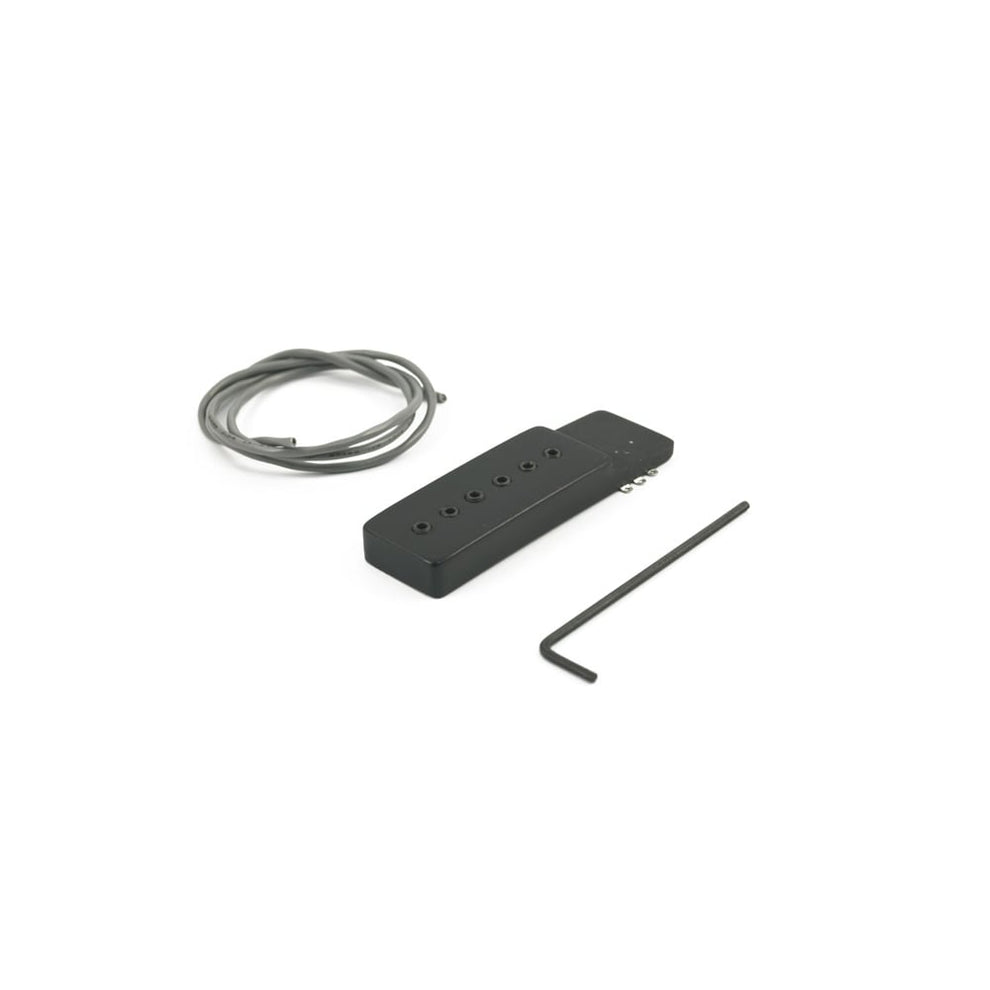

Last edited by GuyBoden; 12-19-2025 at 12:36 PM.
-
I like it too. Im just curious, how close does the tapped setting come to a legit Dearmond?
It doesnt matter becuase Im not changing it...just curious.
I really like how it is so clear and yet you can dial in some weight to the tones. I enjoy that setting for a chord melody. Id probably use the full p90 effect for things with more single note runs. Chords dont get muddy with the P90 but if you start using a lot of bigger chords it overwhelms a little.
-
This old Washburn acoustic-electric guitar stays in tune for months in it's case, I'm talking no pitch variance at all, it's truly remarkable. Originally Posted by Sigmund451
Specs are: Laminate Spruce Top/Mahogany Back and Sides, Mahogany Neck with Rosewood Fingerboard. Good headstock design, and maybe the set bridge plays a big part in it?
-
Originally Posted by GuyBoden
Ah, okay, I had my forum members mixed up then. Glad to hear your Yunzhi is working out.
Any more pictures of the blu-tack install? I think I'm going to try a DeArmond on my Eastman.
-
Here, it's simple, very easy, just put Blu-Tac underneath, put the pickup into position and press down. Originally Posted by AllanAllen
I needed to angle the Bass side away from the strings and the treble strings are nearer the strings. (Because, the DeArmond Rhythm Chief 1000 has no pole pieces.)
So, there's more Blu-tac on the treble side. (It all can be adjusted afterwards.)
See previous Forum posts:
Fitting a DeArmond Rhythm Chief parallel to a neck HB
Rhythm chief 1000 without a pickguard
My DeArmond 1000 reissue has 14-.8K resistance. (It's not the only thing that make a pickup sound character, but interesting to know.)
14.8K is very high for a single coil pickup (IMHO), I think that the post below is very, very interesting:
Dearmon Rhythm Chief 1100 Reissue, low output?
Originally Posted by ThatRhythmMan
Originally Posted by ThatRhythmMan
Last edited by GuyBoden; 12-20-2025 at 06:54 AM.



 Reply With Quote


Interesting Acoustic-Electric 7-String
Yesterday, 06:32 PM in Guitar, Amps & Gizmos