


-
I don't think they're sealed, but the owner can correct me if I'm wrong. It looks to me like the backs ae foil wrapped, which is a common attempt to minimize RFI. My Ibanez AF207 came with foil wrapped completely around each pot, tucked under the contacts (insulated from them with tape) and firmly taped around the base of the shaft, to make sure it's grounded.
 Originally Posted by stevo58
I also don't think they're sealed. There's almost certainly no seal between the top plate and the metal piece that runs across it and down the side, and there are 6 holes in the top. Three are holding the contacts and the other 3 are open (red arrows). Truly sealed pots are great because they keep dust, debris, and moisture out. But unless they're air and water tight, enough moisture gets in over time to enable corrosion of the conductive elements, which causes the scratchy noise we all know so well when adjusting them. The advantage of pots with exposed openings is that you can spray contact cleaner into them before turning the shafts back and forth a number of times to clear the corrosion and eliminate the noise. A lot of so-called sealed pots aren't air tight but lack any openings into which you can spray cleaner (and through which it can get out again). While I agree completely with BBGuitar that this is not the best practice, it's the only way to solve the noisy pot problem when the gig is in an hour and you don't have time to replace the pot. And if it solves the problem for a year, I'm fine with it. FWIW, the pots we had when I was a kid were easily disassembled and cleaned - but those days are long gone, and you can't do that with the pots that come in modern guitars.
I'm pretty sure that's aluminum foil wrapped around the back of this pot:
I agree completely with BBGuitar:
Originally Posted by BBGuitar
-
07-16-2025 12:44 PM

-
I think it's possible to hear tonal differences between capacitors, because the tolerance is usually fairly large, up to 10%, so even if they're both within tolerance, that allows up to 20% difference between actual values. The sound difference is not because of the material they're made of, it's because they have different actual values. Older (and even newer) capacitors may well have drifted out of tolerance to a greater or lesser extent, and that certainly affects the sound.
-
As for cables, George L sells thicker cables. I have some of both diameters. I can't tell any difference in sound between the .155" and .225" cables, but there is a definite difference in pliability. The thicker cable is much stiffer, no surprise there, and harder to deal with in almost every way. I bought some of the thicker cable just to try it out, and have mostly cut it up to use as shorter cables to connect devices. I only use the .155" for instrument cable, because it works better for me - easy to loop, flexible, light, and still reliable. I've been using George L cable for decades, and wouldn't consider anything else, but everyone votes with their pocketbooks. For me, George L cable and Neutrik plugs are what I buy and use. I use the Neutrik silent plugs, usually a 90 degree, on one end of every guitar cable I make, standard plug on the other end, and I've never had one fail. Not the cable, nor the plug. And the tone is the best I've heard from any cable, and I've heard a lot of cables in my lifetime.
-
I thought the controversy was between PIO and ceramic, not PIO and PIO. Originally Posted by Chi
-
For me the best looking Capacitors are the Mullard, so called "Tropical Fish". Originally Posted by garybaldy
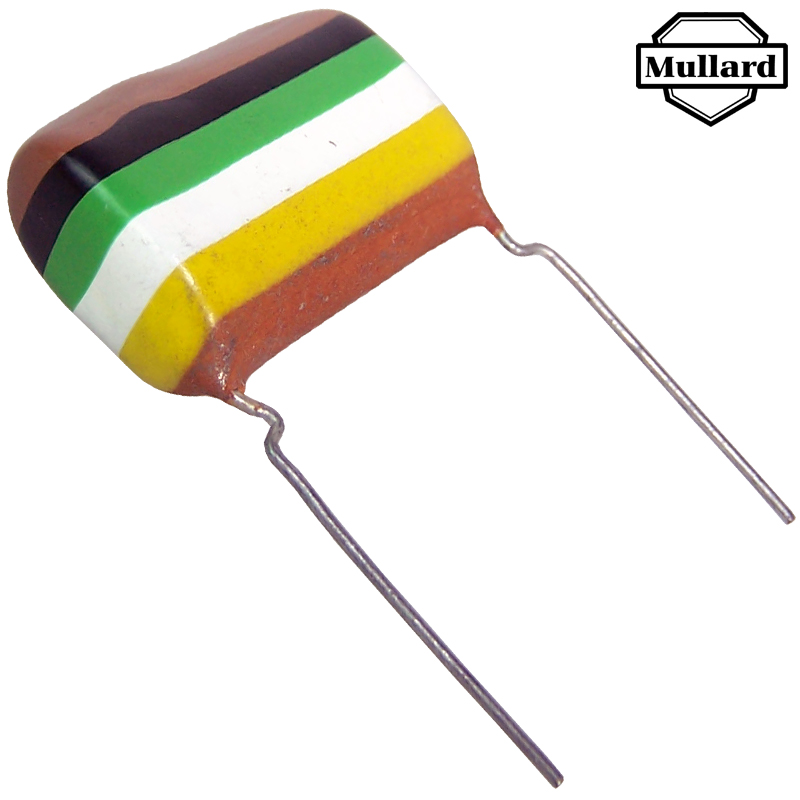
They don't improve sound compared to standard Capacitors, but they look nice.
-
Looking good is important for sales.
-
With a different value cap you would get a different peak in the roll off frequency. If the cap was 20% one way or the other would just impact how much you turn the knob. Still would not change what you hear coming from the amp since there's still no interaction. Just roll off to ground and send on the remaining signal unaltered. Originally Posted by sgosnell
-
-
Again, the filter functioning by being subtractive doesn't mean different material filters can't filter differently. This is extremely basic logic. Ur mad at physics. Originally Posted by Spook410
-
What is PIO filtering that Ceramic isn't filtering? Toan? Originally Posted by Strat-itis
-
How would a filter that passes all signal below a certain frequency and blocks all signal above that frequency made of one material sound different from one that has the same cut off frequency but is made of a different material? What is the physics that explains that? Originally Posted by Strat-itis
-
You guys are mad at physics.
What Governs How a Capacitor Affects Tone?
Capacitors in a tone circuit behave according to electrical physics — namely:
1. AC circuit behavior (filters, impedance, reactance)
- A capacitor passes AC more easily at higher frequencies, which is why it can shunt treble to ground while leaving bass behind.
- This forms a low-pass filter with the pot’s resistance.
- The exact shape of the frequency rolloff depends on the capacitor’s value — and also on its material properties.
2. Dielectric physics (how the cap stores and releases energy)
- Capacitors aren’t perfect. Real-world ones have:
- ESR (Equivalent Series Resistance) affects how “lossy” it is
- Dielectric absorption how slowly it “releases” energy
- Leakage how much it slowly bleeds charge when not in use
These are real physical behaviors, rooted in materials science and electromagnetism. They’re just small enough to only matter in sensitive analog contexts — like audio.
So Why Does This Matter in a Guitar?
Because a passive guitar circuit is pure analog and high impedance, small differences in cap behavior can:
- Change how smoothly or abruptly highs roll off
- Influence resonance peaks
- Affect how the tone responds to pick attack and knob position
That’s why some guitarists claim vintage oil-in-paper caps sound “warmer” or “smoother” than modern ceramics — even if both measure 0.022 F. That might sound like snake oil to some, but it has a physical basis if you look closely enough.
The Disconnect
The “it goes to ground, so who cares” crowd are usually stuck in a first-semester physics mindset, where everything is idealized and linear. But actual analog audio lives in the second-order effects — the non-ideal, gritty, analog physics that defines character.
So yes — it is physics. But not easy physics.
It’s the kind that matters only when you listen.
-
The bot could not possibly be wrong about anything, of course.
-
Hi. I'm not good with these science based explanations. Originally Posted by Strat-itis
Please could describe the noticable sonic differences between equal value PIO and Ceramic caps specifically related to your 9 bullet points that I have asterisked?
Thank you
-
Hi. I'm not terribly versed in electrical physics either. I posted this outline from ChatGPT to Spook since he apparently is and has worked on NASA electronics but can't comprehend that 'dur the filtered out signal goes to ground so different materials can't filter differently' is not a rational argument. Since you're not good with science based explanations you can refer to it as well. Originally Posted by garybaldy
You're welcome
-
OMG........another looooong thread
I rarely if ever turn my (guitar) TONE control down because I like as much TONE as possible to go to the amp. I find that the amp control pots do a much better job of tone shaping. Let's not start talking amplifier pots.
Good night gentlemen.
-
Read my original premise. Highs passing through a cap and going to ground does NOT prevent different materials from filtering differently. This is extremely basic logic.
Say I was going to explain this to a 5 year old:
Ok, we have 2 filters, a colander and a tennis racket. Whatever passes through we're going to throw away. Does throwing away the remains prevent them from filtering differently?
-
Non-sequitur. Those are not capacitors. You can find stuff on the internet to confirm any (and I mean absolutely any) belief you may have. And stuff that contradicts any belief you or anyone else has. The problem with the internet, and especially AI sites, is that there is so much pure BS being hyped as the truth. Most internet sites that have some general credibility say that the material a capacitor is made of is completely immaterial, and all that matters is the actual capacitance value. Check any of the pickup manufacturers' websites, for instance. They've actually done the testing, as have actual physicists. The ones you're citing only play physicists on the internet and in their imaginations. The pot has more effect on tone changes as it's moved through its range than the capacitor material ever could.
But I suspect you're one of those whose beliefs are religious, and become stronger the more evidence they're shown that they're wrong. I'm done with this.
-
I think if I were going to explain it to a five year old it would be more like “I have a plastic colander and a metal colander, if I get rid of the water it filters out, does my baked ziti taste different?”
Honestly I’m not opposed to the idea that it would. Not opposed to the idea that capacitors make something sound different too. I wouldn’t know. Not my area of expertise.
But I did work for a boutique guitar builder for a minute and people would call about their builds agonizing over stuff like this. After much trial and error, the answer I came up with was “everything can change the way your instrument sounds, but the question is whether or not you can tell.” I would tell people if it doesn’t affect the tone as much as the pile of the carpet in your music room, then who cares. Make your next phone call your flooring guy and leave me to my lunch break please.
Then again, this is why I avoid the gear forum. As you were.
-
Haha, sounds reasonable. To me, I can hear a difference so I may as well spend a few bucks for a pio or orange drop instead of several cents for a ceramic. I don't see it as a huge deal. Saying it's physically impossible for different materials to filter differently isn't logically sound, so it's not right to push falsehoods on other people. Originally Posted by pamosmusic
-
True. But it would change the tone somewhat if the tone pot wasn't moved. If the capacitor was changed to a different value, and the tone pot was less than fully open and not changed at all, I suspect there would be a slight difference in tone, the same as if the knob were rotated slightly. That can give the erroneous impression that the material was the cause of the change. The rest is psychoacoustics, which is itself a real thing. Originally Posted by Spook410
-
If you’re having some work done on your guitar and want to pay a few dollars more for something you think will help then it’s not a huge deal. Originally Posted by Strat-itis
If there’s something missing in your sound and you think changing the caps will help, I’d be willing to bet my next paycheck it won’t.
I’ll never forget the time this guy was complaining about his instrument. Sent one back to us and there was nothing wrong with it. Kept complaining about this “mechanical clicking” he was getting when he played. He had all these theories about electronics and interference and this and that. He sent me a recording. It was fretbuzz. I had to figure out how to explain to the guy that no tinkering with the materials will change his technique.
Anyway.
-
Often the different sound of different material cap is not the material but different value. All the .047 uF caps are not .047 uF but higher or lower inside some tolerance, 5% or 15% or so. In ’50s the tolerance was even more. That’s why some (most) of us do not believe that material of a cap affects the tone. Originally Posted by Strat-itis
Or then it is the tinnitus we hear!
-
Again.. they don't 'filter differently'. They filter exactly, precisely the same. uf is all that matters. It's not active.. it's passive. You never hear it because that part of the signal that gets passed to ground never goes to the amp. And what does go to the amp has never interacted with the circuit.. it's just passed on. Possibly you should review how band pass filters actually work before the hyperbole of 'basic logic' and declaring what my relationship with physics might be. Originally Posted by Strat-itis
-
Originally Posted by sgosnell
If you never turn the knob and a cap value changes, the roll off value of the circuit will change. f = 1 / 2(pi)CR. But, knobs and turning kind of go together. Also bear in mind that the circuit starts around 7Khz with a .22uf cap and 500K pot (guessing..forgive me for not reaching for my calculator). You're driving a guitar speaker that runs out of gas around 4.5Khz. So you would already have to be cranking a bit to hear a roll off at the speaker.
As for why some of our comrades believe in snake oil and will defend it even when clues departed the building with Elvis.. that's psycho something but not sure it's acoustics.Last edited by Spook410; 07-18-2025 at 03:58 PM.



 Reply With Quote


Interesting Acoustic-Electric 7-String
Today, 06:32 PM in Guitar, Amps & Gizmos