


-
I agree. I mostly play and record at home now, so it's no problem to use tube amps most of the time, which I prefer. And if I did gig, I would bring a 20 watt tube amp and an LJ in case I needed more volume or a backup..
 Originally Posted by Alter
But I do like the LJ's tone for jazz, and I particularly like that it sounds better at low volumes than my tube amps for the most part, that to me is a big advantage. For almost all other genres I prefer tubes. And I strongly dislike the voicing of most SS amps except the LJ. Like the Katanas.
BTW I don't understand people's problems keeping tube amps going. One visit to a tech and I'm good for like 8 years, although they are not often bounding around in cars these days.
-
03-02-2025 02:58 PM

-
I would go to the hardware store first. Here’s a 5 pack of rollerblade wheels on a stick for $4. Originally Posted by garybaldy
Office Owl 2-7/8" Rollerblade Office Chair Caster Wheels - 5 Pack at Menards
https://www.menards.com/main/hardwar...67-c-13090.htm
-
My twin has big casters on it. I have a good aluminum hand truck that I used to use for my Boogie, Vibrolux etc. But with the casters, the Twin stays right by my side. Originally Posted by wintermoon
-
Thanks. The plan is to get a regular 100mm HD rubber caster (Screwfix in the UK) and add a bolt the same diameter as the end pin (8mm). Once I work out how to get the end pin out. I think there is a stop inside the bass so I need to push it right into the body and retrieve it from the F hole. Originally Posted by AllanAllen
-
Even that's tough, and if there's stairs. Originally Posted by wintermoon
-
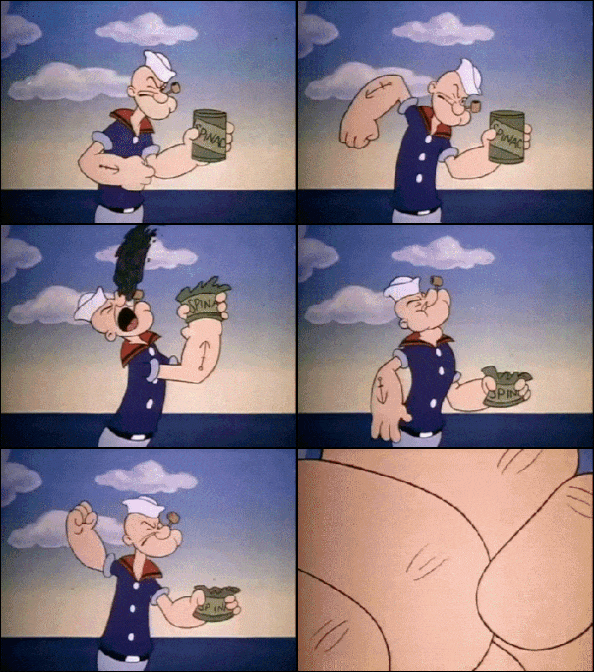
Not if you eat your Wheaties Originally Posted by garybaldy
-
Great advice! Originally Posted by wintermoon

ps when we were kids it was spinach!
-
That makes things easier for sure. I know you didn't install them but I'd never do it on an amp. Originally Posted by nevershouldhavesoldit
Y'know why you see pushed in faceplate near the jacks and pilot lights on old Fenders?
Yup, tipped over amps.
That said I also have a mint like the day it was built Twin w factory JBLs and casters.
I only used it on 1 gig, the day I bought it from the original owner.
-
I haven't had cereal since I was a kid but still eat my spinach. Originally Posted by garybaldy
Somehow the Twin is still heavy.
-
Here are my personal takes on the amps I've tried.
I had a Twin, years ago. Silver face with JBLs. Beyond loud and well beyond heavy. So punchy sounding that I didn't really care for the sound. Maybe that was the JBLs?
I loved my 64 Ampeg Reverberocket from when I bought it new to when I got a Little Jazz. The two amps didn't sound that much different. The LJ's 3 band EQ was more useful than the single "tone" knob on the Ampeg. The Ampeg went back into the closet. I have a feeling it might have sounded better with the original tubes, but I really don't know if I'm imagining that or not.
Then, I gradually realized that the LJ wasn't amplifying chords really clearly at higher volumes. I still use it in the practice room, at jams and so forth, but I don't gig with it.
I went back to a Roland JC55. I solved the hiss problem by sustaining enough high frequency loss in my hearing. I can get my sound from the JC55. If there's a PA, I sometimes run one output of the ME70 into the JC55 and the other into the LJ and then into the PA. In some venues this seems to work well. I get a nice focused sound in front of the band from the JC55 and some ambience from the PA.
I've played through a Quilter once. I didn't get it dialed in for my sound. I remember that it had a lot of knobs. It was too bright, which is usually what I think when I hear others use them.
I tried the Blu, but I thought the sound was too icy, or too sterile, or something. I used it one night with my big band. It worked but only turned up all the way. Dimed. No more volume left. Too bad, because I loved the weight.
I used to use a Hot Rod Deluxe at a friend's house. I thought it was a great sounding amp. Maybe my all time favorite. But heavy.
I've used a Blues Jr. a few times. I thought it sounded great. Probably better than the JC55, but not that cheap and not that light.
I've used a Roland Cube, maybe the 40xl. I'd call it functional but not especially inspiring.
Years ago, I gigged with a Mesa Boogie Mark III head and cab. Dialed in, it sounded awesome. But, it was hard to dial in. And, it later grew roots to the center of the earth, or so it seemed when I tried to move it.
I played through several Polytones. Maybe I didn't get them dialed in right, but I never liked any of them. Sounded sterile and boxy to me. I'm always surprised to hear that the LJ, which I like, is similar in sound to the Polytone.
I tried using a Bose S1 and an Everse 8. I documented those experiments on here with a series of TMI posts. I liked the sound of the Bose in some venues, but couldn't get it dialed in in others. For my purposes it would require some kind of outboard EQ, but I never pursued that approach with it. The onboard EQ is not useful for my purposes. The Everse sounded harsher, no matter how I dialed the EQ (it has very detailed and flexible EQ available).
For louder gigs, I settled on a complicated rig. If I had several loud gigs a week I wouldn't use this, but once in a while it doesn't bother me. Guitar>ME70>LJ>Yamaha mixer>Mackie SRM350. Sounds great and will go louder and stay clean beyond any volume I'd ever use. It sounds almost as good without the LJ in the system.
Here are the advantages of this ridiculous rig.
The ME70 is two generations back, but it's smaller than the ME90 and has 4 band EQ, which the newer models do not. It fits in a rolling briefcase, which is very convenient. For the sounds I use, it seems about as good as the ME90 and it's simpler to dial in.
Having the LJ means I have a monitor if I want to use it that way or I can turn the speaker off. I get the LJ sound and I place it where I can reach it, which gives me control over the EQ and reverb without having to walk over to the mixer. If the venue has a PA, I'll run it from the LJ's XLR output for the same reason.
Having the LJ also means I have a backup amp. If either the LJ or the SRM350 break, I can still play.
The Yamaha MG10XU mixer sounds great. The EQ is, somehow, just what I need. Rolls off some bass exactly the way I want it. I also run mics through it for announcements and vocals. Here's a factoid which might be helpful to somebody: the reverb doesn't pan.
The SRM350 weighs 25 lbs or something like that, but has handles which make it non-awkward to lift. It sounds fine to me. I have a pole for it. I didn't try the Bose S1 in this rig, but my guess is that it would work great.
The disadvantages to this rig are the obvious ones. A lot of components. A lot of cables. Can be tricky to troubleshoot.Last edited by rpjazzguitar; 03-02-2025 at 04:13 PM.
-
Now when we have gone thru the usual and never ending argument ”tubes vs. modern amps” (aren’t we?) could we continue from the Markku’s suggestion and try to make a more contemporary look on the jazz guitar amps?
Here I tried to collect some amps that are mentioned most in these pages last years. I must have forgotten some, too. I have not played with these all so forgive me if all characterizations do not do them justice.
I am non-native english speaker so my sentences are probably clumsy. Some one can make better!
”Megatrend toward lighter gear has brought many more options to jazzguitarists too. Fender has released convincing versions of their loved jazz models Deluxe Reverb and Twin Reverb under the Tone Master label.
Small combos Henriksen Bud (& Blu) and DV Mark 12 Jazz and Little Jazz are holding the flag high for the Polytone type classic jazz sound.
Different amps from Quilter Labs has made many jazz guitarists happy with their various Mach and Cub combos and heads like Tone Block 202 and Superblock US & UK pedal board amps.
Many jazz guitarists find their inspiration from amp modelers too. Kemper, Axe FX and Quad Cortex are maybe the most famous pioneers in this front.
Lightest end of guitar gear is probably the Finnish TOOB speaker cabs. The round design represents literally The Out Of the Box thinking and weighs only 2 kg in minimum. Combined with f.ex. small bass amp head like TC Electronics BAM200 it will give You lightest Watts in the jazz playing world."
(Yes it is megatrend, starting from Polytone, especially younger players use modelers, in ear monitors etc.)
-
AER! Does it belong to the list? Originally Posted by Herbie
And the Django style gear is totally unknown to me. Is it played with the acoustic guitar amps? Or straight thru the FOH?
-
There's also this one from Gollihur, which is more affordable (but not inexpensive – $78): Originally Posted by garybaldy
Upright Bass Wheel Glasser solid rubber
It also has information on removing a pin that won't come out.
-
Thanks for info but I shall stick to my skinflint plan! I've read about end pin removal as mentioned in my post. Cheers Originally Posted by Ukena
-
Tonemaster's aren't junk. They have killer cabinets. A 2x12 Mesa Boogie cabinet is sold for over a 1000USD:
2x12 Vertical/Slant Rectifier Cabinet | Mesa/Boogie
Twin Tonemaster cabinets are even of a higher quality than the regular Twin Reverb reissues. If your Tonemaster amp dies you can just use the cab with something like Quilter OD202, or for a few hundred dollars turn it into a hardwired tube amp with a pine cabinet.
-
whats missing from this discussion for me is the point that saying "tube amp" is like saying car with internal combustion engine. Its meaningless, so a marshall sounds the same as a fender? an el34 sounds the same as a 6l6 ? what about the input tube or the type of rectification. Have you compared a tube amp to a mosfet amp? I have an HR Deluxe project amp. I been taking the preamp out (modified to include the reverb) into a variety of power amps. Most recently a quilter micro, this could be the best studio amp as it is super quiet and every bit as good as the tube power amp section of the amp. Not a practical gigging solution (yet) but for beautifull twin like tone and dead quiet if Im recording a solo archtop or such it seems to be the ticket. You cant generalize about the sound of an amp based on its topology there are to many variables. Class D sounded like shit when it was first introduced now (unless your obsessed like me) youd never notice the difference factoring for all the other things that influence tone. For anyone new to tubes the golden age of the tube is long gone and when you hear a great tube amp your hearing the input tube. In the good ol days american tubes from sylvania raytheon rca etc could be bought at the drug store and generally sounded great, the tubes from Europe were legendary and are why those old jazz recordings you love sound so good. Thats over forever and old stocks have been hoarded by old farts like me. The JJs etc from China are very much hit and miss, Russian tubes used to be great but not sure what that future will be. My advise to gigging players without romantic attachments to outdated equipment is to get the smallest lightest rig that gets your sound close and be done with it. The audience does not give a crap about what amp you play or guitar nor do they hear the nuances we obsess about. If you can play theyll dig it, if not no guitar or amp will help. Thankyou for enduring my old man point of view...my kids like to remind me Im "acting my age!"
-
I just had my Mark IV combo retubed and recapped, first time since I got it in about '04. It better last at least 8 years since it cost me $770 Originally Posted by bluejaybill

-
"I'm just a soul whose intentions are good; oh Lord, please don't let me be misunderstood."
When I pointed out the outdated nature of the JGO's amps presentation, the first few thumbs and posts showed understanding. Garybaldy even innocently asked: Any volunteers?
Challenging, after this thread full of very personal experiences, opinions and emotions. I don't even pretend to qualify, for several reasons: 1) Lack of knowledge and experience regarding tube amps; 2) Lack of professional playing and/or teaching experience; 3) Remoteness from the all-important US scene and jazz culture, which varies regionally; 4) Very superficial understanding of modern DSP, modeling amps and so on; 5) My geezer's age (78) and retirement passion of making ultra-light speaker cabinets, which after over 850 units does constitute a vested interest.
I'm calling on someone or, better still, a small group of experts, with both frontline and teaching experience, i.e. a broad contact surface with audiences, colleagues, equipment, and the next generation. Dirk to me represents all this, and is behind the original amp presentation and poll. I actually tried to contact him direct before going public; no response so far. During soon 20 years in charge, he must have received dozens of requests and ideas, and is in a position to judge their merits and feasibility better than anyone else.
I rest my case and thank all who have cared to contribute.
Cheers,
Markku
-
VS

-
Should there be a forum tutorial on jazz amps? Meh.. if someone finds it useful I suppose. Will it go into speaker IR's, FRFR's, and all the preamp alternatives or will it just reflect the individual (or AI tool) that writes it up? Since jazz is a dinosaur, maybe recommendations from a previous age make sense?
As for all the other stuff, I really like a nice Fender tube amp but at over 70 pounds for my Concert model, I choose not to move it about. I'm not disabled. I could move it if it were worth it to do so. It's just not. Not even if it were just the dead lift from trunk to cart (as if carts get you all the way from A to B). There are 25 pound options that are easier to maintain and sound fine.
-
JJ valves are made in Slovakia. Originally Posted by Rickco
-
The two pictures of the innards of Fender amps shows that they're very similar. Circuit boards with components on them, some components smaller than others. The thing that mostly separates them is the metric ton of iron that makes up the transformers in the tube amp along with the fragile vacuum tubes.. There is so much wasted power and material it makes one wonder why the intense nostalgia continues to exist. But of course logic and reason have nothing to do with it. Many people long for the return of the good old days, which truthfully weren't all that good. If I could go back to 1958, I wouldn't.
-
The big difference is that every part of the valve amp is replaceable, while the printed circuit boards are unique. Originally Posted by sgosnell
-
Everyone has missed the best thing about having a Twin, it makes all your other amps featherweights. I'm appalled at these 11 to 20 pound amps mentioned, my light ones are 40-50! I've put my favorite 15" JBL back in the Twin to make it even better, it looks like a D130 but is out of a Sunn Coliseum PA.
For many people the real heavy lifting is finding a gig or jam so get to work. You won't care what you carry.
I do recommend hand carts with big air filled wheels, my funniest Twin story happened while rolling along the street on the casters. It didn't turn on when I plugged in! I looked in the back, the power tubes had rattled out from the rough road.... Nothing a flashlight couldn't cure but I use the hand truck now.
-
One is full of ribbon wiring with PCB soldered pots and jacks i.e cheaply made shit. Those are your likely first points of failure. The lack of iron is also why I seriously doubt it can match it's tube counterpart in output. Originally Posted by sgosnell
"Fragile vacuum tubes"
We fought world wars using vacuum tube technology. There is nothing fragile about them when used properly but I guess if you wanted to drive nails with them then yes, they will break.


 Reply With Quote




Interesting Acoustic-Electric 7-String
Yesterday, 06:32 PM in Guitar, Amps & Gizmos