


-
I know there are similar threads that have been posted in years past, but I was curious whether there are any recent solutions to this problem.
Several months ago I purchased a pre-Norlin Gibson Johnny Smith guitar which has a 1/8 inch mini-jack mounted on the underside of the pickguard. Unfortunately the sound cuts out at times when I make a slight, random movement which is only rectified by fiddling with the plug. I have tried to address this problem by fine-sanding the jack arm and socket and by bending the arm slightly, but to no avail. Consequently I am considering various alternatives which involve replacing the jack. I would prefer a solution that would retain as much of the instrument’s current value as possible. Here are a couple of ideas:
- Mount a ¼ inch jack in a rectangular housing (wood or plastic?) and cement it to the underside of the pickguard, possibly leaving the old jack In place.
- Remove the pickguard and pickup and replace it with a vintage DeArmond pickup and control box that would be attached by using a monkey-on-a-stick rod and mounting bracket
I considered the Tapastring Vintage Jack but the current endpin screws in so it would require enlarging the endpin hole which I’d rather not do.
Does anyone have any other ideas on how to deal with this problem?
Thanks!
-
01-29-2025 09:47 PM

-
Most people just convert to end pin. Not a big deal imo, I'd probably go that route if I owned one.
Why Gibson didn't do it standand is beyond me, but most builders back in the day like D'Angelico, Koontz etc did the guard thing too w Dearmond control boxes.
-
I agree that an endpin jack is the best way to go. It's secure, and common with many boutique builders. Anything mounted on the pickguard is going to be problematic in the long run, especially if a 1/8" jack is used.
-
A question would be whether the loss of signal is occurring within the jack or within the cable. Within the jack is pretty easy to look at. It's entirely possible there is a failed solder joint which, if touched up, would fix the problem. If the failure is within the cable, trying a different cable might answer that question.
If you do decide replace the jack with a 1/4" pickguard mounted jack rather than an endpin jack, I would suggest using a lightweight cable with a right angle plug, such as a George L's .155 cable. Then run the cable from the jack around the end pin and strap to support it.That will put less weight on the jack, isolate it from tugging and hopefully reduce the risk of future problems. Frank Vignola has I believe an old L7 with a McCarthy pickup, which is also contained within the pickguard assembly; he appears to use a 1/4" jack and runs the cable through the strap at the end pin to support the weight and reduce strain on the jack.
It's frankly not a good design from the standpoint of robustness. But, as was mentioned above, it was the standard for a long time starting with the DeArmond pickups back in the 40s and early 50s, the McCarty pickup, Jimmy D'Aquisto did the same thing on at least one guitar, etc.
-
Right you are! Yesterday while working out in our gym, I watched a Guitar Night video from 2 weeks ago and he plays the L-7 with twin McCarty (which sounds great):
 Originally Posted by Cunamara
-
Why not replace the mini jack? 1/4 jack is pretty big Legrand uses that and It's much heavier seems like a lot of load on the pickguard. All and all I don't like it as well as the mini. The mini jacks do have to be replaced here and there. Source a decent one (might take some real looking) and get a few.
-
There is a fitting called a Cliff jack(female, 1/4"), which has a plastic housing and can be glued to the underside of the pickguard. I've done it, it works well. That may be what Frank Vignola has on his L-7.
-
BebopFan, have you tried another cable? I’d do that before changing anything on the guitar. Depending on the type of 1/8” plug on your current cable (molded on vs screw or solder terminals), you can also check the connections to the plug. If the issue is just a bad connection, you can either redo it or cut off the old plug & put on a new one.
You really should have a spare cable anyway.
-
+1 to endpin. All those pickguard mounted jacks are so annoying. Also I don’t think it would hurt the value much. I’m sure there will be some obsessive collectors out there who will tell you otherwise but I like to pretend those people don’t exist. There will always be reasonable people looking for these guitars.
-
I have also wrestled with this decision. I have a late sixties JS with a 1/8” Jack on the Pickguard and an early sixties L5C with an original older style JS pickup that has a screw-on connector. I don’t really like these rather flimsy connections and I would much prefer end-pin jacks. Having said that, both guitars are entirely original and I feel a little uncomfortable with making any modifications. How do others feel about reaming out the end-pin on a vintage guitar?
Keith
-
I did it on a 64' L7 (not mine, it belongs to a friend). The strap pin hole in the tailpiece was big enough for the endpin jack. Only the hole in the endblock of the guitar has to be enlarged. Originally Posted by floatingpickup
We are both (my friend and me) convinced that this was an improvement regarding playability of the guitar.
-
I agree, in principle, but I use a pcb mounted to my pickguard (like the one below). The pickup connection is hardwired and soldered, but the end pin connection is through a ‘pig tail’ and has a 1/8” Jack connection to the pcb. Originally Posted by sgosnell
I know this is different to the concern that you have raised as the 1/8” Jack is rarely (if ever) disconnected and then reconnected. All I say is “horses for courses”.
https://www.stewmac.com/electronics/...heel-controls/
-
Frank said in an interview he likes how the whole assembly comes off with two screws so he can do an acoustic gig by taking off the pickguard and an electric one by putting it back on. Might be something for OP to consider... Originally Posted by nevershouldhavesoldit
-
As this thread lengthens, I’m a bit concerned that Cunamara’s advice (echoed by my own post a bit later) to check the cable first has been overlooked. Before spending time, money, and anguish on alterations to the instrument, you need to identify the cause of the problem. The cable is the only thing in the signal chain that’s quick and easy to check and replace. Everything else mentioned in this thread requires more resources and is an alteration of some kind to what’s described as an original guitar.
Check the cable first!
-
WHat i now do is pull the jack itself an leave everything as it is. Then I run a 1/8 inch lead female input. Here it is. 6Pcs 3.5mm Female Jack to Bare Wire Open End TRS 3 Pole Stereo 1/8" 3.5mm Jack Plug Audio Cable Replacement for Headphone Cable Repair : Amazon.ca: Electronics
This then I simply leave in the f hole when in the case and take it out to plug in. You can run the wire so in loops through your tailpiece too. While this is not as convenient as endpin jack it does nothing to the guitar. This set up works the best when you have a guitar you use acoustically much of the time and do not want to mess up the pickguard. I did this on my 1938 L5 and made no holes or modifications to pickguard it is all held on by double stick tape under pickguard. I can convert it nothing but acoustic pickguard in minutes.
To me if you are gigging your Johnny Smith it probably is better to have the endpin jack. However, if you just play at home or rarely, I think my way it better.
-
I've seen more than a few torn off guard assemblies by someone accidentally stepping on the cable, it ain't pretty.
Guard mounted jacks are just asking for trouble unless you're a careful home player like Mark said.
-
I'm careful at home, but not infallible. I've done my fair share of tripping and cable jerking over the years, and more as I age. I'm not quite as spry as I was at 21. It's not so difficult to use an inline jack on the end of the cable from the endpin jack, and a matching plug on the cable from the pickup, so that the pickup and/or pickguard can be easily removed for acoustic playing.
-
Thanks for the responses so far to my post! I'm still mulling over what is the best solution for me. If I were just playing at home, I probably wouldn't change anything. However I do get together on a regular basis to jam and it really bugs me when the sound cuts out either during my solo or just before it.
FYI. One of the first things I did was check the cable by plugging it into another guitar that has a control box with a 1/8 inch jack built into it. It worked fine.
-
You might want to try this if you're that concerned about investment value. Tapastring Guitar Care Products | The "Vintage Jack" | End Pin Jack No Drilling Required
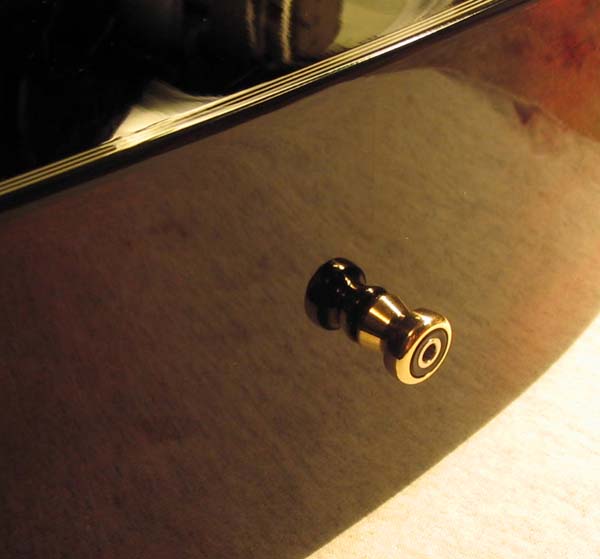
It's 1/8" endpin jack, so you don't have to ream as large a hole as you would for 1/4". Honestly though I'd just go for the 1/4" and not mess with flimsy 1/8" connectors.
-
I have considered this option before, but I wasn’t sure if it would actually fit in a Johnny Smith without alteration. It seems to be the size of a pressed-in endpin that you would find on an acoustic guitar, like a Martin. I think a Johnny Smith has a brass strap button with a screw, and I wondered if it would still have to be reamed out for this to fit. Originally Posted by omphalopsychos
Keith
-
Here’s the totally non-invasive solution Tony Duggan-Smith devised for my Stromberg:
-
Not invisible, but also not bad.
-
With average soldering skills, or even less, it's not that difficult to make a cable with a male 3.5mm(1/8") plug on one end and a 1/4" inline jack on the other, and the jack can be attached to the tailpiece in multiple ways, including zip ties or whatever. The cable could be run much like the one in post #21. The cable would be visible and perhaps in the way, but it doesn't alter the guitar in any way.
-
I’m glad the cable has been ruled out as the cause. But the assumption that the jack is the problem remains unproven. We know that you’ve “tried to address this problem by fine-sanding the jack arm and socket and by bending the arm slightly, but to no avail”. But that suggests only that there’s adequate contact and presumed conduction between the tip and the jack. Contact between the sleeve (the shaft of the plug) and the body of the jack is probably OK. But it’s possible that over years of use, one or both have worn enough to loosen the fit of plug in jack and cause crackles and even intermittency. So trying a fresh cable or putting a fresh 1/8” plug on the existing one could fix it even though the old cable worked fine in a newer jack.
Work your way back along the signal path. The solder joints between the wires and the jack could be oxidized or otherwise weakened such that tiny shifts in position could cause noises and interruptions by very slightly separating a flaw. This is common in old tube amps, and reflowing or resoldering joins is a routine part of rehab.
Then follow the wires back to the pot(s) looking for the same thing. Old wiring gets brittle and wonky from years of vibration. I don’t know what “fiddling with the plug” means - but if you pushed on it and moved it around, you may have been pushing a fine break or discontinuity back together in either a wire close to the jack or a solder joint on the jack.
This may be an easy fix, and finding the above problems is quick. Before I did anything else, I’d thoroughly check the entire existing assembly. I’ve never taken a JS apart, so I don’t know how that 1/8” jack is held in its housing. But if it’s a standard nut-retained jack, I’d just replace it. This deals with possible wire and solder issues as well as wear inside the jack body. Also inspect the shaft of the old plug closely (with magnification if necessary) to see if the surface is worn down at the top, where it contacts the inside of the jack.
I agree that an eighth inch connector is not ideal. But I’d be comfortable gigging with a right angle plug and the cable secured over the end pin (especially if you use a strap and secure the cord between the strap and the body).
-
Give this style a try. They are stereo but just use 2 terminals.5Pcs Gold Plated 3.5Mm Female Stereo Panel Mount Jack Connector, Audio Headph... | eBay


 Reply With Quote


Interesting Acoustic-Electric 7-String
Today, 06:32 PM in Guitar, Amps & Gizmos