

Though closely related in form and harmonic movement to its major blues cousin, the minor blues requires an understanding of a number of new scales and modes when first learning how to solo over this common jazz form. In this lesson, you will learn all the scales needed to improvise over a minor blues.
Though guitar scales such as melodic minor and Phrygian dominant might seem out of reach at this point in your studies, by learning how to play these scales in two fingerboard positions, you will learn to understand how to apply them to the correct chord changes of the minor blues.
In case you missed it, please check out our minor blues chord progressions lesson, as it will help you understand the construction of 11 different variations of the minor jazz blues chord progression.
Minor Blues Backing Track Video
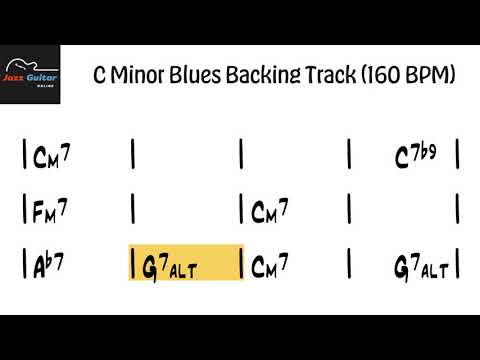
Here is a backing track in C minor you can use to practice the scales below.
Basic Minor Blues Progression
Before moving on to learning a set of scales that you can use to solo over the minor blues progression, let’s take a look at the guitar chords that you will be soloing over with these particular scales.
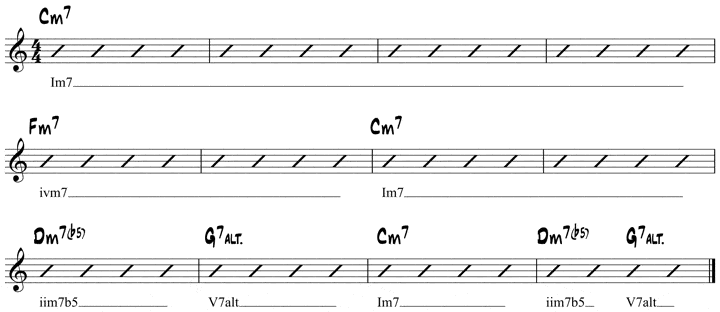
Below are the basic changes to a C minor blues progression, without any substitutions or alterations to the standard form.
Notice that there are two different minor 7 chords in this progression (Im7 and ivm7), as each of those chords will require a different scale approach
Listen & Play Along
Minor Blues Scales Practice Guide
As you learn the various scales in this lesson, having a practice strategy will ensure that you take a well-rounded and full approach to learning the material.
Here is a short guide to exercises that you can do in order to integrate these scales into your improvisations.
- Start by learning the 6th string shape for each scale in this lesson, one at a time, with a metronome and at a wide range of tempos.
- When you have the 6th string scale under your fingers in one key, put on a one-chord backing track and solo with that one scale.
- Move on to learning that scale in all 12 keys, and soloing over one chord in multiple keys.
- Repeat these exercises with the 5th-string scale shape.
- Mix the two shapes together as you begin to improvise in one, and then all 12 keys, for each scale presented in this article.
As well as working each scale one shape at a time, you can also organize their application to the full minor blues form in order to get the most out of your practicing.
- Start by soloing over the minor blues in C changes, using only the C minor blues scale to build your lines.
- Start to insert the other scales in this lesson one at a time.
- Start by playing C blues and C melodic minor, then C blues and F Dorian, then C blues and D Locrian, and finally C blues and G Phrygian dominant.
- Once you have practiced playing the C minor blues scale and each of the other scales over the changes, you can start to bring these scales together in your solos.
- Start by playing C melodic minor and C blues, then add F Dorian, then when that’s comfortable add D Locrian, and finally add G Phrygian dominant, so that you are now using one scale per chord in your solos.
Working scales one at a time in this way will not only get them under your fingers in a secure fashion, but it will allow you to focus your ears on one new sound at a time, rather than all at once.
The Minor Blues Scale
To begin, let’s take a look at two fingerings for the universal scale, one that you can apply to all of the chords in a C minor blues, the minor blues scale itself.
Just like with a major blues progression, you can use this scale to create lines and phrases over any or all chords in a minor blues progression.
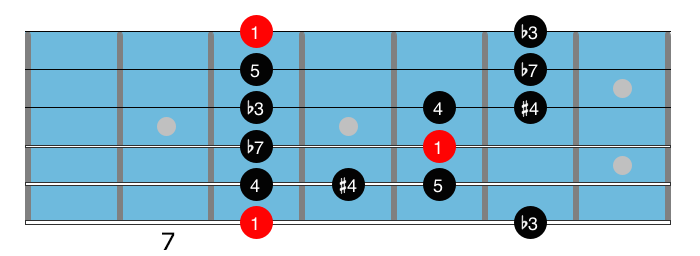
If this scale is new to you, or you just need a refresher, here is a 6th-string root position for the C minor blues scale that you can learn and bring into your soloing lines in your playing.
Listen & Jam Along
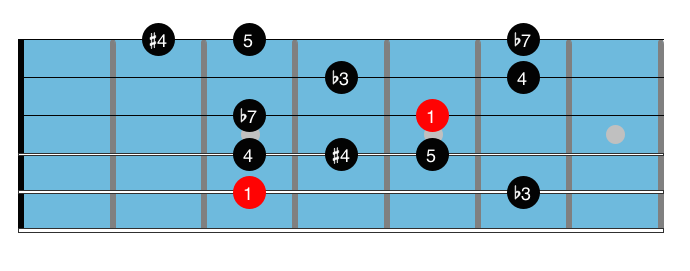
And here’s a 5th-string root fingering for the C minor blues scale that can be applied to all 12 bars of a minor jazz blues progression in C.
Listen & Jam Along
The Melodic Minor Scale
The first mode that you will explore in this lesson outside of the minor blues scale is the melodic minor scale.
Only one note different from a major scale (it has a b3 interval), the melodic minor scale is effective when soloing over tonic minor chords, such as the Im7 chord in a minor blues progression.
Here is the interval pattern for the melodic minor scale.
Notice the major 7th interval in this scale, which gives the mode its characteristic sound and creates a bit of tension when applied to a m7 chord in your solos.
Because it creates tension, you will need to work with this scale in order to learn how to resolve and handle that tension when applied to a soloing situation.
| C Melodic Minor Scale | C | D | Eb | F | G | A | B |
|---|---|---|---|---|---|---|---|
| 1 | 2 | b3 | 4 | 5 | 6 | 7 |
Here is a C melodic minor scale from the 6th string that you can use to begin your studies of this important melodic device.
Listen & Jam Along
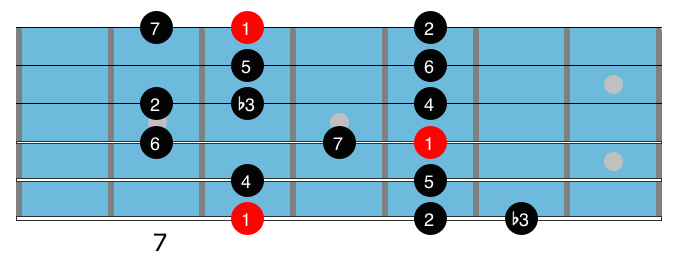
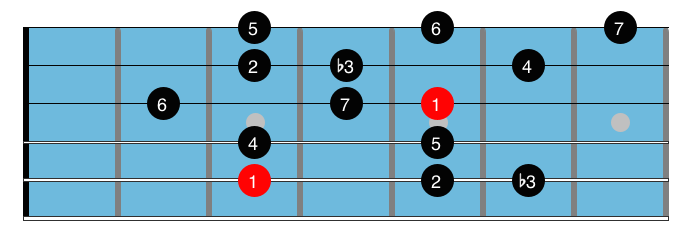
You can also work the melodic minor scale from a 5th string root, as you can see in the following example which shows a C melodic minor scale.
Listen & Jam Along
The Dorian Scale
The Dorian mode is the second mode of the major scale, meaning that it is the same as playing an Eb major scale from the notes F to F.
If guitar modes are new to you, check out our Beginner’s Guide to Guitar Modes.
You will notice that the Dorian mode is only one interval different than the melodic minor scale, it has a b7 compared to the 7 found in melodic minor.
Because of this, Dorian has a bit of a “softer” sound when applied to m7 chords than melodic minor, and it works well when applied to the ivm7 chord in a minor jazz blues chord progression.
Here is the interval pattern for the Dorian mode.
| D Dorian Scale | D | E | F | G | A | B | C |
|---|---|---|---|---|---|---|---|
| 1 | 2 | b3 | 4 | 5 | 6 | b7 |
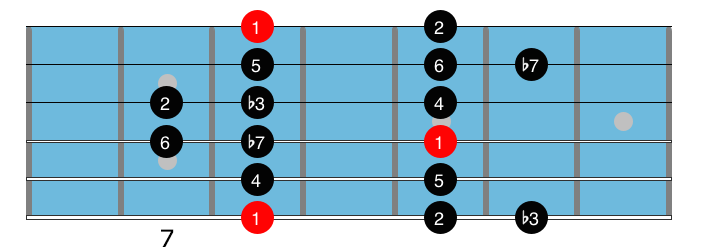
You can now take this theoretical knowledge and apply it to the fretboard as you learn to play a 6th-string root Dorian mode in D at first, followed by all 12 keys after that.
Listen & Jam Along
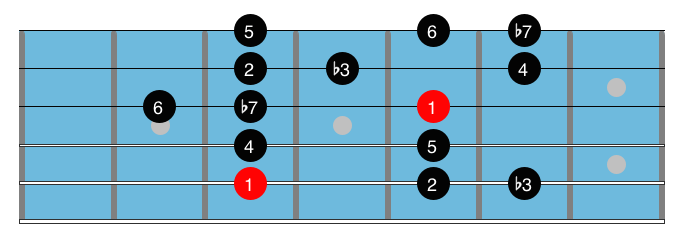
You will now move on to learning how to play the Dorian scale with a 5th-string root note, from the root F in this example.
Listen & Jam Along
The Locrian Scale
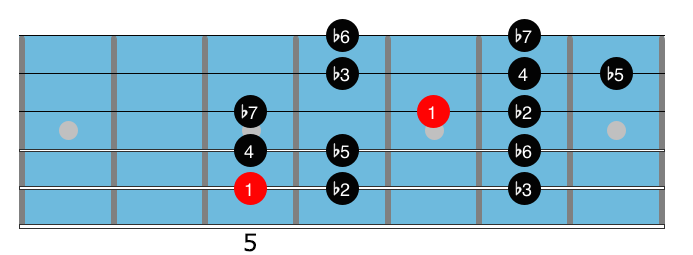
The second major mode that you’ll learn over the minor blues progression is the Locrian mode, which is used to solo over the iim7b5 chord in these changes.
Built from the 7th mode of the major scale, the D Locrian mode is the same as playing an Eb major scale from the notes D to D.
Here is the interval structure of the Locrian scale to study from a theoretical perspective before applying it to your fretboard.
| B Locrian Scale | B | C | D | E | F | G | A |
|---|---|---|---|---|---|---|---|
| 1 | b2 | b3 | 4 | b5 | b6 | b7 |
Here is a D Locrian mode to explore in your studies, beginning with the root note on the 6th string of the guitar.
Listen & Jam Along
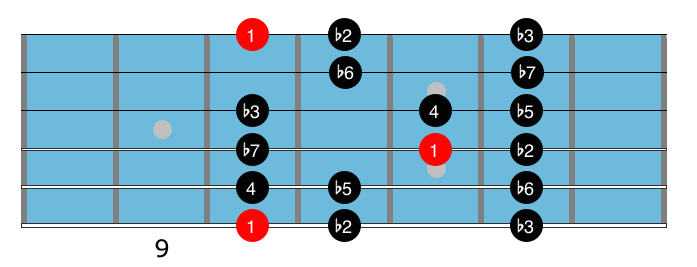
With the first Locrian scale under your fingers, you can learn how to play this important jazz scale with a 5th-string root note, which is a D in this example.
Listen & Jam Along
Phrygian Dominant
The final scale that you’ll learn in this lesson is the 5th mode of the harmonic minor scale, otherwise known as Phrygian dominant.
When applied to a C minor blues (over the G7alt chord), you are playing a C harmonic minor scale from the notes G to G.
Here is the interval structure of a Phrygian dominant scale.
Notice the b9 and b13 intervals which are the notes that provide the 7alt sound when applied to a dominant chord in your solos.
| G Phrygian Dominant Scale | G | Ab | B | C | D | Eb | F |
|---|---|---|---|---|---|---|---|
| 1 | b2 (b9) | 3 | 4 | 5 | b6 (b13) | b7 |
To begin getting this scale under your fingers, here is a G Phrygian dominant scale from the 6th string that you can learn in one key, and then all 12 keys.
Listen & Jam Along
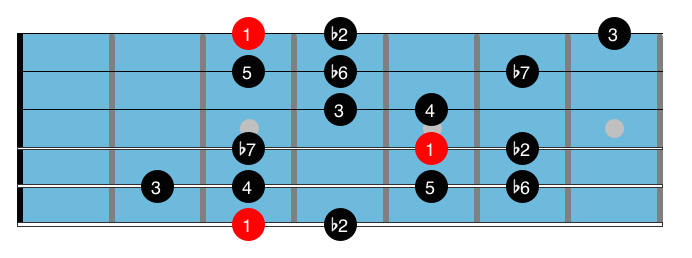
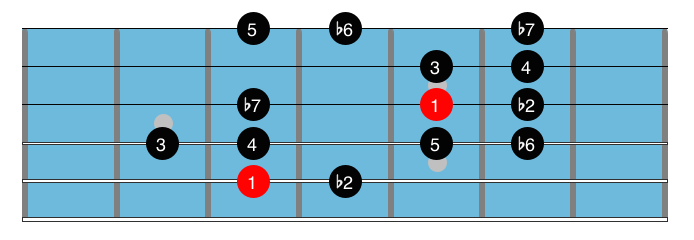
As with all the scales in this lesson, you can now move on to learning and applying a 5th-string root based Phrygian dominant scale.
Listen & Jam Along
Minor Blues Scales Layout
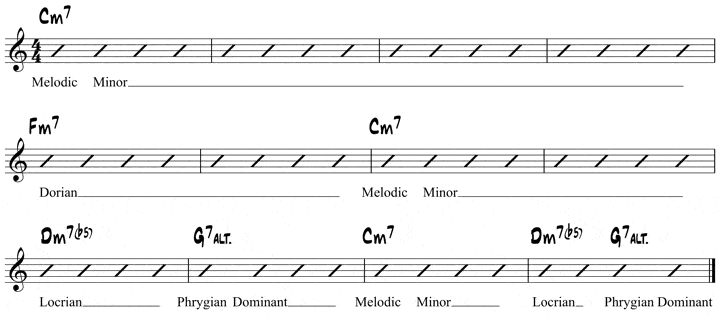
Now that you have worked on each of the scales used to solo over a C minor blues, and any key of the minor blues, in your studies, here is a handy reference chart that shows each chord with its corresponding scale.
When first soloing with these scales in your practicing, feel free to have this chart in front of you as a practice aid, before removing it from your music stand and working from memory.
Minor Blues Solo
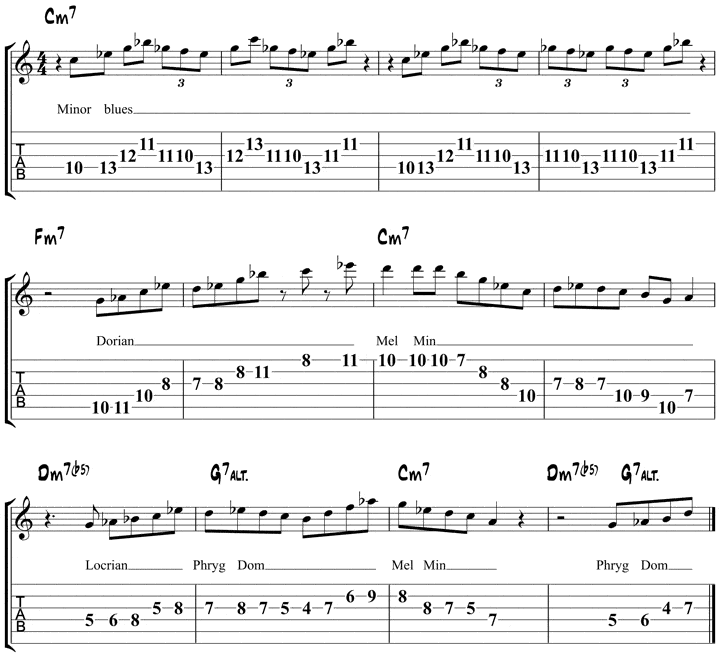
To help you bring these scales into a musical situation, here is a sample one-chorus minor blues solo that uses all of the various scales discussed in this lesson.
Start by learning each phrase in the first chorus, until you can play all 12 bars on your own.
From there, aim to be able to play this one-chorus solo along with the track provided, as well as over a backing track without a recorded guitar part, in order to get the most out of this solo study.
Listen & Jam Along
Do you want to learn more about the minor blues? Check out our eBook Introduction to Jazz Blues Guitar Volume 2


Sorry to be silly but I was really enjoying practicing the E Harmonic Minor scale with a backing track of about 3:20 . Now I can’t remember where it is on your website…can you send me back there please. I bought the Arpeggio book and love your lessons…plpease help… I have searched all over your site and cannot see it. I am sure there was a neck diagram showing the D# to E etc…. Thanks…Lawrence
ON the Dorian scale, the example is in F but the starting fret is marked as 7 – should it be 12?
Excellent lesson! Thank you very much..