The Jazz Guitar Chord Dictionary
Reply to Thread Bookmark Thread
Page 2 of 2 FirstFirst 12
Posts 26 to 32 of 32
  1. #26

    User Info Menu

    Quote Originally Posted by joe2758
    Cliff, is the main purpose here technique or vocabulary? Obviously both, but is there a primary?

    If you are just getting lines under your fingers to use in your playing (rather than pushing your technical boundaries), I am a big fan of taking a lick and changing all the hard parts.

    Like if there is an awkward phrase you can shed it and improve your technique, or most likely you could change one note and make it half as difficult to play.

    For some reason, things natural on the guitar stick with me twice as well as hard stuff I had to shed twice as long (you'd think the more you play it the more it sticks). Bleh sorry you get the point
    Good question. I guess a bit of both. This is one of several licks I've been trying over various chords and chord changes. I just wanted to challenge myself to see if I could play it faster (since I was trying to fit 16 notes over a single bar in this particular instance). I normally wouldn't try to learn an entire 16 note line as a piece of vocab, rather break it down into bits. But I do particularly like this one and it gives a good insight into how George creates these long chromatic lines.

  2.  

    The Jazz Guitar Chord Dictionary
     
  3. #27

    User Info Menu

    Quote Originally Posted by djg
    i listened to the portion at 0:16 and onwards. it is clear now. i'm talking in G:

    you can not really isolate the line the way you did. the first note in the Gmaj bar, the B belongs to the phrase that comes before.

    even though you got consecutive eight notes, there are two phrases present.

    the first II-V phrase that *ends* on the B. and the phrase you want to study that actually starts on the 1+. namely on the D.

    as per hal galper, bird and bach: contrary to popular belief the 1 is usually the *end* of the bar.

    i can almost guarantee you that your problem with this lick immediately goes away once you start it on the and of 1 and on the D.
    Thanks for the advice! I'll give that a try.

  4. #28

    User Info Menu

    I listened to the slower version.


    It sounded like the entrance, that is the first note, was a little fuzzy as to the time.


    I’d suggest strongly emphasizing the first note of each group of 4 16th notes. My thought is that it may help you feel the time. Then you can go back to whatever accenting you prefer once the time is clear. Good luck!

    ONE! e & uh. With ONE really loud.

  5. #29
    PMB's Avatar
    PMB
    PMB is offline

    User Info Menu

    I feel it may be more mental placement of the phrase rather than a physical hurdle that's holding you back, Cliff.

    Having said that, while it's useful to practise phrases in various positions, the one shown in the video around the 7th position (in G major although the audio has been sped up at some stage and does sound closer to Ab as played in your own video) seems much better suited for clean execution.

    Regarding rpjazzguitar's post, yes we should be aware of where the primary 1st and 3rd downbeats are but as djg noted above, pros generally treat them as points of arrival not departure.

    Contrary to expectations, consistently accenting them can actually destabilise our time feel or at least inhibit our sense of flow. Witness the 'stuck in the mud' result when audiences clap on the '1' and '3'. For that reason, most jazz musicians set their metronome in 4/4 tunes on beats '2' and '4' where it acts as a surrogate snare (most modern popular music forms feature this snare drum pattern). It helps create forward motion, a push and pull effect and tightens our groove.

    However, the tempo of your Benson example is rapid and 8th notes now take on the role of 16ths. This means that beats '3' and '4' will be combined and felt as the new backbeat (or '2' at a slower tempo). As a result, if employing a metronome, we would practise this phrase with the click on beat '3' only - the equivalent of beats '2' and '4' at half the tempo.

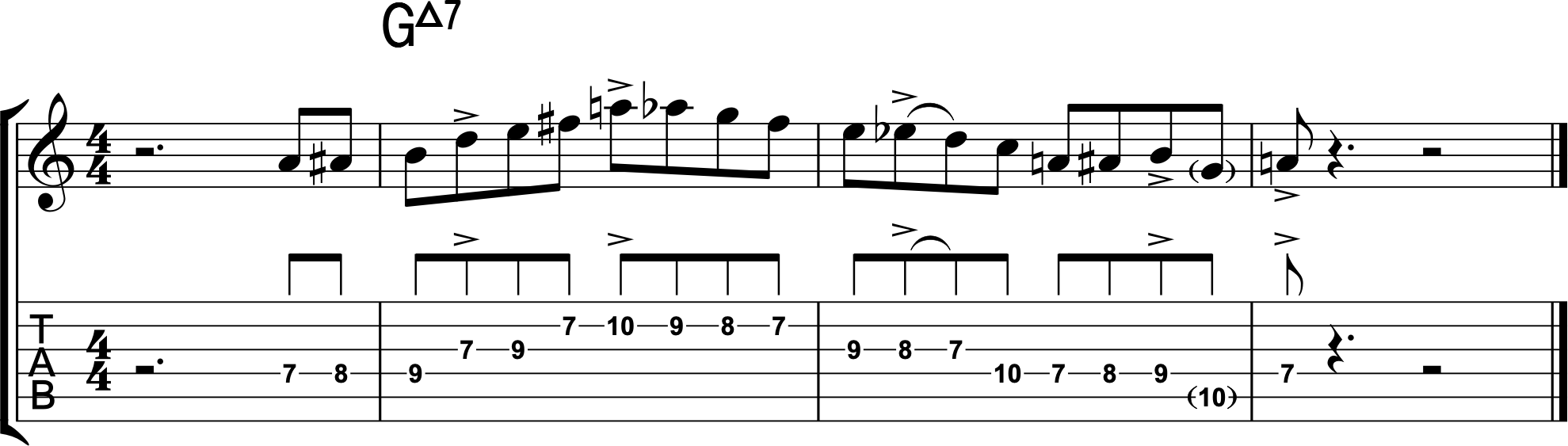
    Does this all square up with Benson's performance? Here it is with accents and slurs added. By the way, the green play line posted in the notated video is out of synch by an eighth note so listen rather than watch:
    Double time fail-gb-png

    Picking up on djg's observations, notice that the first accent occurs on the 'and of 1' rather than the '1'. The next occurs on our new backbeat (remember that '3' in a bar of eighth note subdivisions is the equivalent of beat '2' when 16ths are the main subdivision). Importantly, it's also the apex of the whole phrase. Benson is a huge Charlie Parker fan and CP often places his accents in this manner.

    Once again, the following accent comes on the 'and of 1' and in this instance, is slurred onto the next beat (yet another common device that prioritises the upbeat rather than downbeat). The penultimate accent lands on the last beat of that bar with the final one acting as a full stop to the whole phrase.

    In closing, my advice if you want it to sound relaxed yet in the groove and swinging is to try playing the phrase in 7th position (or 10th if you're looking at playing it over Bb rhythm changes), follow djg's suggestions in #26 and have your metronome set to 130bpm clicking on beat '3' only (or beats '2' and '4' at 65bpm).

    Best of luck and I hope all that makes sense.

  6. #30

    User Info Menu

    Quote Originally Posted by PMB
    I feel it may be more mental placement of the phrase rather than a physical hurdle that's holding you back, Cliff.

    Having said that, while it's useful to practise phrases in various positions, the one shown in the video around the 7th position (in G major although the audio has been sped up at some stage and does sound closer to Ab as played in your own video) seems much better suited for clean execution.

    Regarding rpjazzguitar's post, yes we should be aware of where the primary 1st and 3rd downbeats are but as djg noted above, pros generally treat them as points of arrival not departure.

    Contrary to expectations, consistently accenting them can actually destabilise our time feel or at least inhibit our sense of flow. Witness the 'stuck in the mud' result when audiences clap on the '1' and '3'. For that reason, most jazz musicians set their metronome in 4/4 tunes on beats '2' and '4' where it acts as a surrogate snare (most modern popular music forms feature this snare drum pattern). It helps create forward motion, a push and pull effect and tightens our groove.

    However, the tempo of your Benson example is rapid and 8th notes now take on the role of 16ths. This means that beats '3' and '4' will be combined and felt as the new backbeat (or '2' at a slower tempo). As a result, if employing a metronome, we would practise this phrase with the click on beat '3' only - the equivalent of beats '2' and '4' at half the tempo.

    Does this all square up with Benson's performance? Here it is with accents and slurs added. By the way, the green play line posted in the notated video is out of synch by an eighth note so listen rather than watch:

    Double time fail-gb-png

    Picking up on djg's observations, notice that the first accent occurs on the 'and of 1' rather than the '1'. The next occurs on our new backbeat (remember that '3' in a bar of eighth note subdivisions is the equivalent of beat '2' when 16ths are the main subdivision). Importantly, it's also the apex of the whole phrase. Benson is a huge Charlie Parker fan and CP often places his accents in this manner.

    Once again, the following accent comes on the 'and of 1' and in this instance, is slurred onto the next beat (yet another common device that prioritises the upbeat rather than downbeat). The penultimate accent lands on the last beat of that bar with the final one acting as a full stop to the whole phrase.

    In closing, my advice if you want it to sound relaxed yet in the groove and swinging is to try playing the phrase in 7th position (or 10th if you're looking at playing it over Bb rhythm changes), follow djg's suggestions in #26 and have your metronome set to 130bpm clicking on beat '3' only (or beats '2' and '4' at 65bpm).

    Best of luck and I hope all that makes sense.

    This is awesome - thanks so much! And thanks to all of you who've have endeavoured to help me improve on this.

  7. #31

    User Info Menu

    In the slower recording, you started with bass notes on the beat. excellent idea, but when the line came in, you weren’t on the eighth note pulse precisely

    I would suggest that while you play those bass notes, you be scatting eighth notes, so that when the line starts, you’re right on the pulse. DA da da da DA da da da.

    To my way of thinking, the idea is to play as if there were an eighth note metronomic pulse constantly ticking in your head informing where you’re going to place the eighth notes. Once you feel this pulse, all the other advice will be easier to follow and beneficial.

  8. #32

    User Info Menu

    Quote Originally Posted by rpjazzguitar
    In the slower recording, you started with bass notes on the beat. excellent idea, but when the line came in, you weren’t on the eighth note pulse precisely

    I would suggest that while you play those bass notes, you be scatting eighth notes, so that when the line starts, you’re right on the pulse. DA da da da DA da da da.

    To my way of thinking, the idea is to play as if there were an eighth note metronomic pulse constantly ticking in your head informing where you’re going to place the eighth notes. Once you feel this pulse, all the other advice will be easier to follow and beneficial.
    Nice idea!

